
TL;DR: Finasteride's plasma half life is 6 to 8 hours in adults under 70, meaning the drug itself clears your bloodstream within about two days. But its DHT-blocking effect at the scalp lasts 24 hours or longer because finasteride binds tightly to 5-alpha-reductase enzymes. One missed dose does little harm; stopping entirely reverses DHT suppression within roughly two weeks.
What is finasteride's half life, exactly?
The plasma half life of finasteride is 6 to 8 hours in men under 70, according to the FDA-approved prescribing information for Propecia [1]. Take a 1 mg tablet at 8 a.m. and roughly half the drug has left your bloodstream by 2 to 4 p.m. About 97% is gone within 36 to 40 hours.
Here is the part that actually matters for hair loss: finasteride does not work by floating freely in your blood. It works by binding to and inhibiting 5-alpha-reductase type II, the enzyme that converts testosterone into dihydrotestosterone (DHT) in hair follicles and the prostate. That binding is tight enough that a single 1 mg dose suppresses scalp DHT for roughly 24 hours, even as blood levels fall [1][2].
So the clinical effect outlasts the drug's presence in plasma. This is why once-daily dosing works well despite the relatively short half life, and why missing one dose is rarely a problem. The enzyme inhibition lingers even after the molecule itself has mostly gone.
In men over 70, the half life stretches to around 8 hours, with slower clearance [1]. That is not clinically significant for the 1 mg hair-loss dose, but it does mean older men accumulate slightly higher steady-state levels with daily use.
How does finasteride's half life compare to other hair loss drugs?
Half life alone tells you little unless you compare it to something. Here is how finasteride stacks up against other drugs commonly used for hair loss and related hormonal conditions:
| Drug | Typical half life | Dosing frequency | DHT suppression duration |
|---|---|---|---|
| Finasteride 1 mg (Propecia) | 6-8 hours | Once daily | ~24 hours |
| Dutasteride 0.5 mg (Avodart) | 3-5 weeks | Once daily | 24+ hours |
| Minoxidil (topical) | ~22 hours (active sulfate metabolite) | Twice daily | Duration tied to topical application |
| Spironolactone (systemic, used off-label) | 1.4 hours (active metabolite ~16.5 hours) | Once or twice daily | Variable |
Dutasteride is the starkest contrast [3]. Its half life of 3 to 5 weeks means the drug builds up in fat tissue and takes months to leave your system after stopping. That longer half life goes with deeper DHT suppression (it blocks both type I and type II 5-alpha-reductase, compared to finasteride's type II selectivity), but it also means side effects, if they show up, take much longer to fade. Finasteride's shorter half life is actually an advantage there: stop the drug, and your system rebounds within days to weeks, not months.
Minoxidil for men works through a completely different mechanism (vasodilation and potassium channel opening), so comparing half lives is not directly meaningful for efficacy, only for understanding how each drug behaves when you miss doses or stop.
How quickly does finasteride build up to a steady state?
Steady state is the point at which the amount of drug entering your body each day equals the amount leaving. For most drugs, steady state arrives after about 4 to 5 half lives.
For finasteride with a half life of 6 to 8 hours, that is roughly 24 to 40 hours after you start daily dosing. In practice, your blood levels are stable within about two days [1]. There is no meaningful "loading period" the way there is with dutasteride, which takes months to reach steady state.
Here is what steady state does not mean. Reaching stable blood levels in two days is not the same as seeing hair growth in two days. Hair follicle biology runs on a much slower clock. A follicle that DHT has miniaturized can take 3 to 6 months to respond to reduced DHT levels, and clinical trials measured meaningful hair count changes at 12 months, not weeks [2]. The drug gets to work fast. The follicles take their time.
This is one of the most common misunderstandings about finasteride. Pharmacokinetics (what the body does to the drug) move quickly. Pharmacodynamics at the follicle level (what the drug does to your hair) move slowly. Patience is the real variable, not the half life.
What happens to DHT levels while you take finasteride?
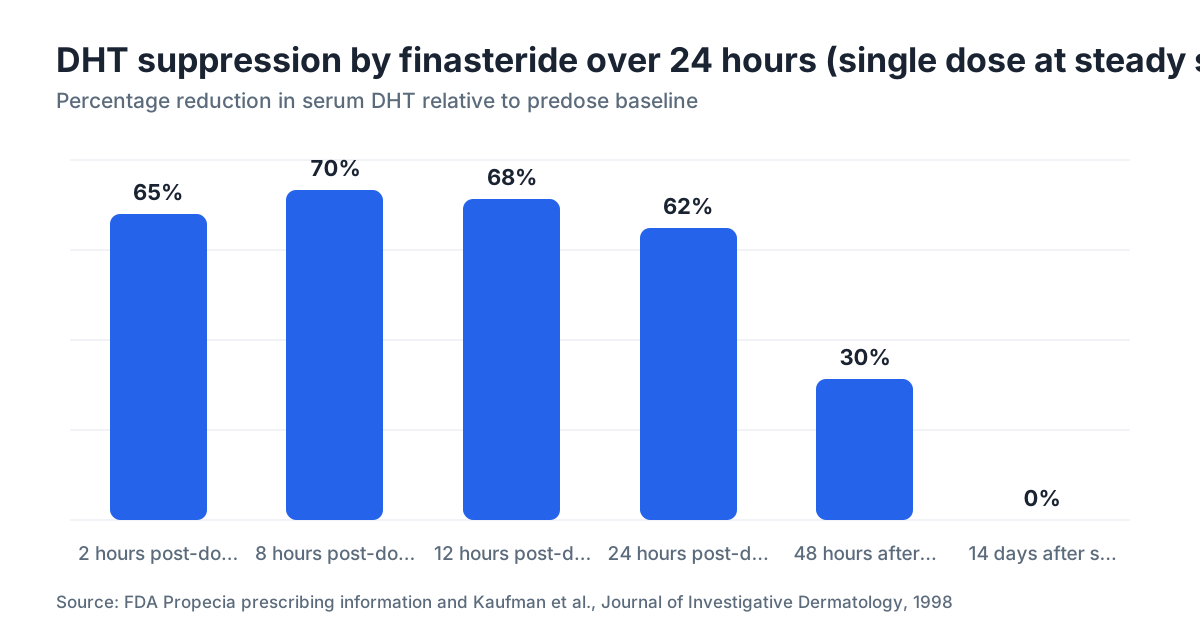
The clinical data here is straightforward. The FDA label for Propecia states that 1 mg daily reduces serum DHT by approximately 70% and scalp DHT by approximately 64% compared to placebo [1]. A more detailed pharmacodynamic study published in the Journal of Investigative Dermatology found that maximum DHT suppression occurs within 8 hours of a dose and stays above 60% throughout the 24-hour dosing interval with daily use [2].
That 24-hour maintenance is what makes once-daily dosing viable despite the 6-8 hour plasma half life. The residual enzyme inhibition from even declining drug levels keeps DHT suppressed between doses.
Serum testosterone levels rise slightly when DHT production is blocked (typically by 10-15%), because testosterone that would have been converted to DHT stays in circulation [1]. For most men this is not noticeable, but it is real biochemistry worth knowing. DHT blockers work precisely by interrupting this testosterone-to-DHT conversion step.
For women, the DHT picture is more complicated. Finasteride is not FDA-approved for hair loss in women (it is teratogenic in pregnancy and lacks consistent trial evidence in women) [4], though some dermatologists prescribe it off-label for postmenopausal women. The half life is the same, but the link between DHT and female pattern hair loss is less clear-cut than in men.
What happens if you miss a dose of finasteride?
Missing one dose is not a disaster. Steady-state enzyme inhibition persists for most of the 24-hour interval, so a single skipped day causes only a partial, temporary rebound in DHT. Your follicles will not suddenly miniaturize further from one missed day.
The FDA label advises simply taking the next dose at the regular time and not doubling up [1]. Doubling the dose does not double the DHT suppression and adds theoretical side effect risk without benefit.
Missing doses regularly is a different matter. Inconsistent use turns a drug with a stable steady-state profile into one with fluctuating DHT suppression. No clinical trial has tested "three days on, one day off" schedules for hair loss, so nobody can tell you exactly what partial adherence does to long-term outcomes. Common sense and the mechanism both point to consistent daily use.
If you forget whether you took your dose on a given day, taking it is probably fine, since the drug clears quickly and you are unlikely to accumulate to a harmful level. But building a daily habit (same time, same trigger) removes the guessing entirely.
How long does finasteride stay in your system after you stop?
After you stop finasteride, plasma clearance follows the half life: about 97% is gone within 36 to 40 hours. It is fair to say finasteride is out of your bloodstream within two days of the last dose [1].
DHT levels begin rebounding almost immediately. Within 14 days of stopping, serum DHT typically returns to baseline [1]. Scalp DHT may take slightly longer to fully rebound because the enzyme population at the follicle turns over more slowly than circulating drug levels.
For hair loss, the rebound is what matters most. Studies show that men who stop finasteride lose most of the hair they had gained or kept within 9 to 12 months of stopping [2]. The follicles that DHT suppression rescued from miniaturization are exposed again once DHT returns. This is why finasteride is a long-term commitment, not a short course of treatment.
For drug testing: finasteride is detectable in urine for up to 6 days after the last dose using standard immunoassay methods, with more sensitive techniques potentially catching it slightly longer. This once mattered for athletes, since finasteride was on the World Anti-Doping Agency (WADA) prohibited list as a masking agent until 2009 [9]. It is no longer prohibited.
For surgical planning: some surgeons ask patients to stop finasteride before a hair transplant to get a clearer picture of baseline loss, though there is no consensus requirement on this.
Does the half life explain why side effects resolve after stopping?
Mostly, yes. Finasteride clears plasma within about 40 hours and DHT rebounds to baseline within two weeks of stopping, so most pharmacological side effects should resolve on a similar timeline.
The most commonly reported side effects, affecting roughly 1-2% of men in placebo-controlled trials, are sexual: reduced libido, erectile difficulty, and decreased ejaculate volume [1]. For the majority of men who notice these, they resolve after stopping the drug, usually within days to a few weeks given the short half life.
The more contested issue is post-finasteride syndrome (PFS), where a subset of men report persistent sexual, neurological, and mood-related symptoms lasting months or years after stopping. The FDA has updated finasteride labels to include persistent sexual side effects as a potential risk [5]. This is genuinely hard to explain through the half life alone, since the drug itself is gone quickly. Proposed mechanisms include lasting changes in neurosteroid synthesis, androgen receptor sensitivity, or epigenetic effects, none of which have been proven. The honest answer is that nobody fully understands PFS at a mechanistic level yet.
For the large majority of users, the short half life does mean stopping finasteride is a relatively clean pharmacological exit. Side effects tied directly to DHT suppression or drug presence should resolve within days to weeks. Anyone dealing with side effects should talk to their prescribing doctor rather than self-managing by adjusting doses.
Does taking finasteride every other day work?
This question comes up constantly, usually from men trying to cut side effect risk while keeping some hair benefit. The pharmacology is nuanced.
A single dose suppresses DHT for most of the 24-hour interval, so every-other-day dosing would mean roughly 12 hours of reduced DHT suppression between doses, compared to near-continuous suppression with daily dosing. The DHT rebound during that gap is partial, not complete, because the enzyme inhibition does not instantly disappear.
A small study published in the Journal of the American Academy of Dermatology examined lower-dose and alternate-day regimens and found that 1 mg every other day still produced meaningful DHT suppression, though modestly less than daily dosing [6]. No long-term head-to-head trial has compared hair count outcomes between daily and every-other-day dosing over 12 to 24 months, which is the endpoint that matters.
Dermatologists sometimes suggest alternate-day dosing for men who get mild side effects on daily dosing, reasoning that lower average DHT suppression might reduce side effect burden while keeping partial benefit. This is off-label and the evidence base for it is thin. If you are thinking about it, the conversation belongs with your doctor, not a forum.
If you are curious about how finasteride fits with other treatments, finasteride and minoxidil covers the combination approach in detail.
Does age or body composition change how finasteride is processed?
Age is the clearest factor. In men over 70, the mean plasma half life rises toward 8 hours from the 6 to 8 hour range in younger adults [1]. Renal clearance slows with age, which adds to longer retention. The FDA label notes this difference but also notes no dose adjustment is recommended for older men on the 1 mg formulation, since the clinical effect is similar and the drug stays safe at this level.
Liver function matters too. Finasteride is metabolized in the liver, primarily via the cytochrome P450 3A4 pathway [8]. Men with significant hepatic impairment may metabolize it more slowly, which can raise exposure. The prescribing information recommends caution in patients with liver disease, though serious hepatic impairment is rare in the typical hair-loss patient.
Body fat percentage has less impact on finasteride than on drugs that are highly fat-soluble. Finasteride has moderate lipophilicity, so it does distribute into fat tissue to some degree, but not to the extreme extent dutasteride does. For the 1 mg dose, weight and body composition differences do not translate into clinically meaningful dosing changes for most men.
And yes, some people worry that creatine supplementation speeds up DHT conversion and might interact with finasteride's half life or efficacy. The short answer: creatine may modestly raise DHT levels, but there is no pharmacokinetic interaction with finasteride. If you want the creatine-DHT question on its own, does creatine cause hair loss goes through the evidence.
What does the half life mean for timing your dose?
The honest answer: for most people, the time of day you take a daily dose matters far less than whether you take it at all. Steady state arrives within two days and 24-hour DHT suppression holds with daily dosing, so whether you take it at 7 a.m. or 10 p.m. has no meaningful effect on hair outcomes.
There is a theoretical argument for taking finasteride at night if you want to blunt any transient side effects, since some men report mild sexual side effects more acutely in the hours after dosing. Taking it before bed would put peak blood levels during sleep, when those effects might be less noticeable. No clinical trial supports this. It is speculative.
What does matter: taking it at the same time each day cuts down on accidental double-dosing or missed doses. Anchoring it to an existing daily habit (morning coffee, brushing teeth at night) is more reliable than a phone alarm you can snooze indefinitely.
For anyone starting finasteride for the first time, knowing that peak blood levels occur roughly 1 to 2 hours after an oral dose helps explain why some side effects, if they appear at all, tend to cluster in the first few hours after taking it [1].
If you want a personal baseline on your own hair loss pattern before starting any treatment, the free AI scan at MyHairline can help you understand what you are working with.
How does finasteride's mechanism of action relate to its half life?
Understanding why the half life and the effect duration diverge so much takes a quick look at the mechanism.
Finasteride is a competitive inhibitor of 5-alpha-reductase type II, but in practice it behaves more like a slow, tight-binding inhibitor. When finasteride binds the enzyme, it forms a stable complex that takes time to come apart, even after free drug concentrations in plasma fall [10]. The enzyme essentially stays occupied.
The result: the pharmacodynamic effect (DHT suppression) lasts longer than the pharmacokinetic half life predicts it should. This is a well-recognized pattern for enzyme inhibitors as a class. The drug clears faster than the enzyme recovers.
It also explains why once-daily dosing works at all. If DHT suppression were tightly coupled to plasma drug levels, you would need multiple daily doses to hold 24-hour suppression with a 6-8 hour half life. Instead, the tight enzyme binding stretches the functional duration well past the plasma clearance.
For hair loss specifically, this matters because the follicle is the target organ. Scalp 5-alpha-reductase activity stays suppressed as long as enzyme turnover (the body making new enzyme molecules) has not replaced the inhibited population. At steady state with daily dosing, new enzyme gets inhibited about as fast as old enzyme recovers, keeping scalp DHT chronically low. That is the pharmacological foundation for why finasteride works at all for receding hairlines and vertex thinning.
What causes hair loss and why does DHT suppression help?
Androgenetic alopecia (male and female pattern hair loss) comes from genetic sensitivity of hair follicles to DHT. Follicles on the top and front of the scalp, in men predisposed to pattern baldness, carry androgen receptors that drive progressive miniaturization under chronic DHT exposure. Each growth cycle produces a slightly thinner, shorter hair until the follicle eventually produces nothing visible [7].
Finasteride interrupts this by cutting the DHT available to bind those receptors. It does not eliminate DHT entirely and does not reverse decades of follicle death, but it can halt or slow active miniaturization and, in some follicles, allow partial recovery. The two-year trial data in the original Propecia approval showed statistically significant hair count increases at 12 months versus placebo, with results held at 24 months [2][4].
The half life matters here because the DHT suppression has to be sustained to work. A drug that only suppressed DHT for 8 hours out of every 24 would hand follicles a daily window of DHT exposure. Finasteride's tight enzyme binding keeps that gap from opening much.
A broader look at what causes hair loss shows DHT is one factor among several, including genetics, age, and in some cases nutritional or inflammatory triggers like telogen effluvium. Finasteride addresses the DHT piece only.
If you are tracking your own progression, the free AI scan at MyHairline (myhairline.ai/scan) can map your current pattern against Norwood stages, which helps you gauge whether finasteride's mechanism is relevant to your specific loss pattern.
Sources
- FDA, Propecia (finasteride 1 mg) prescribing information
- Journal of Investigative Dermatology, Kaufman et al. 1998, finasteride phase III trial
- FDA, Avodart (dutasteride) prescribing information
- FDA, Propecia approval history and labeling
- FDA, finasteride label update (2012) regarding persistent sexual side effects
- Journal of the American Academy of Dermatology, Leyden et al. 1999, low-dose finasteride study
- American Academy of Dermatology, androgenetic alopecia clinical guideline
- National Library of Medicine, StatPearls: Finasteride
- World Anti-Doping Agency (WADA), prohibited list history
- Journal of Urology, Gormley et al. 1992, original finasteride DHT pharmacodynamics