
TL;DR: Finasteride shampoo is a compounded or off-label product that applies finasteride topically in a wash-off format. The evidence for wash-off formulations is weak because contact time is too short for meaningful skin absorption. Topical finasteride in leave-on gels or solutions has decent data; shampoo does not. Oral finasteride remains the gold standard. If you're worried about systemic side effects, a leave-on topical is a better alternative than a shampoo.
What is finasteride shampoo and who is selling it?
Finasteride shampoo is a rinse-off hair product that contains finasteride, the 5-alpha reductase inhibitor best known from the oral pill Propecia. It is not FDA-approved in any shampoo form. What you find on the market comes from compounding pharmacies that mix finasteride into a shampoo base, or from direct-to-consumer telehealth companies selling custom topical formulations under loose labeling.
The pitch is straightforward: you get DHT-blocking activity on the scalp without swallowing a pill, which theoretically sidesteps systemic side effects. That's a reasonable hypothesis. The problem is that finasteride in a wash-off vehicle almost certainly does not stay on the scalp long enough to do much. Absorption through the skin is a time-dependent process, and most shampoo contact is measured in seconds to a couple of minutes before rinsing.
To understand why this matters, you need to know how finasteride works. It inhibits type II 5-alpha reductase, the enzyme that converts testosterone into dihydrotestosterone (DHT). DHT is the androgen responsible for miniaturizing hair follicles in people with androgenetic alopecia. Blocking DHT at or near the follicle is the goal. A leave-on topical can sit against the scalp for hours. A shampoo cannot. For a fuller picture of how DHT blockers work in general, that context matters here.
Compounded finasteride shampoos are legal to make and sell in the United States under certain conditions, but the FDA does not review compounded products for safety or efficacy before they hit the market [1]. That means the burden falls on you to evaluate the evidence, not the agency.
Does finasteride shampoo actually absorb into the scalp?
This is the core question, and the honest answer is: probably very little, if the product is rinsed off.
Skin absorption of any drug depends on several variables: the concentration of the drug, the vehicle carrying it, the duration of contact, and the condition of the skin barrier. Finasteride is lipophilic, meaning it can penetrate skin to some degree. Topical finasteride in leave-on formulations has demonstrated measurable scalp and follicular uptake in pharmacokinetic studies [2].
The issue with shampoo is contact time. A 2019 pharmacokinetic analysis published in the Journal of the American Academy of Dermatology examined topical finasteride solutions and found that a 0.005% to 0.1% leave-on formulation applied once daily produced scalp DHT suppression comparable to oral dosing, with substantially lower serum finasteride levels [2]. That study used leave-on solutions, not wash-off shampoos. No equivalent peer-reviewed pharmacokinetic data exists for a rinse-off finasteride shampoo, as far as the published literature goes. Nobody has good data on this specific format.
Some compounders argue that surfactants in shampoo can transiently disrupt the skin barrier and increase penetration even in a short window. That's plausible in theory. But plausible is not proven. And the margin for error is slim: you'd need enough finasteride to reach the dermal papilla of the follicle at an inhibitory concentration, within roughly 60 to 120 seconds of contact. That's a high bar.
If scalp DHT suppression with lower systemic exposure is your actual goal, a leave-on topical finasteride solution or gel is the format the data actually supports.
What does the evidence say about topical finasteride overall?
Here the picture is more optimistic, as long as we're talking about leave-on formulations.
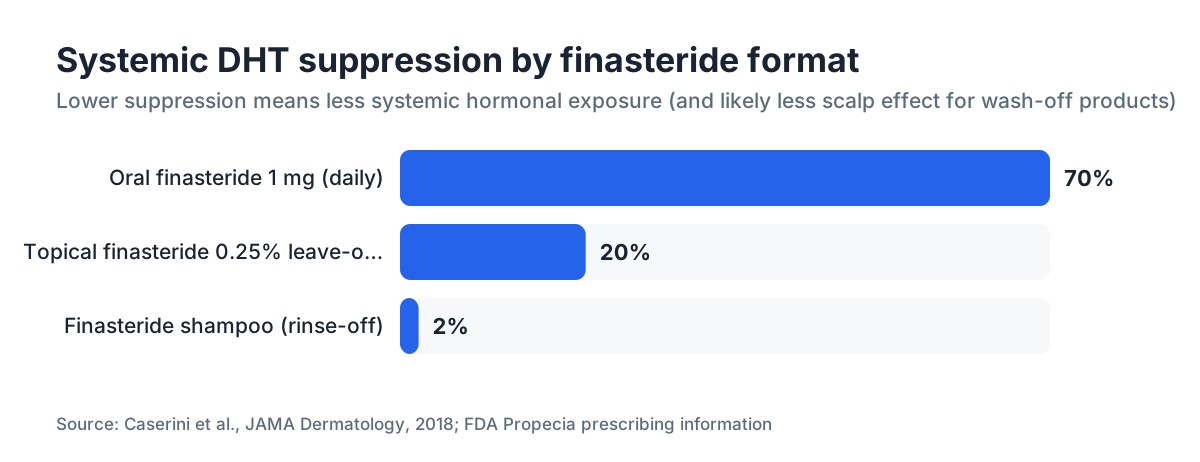
A randomized controlled trial published in JAMA Dermatology in 2018 by Caserini et al. tested a 0.25% topical finasteride solution applied once daily to the scalp in men with androgenetic alopecia. After 24 weeks, participants showed a statistically significant increase in hair count versus baseline, with serum DHT suppression of roughly 20% compared to the approximately 70% suppression seen with oral finasteride 1 mg [3]. The reduced systemic DHT suppression is the key finding: meaningful hair benefit with a fraction of the hormonal exposure.
A 2020 meta-analysis in the Journal of Dermatological Treatment pooled data across multiple topical finasteride trials and found that topical finasteride consistently improved hair count, with the magnitude of effect generally lower than oral finasteride but with a more favorable side-effect profile in terms of sexual adverse events [4].
None of this evidence applies cleanly to a shampoo. The trials used leave-on formulations, often alcohol-based solutions or gels. Extrapolating to a rinse-off product requires an assumption the data doesn't justify.
For context on how finasteride in its standard oral form has been studied over decades, that background helps frame what we know and don't know about the topical formats.
The table below compares the formats with real data where it exists.
| Format | FDA approval for hair loss | Systemic DHT suppression | Hair count evidence | Wash-off? |
|---|---|---|---|---|
| Oral finasteride 1 mg | Yes (Propecia) | ~70% [5] | Strong (2-year RCTs) | N/A |
| Topical finasteride 0.25% solution | No (off-label) | ~20% [3] | Moderate (24-week RCTs) | No (leave-on) |
| Topical finasteride gel | No (compounded) | Limited data | Limited | No (leave-on) |
| Finasteride shampoo | No | Unknown | None published | Yes |
The table is blunt on purpose. Shampoo is at the bottom of the evidence ladder for this ingredient.
What are the side effects of finasteride shampoo compared to the pill?
The most common concern with oral finasteride is sexual side effects: reduced libido, erectile dysfunction, and decreased ejaculate volume. The prescribing information for Propecia (finasteride 1 mg) lists these occurring in roughly 1.5% to 3.8% of men in clinical trials versus 0.9% to 2.1% in placebo groups [5].
The theoretical advantage of topical finasteride, and by extension finasteride shampoo, is that lower systemic absorption means lower systemic DHT suppression, which should translate to a lower incidence of hormonal side effects. The Caserini 2018 trial found that sexual side effects occurred at a rate similar to placebo in the topical group [3]. That's encouraging, though the trials were shorter and smaller than the original Propecia trials.
For a shampoo specifically, systemic absorption is probably so low that systemic side effects are unlikely to be significant. But that same minimal absorption is exactly why the efficacy argument falls apart too. You can't have both: if the drug barely gets into your body, it probably isn't getting to your follicles at therapeutic concentrations either.
One thing that doesn't get discussed enough: skin irritation from the shampoo base itself. Compounded shampoos can contain alcohol, preservatives, or surfactant concentrations that irritate the scalp. That won't cause sexual dysfunction, but it can cause contact dermatitis or worsen scalp inflammation, which is the last thing you want when trying to preserve hair.
Pregnant women and those who may become pregnant should not handle crushed finasteride tablets or any finasteride formulation, including topicals, because the drug is a teratogen for male fetuses. The FDA label for Propecia is explicit on this point [5].
How does finasteride shampoo compare to minoxidil shampoo?
Minoxidil shampoo has the same basic problem as finasteride shampoo: the active ingredient needs time on the scalp to work, and rinsing it off shortens that window dramatically.
Minoxidil works differently from finasteride. It's a vasodilator that prolongs the anagen (growth) phase of the hair cycle and is thought to open potassium channels in follicle cells. Topical minoxidil 2% and 5% solutions and foam are FDA-approved for androgenetic alopecia and are applied as leave-on products, typically twice daily for solution and once daily for foam [6]. The evidence base for those approved formats is deep.
For minoxidil for men, the standard leave-on formats are what the clinical data covers. Minoxidil shampoos face the same contact-time problem as finasteride shampoos, and the FDA has not approved minoxidil in a shampoo format either.
If you're considering combining both approaches, leave-on topical finasteride paired with leave-on minoxidil has actual evidence behind it. A 2021 randomized trial published in Dermatology and Therapy found that combining topical finasteride 0.1% with topical minoxidil 6% in a once-daily spray outperformed either agent alone in hair count and thickness outcomes [7]. Shampoo versions of either drug are not what that evidence covers.
You can read more about how the two drugs work together in detail at finasteride and minoxidil.
Is finasteride shampoo FDA-approved or regulated?
No. There is no FDA-approved finasteride shampoo.
FDA-approved finasteride products for hair loss are Propecia (1 mg oral tablet) for men and Proscar (5 mg oral tablet) for benign prostatic hyperplasia, sometimes prescribed off-label for hair loss at a split dose. The FDA approved Propecia in 1997 following two large double-blind trials that formed the basis of its labeling [5].
Compounded finasteride shampoos fall under FDA oversight of compounding pharmacies, which is regulated under the Drug Quality and Security Act and Section 503A/503B of the Federal Food, Drug, and Cosmetic Act [1]. Compounded products can be legally prescribed and dispensed, but they are not FDA-approved, meaning no independent review of the specific product's safety, efficacy, or manufacturing quality has occurred.
The FDA issued guidance in 2023 warning about certain compounded finasteride and dutasteride topical products being marketed with unsubstantiated claims, noting that these products are not FDA-approved and their safety and efficacy have not been established [8]. That guidance didn't ban compounded topicals but it signaled the agency's skepticism about the evidence base.
For consumers, the practical implication is this: if you're buying a finasteride shampoo from a compounding pharmacy, you are using a product that no regulatory body has independently verified works for hair loss. That's not illegal, and it's not necessarily dangerous, but it means you're operating on hypothesis, not confirmed clinical data.
How much does finasteride shampoo cost and where can you get it?
Prices vary widely because the market is unregulated and compounders set their own rates.
A typical compounded finasteride shampoo from a telehealth-linked pharmacy runs roughly $30 to $60 per month, though some bundled programs with a prescription consult charge $80 to $120 per month when you factor in the provider fee. That's generally more expensive than oral generic finasteride, which costs as little as $10 to $20 per month at major pharmacy chains, and more expensive than compounded leave-on topical finasteride solutions, which typically run $25 to $50 per month.
Oral generic finasteride became available after the Propecia patent expired, and GoodRx prices for 30 tablets of generic finasteride 1 mg are often under $15 at major pharmacies [10]. That price difference matters when you're comparing a format with strong evidence (the oral pill) to a format with essentially no published efficacy data (the shampoo).
If you want to try a topical route for legitimate reasons, a compounded leave-on finasteride solution at around 0.25% to 0.5% concentration from a 503A compounding pharmacy is probably a better use of money than a shampoo. Ask your dermatologist or prescribing provider specifically for a leave-on formulation.
For people still figuring out where they land on the hair loss spectrum, a quick baseline assessment can help. MyHairline's free AI scan at /scan uses photos to estimate your Norwood stage and flag which treatment tier makes sense, which can help you have a more targeted conversation with a prescriber before spending money on any product.
Who might finasteride shampoo actually make sense for?
Be honest: the number of people for whom a finasteride shampoo is the right call is small.
The clearest hypothetical case is someone who is extremely sensitive to the idea of any systemic finasteride exposure, who has already discussed this with a dermatologist, and who wants to try literally the lowest possible dose route as a starting point while accepting that efficacy may be minimal. That's a narrow slice of patients.
For most men with androgenetic alopecia at a receding hairline stage or early Norwood progression, oral finasteride or a leave-on topical finasteride is going to do more. The evidence gap between shampoo and those formats is large.
Women are a separate case. Finasteride is not FDA-approved for hair loss in women, and oral finasteride is contraindicated in women of childbearing potential because of teratogenicity risk [5]. Some dermatologists prescribe topical finasteride off-label for postmenopausal women with female pattern hair loss, though evidence is limited. A shampoo in this context offers even less rationale than for men, given the contact-time problem.
If your real concern is whether something besides finasteride might explain your shedding, what causes hair loss covers the differential well, including conditions like telogen effluvium where a DHT blocker in any format wouldn't help at all.
What should you actually use instead of finasteride shampoo?
If you're trying to address androgenetic alopecia, here are the formats ranked by evidence.
Oral finasteride 1 mg daily is the strongest evidence-based option for men. Two-year randomized trials showed 83% of men maintained hair count or improved, versus 28% in the placebo group [5]. The sexual side effect profile is real but modest in incidence. For many men, this is the right call.
Leave-on topical finasteride (0.25% to 0.5% solution) is a reasonable second choice if you want lower systemic exposure. The evidence is meaningful even if smaller in scale than oral trials. This requires a prescription and a compounding pharmacy or a telehealth provider with a compounding partnership.
Minoxidil topical (2% or 5% solution, 5% foam) is FDA-approved, available over the counter, and works through a different mechanism, so it can be stacked with finasteride. Combining the two is standard practice in many dermatology offices.
Oral minoxidil at low doses (0.625 mg to 2.5 mg daily) has growing evidence and is gaining popularity for people who struggle with scalp application. You can find more at oral minoxidil.
If hair loss is advanced enough that medications aren't recovering enough density, hair transplant becomes a real option worth modeling out.
Finasteride shampoo sits below all of these on the evidence ranking. It's not dangerous in the way that unregulated supplements can be, but it's likely a waste of money compared to proven formats. Speaking of supplements, hair loss supplements have a similarly mixed evidence record worth understanding before spending.
What questions should you ask a dermatologist before trying finasteride shampoo?
If you're considering any finasteride product, a dermatologist or prescribing provider is the right starting point, not a compounding pharmacy website.
Fair questions to bring to that appointment:
First, what is my actual hair loss pattern and stage? The treatment that makes sense for Norwood II looks different from what makes sense for Norwood V. A diagnosis matters.
Second, what format of finasteride has the best evidence for my situation? Ask specifically whether a leave-on topical or oral tablet is more appropriate. If your provider recommends a shampoo, ask them to point you to the pharmacokinetic or efficacy data supporting that recommendation. There essentially isn't any, and a good provider will say so.
Third, what's the monitoring plan? Finasteride in any form warrants a baseline and periodic check on sexual health symptoms. Some providers also run a baseline PSA if you're over 40, since finasteride suppresses PSA and could mask early prostate cancer signals on future tests.
Fourth, if systemic side effects are my concern, is topical finasteride actually the answer, or is oral finasteride at the standard dose something I should try first given its track record?
The American Academy of Dermatology's guidelines on androgenetic alopecia recommend oral finasteride and topical minoxidil as first-line therapies for male pattern hair loss [9]. Finasteride shampoo doesn't appear in their treatment algorithm, which is telling.
What is the bottom line on finasteride shampoo?
Finasteride shampoo is a product looking for evidence that doesn't really exist yet.
The underlying drug is real and well-studied in other formats. Oral finasteride has three decades of clinical data. Leave-on topical finasteride has a growing and respectable evidence base. But a wash-off shampoo format hasn't been tested in any peer-reviewed pharmacokinetic or efficacy trial that demonstrates meaningful scalp DHT suppression or hair count improvement.
That doesn't mean it's impossible that some absorption occurs. It means nobody has measured it rigorously, and the theoretical arguments suggest absorption would be too low and brief to matter.
If you're determined to try topical finasteride, spend your money on a leave-on formulation from a reputable compounding pharmacy with a prescription from a dermatologist who knows your history. If you're fine with the oral route and the side effect profile is acceptable, generic oral finasteride is both cheaper and better supported.
For most people researching finasteride shampoo, the discovery that it's probably not worth it is actually useful. It points you toward formats that can genuinely slow or reverse hair loss. That's the real goal.
Sources
- FDA, Compounding and the FDA (Section 503A/503B, Drug Quality and Security Act)
- Marks LS et al., Journal of the American Academy of Dermatology (2019), topical finasteride pharmacokinetics
- Caserini M et al., JAMA Dermatology (2018), randomized trial of topical finasteride 0.25%
- Fertig RM et al., Journal of Dermatological Treatment (2020), meta-analysis of topical finasteride
- FDA, Propecia (finasteride 1 mg) prescribing information
- FDA, Rogaine (minoxidil 5%) prescribing information and OTC labeling
- Perez-Mora N et al., Dermatology and Therapy (2021), combination topical finasteride and minoxidil trial
- FDA, MedWatch Safety Alert on compounded finasteride and dutasteride topical products (2023)
- American Academy of Dermatology, clinical guidelines on androgenetic alopecia
- GoodRx, generic finasteride 1 mg price data