
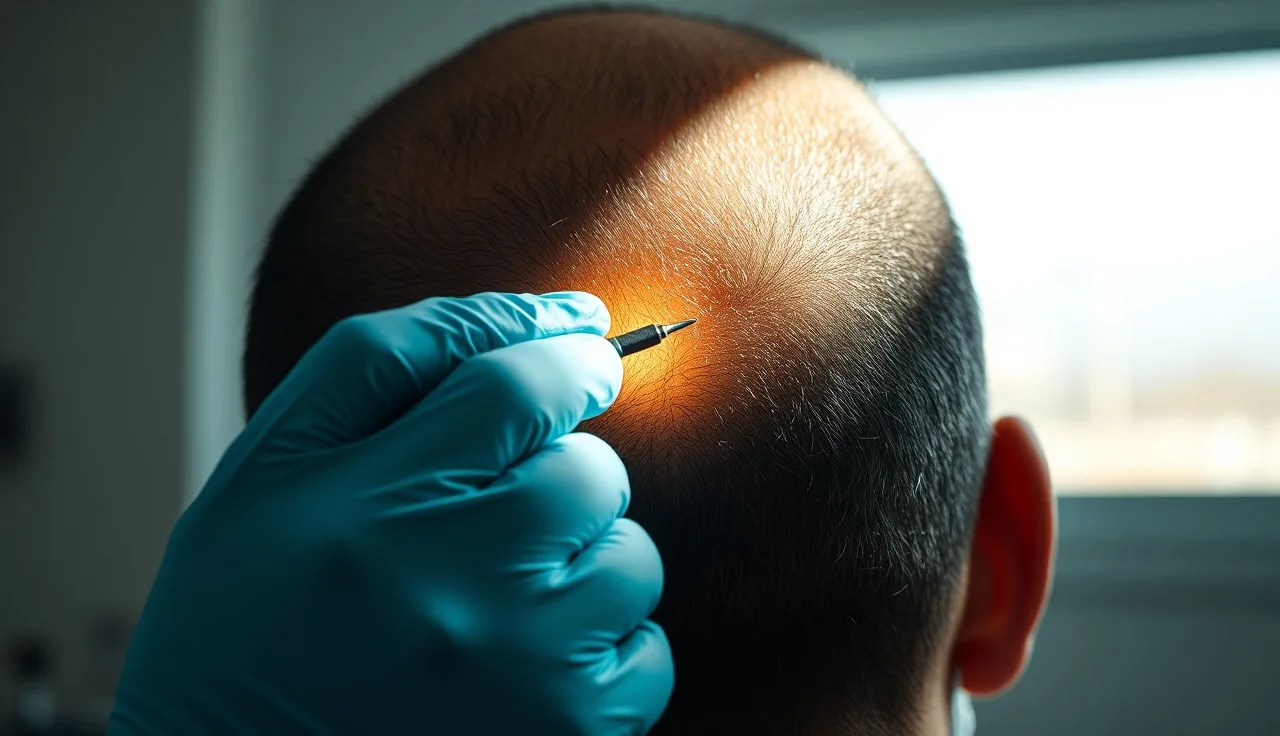
TL;DR: Hair transplants permanently move follicles from your donor zone to thinning areas. FUE and FUT are the two main surgical methods. Full results take 12 to 18 months. Costs run $4,000 to $15,000+ in the US, depending on graft count and clinic. Surgery works best once hair loss has stabilized and enough donor hair exists. Medical therapy before and after improves long-term outcomes.
What is a hair transplant and how does it actually work?
A hair transplant is surgery. A surgeon removes hair follicles from a part of your scalp (or rarely body) where hair grows densely and permanently, then implants those follicles into areas where hair has thinned or stopped growing. That donor region, usually the back and sides of the scalp, is genetically resistant to the hormone DHT that drives male pattern baldness. Once moved, those follicles keep that resistance. They behave as if they never left the donor site.
The transplanted hairs shed within the first 2 to 6 weeks after surgery. That's normal and expected. The follicle itself survives under the skin and enters a resting phase. New growth typically starts around month 3 to 4, looks noticeably better by month 6 to 9, and reaches full maturity somewhere between 12 and 18 months [1]. Most men are surprised how much patience the process demands.
Two things decide whether surgery is worth doing: how many good donor follicles you have, and whether your loss has stabilized enough that the transplant won't look odd in five years as the surrounding native hair keeps thinning. A surgeon who skips a detailed assessment of both is a surgeon worth walking away from.
FUE vs FUT: which transplant method is better for men?
These are the two dominant surgical techniques. The right choice depends on your situation, not marketing.
FUE (Follicular Unit Extraction) means the surgeon extracts individual follicular units one at a time using a small punch tool, typically 0.8 to 1.0 mm in diameter. The donor area heals with tiny round scars scattered across the back and sides of your scalp. They're nearly invisible once hair grows back. FUE is better for men who wear their hair short, want a faster initial recovery, or need grafts from body hair.
FUT (Follicular Unit Transplantation) means the surgeon removes a strip of scalp from the donor area, then technicians dissect individual follicular units from that strip under microscopes. The donor area heals as a single linear scar, well-hidden by overlying hair but visible if you cut down to a very short length. FUT generally yields more grafts in a single session and can be the better option for men who need a large session count or who have already depleted donor density from prior FUE.
Graft survival is comparable between the two when both are performed by an experienced team. A 2019 review in the Journal of Cutaneous and Aesthetic Surgery found no statistically significant difference in overall graft survival between FUE and FUT when technique quality was controlled [2].
There is a third term you'll see: "DHI" (Direct Hair Implantation). It's a variation of FUE that uses a pen-like implanter tool to place grafts directly without pre-made recipient sites. Some clinics charge a premium for it. The honest answer: outcomes depend far more on surgeon skill and the graft handling team than on the specific implanter device.
| Factor | FUE | FUT | |---|---|---|| | Scarring | Tiny scattered dots | Linear strip scar | | Max grafts per session | ~2,500 to 3,500 | ~3,000 to 4,500 | | Recovery time | 7 to 10 days | 10 to 14 days | | Best for short styles | Yes | No | | Cost | Usually higher | Usually lower | | Revision-friendly | Easier | Can limit future FUE |
My honest take: most men in their 30s and 40s with moderate loss and adequate donor density do fine with FUE. Men needing high graft counts or who've already had one FUE procedure should raise FUT as a real conversation at their consultation.
How much does a hair transplant cost for men in the US?
The honest price range is wide: $4,000 on the low end for a small session at a competent clinic, up to $15,000 or more for a large multi-session case at a high-volume specialty practice. The most commonly cited range for a standard single session in the United States is $7,000 to $12,000 [3].
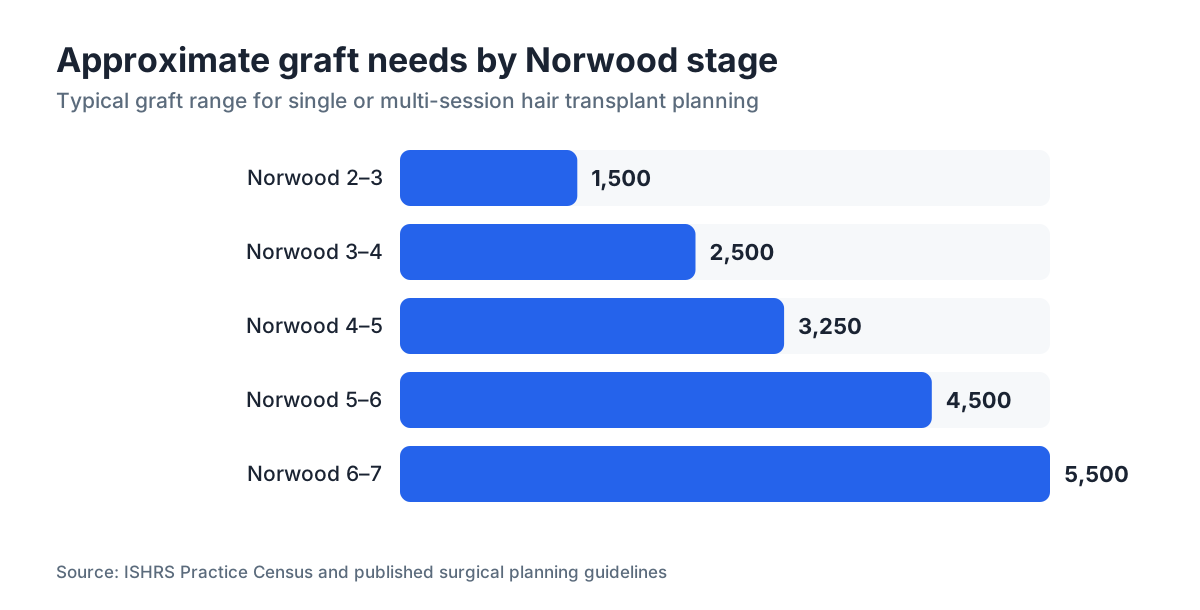
Clinics price by the graft. Typical rates run $3 to $10 per graft, and the number you need depends on the degree of your loss. A man at Norwood stage 3 might need 1,500 to 2,000 grafts. A Norwood 6 case requiring aggressive coverage across the crown and mid-scalp could need 4,000 to 6,000 grafts, sometimes spread across two sessions.
Hair transplants are not covered by health insurance in the United States because they're classified as cosmetic. Some clinics offer financing through third-party lenders. HSA and FSA accounts generally can't be used for cosmetic procedures either, so plan to pay out of pocket.
Turkey, India, and parts of Eastern Europe offer procedures at a fraction of US prices, often $1,500 to $4,000 all-in including hotel stays. Some clinics abroad are excellent. Many are not. The risk of infection, poor graft placement, and no local recourse if something goes wrong is real. If you go abroad, research the surgeon's individual credentials over the clinic's marketing photos, and understand that corrections done in the US after a botched international procedure can cost more than a good domestic surgery would have.
One fact worth keeping in mind: the cost of doing nothing is also real. Progressive loss means more area to cover later, more grafts needed, and potentially more sessions. Men who wait until Norwood 6 or 7 sometimes find they don't have adequate donor supply for full coverage anyway.
Who is a good candidate for a hair transplant?
Good candidates share a few traits. Their loss has stabilized, meaning no significant new thinning in the past 12 to 18 months. They have adequate donor density at the back and sides. They hold realistic expectations about coverage and density, not restoration to a teenage hairline. And they're healthy enough for outpatient surgery.
Age matters more than most men realize. Surgery on a 22-year-old who's still actively losing hair is risky business. You can transplant into areas that look thin now, then watch surrounding native hair fall out over the next decade, leaving the transplanted islands looking artificial. Most experienced surgeons recommend waiting until a stable pattern is clear, which often means the mid-to-late 20s at the earliest, and only then with medical therapy in place to slow continued loss.
Men at Norwood stage 2 to 5 are typically the best surgical candidates. Stage 6 and 7 cases are harder because the donor supply is finite and the area needing coverage is large. Some men at advanced stages are better served by SMP (scalp micropigmentation) or simply committing to a shaved look.
Health conditions that can affect candidacy include uncontrolled diabetes (affects wound healing), active scalp conditions like alopecia areata (transplanted hair may be attacked by the immune system), and bleeding disorders. Discuss your full medication list with any surgeon you consult, including supplements, because some blood thinners and high-dose fish oil can increase surgical bleeding.
If you're unsure where your loss falls on the Norwood scale, understanding your receding hairline is a useful starting point before booking consultations.
What results can men realistically expect?
A well-performed transplant adds real density to areas that had little or none. What it doesn't do is give you the hair you had at 18. Transplant density is typically lower than native density in youth, because surgeons must space grafts to allow blood supply and can't implant as densely as natural follicles originally grew.
Studies on graft survival show that 85 to 95% of transplanted follicles survive and produce hair when the procedure is performed correctly [4]. If a clinic promises 100% survival, that's a sales claim, not biology.
Portfolio photos are honest only when they show the same lighting, angle, and hair length in before and after shots. Always ask to see post-operative photos at 12+ months, not at 6. Ask to speak with actual patients if possible.
Hairline design matters enormously for how natural the result looks. A hairline placed too low looks artificial at any age. One designed without accounting for future loss looks stranded as surrounding hair recedes. The best surgeons design hairlines conservatively for where you're likely to be at 50 or 60, over where you want to be at 35.
Hair characteristics affect outcome too. Men with thick, coarse, dark hair against a lighter scalp benefit most from transplant, because each graft covers more visual surface area. Men with fine, light hair against a light scalp need more grafts to hit the same visual density. Curly or wavy hair covers better than straight hair. None of these factors disqualify anyone, but they shape what's achievable.
What happens during the surgery and recovery?
The procedure is done under local anesthesia as outpatient surgery. Most sessions run 4 to 10 hours depending on graft count. You're awake the whole time. Most men watch movies or nap through the middle hours. The injections for local anesthesia are the most uncomfortable part for most patients.
After surgery, the transplanted area looks like a sunburn with small scabs at each graft site. The donor area (for FUT) will have sutures removed 10 to 14 days later. Swelling of the forehead is common in the first 3 to 5 days and usually resolves on its own.
Recovery milestones look roughly like this:
- Days 1 to 3: Rest, keep head elevated, take prescribed pain and anti-inflammatory medications.
- Days 4 to 10: Scabs form and begin to loosen. Follow the washing protocol your surgeon gives you. Don't pick at scabs.
- Week 2: Most men return to desk work. Physical labor and intense exercise wait 3 to 4 weeks.
- Weeks 2 to 6: Transplanted hairs shed. This is normal, and alarming the first time it happens.
- Months 3 to 4: New hair begins emerging.
- Months 6 to 9: Visible improvement that others will notice.
- Months 12 to 18: Final result.
Some shock loss of native hair near the recipient area can happen in the first few weeks. It's usually temporary and reverses. Men on finasteride or minoxidil before surgery tend to have less shock loss and faster recovery of native hair [5].
If you've been diagnosed with telogen effluvium, resolve that before scheduling surgery, since an active effluvium can complicate recovery and graft survival.
Do you need to take finasteride or minoxidil after a hair transplant?
Transplanted follicles are DHT-resistant. They don't need medication to survive. But the native hair around them absolutely does, unless you've already stopped losing native hair entirely.
Here's the problem men underestimate. Get a transplant at 35 and take no medical therapy, and your native hair keeps thinning around the transplanted grafts. Ten years later you can end up with dense islands of transplanted hair surrounded by thinning native hair, a pattern that looks nothing like natural loss.
Finasteride (1 mg daily, oral) is an FDA-approved treatment for male pattern hair loss [6]. It blocks the conversion of testosterone to DHT, the hormone that miniaturizes genetically susceptible follicles. Multiple large trials show finasteride preserves existing hair and can regrow some, making it the most important post-transplant medication for most men.
Minoxidil (topical or oral) promotes hair growth through mechanisms separate from DHT blockade and works well alongside finasteride. The FDA approved 2% and 5% topical minoxidil for men [7]. Low-dose oral minoxidil (0.625 to 2.5 mg daily) is increasingly used off-label and shows strong results in several recent trials, though it's not FDA-approved for hair loss at those doses.
For more on how these work together, the finasteride and minoxidil combination article covers the evidence in depth. You can also read minoxidil for men for dosing and application guidance.
Most surgeons recommend starting finasteride several months before surgery if you're going to take it, so any initial side effects have resolved and the drug is already working. Plan to stay on medical therapy indefinitely after transplant if you want to preserve the overall result.
The American Academy of Dermatology recommends both medications as first-line treatments for androgenetic alopecia in men [8]. Surgery works best as an addition to medical therapy, not a replacement for it.
How do you find a qualified hair transplant surgeon?
This is where men consistently go wrong. Hair transplant surgery in the United States is not tightly regulated as a specialty. Almost any licensed physician can legally perform the procedure, and clinics often employ non-physician technicians to do most of the actual graft extraction and placement, with a supervising physician who may see each patient for only a few minutes.
The International Society of Hair Restoration Surgery (ISHRS) publishes a member directory, and members must meet training requirements [9]. The American Board of Hair Restoration Surgery (ABHRS) offers a board certification for surgeons who meet specific training, case volume, and examination requirements. Neither credential guarantees an excellent surgeon, but they're a reasonable baseline.
Questions worth asking during a consultation:
- Who physically extracts the grafts? Who places them?
- How many procedures does the surgeon perform per week?
- Can I see results from patients similar to my degree of loss, photographed at 12+ months?
- What is your policy if I'm unhappy with the result?
- Do you recommend medical therapy alongside surgery? Why or why not?
A surgeon who rushes a consultation, avoids discussing your future hair loss trajectory, or promises you the hairline of a 20-year-old is not a surgeon you should trust with your scalp.
The myhairline.ai free AI scan (/scan) can give you a preliminary read on your Norwood stage and donor density before you ever sit down with a clinic, so you walk into consultations with a clearer picture of what's realistic for your specific pattern.
What are the risks and side effects of hair transplant surgery?
Hair transplants are generally safe when performed by a trained surgeon in a proper setting, but real risks exist.
Common and expected effects include temporary swelling (especially the forehead and around the eyes), scabbing at graft sites, itching, and shedding of transplanted hairs in the first 1 to 6 weeks. These are part of normal healing.
Less common but real complications include infection (occurs in roughly 1% of cases in published series), folliculitis (inflammation of hair follicles, looks like small pimples), cyst formation, and numbness or altered sensation in the scalp that can last months. Scarring beyond what's expected is possible, particularly with poor technique.
The most serious aesthetic complication is an unnatural result: a hairline that's too low, too regular, or placed in a way that looks artificial in 20 years. This is harder to fix than people expect. Revision surgery is possible but limited by donor supply.
Necrosis (tissue death) at the recipient site is rare but serious, often tied to over-dense packing of grafts in a single session. It can permanently damage areas and is more likely with inexperienced operators.
Keloid scarring affects some patients, particularly those of African or Southeast Asian descent who may be predisposed. Discuss this explicitly with your surgeon before any procedure.
The FDA has no specific approval process for hair transplant procedures as devices or drugs. The procedure itself is regulated as surgery under state medical boards. Choosing a surgeon operating in an accredited surgical facility reduces risk substantially.
How does a hair transplant compare to other hair loss treatments?
Hair transplant surgery is the only treatment that permanently moves hair to areas where it's gone. Every other treatment maintains or modestly regrows hair you still have. They don't restore areas that are already bare.
That distinction sounds obvious, but it matters for sequencing decisions. A man with a thinning crown who still has decent density there is often better served starting with finasteride and minoxidil for 12 months before even considering surgery. If medical therapy works well enough, surgery becomes optional or at least deferred. If it slows loss but doesn't restore the crown, surgery can address what remains.
Finasteride is the most important non-surgical option. The original 5-year registration trial showed 48% of men on 1 mg finasteride had visible hair regrowth vs 7% on placebo [10]. It works best for crown loss and slower loss in general.
DHT blockers like finasteride and dutasteride address the root cause. Hair loss supplements have far weaker evidence. If you're considering supplements, the hair loss supplements article is honest about what the data actually shows.
SMP (scalp micropigmentation) is tattooing that simulates a shaved-hair look. It's not a hair loss treatment but can be a good option for men who aren't surgical candidates or who want to camouflage a scar.
PRP (platelet-rich plasma) injections are offered by many clinics as an adjunct or standalone treatment. The evidence is mixed. A 2019 systematic review in Dermatologic Surgery found PRP likely has a positive effect on hair density but noted the quality of studies was low [11]. Costs run $1,500 to $3,500 per course. It may be worth discussing with your dermatologist as an adjunct, but I wouldn't pay for it as a standalone treatment over medical therapy.
If you're trying to understand what causes hair loss before committing to any treatment, that foundational read should come first.
Can hair transplants fail, and what can be done about it?
Yes, they can fail or underperform. The most common reasons:
Poor graft handling is probably the leading cause of disappointing results. Follicles are fragile outside the body. Every minute they spend outside in poor conditions reduces survival. Rushed procedures, undertrained technicians, inadequate graft storage, and overly long extraction-to-implantation times all cut the percentage of grafts that actually produce hair.
Design problems are aesthetic failures. A hairline placed too low, too symmetrical, or without consideration of future recession can look acceptable at 35 and strange at 50. An experienced surgeon designs for how your face and hairline will look over decades.
Patient factors matter too. Men who didn't follow post-operative instructions, who exercised hard in the first two weeks, who picked at scabs, or who went back to smoking immediately after surgery can compromise graft survival.
If a transplant fails or produces poor density, options include a second procedure using remaining donor grafts, SMP to fill the appearance of density, or in some cases beard or chest hair used as additional donor via body hair FUE. Revision surgery is harder and more expensive than getting it right the first time.
Preventing failure starts with choosing a surgeon who personally performs the most demanding steps of the procedure, rather than one who delegates extraction and placement to technicians while supervising several rooms at once. Ask this question directly before you book. The answer tells you a lot.
How many grafts do men typically need, and how many sessions?
Graft needs scale with Norwood stage. Here's a general reference, though individual anatomy varies and any honest surgeon will give you a specific estimate only after examining your scalp:
| Norwood Stage | Approximate Graft Range | Sessions Usually Needed |
|---|---|---|
| 2 to 3 | 1,000 to 2,000 | 1 |
| 3 to 4 | 2,000 to 3,000 | 1 |
| 4 to 5 | 2,500 to 4,000 | 1 to 2 |
| 5 to 6 | 3,500 to 5,500 | 2 |
| 6 to 7 | 4,000 to 7,000+ | 2 to 3 |
The average donor supply for a man is roughly 6,000 to 8,000 total extractable grafts across a lifetime, though this varies considerably based on scalp laxity, donor density, and hair characteristics. That lifetime supply is finite. Spending 5,000 grafts at age 30 may leave little reserve for further loss in your 40s and 50s.
This is why aggressive surgery in young men with progressive loss is risky. A surgeon willing to harvest 80% of your lifetime donor supply in one session at age 28 is not thinking about your best interest at age 48.
Between sessions, most surgeons recommend waiting at least 12 months so the full result of the first procedure is visible before planning the next.
Sources
- American Academy of Dermatology, Hair loss: diagnosis and treatment
- Journal of Cutaneous and Aesthetic Surgery, 2019 review comparing FUE and FUT graft survival
- International Society of Hair Restoration Surgery (ISHRS), Practice Census
- Journal of the American Academy of Dermatology, finasteride for androgenetic alopecia
- FDA, Propecia (finasteride 1 mg) prescribing information
- FDA, Rogaine (minoxidil topical solution) OTC labeling
- American Academy of Dermatology, Guidelines of care for androgenetic alopecia
- International Society of Hair Restoration Surgery, member directory and standards
- New England Journal of Medicine, Kaufman et al. 1998, finasteride 5-year trial