

TL;DR: A hairline that recedes more on one side is usually early androgenetic alopecia (pattern baldness) showing up asymmetrically, though traction, styling tension, and sleeping position can also cause one-sided loss. On its own it rarely signals anything serious, but it does mean hair loss is active. The proven fixes are minoxidil, finasteride, and, once loss is stable, a transplant.
Is it normal for a hairline to recede more on one side?
Yes. Asymmetric recession is genuinely common, and for most men it is the first visible sign that androgenetic alopecia (male pattern baldness) has started. Norwood scale diagrams show tidy, symmetrical hairlines. Real hair loss rarely reads the memo. Follicles on the two sides of your scalp can differ in sensitivity to dihydrotestosterone (DHT), in how fast they miniaturize, and in baseline density before any loss begins. One side simply crosses the threshold first.
That said, "more on one side" covers a lot of ground. A few millimeters of difference after six months of watching is almost always pattern loss. A dramatically thinning temple on one side with no change on the other, or loss that showed up right after a new medication, a tight hairstyle, or scalp surgery, deserves a closer look, because the mechanism is probably different.
Asymmetric recession is normal. The cause is what varies, and the cause decides what you should do about it.
What causes a hairline to recede on only one side?
Several distinct processes produce one-sided or noticeably asymmetric recession. They look alike in the mirror and behave nothing alike underneath.
Androgenetic alopecia (pattern hair loss). This is the cause in most cases. DHT binds to androgen receptors in genetically susceptible follicles and shrinks them over time. Because DHT sensitivity varies follicle by follicle, one temple often gets a head start. Over months to years the other side usually catches up, building toward the classic Norwood pattern [1].
Traction alopecia. Steady mechanical pull on one spot, from a side part you always wear the same way, sleeping on the same side, putting a headband on identically every day, or a hat whose band sits crooked, can injure follicles there. The American Academy of Dermatology says traction alopecia can reverse if caught early, before the follicles scar [2]. The diagnostic tell: the loss traces the exact line of tension, not a normal temple arc.
Sleeping position. Pressing one side of the scalp against a pillow night after night reduces local blood flow and can put mild, chronic stress on follicles. This mechanism is barely studied and the evidence is mostly observational, but it is plausible and worth flagging if you always sleep on the same side.
Scarring alopecia. Rare but serious. Lichen planopilaris or frontal fibrosing alopecia can start in one area and spread. These involve inflammation that destroys follicles permanently. Unlike pattern loss, the affected skin often looks off: redder, with follicular plugging, or a distinct "burned" border. A dermatologist can settle it with a scalp biopsy.
Telogen effluvium that shows up unevenly. Telogen effluvium after a systemic shock (illness, crash diet, surgery) usually causes diffuse shedding. But if your density was already uneven, the thinner side can look dramatically worse after a shed. That creates the illusion of one-sided recession when the real loss is global.
Trauma or surgery. A scalp injury, a prior procedure, or radiation to one side of the head can kill follicles locally. The history here is almost always obvious.
For most people reading this, androgenetic alopecia or traction is the answer. Because the treatments diverge, sorting out which one you have is the whole game.
How can you tell the difference between pattern loss and traction alopecia?
Shape and location give it away. Pattern loss starts at the temples in a rounded arc that widens toward the crown. Both sides recede, just at different speeds. Traction follows the mechanical stress: a line where a part sits, a band where a hat rests, or along the edges when you pull your hair back tight.
Run through these questions:
- Do you always part your hair on the side that is receding more?
- Do you sleep mostly on that side?
- Do you wear a hat, helmet, headband, or ponytail that pulls on that temple unevenly?
- Is the receding edge a straight or irregular line rather than a smooth arc?
A yes to any of those makes traction a real possibility. The fix is removing the source of tension, and the AAD says early traction alopecia can regrow without medication [2]. Give it three to six months after you change the habit before you add a topical.
If the recession follows a temple arc that looks like a Norwood II or III no matter how you style your hair, pattern loss is almost certainly the driver, and you need a different plan. Reading up on how a receding hairline progresses helps you place where you are right now.
Does one-sided recession mean you will go fully bald?
Not automatically. It does mean hair loss is active. How far it eventually goes depends almost entirely on your genetic programming, not on whether the recession started even or lopsided. A man with a family history of Norwood VI baldness who shows an asymmetric Norwood II recession at 22 is likely to progress further than a 45-year-old with the same hairline and no family history of heavy loss.
Asymmetric recession in your early 20s, when DHT receptor activity runs high and the genetic clock is fast, does tend to move. The same asymmetry at 50, unchanged for three years, may just be where your hairline landed.
A small share of men with early recession progress fast; the rest move at wildly different speeds [3]. Nobody can look at a one-sided hairline and call exactly where it stops. What is true: treating it early, if you want to, leaves you more hair to work with.
What treatments actually work for one-sided hairline recession?
Mechanism decides the plan. For traction alopecia, stop the tension and, if you want faster regrowth, add topical minoxidil. For pattern loss, the treatments with the strongest evidence are minoxidil and finasteride, alone or together.
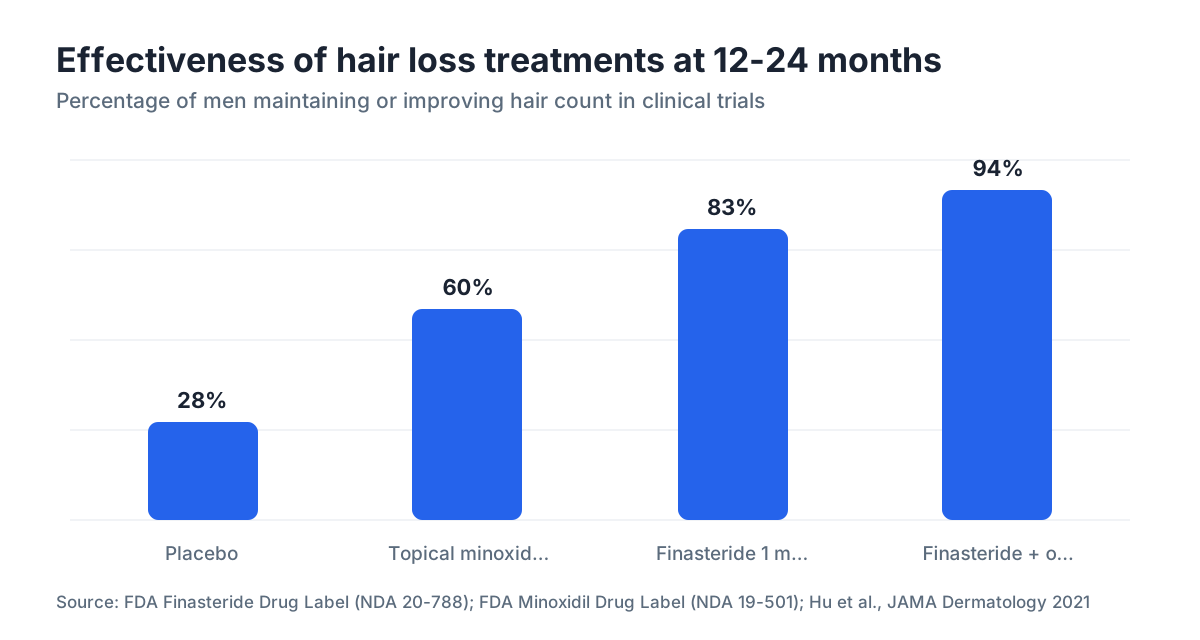
Minoxidil. Sold over the counter as 2% and 5% solutions or 5% foam. The FDA approved topical minoxidil for androgenetic alopecia; it works by extending the anagen (growth) phase and widening the blood vessels around the follicle [4]. It does not block DHT, so it treats the symptom, not the cause. Trials generally show maintenance and modest regrowth in about 60% of users after 12 months of steady use [4]. Stop using it and the results fade. You can weight application toward the worse side. Minoxidil for men covers dosing and application in detail.
Finasteride. A prescription oral drug that blocks the type II 5-alpha reductase enzyme, cutting scalp DHT by roughly 60 to 70% [5]. In clinical trials, 83% of men taking 1 mg daily maintained or improved hair count at two years, against 28% on placebo [5]. It is the most evidence-backed drug for slowing pattern hair loss. Read the finasteride breakdown, side effect profile included, before you start. For one-sided recession from pattern loss, finasteride hits the root cause across the whole scalp, which is exactly the point.
Combining both. A 2021 trial in JAMA Dermatology found men on oral minoxidil 5 mg plus finasteride 1 mg had significantly greater hair count gains than either drug alone [6]. The finasteride and minoxidil combination is now the common recommendation for active pattern loss.
DHT-blocking supplements. Saw palmetto and its cousins get marketed as natural DHT blockers. The evidence is thin next to finasteride. A systematic review in Skin Appendage Disorders found some studies show modest benefit, but effect sizes were small and trial quality was mixed [7]. If you want to try this route, dht blocker compares the options honestly.
Hair transplant. If loss is stable (no continued recession for at least one to two years) and the asymmetry bothers you cosmetically, follicular unit extraction (FUE) or strip surgery can move follicles from a donor zone to the receded temple. A transplant does not stop ongoing loss, so it usually pairs with medical therapy to protect the hair you keep. Hair transplant explains candidacy and costs in full.
For most people with active one-sided recession in their 20s or 30s, starting minoxidil and finasteride now, before the asymmetry widens, is the most rational move.
Can minoxidil or finasteride be applied to just one side?
Topical minoxidil can absolutely go on more heavily where things are worse. It absorbs locally and there is no systemic downside to concentrating it on one area. In practice, apply a standard dose across your full hairline (foam and solution are built to cover the scalp, not pinpoint a spot), then spend extra time working it into the worse temple. The evidence does not show targeted application beats full coverage, but it does not hurt either.
Finasteride works systemically. It lowers DHT across the entire scalp through the bloodstream. You cannot steer it to one side. That is fine, because if pattern loss is driving your asymmetry, both temples share the same DHT environment. The side that looks fine today probably has susceptible follicles too. Protecting them early is the whole idea.
Oral minoxidil (low-dose, typically 0.625 mg to 2.5 mg daily) is also systemic. It has become a convenient alternative for people who struggle to keep up with topical application. Oral minoxidil covers what the data shows and how the side effect profile differs.
How fast does a one-sided receding hairline progress?
There is no clean universal answer, because speed depends on genetics, age at onset, and whether you treat it. Real-world data still gives a rough shape.
In observational follow-up of men with androgenetic alopecia, roughly 50% of untreated men progressed at least one Norwood stage over five years [3]. The fastest progressors, often those who started before 30, can advance a full Norwood stage in under two years. Slower ones may hold the same stage for five to ten.
Asymmetric recession tends to even out over time. The slow side usually catches up within a year or two, and then both sides may stabilize or keep moving together.
The honest takeaway: if you noticed one-sided recession and you are under 35, photograph it monthly under the same lighting. If it moves more than a centimeter over six months, it is active. That is the window where treatment does the most, because you still have hair to save.
Should you see a dermatologist for asymmetric hairline recession?
For most people, yes, at least once. A dermatologist can separate the causes far more reliably than a mirror can. Scalp dermoscopy (a magnified look at the surface) can reveal miniaturized follicles that point to pattern loss, inflammatory changes that suggest scarring alopecia, or follicular plugging from traction. A scalp biopsy is usually unnecessary, but it can definitively rule out scarring if there is any doubt.
See a doctor for sure if:
- The recession is on one side only with zero change on the other after 12 or more months of watching.
- The affected skin looks red, scaly, or different from the surrounding scalp.
- You are losing hair in patches, more than at the hairline.
- A major health event, big weight loss, or a new medication came right before the loss.
- You are a woman with one-sided hairline recession, because pattern loss looks different in women and other diagnoses are more likely.
Want a first pass without a clinic visit? MyHairline's free AI hair scan (/scan) analyzes your hairline photos and flags patterns worth raising with a doctor. It does not replace an in-person scalp exam.
One-sided recession in a young man with a family history of pattern baldness rarely needs a biopsy. Getting professional confirmation just means you treat with confidence instead of guessing.
Does hair loss being asymmetric affect hair transplant eligibility?
Asymmetric recession by itself does not disqualify you. What matters for transplant candidacy is whether the loss is stable, whether you have enough donor hair, and whether you are realistic about what surgery can and cannot do.
One-sided recession does make the planning harder. A surgeon has to design a hairline that will still look natural once the other side potentially catches up. If the untouched temple is likely to recede over the next decade, transplanting only the worse side today can leave you uneven later. Most experienced surgeons insist on medical therapy to stabilize ongoing loss before they operate, for exactly this reason.
If your recession has held steady for at least one to two years and both sides are on medical therapy, a transplant to correct the asymmetry is reasonable. Cost runs roughly $4,000 to $15,000 in the US depending on graft count, clinic, and technique [8]. The full picture is at hair transplant.
Avoid any clinic that pushes surgery before you have had at least six months on medical therapy. That is a red flag.
What does research say about asymmetric hairline recession in women?
Women get asymmetric hairline recession too, but the causes and patterns differ. Female pattern hair loss (FPHL) usually thins the crown and part line diffusely rather than receding the temples. When a woman does get one-sided temporal recession, traction alopecia is far more common than in men, thanks to tight braids, weaves, and high ponytails.
Frontal fibrosing alopecia, a scarring condition, can also cause recession that is asymmetric early on, and it mainly affects post-menopausal women. The AAD treats it as a diagnosis distinct from female pattern hair loss [10].
For women, asymmetric recession earns an earlier dermatology visit than it does for men, partly because pattern loss is a less reliable default explanation, and partly because some causes (like frontal fibrosing alopecia) need early treatment to stop permanent follicle destruction. Minoxidil 2% is FDA-approved for women; 5% is used off-label and also works [4]. Finasteride is not approved for premenopausal women and carries a teratogenicity risk in pregnancy.
Reading up on what causes hair loss in women specifically is worth doing before drawing conclusions from a man-centered framework.
Can lifestyle changes slow down a one-sided receding hairline?
Lifestyle changes alone will not stop androgenetic alopecia. Full stop. The genetic and hormonal program does not respond to diet or stress reduction in any clinically meaningful way. A few things do matter at the margin.
Nutrient deficiencies, especially iron (ferritin below 30 ng/mL comes up often in dermatology literature), vitamin D, and zinc, can worsen shedding on top of whatever pattern loss is already running [9]. Bloodwork to rule these out is cheap and sensible. Fixing a deficiency will not regrow a receding hairline, but it removes a factor making things worse.
Chronic high stress raises cortisol, which can push more follicles into the telogen (resting) phase and worsen shedding from telogen effluvium. Again, fixing this does not reverse pattern recession, but it stops adding fuel.
If creatine is part of your routine, there is ongoing discussion in the research about whether it raises DHT. The data is limited to one small study, but if you are already losing hair and taking creatine, read does creatine cause hair loss before you decide to keep going.
The short version: clean up deficiencies, cut unnecessary stressors, and stop any styling habit that pulls on the worse side. Then, if you actually want to slow or halt the recession, use drugs that work.
What should you actually do if your hairline is receding on one side?
Here is a straight sequence, built on what the evidence supports.
Step 1: Document it. Take photos once a month, same lighting, same camera distance. You cannot track change from memory.
Step 2: Identify the likely cause. Is the loss following a part line or hat band? Stop that habit and wait three to six months. Is it a temple arc with a family history of baldness? That is pattern loss.
Step 3: Decide if you want to treat it. Hair loss does not require treatment. If the asymmetry does not bother you, monitoring is fine. If it does, earlier treatment keeps more options open.
Step 4: Start with minoxidil for the over-the-counter route. Applied twice daily to the hairline, it is the lowest-risk first step with real evidence behind it. Give it at least six months before you judge it.
Step 5: Add finasteride if you are male and the loss is moving. It is the most evidence-backed drug for pattern loss, and the combination beats either drug alone [6].
Step 6: See a dermatologist if anything is unclear. Especially if you are female, if the skin looks abnormal, or if the loss looks like it is scarring.
Step 7: Consider a transplant only after medical therapy has stabilized the loss. And only if the asymmetry still bothers you after treatment.
MyHairline's AI scan (/scan) gives you a baseline map of your hairline to track against over time. Treat it as a free starting point before a clinic visit.
Supplements like saw palmetto sit a distant fourth, not a replacement for anything above. If you go there, hair loss supplements gives an honest read on the data.
Sources
- American Academy of Dermatology Association, Hair Loss Types: Androgenetic Alopecia
- American Academy of Dermatology Association, Hair Loss: Traction Alopecia
- Norwood OT, Journal of the American Medical Association, Classification of Male-Pattern Baldness, 1975
- FDA, Minoxidil Drug Label (NDA 19-501)
- FDA, Finasteride (Propecia) Drug Label (NDA 20-788)
- Hu R et al., JAMA Dermatology, 2021, Oral Minoxidil Plus Finasteride vs Either Drug Alone for Androgenetic Alopecia
- Evron E et al., Skin Appendage Disorders, 2020, Natural Hair Supplement: Friend or Foe? Saw Palmetto, a Systematic Review in Alopecia
- International Society of Hair Restoration Surgery, Practice Census
- Almohanna HM et al., Dermatology and Therapy, 2019, The Role of Vitamins and Minerals in Hair Loss: A Review
- American Academy of Dermatology Association, Frontal Fibrosing Alopecia