
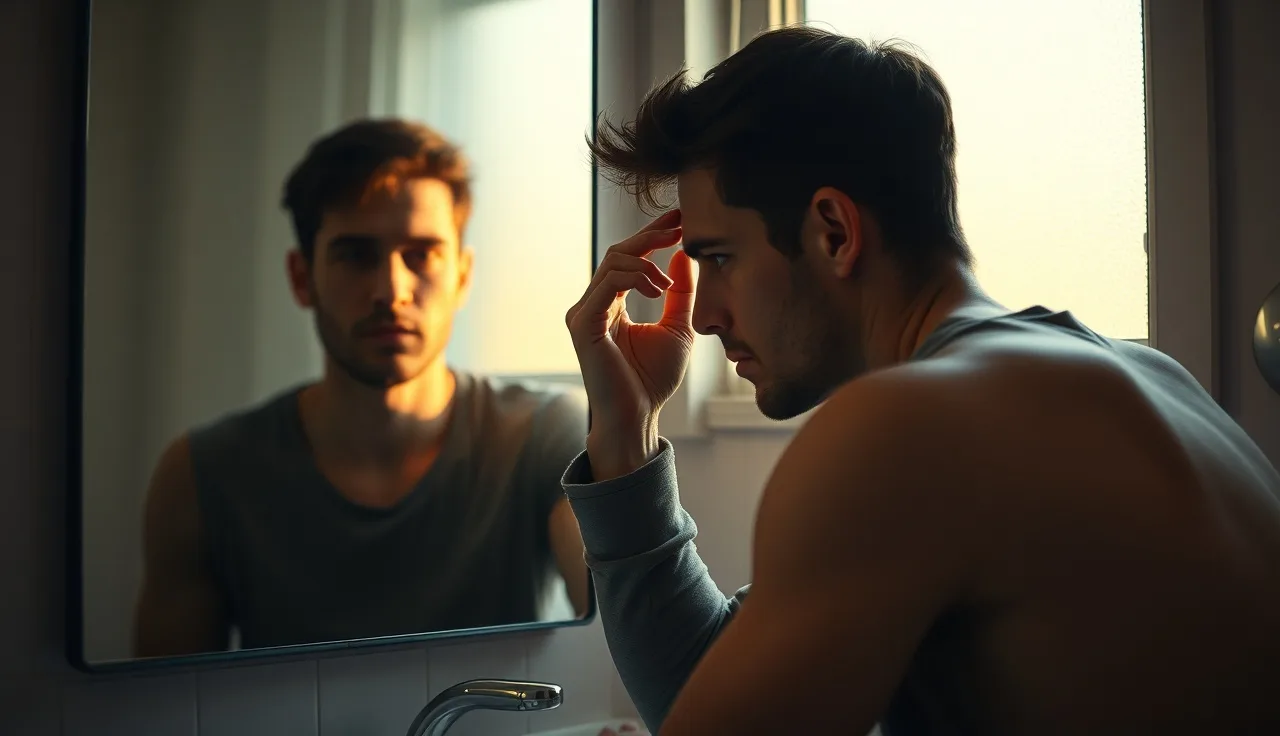
TL;DR: Male hair loss links to measurable drops in self-esteem, body image, and quality of life. Anxiety and depression run higher in men with androgenetic alopecia than in men without it. The burden is real, it varies by age and personality, and effective treatment tends to lift mental health scores right alongside hair counts.
What does the research actually say about hair loss and men's mental health?
The short answer: the research is surprisingly consistent. Hair loss hurts. Not every man, not equally, but the population-level signal is hard to dismiss.
A 2019 systematic review published in the Journal of the American Academy of Dermatology found that androgenetic alopecia (the most common form of male hair loss) is associated with significantly lower scores on quality-of-life measures, higher rates of anxiety, and elevated rates of depression compared to men without hair loss [1]. That review pulled data from dozens of studies across multiple countries, so it's not a single quirky sample.
The numbers depend heavily on which scale researchers use and which population they study. On the Dermatology Life Quality Index (DLQI), men with moderate-to-severe androgenetic alopecia average scores in the range of 5 to 10, territory that indicates a "moderate" impact on daily life [2]. Men with alopecia areata (the patchy, autoimmune type) tend to score even higher, sometimes in the "very large" effect range.
Here's what catches researchers off guard. Objective severity doesn't cleanly predict distress. A man at Norwood Stage II can be more psychologically affected than a man at Norwood Stage V. Age, social role, perceived control, and whether the loss feels sudden all matter more than the mirror sometimes does.
The research is not claiming every bald man is miserable. Plenty aren't. But the idea that hair loss is trivial, that men should "just get over it," doesn't hold up against the data.
How common are depression and anxiety among men experiencing hair loss?
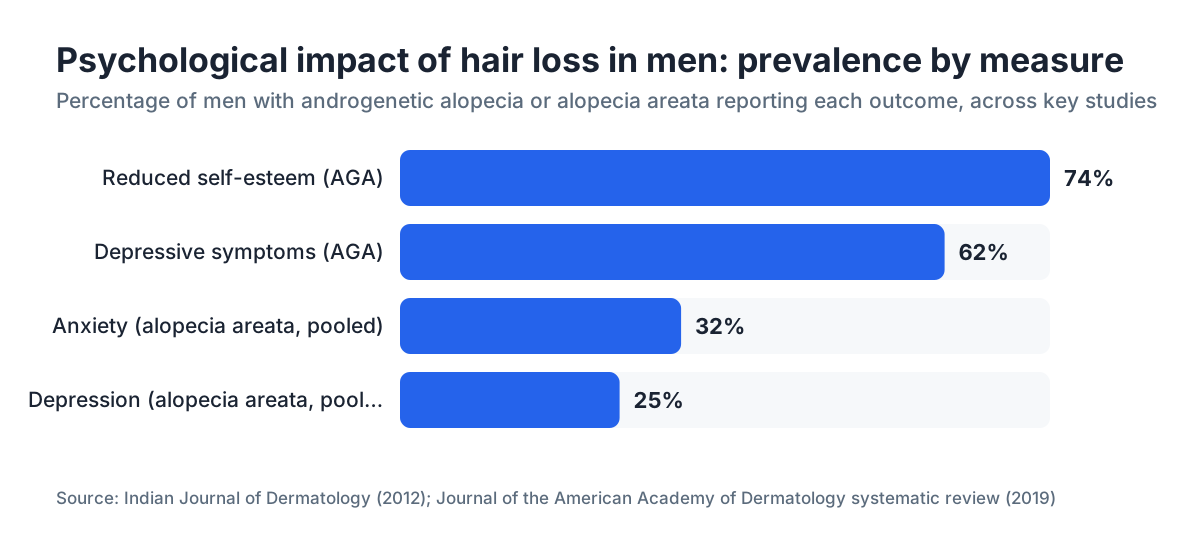
Rates vary by study design, but the direction is consistent. A 2012 study in the Indian Journal of Dermatology surveyed 200 men with androgenetic alopecia and found that 62% reported some level of depression and 74% reported reduced self-esteem [3]. Those are self-report figures, not clinical diagnoses, so treat them as indicators rather than clinical prevalence.
Clinical diagnosis studies are harder to run and less common, but cross-sectional work has found that men with early-onset androgenetic alopecia (hair loss starting before age 35) carry significantly higher rates of clinically significant anxiety than age-matched controls [4]. Early onset seems to be a particular risk factor, probably because hair loss before your 30s is more socially unexpected and less normalized.
Alopecia areata carries an even heavier psychological load. A meta-analysis in the Journal of the American Academy of Dermatology found the pooled prevalence of depression in alopecia areata patients at around 25%, and anxiety at roughly 32%, both well above general population base rates [1].
One pattern shows up across studies. Men who attribute high social or professional weight to their appearance score worse on mental health measures. That might sound obvious, but it has a practical implication. Psychological screening tools used by dermatologists increasingly ask about occupation, social life, and self-image, more than how much hair is left.
Does hair loss affect self-esteem and body image in men?
Yes, and more than most people expect. Self-esteem and body image are where the research gets especially consistent.
A widely cited study in the Journal of Investigative Dermatology Symposium Proceedings found that men with hair loss scored significantly lower on the Rosenberg Self-Esteem Scale compared to controls, and that the gap widened with earlier age of onset [5]. The researchers noted that hair is strongly tied to masculine identity in Western cultures, which raises the psychological stakes.
Body dysmorphic disorder (BDD) belongs in this conversation. Research suggests men with hair loss have higher rates of BDD symptoms than the general population, though full BDD is still relatively uncommon. The distinction matters clinically. A man with BDD-level preoccupation with his hair may not benefit much from transplant surgery, and several studies have documented ongoing distress even after technically successful procedures [6].
The social dimension is real too. Research on hair loss and self-perception finds that affected men rate themselves as less attractive and anticipate negative social judgments, regardless of whether those judgments are actually being made [5]. Perceived stigma is itself a mental health burden, separate from any actual discrimination.
If you want a clear picture of your current hair loss stage before talking to a doctor, the free AI hair analysis at MyHairline can map your loss against Norwood stages and give you a starting point for that conversation.
Does the psychological impact of hair loss differ by age?
It does, quite a bit.
Younger men consistently report more distress from hair loss than older men, even when the objective degree of loss is similar. Survey-based work finds that men who started losing hair before age 30 report higher anxiety scores, lower body image satisfaction, and greater impact on social functioning than men whose loss began after 40 [4].
The likely explanation isn't complicated. Hair loss in a 25-year-old is off-script. It clashes with expectations about age and appearance, triggers worry about looking older, and often lands during years when dating, social identity, and early career are all front of mind. For a 55-year-old, the same Norwood Stage IV often reads as expected and less threatening to identity.
There's a habituation effect too. Men who have lived with hair loss for years often report lower distress than men in the early, active phase of losing it. Losing hair may be psychologically harder than having already lost it.
That said, age is not destiny. Some older men do carry real distress, particularly those in careers or social settings where appearance carries weight.
What is the link between hair loss and quality of life in men?
Researchers use validated instruments to measure this, and the findings line up well enough to trust.
The DLQI is the most commonly used tool in dermatology quality-of-life research. It asks about symptoms, daily activities, leisure, work, relationships, and treatment burden. A score of 0-1 means no effect; 11-20 means very large effect. Men with moderate androgenetic alopecia typically score in the 4-8 range [2]. Men with alopecia areata, especially when widespread, regularly score above 10.
The Hair-Specific Skindex (a validated tool built specifically for hair disorders) shows that social functioning and emotional domains take the biggest hit, more so than physical symptoms [1]. In plain terms: men are less bothered by the physical sensation of losing hair than by what it signals about how they're seen.
Work and relationships show up in the data too. Some studies find men with visible hair loss avoiding social situations, canceling plans, and changing behavior specifically to manage how others read their hair [3]. That avoidance is clinically meaningful because it feeds anxiety rather than easing it.
Understanding what causes hair loss is often where men start, and that knowledge itself can reduce distress by turning a scary unknown into something manageable.
Are the mental health effects different for men versus women with hair loss?
Women generally report higher distress from hair loss than men on most scales, but the gap is smaller than the popular assumption suggests.
A comparative analysis in the Journal of the American Academy of Dermatology found that women with androgenetic alopecia scored worse than men on emotional and functional domains of hair-specific quality-of-life tools [1]. Both groups scored meaningfully below controls. The conclusion isn't that men are fine and women suffer. Both suffer, and women tend to suffer somewhat more.
The reason is probably social. Hair is a more explicit marker of femininity in most cultural contexts, so loss carries a different social signal for women. Men also have more widely accepted scripts for being bald or shaved, which gives some of them an exit ramp that women don't have.
For men specifically, distress runs highest in those who score high on appearance investment measures, regardless of how they compare to women. If your own psychology places high value on your appearance, your gender matters less than that underlying trait.
Does treating hair loss actually improve mental health?
Yes, and the evidence for it is fairly good.
Multiple randomized trials of finasteride and minoxidil for men have included quality-of-life endpoints alongside hair count endpoints. A major finasteride 1mg trial published in the Journal of the American Academy of Dermatology found statistically significant improvements in patient self-assessment of hair appearance, self-esteem related to hair, and overall self-perception after 12 months compared to placebo [7]. The FDA label for Propecia (finasteride 1mg) notes improvements in patient self-perception.
Hair transplant research tells a similar story. A study in Dermatologic Surgery found men reporting significant improvements in body image, self-esteem, and psychological well-being at 12 months post-transplant, with the largest gains in men who had reported the highest pre-operative distress [6]. The people most affected before treatment tended to gain the most from a successful procedure.
Minoxidil trials have shown quality-of-life improvements too, though the effect sizes run somewhat smaller than for finasteride, possibly because regrowth with minoxidil alone tends to be more modest [8].
One caveat matters: treatment only helps if it works. Partial responders and non-responders don't see the same lift, and the ongoing effort and cost of treatment can be a stressor in itself. Finasteride and minoxidil combined tends to beat either one alone, which counts both for hair and for the psychological payoff.
For men weighing options, a receding hairline guide can clarify which treatments fit their specific loss pattern.
Can hair loss cause or worsen depression or anxiety disorders?
"Cause" is a strong word and the research is careful with it. The studies show association, not clean causation. But the mechanistic story holds together.
Hair loss lowers perceived attractiveness and social confidence, triggers behavioral avoidance, and in some men activates existing tendencies toward body-focused anxiety. Each of those is a known pathway into depression and anxiety disorders. So while hair loss probably isn't creating depression from scratch in most men, it can be a real trigger or amplifier.
There's a separate biological consideration for men using finasteride. The FDA updated the label for finasteride 1mg to include depression among other mood-related side effects [7]. The rates are low and causation is debated, but it's a real consideration. Post-finasteride syndrome is contested in the literature; documented mood-related adverse events are on the label. Anyone starting finasteride should know this. It doesn't mean you'll get depressed. It means you should monitor and tell your prescriber if your mood shifts.
Then there's telogen effluvium, the shedding type of hair loss that often follows stress, illness, or trauma. It creates a feedback loop. Stress causes shedding; shedding causes more stress. That loop is well documented and worth spotting if you're in it.
What do men say are the social consequences of hair loss?
The qualitative research here is illuminating and sometimes bleak.
A 2007 qualitative study in the British Journal of Dermatology ran in-depth interviews with men experiencing androgenetic alopecia [9]. The same themes kept surfacing: embarrassment in social situations, anxiety about intimacy and dating, reduced confidence at work, and a sense of lost control over their appearance. Several men described spending real time each day arranging remaining hair or dodging situations where it might be seen in unflattering light.
That avoidance is important clinically. Avoiding mirrors, skipping social events, staying out of pools or wind are all subtle compulsions that reinforce body-focused anxiety instead of easing it. Cognitive behavioral therapy (CBT) techniques target exactly this kind of avoidance.
Dating and relationships come up in almost every qualitative study. Men worry that prospective partners will reject them or find them less attractive. Research on actual partner preferences shows a much weaker link between hair and attractiveness ratings than hair-loss-anxious men believe. The fear is usually worse than the reality.
Workplace concerns appear regularly too. Some men in client-facing or appearance-sensitive jobs report genuine career anxiety about hair loss, while others in different fields say it rarely crosses their minds at work.
What coping strategies actually help men dealing with hair loss?
The evidence here is thinner than the evidence for biological treatments, but a few things have real support.
Cognitive behavioral therapy is the best-studied psychological intervention for appearance-related distress, including hair loss. A randomized trial in the British Journal of Dermatology found that group CBT significantly reduced anxiety, depression, and avoidance behaviors in patients with alopecia areata, with gains held at six-month follow-up [10]. CBT isn't designed for hair loss specifically, but the skills (challenging catastrophic thoughts, cutting avoidance, building behavioral activation) map directly onto the patterns hair loss creates.
Acceptance-based approaches have theoretical support too. Some men find that reframing hair loss as a normal biological process (which it is, for androgenetic alopecia) rather than a failure or defect meaningfully reduces distress. This isn't "toxic positivity" or being told to feel fine. It's a different cognitive model.
On the practical side, the research supports treating the underlying hair loss when possible. If minoxidil or finasteride works for you, the psychological benefit is real, more than cosmetic. Knowing your options, understanding the stages of hair loss, and making an informed treatment decision often reduces the helplessness that drives anxiety.
Support groups, in person and online, show up in qualitative research as helpful for alopecia areata specifically. Shared experience and normalization carry weight.
The one thing the research warns against consistently: surgery done mainly to relieve psychological distress without addressing the underlying psychological state. A hair transplant can help a lot, but men with BDD-level preoccupation often stay distressed after surgery and may do better with psychological care first.
Should men talk to a doctor about the emotional side of hair loss?
Yes. Full stop.
Dermatologists increasingly screen for psychological distress during hair loss consultations, and the American Academy of Dermatology's guidelines on androgenetic alopecia recommend assessing quality-of-life impact as part of the clinical evaluation [2]. If yours doesn't ask, bring it up yourself.
For men whose distress is meaningfully hitting daily life, relationships, or work, a referral to a psychologist or psychiatrist is appropriate and nothing to be embarrassed about. The research is clear that the psychological burden of hair loss is real, not imagined. Treating it like a real medical concern is exactly right.
For a low-stakes starting point, the MyHairline AI scan can help you understand your hair loss pattern and generate informed questions before a clinical appointment. It's a starting point, not a substitute for a dermatologist.
If you're thinking about treatment and want a clear picture of what's available and what the side effect profiles look like, reviewing the data on minoxidil side effects or DHT blockers gives you a realistic frame before any prescription conversation.
Sources
- Journal of the American Academy of Dermatology: systematic review of psychosocial impact of alopecia areata and androgenetic alopecia
- American Academy of Dermatology: clinical guidelines on androgenetic alopecia
- Indian Journal of Dermatology (via PubMed Central, US National Library of Medicine): survey of 200 men with androgenetic alopecia on depression and self-esteem
- National Library of Medicine (PubMed): studies on early-onset androgenetic alopecia and anxiety in men
- Journal of Investigative Dermatology (Society for Investigative Dermatology): hair loss, self-esteem, and social perception in men
- PubMed (US National Library of Medicine): psychological outcomes after hair transplantation in men
- FDA: Propecia (finasteride 1mg) prescribing information and label (DailyMed / Drugs@FDA)
- Journal of the American Academy of Dermatology: minoxidil randomized trials quality-of-life endpoints
- National Library of Medicine (PubMed): qualitative study of men's experience of androgenetic alopecia
- National Library of Medicine (PubMed): randomized trial of CBT for alopecia areata