

TL;DR: Most hair transplant surgeries in the United States cost between $4,000 and $20,000, with a typical bill around $7,000 to $10,000. FUT (strip) is cheaper per graft than FUE. Your final price depends on how many grafts you need, where the clinic is, and how experienced the surgeon is. Insurance almost never covers it.
What is the average cost of a hair transplant in the US?
There is no single number that means much here, and any clinic that gives you one before looking at your scalp is guessing. The American Society of Plastic Surgeons reported the average surgeon fee for hair transplantation was about $4,300 in 2022, but that figure covers the surgeon's fee alone, not anesthesia, facility costs, or post-op medications [1]. All-in prices at reputable US clinics usually land between $7,000 and $15,000 for a moderate session. Complex cases that need 3,000 or more grafts routinely pass $20,000 [2].
The range is wide because hair transplants are sold by the graft. One graft is a natural cluster of one to four hairs. US clinics generally charge $3 to $8 per graft for FUE (Follicular Unit Extraction) and $1.50 to $4 per graft for FUT (Follicular Unit Transplantation, the strip method) [2]. Someone who needs 1,500 grafts for a slightly receding hairline pays far less than a Norwood 5 or 6 patient who may need 3,500 to 4,500 grafts.
Geography moves the number a lot. A board-certified surgeon in Manhattan or Beverly Hills charges more than an equally skilled surgeon in Nashville or Phoenix, mostly because their rent is higher. Clinics in Turkey, Mexico, and India advertise all-inclusive packages under $2,500, but that comparison needs its own honest look, which comes later in this piece.
FUE vs FUT: which method costs more and why?
FUE costs more per graft, roughly 30 to 50% more than FUT, and the reason is labor. In FUE, a technician or surgeon uses a small punch tool (typically 0.8 to 1.0 mm) to pull follicles out one at a time from the donor area. A 2,500-graft FUE session can run six to ten hours across a surgical team. In FUT, a strip of scalp is cut from the back of the head, dissected under microscopes into individual grafts, then implanted. The strip method is faster and gives a higher yield per session, so surgeons can charge less per graft and still make money [2].
For you, the tradeoff is the scar. FUT leaves a thin linear scar along the donor strip, which shows if you wear your hair very short. FUE leaves tiny round scars scattered across the donor area, mostly invisible through normal-length hair. Done well by an experienced surgeon, the transplanted result looks the same either way.
| Method | Typical US cost per graft | Session size range | Scarring |
|---|---|---|---|
| FUT (strip) | $1.50 to $4.00 | 1,500 to 4,000 grafts | Linear scar |
| FUE | $3.00 to $8.00 | 800 to 3,500 per session | Tiny scattered dots |
| Robotic FUE (ARTAS) | $5.00 to $10.00 | 1,500 to 2,500 | Tiny scattered dots |
Robotic FUE, sold under names like ARTAS, adds a premium for the robot-assisted extraction step. The evidence that the robot beats an experienced manual FUE surgeon is thin. You are mostly paying for the machine's lease, not for better hair.
How does graft count affect what you pay?
Graft count is the most direct lever on your total bill. The math is simple: multiply the quoted per-graft price by the number of grafts your surgeon estimates at the consultation. Most US clinics charge $4 to $6 per graft for FUE, so a 2,000-graft session runs $8,000 to $12,000. A 3,500-graft session at the same rate is $14,000 to $21,000.
How many grafts you need tracks roughly with your Norwood stage. A Norwood 2 or early 3 (receding hairline, temples thinning) usually needs 1,000 to 2,000 grafts. A Norwood 4 (a clear bald patch with real temple recession) often needs 2,500 to 3,500. A Norwood 5 or 6 can require 4,000 or more, sometimes split across two sessions. Reading about receding hairline stages first lets you walk into any consultation with expectations that match reality.
One caveat that costs people money: some clinics quote a flat session price instead of a per-graft price. It sounds simpler, but it can hide the fact that they plan to place fewer grafts than you actually need. Get a specific graft estimate in writing before you sign anything.
What factors push the price up or down?
Surgeon experience and reputation are the biggest upward drivers. A surgeon who trained under a recognized program, belongs to the International Society of Hair Restoration Surgery (ISHRS), and has a documented record of natural results charges more. That premium is usually worth paying. Hair transplants are permanent, and a botched job with an unnatural hairline or pitted scarring is hard and expensive to fix [3].
Clinic location matters almost as much. New York and Los Angeles clinics generally charge 20 to 40% more than comparable clinics in the Midwest or South, purely on rent and labor. Overseas destinations, mostly Turkey, sell FUE packages all-in for $1,500 to $4,000. Some Istanbul clinics are genuinely excellent and their physicians trained in Europe or the US. Others use barely trained technicians doing unsupervised extraction, which is against Turkish law (Turkish rules require a physician to perform extractions) but enforcement is patchy [4].
Body hair transplants (BHT), which use beard or chest hair when the scalp donor area is depleted, cost more per session. The technique is harder and yields are lower.
Anesthesia type moves the price too. Most transplants are done under local anesthesia with oral sedation, which is far cheaper than general anesthesia. If a clinic quotes general anesthesia for a standard session, ask why.
Most clinics bill separately for post-op medications, including topical minoxidil, which many surgeons start after surgery to protect surrounding native hair. If minoxidil is new to you, minoxidil for men covers the basics clearly.
Does insurance cover hair transplants?
Almost never, if the cause is androgenetic alopecia (pattern baldness). Carriers classify elective cosmetic procedures as non-covered, and genetic hair loss falls there. Narrow exceptions exist: transplants to repair scalp skin grafted after burns or trauma may fall under reconstructive benefits in some plans. Patients with alopecia areata or scarring alopecia from an underlying covered condition sometimes have a partial coverage argument worth making, though approvals are rare [5].
There is no tax angle for most patients either. The IRS does not allow a medical expense deduction for purely elective cosmetic procedures [10].
Financing is the real option. Almost every clinic offers in-house plans or partners with lenders like CareCredit or Prosper Healthcare Lending. Rates swing hard, from 0% promotional periods (usually 12 to 18 months) to 26% APR for borrowers with lower credit. Run the numbers first. A $10,000 transplant at 26% APR over three years costs you roughly $3,700 in interest, which buys nothing.
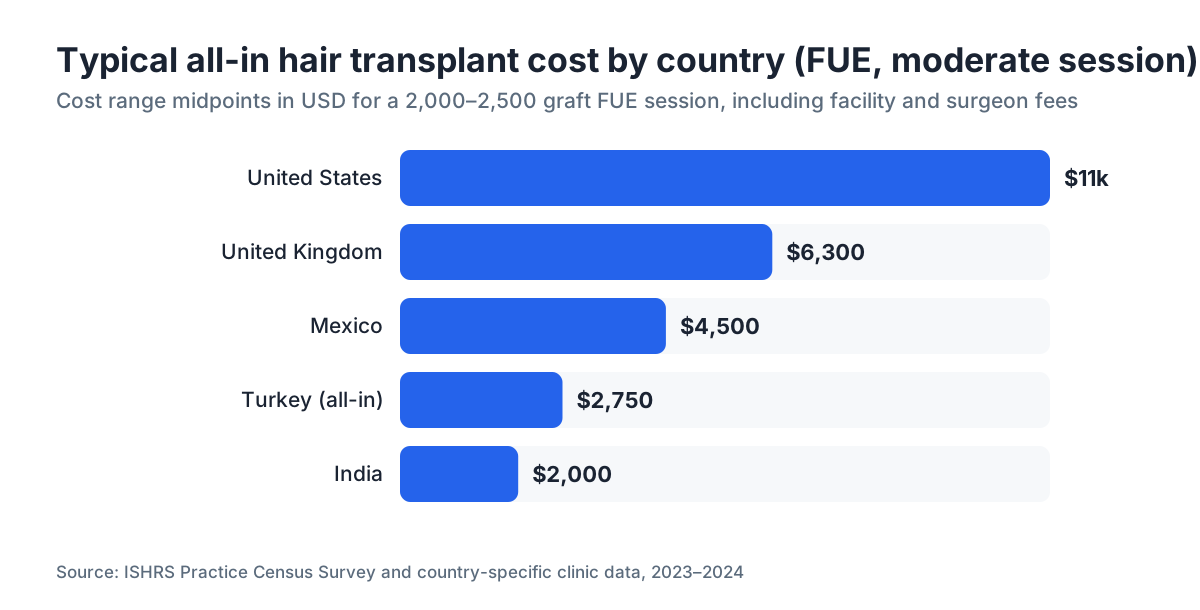
How much do hair transplants cost outside the US?
Medical tourism for hair transplants is huge. Turkey alone performs an estimated 700,000 to 1,000,000 procedures a year, more than any other country [4]. All-inclusive packages (flights, hotel, transfers, procedure) from major Istanbul clinics run $1,500 to $4,000 for sessions that would cost $10,000 to $15,000 in the US.
The UK average for FUE sits around £3,000 to £7,000 ($3,800 to $8,900 at typical exchange rates). India ranges from $800 to $3,500 depending on city and clinic tier. Mexico, especially Tijuana, runs $3,000 to $6,000 for FUE and draws US patients who want a short flight home.
| Country | Typical FUE price range (USD) | Key consideration |
|---|---|---|
| United States | $7,000 to $20,000+ | Highest regulatory oversight |
| United Kingdom | $3,800 to $8,900 | CQC-regulated clinics |
| Turkey | $1,500 to $4,000 all-in | Wildly variable quality |
| India | $800 to $3,500 | Clinic accreditation varies |
| Mexico | $3,000 to $6,000 | Proximity for US patients |
The risk in medical tourism is bigger than the procedure. Complications like infection, necrosis, or poor yield that show up after you fly home land on a local physician who had no part in your care. US dermatologists see post-travel transplant complications regularly, and corrective work is expensive [3].
Some patients take a middle path: get the consultation and surgical plan done by a US surgeon they trust, then decide whether an overseas clinic working from that same plan is viable. This does not erase the risk, but it gives you an independent baseline before you get on a plane.
Is a hair transplant worth the cost compared to medication?
This is a fair question, and the honest answer turns on where you are in your hair loss and what you can realistically spend.
Finasteride (generic, oral) costs $15 to $40 per month at most US pharmacies, or $10 to $25 per month through telehealth prescribers. Over ten years that is $1,200 to $4,800, assuming you stay on it (you have to, indefinitely, to keep the effect). Phase III trials showed finasteride stopped or slowed loss in about 87% of men and produced visible regrowth in about 66% at two years [6]. If you have not started there, the finasteride explainer is worth reading.
Minoxidil is cheaper still, usually $10 to $25 per month for topical, and adds its own benefit on top of finasteride in many patients [7]. Some clinicians now use low-dose oral minoxidil as an alternative or add-on, and oral minoxidil has become a real option worth knowing.
Here is the practical split. Medication is cheaper and lower risk, but it maintains and modestly improves what you still have. It does not rebuild a hairline that has fully receded or fill a bald crown. A transplant places real hair where the follicles are already gone. Plenty of patients do both: a transplant to restore what is lost, medication to protect the surrounding native hair and avoid needing another transplant in five years.
Still not sure whether you have pattern loss or something else? What causes hair loss and telogen effluvium can sort that out before you spend money in the wrong direction.
A free AI hair analysis at MyHairline maps your pattern and Norwood stage in a few minutes. It gives you a starting point for realistic graft estimates before you sit down with any surgeon.
What does a hair transplant consultation cost?
Most consultations at US clinics are free, at least the first visit. The clinic makes its money on the procedure, so the consultation is really a sales meeting. That is fine, as long as you know it going in. Some high-end surgical practices charge $100 to $300, sometimes credited toward the procedure if you book.
A real consultation should include a scalp assessment under magnification (trichoscopy or densitometry), a frank talk about your donor density and whether it can actually cover the area you want, and a written estimate of graft count and total cost. If a clinic skips the scalp exam and quotes you from photos alone, leave.
Getting three consultations before you choose is normal, not paranoid. Graft estimates often vary 20 to 30% between clinics for the same patient, and pricing varies more. A quote that is dramatically cheaper than the rest deserves extra scrutiny, not your deposit.
What are the additional costs after a hair transplant?
The surgery bill is not where spending ends. Plan for these:
Post-op medications usually include an antibiotic course ($15 to $50), an anti-inflammatory ($20 to $60), and sometimes minoxidil (topical, $10 to $25 per month, ongoing). Many surgeons also want you on a DHT blocker like finasteride afterward to slow loss in native hair. DHT blocker covers how those work.
Specialized shampoos and post-op sprays sold by the clinic run $30 to $80, though whether branded post-op shampoos beat a gentle drugstore alternative is genuinely debatable.
Time off work is a real cost. Most patients take 5 to 10 days. The transplanted area shows crusting and redness for 7 to 14 days. If your job is client-facing or physical, budget for that downtime.
A follow-up at 6 to 12 months is standard and usually included in the procedure price at reputable clinics. If not, expect $100 to $200 per visit.
PRP (platelet-rich plasma) therapy gets upsold as a recovery booster. The evidence for PRP improving transplant outcomes is mixed at best. A 2019 systematic review in the Journal of Dermatological Treatment found some positive signals but called the evidence base limited [8]. PRP typically costs $500 to $1,500 per session and is almost never needed for a routine case.
How do you avoid getting ripped off on a hair transplant?
A few checks filter out the bad actors fast.
Verify board certification. In the US, look for the American Board of Hair Restoration Surgery (ABHRS) or a relevant dermatology or plastic surgery board. ISHRS membership (ishrs.org) is a positive signal because members sign onto a code of ethics [3].
Ask who performs the extractions. In most US states, each extraction step must be done or directly supervised by a licensed physician. Clinics that hand extraction to unlicensed technicians are breaking state medical practice acts and cutting a corner that shows up directly in your results.
Study the before-and-after photos. Look for patients with hair color, texture, and Norwood stage like yours. Mismatched hairlines, a plug-like look, or photos shot under flattery lighting are red flags.
Ask about the revision policy. Good clinics will tell you what happens if graft yield comes in low or you are unhappy. A clinic that waves this off or claims it never happens is overselling.
Skipping the cheapest option is not snobbery. Hair transplants are permanent. Corrective transplants to fix a botched one are harder, cost more, and yield less, because the donor supply is already partly spent.
When should you consider a hair transplant versus other options?
A transplant makes the most sense once your hair loss has stabilized, you have enough donor density at the back and sides, and your expectations match what surgery can do. The American Academy of Dermatology recommends patients try and document results from medications like minoxidil and finasteride before pursuing surgery, largely so you know your loss pattern is stable before placing permanent grafts into a scalp where native hair may keep falling [9].
If you are 22 and have been shedding hard for six months, you are probably not a candidate yet. Your pattern has not declared itself. A surgeon who wants to operate right away without first suggesting a medication trial should worry you.
If you have been stable on medication for 12 to 24 months, your donor area is dense, and you have a clearly defined area you want fixed, you are likely a good candidate. The hair transplant overview walks through candidacy in more detail.
A free AI scan at MyHairline gives you a Norwood stage estimate and a ballpark graft range, which makes that first surgical consult a sharper conversation.
For some patients, finasteride and minoxidil together bring back enough that surgery can be postponed or skipped. That is worth knowing before you commit $10,000 or more.
Sources
- American Society of Plastic Surgeons, Plastic Surgery Statistics Report 2022
- International Society of Hair Restoration Surgery, Practice Census Survey
- International Society of Hair Restoration Surgery, Patient Education
- International Society of Hair Restoration Surgery, Practice Census Survey
- U.S. Centers for Medicare and Medicaid Services
- Kaufman KD et al., Journal of the American Academy of Dermatology, 1998; finasteride Phase III trials
- U.S. Food and Drug Administration, Drug Label for Rogaine (Minoxidil) Topical Solution
- Giordano S et al., Journal of Dermatological Treatment, 2019, systematic review of PRP in hair transplantation
- American Academy of Dermatology, Hair Loss Diagnosis and Treatment Guidelines
- U.S. Internal Revenue Service, Publication 502: Medical and Dental Expenses