
TL;DR: Graft needs climb fast with Norwood stage. Early loss (NW2-3) runs 500 to 2,000 grafts. Mid stages (NW3V-4) run 1,800 to 2,800. Advanced loss (NW5-7) runs 2,500 to 4,500 or more. One safe surgical session tops out near 3,000 to 4,000 grafts. US pricing sits at $3 to $10 per graft, so a full restoration can pass $20,000.
What is the Norwood scale and why does it matter for hair transplants?
The Norwood-Hamilton scale is the classification surgeons use to grade male pattern baldness. It runs from Type 1 (no meaningful recession) through Type 7 (a bare crown joined to a bare top, with only a horseshoe fringe left at the sides and back). Dr. James Hamilton published the original scale in 1951. Dr. O'Tar Norwood revised and expanded it in 1975, and that revised version is what every clinic uses today [1].
The scale matters for one plain reason: the higher your stage, the more bald area you have to cover, and the more grafts that takes.
But graft count is about more than surface area. It also depends on how dense your donor zone is, how coarse or fine your hair is, and what final density you and your surgeon agree is realistic. Coarse, wavy hair covers more scalp per graft than fine, straight hair does. A NW4 with thick dark hair can look fuller on fewer grafts than a NW3 with fine flat hair.
Want to figure out where you fall before booking a consult? A receding hairline guide helps you map your pattern. For this article, assume we are always talking about male androgenetic alopecia, which is the condition the Norwood scale was built to describe. Women get graded on the Ludwig scale instead.
What does each Norwood stage actually look like?
Here is each stage in plain language, so the graft numbers later make sense.
NW1: No recession. A teenager's hairline. Almost nobody transplants here.
NW2: Slight recession at the temples. The corners have crept back but the overall shape still reads as a hairline. This is where many men first notice a change.
NW3: The first stage Norwood calls significant recession. The temples have pulled back into a more angular shape. NW3 Vertex (NW3V) adds a thinning crown on top of that temporal recession.
NW4: Temples and crown are both hit. A bridge of hair still links the front and back, but it is thinner than the sides.
NW5: That bridge has thinned further or broken. The bald patch on top is bigger, and the two zones are starting to merge.
NW6: The bridge is gone. The top is one continuous bald zone, with only the side and back fringe intact.
NW7: The most advanced stage. Even the fringe has thinned and receded. The safe donor zone at the back narrows here, which caps how many grafts a surgeon can harvest.
Most men who seek transplants land between NW2 and NW5. NW6 and NW7 patients can still get surgery, but they face the worst math: a lot of area to cover, and less donor hair to cover it with.
How many grafts does each Norwood stage typically require?
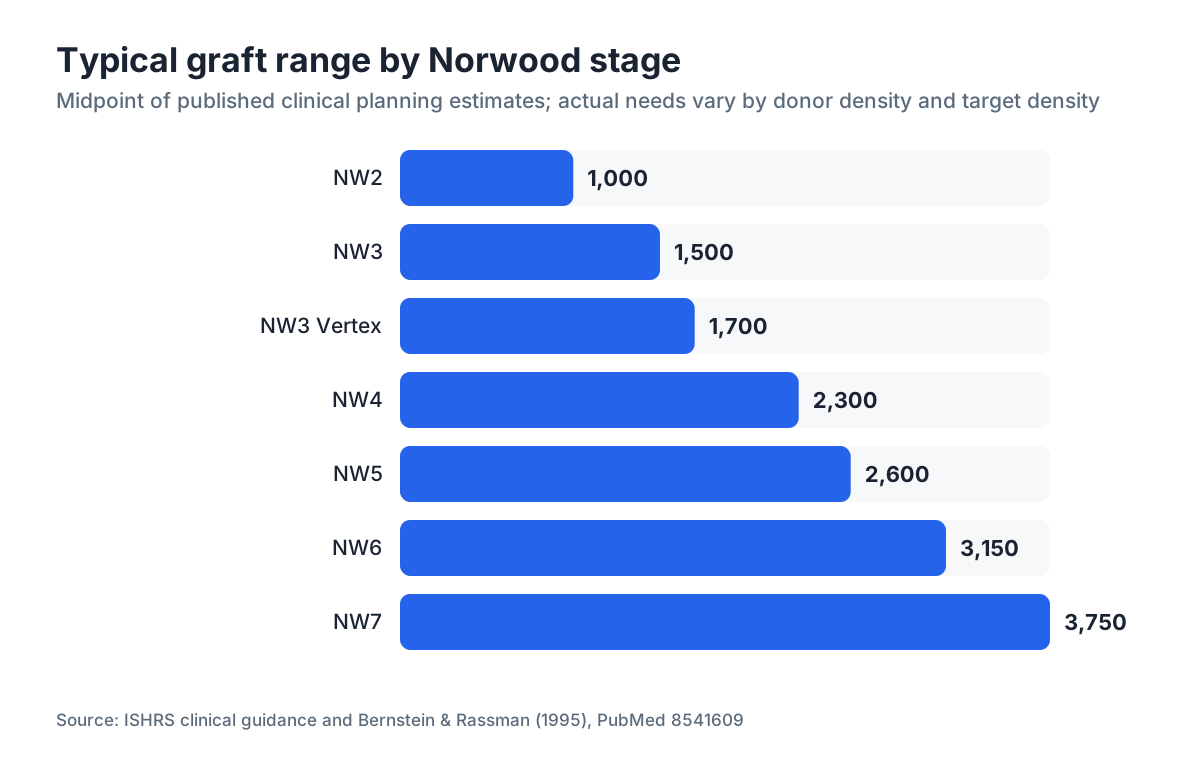
Surgeon estimates vary, but the ranges below track what hair restoration societies and published clinical literature report [2][3]. These are planning estimates, not promises. Your real number turns on donor density, hair caliber, scalp laxity, and the target density you settle on with your surgeon.
| Norwood Stage | Approximate Graft Range | Notes |
|---|---|---|
| NW2 | 500 to 1,500 | Hairline refinement only; often a single modest session |
| NW3 | 1,000 to 2,000 | Temples plus early frontal zone |
| NW3 Vertex | 1,200 to 2,200 | Adds early crown coverage |
| NW4 | 1,800 to 2,800 | Frontal zone plus partial crown |
| NW5 | 2,000 to 3,200 | Larger bald zone; may need two sessions |
| NW6 | 2,500 to 3,800 | Top of donor limit for single session |
| NW7 | 3,000 to 4,500+ | Often two sessions; body hair sometimes discussed |
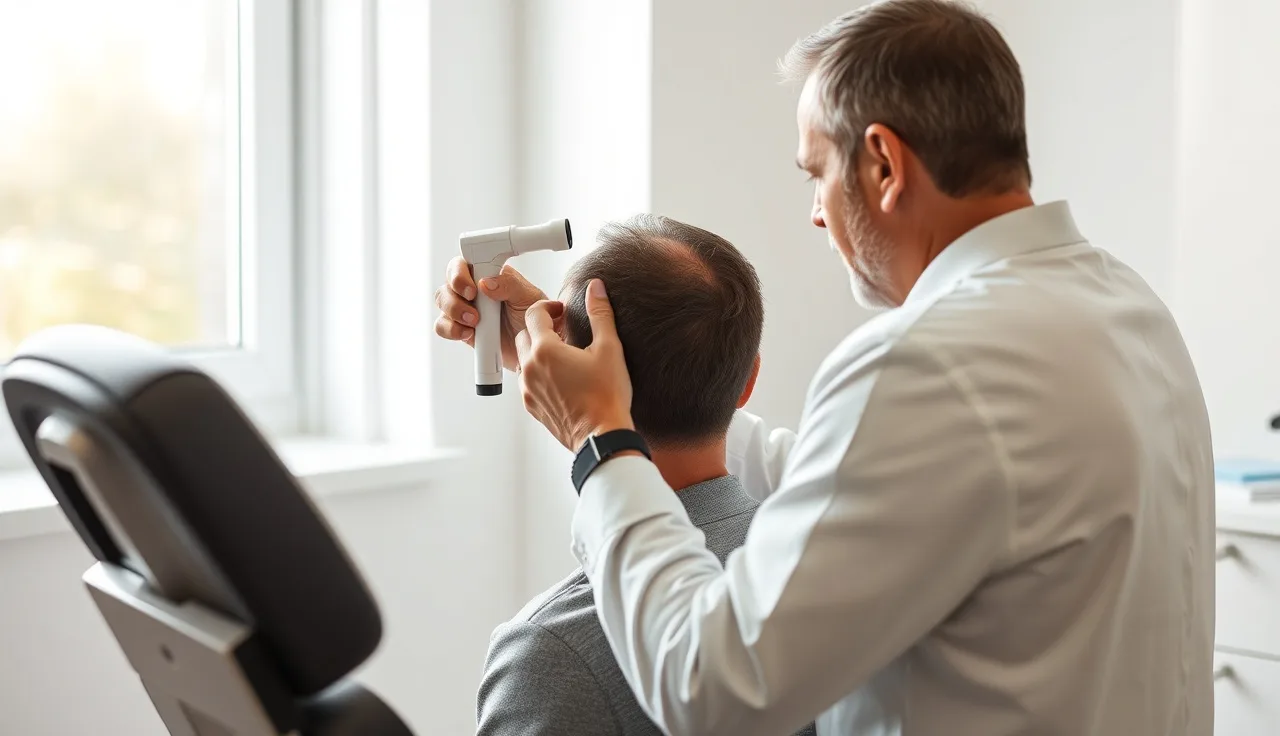
Those ranges are wide on purpose. A surgeon who tells you they can fix your NW5 with exactly 2,100 grafts before touching your scalp is guessing. A real consult measures the bald area in square centimeters and estimates donor density with a trichoscope or dermoscope.
Here is a benchmark worth memorizing: published hair restoration data suggests the average donor zone holds roughly 6,000 to 8,000 extractable follicular units across a lifetime before density visibly drops [3]. If you are NW5 and spend 3,000 grafts now, you may not have much left for a second session if your loss keeps moving. That math is why surgeons push finasteride and minoxidil for men before and after surgery. Slowing future loss protects the money you already spent.
How much does a hair transplant cost by Norwood stage?
US hair transplant pricing runs about $3 to $10 per graft, with most respected FUE clinics landing in the $5 to $8 band [4]. FUT (strip) work sometimes comes in a little lower per graft. Overseas clinics in Turkey, Thailand, and parts of Europe advertise packages of $1,500 to $4,000 for what they call unlimited grafts, but per-graft quality and safety standards swing wildly, and those prices often bundle flights and hotels while skimping on post-op care.
Apply domestic per-graft rates to the stage estimates above and you get a realistic cost picture:
| Norwood Stage | Graft Range | US Cost (at $5-$8/graft) |
|---|---|---|
| NW2 | 500 to 1,500 | $2,500 to $12,000 |
| NW3 | 1,000 to 2,000 | $5,000 to $16,000 |
| NW3V | 1,200 to 2,200 | $6,000 to $17,600 |
| NW4 | 1,800 to 2,800 | $9,000 to $22,400 |
| NW5 | 2,000 to 3,200 | $10,000 to $25,600 |
| NW6 | 2,500 to 3,800 | $12,500 to $30,400 |
| NW7 | 3,000 to 4,500+ | $15,000 to $36,000+ |
Insurance does not cover any of this. Hair transplants are elective cosmetic procedures. Some clinics offer financing, but rates vary a lot, so read the terms before you sign.
One thing genuinely worth knowing: the International Society of Hair Restoration Surgery (ISHRS) publishes a practice census tracking average session sizes and per-graft rates, and those numbers have stayed fairly stable in recent years [2]. If a quote sits far below market, ask what the graft count includes and whether the surgeon is counting individual hairs or follicular units. A follicular unit usually holds one to four hairs. Graft counts should always mean follicular units, not hairs.
What is the maximum number of grafts that can be done in one session?
Most surgeons cap a single FUE session at 2,500 to 4,000 grafts, for practical reasons. Push past that and the procedure runs so long (10 to 14 hours) that graft survival drops, because extracted follicles spend too long outside the body. Graft survival degrades with time out of the scalp, especially past 6 to 8 hours of storage [5].
FUT (strip) surgery can sometimes yield more grafts per session, because the whole strip gets processed at once rather than pulled follicle by follicle. But the total safely usable number still runs into the same survival limits.
Some clinics advertise mega-sessions of 5,000 to 8,000 grafts in a single day. Be skeptical. The ISHRS has flagged that mega-session marketing often inflates graft counts by tallying hairs instead of follicular units, or by including miniaturized hairs that will not last [2].
For NW6 and NW7 patients who truly need more than 4,000 grafts total, the standard route is two sessions spaced at least 9 to 12 months apart. That lets the scalp heal and the transplanted hairs establish. Rushing the second session before the first has matured leads to bad placement calls, because the surgeon cannot yet see where the first batch grew in.
Some patients hear a hard answer: no more surgery. That happens to people who already burned through their donor zone in prior procedures, or who started at NW7 with a naturally thin donor supply. It is a rough conversation, but an honest surgeon has it anyway.
FUE vs. FUT: which technique is better at each Norwood stage?
Both FUE (follicular unit extraction) and FUT (follicular unit transplantation, also called strip surgery) move follicular units from the donor zone to the recipient area. The difference is how the grafts come out.
FUT removes a strip of scalp from the back of the head, closes the wound with stitches (leaving a linear scar), and dissects the strip into individual follicular units under microscopes. FUE takes grafts out one by one with a small punch tool (0.7 to 1.0 mm across), leaving tiny circular scars that hide well under short hair.
For NW2 and NW3 patients, either technique works. Many pick FUE because they want to wear their hair short without a visible line at the back.
For NW5 through NW7 patients chasing maximum yield, some surgeons still favor FUT. Strip dissection can produce more follicular units from the same patch of donor scalp, with slightly higher graft viability when an experienced team does the cutting [3]. The linear scar is the price you pay.
A middle path some advanced patients use: FUT first to bank the highest graft count, then FUE years later to harvest the donor area around the strip scar. That sequence is not universal, but the logic holds up.
The honest bottom line is that technique matters less than surgeon skill and team quality. A mediocre FUT surgeon loses to an excellent FUE surgeon, and the reverse is just as true. ISHRS credentials and a large, verified before-and-after portfolio predict outcomes far better than which method someone likes.
Should you get a hair transplant before you finish losing hair?
This is the question surgeons argue about most. Transplanting at NW2 or NW3 while you are still losing hair is risky for one reason: the transplanted hairs are permanent (they come from the DHT-resistant donor zone), but the native hairs around them are not. If your loss marches on to NW5, you can end up with islands of transplanted hair marooned in bald scalp. That looks strange and usually needs another procedure to fix.
The American Academy of Dermatology recommends stabilizing hair loss with medical therapy before surgery when possible [6]. That means giving finasteride and minoxidil a real trial, usually 12 to 18 months, to confirm loss has slowed before you commit to a scalpel.
For men in their early 20s, many experienced surgeons decline to operate at all, or insist on a conservative hairline that leaves room for future loss. A hairline drawn for a 22-year-old looks wrong on a 45-year-old who has slid to NW5 behind it.
For men in their 30s or older who have held the same Norwood stage for a few years and who take medication, the odds of dramatic future progression drop. That is the stronger candidate profile.
Do not rush. If you are under 30, the cost of waiting a few years to confirm your pattern is far smaller than the cost of a badly planned early transplant.
How do medications like finasteride and minoxidil affect graft planning?
Finasteride and minoxidil are the only medications with strong evidence behind them for androgenetic alopecia, and both feed directly into how you plan a transplant [6][7].
Finasteride (1 mg/day oral) blocks the conversion of testosterone to DHT, the androgen that shrinks follicles in genetically susceptible men. A 5-year trial published in the Journal of the American Academy of Dermatology found finasteride slowed progression in roughly 90% of men and produced regrowth in about 65% [7]. That reshapes graft planning: if finasteride thickens your existing native hair, you may need fewer grafts, and the result looks better because natural hair fills in around the transplants.
Minoxidil (topical or oral minoxidil) works another way, as a vasodilator that stretches the growth phase of follicles. It does not block DHT, so it does not stop the underlying loss, but it can meaningfully thicken miniaturized hairs still hanging on. Most surgeons want you to keep using minoxidil after surgery to support the native hairs in the recipient zone.
Stop finasteride after a transplant and any loss the drug was holding back can resume. The transplanted hairs themselves shrug it off (they are DHT-resistant by origin), but the native hairs around them can thin again and undercut the cosmetic result.
One practical point: some men cannot take finasteride because of side effects, mostly sexual ones, which hit a minority of users. If that is you, your surgeon needs to know before surgery, because it means designing for a more aggressive future loss pattern. A DHT blocker overview walks through the options, including topical finasteride, which may carry lower systemic exposure.
What does graft survival and density look like after the procedure?
Not every transplanted graft survives, even in the best case. Survival rates from well-run FUE clinics run 85% to 95% per session when grafts are handled and implanted properly [5]. That is why an estimate of 2,000 grafts might really deliver coverage equal to 1,700 to 1,900 surviving follicular units.
Surgeons usually aim for a recipient density of 30 to 45 follicular units per square centimeter in the transplanted zone. Natural scalp density sits around 65 to 85 follicular units per cm2. So transplants do not restore original density. They restore the appearance of density, which is a different thing. Hair caliber, curl, and the color contrast between hair and scalp all decide whether a given density reads as full or sparse.
The growth timeline is predictable. Most transplanted hairs shed within 2 to 8 weeks (called shock loss or telogen effluvium, covered in the telogen effluvium guide). New growth starts around month 3 to 4. Roughly 60% of the final result shows by month 6, and the full result takes 12 to 18 months. Anyone judging a transplant at 6 months is reading half a book.
MyHairline.ai's free AI scan (/scan) helps you document your current density and track how your hairline shifts over time, which is useful before you commit and after, while you wait out the growth window.
Here is the underappreciated part: your donor density sets your ceiling, more than the number of grafts you want. A surgeon who sees a thin donor zone at NW3 should talk to you about lifetime donor management, because spending everything now can leave you with nothing when you hit NW5 a decade later.
Are there risks specific to later Norwood stages?
Yes. Advanced stages (NW5 through NW7) stack several risks that earlier patients do not face as sharply.
Donor depletion comes first. Pulling a large number of grafts thins the donor area. Done too aggressively, it leaves visible thinning at the back of the head, which trades one bald zone for another. This is overharvesting, and it is one of the most common complaints among hair transplant revision patients [2].
Unrealistic expectations come second. NW6 and NW7 patients often want full restoration, but the math frequently does not support it. A surgeon who promises NW7-to-NW1 is either lying or betting you will not run the numbers. A realistic goal at NW6 or NW7 is frontal coverage at lower density, a natural improvement, not a full head.
The aging scalp comes third. As scalp laxity drops with age, harvesting and implanting get technically harder. Older patients also tend to carry more health conditions that slow wound healing.
Beard and body hair grafts come fourth. Some clinics offer beard or body hair FUE to stretch scalp donor supply for NW6 and NW7 patients. Long-term growth data for beard-to-scalp grafts is genuinely thin. The hairs grow on a different cycle with different texture, and results are inconsistent. Major surgical societies do not endorse it as standard care; it is a last resort discussed case by case.
At an advanced stage and unsure whether surgery is right? Reading about what causes hair loss first helps you understand how your pattern is likely to evolve, which feeds straight into the surgical planning conversation.
How do you find a qualified surgeon and avoid bad outcomes?
The hair transplant industry spans genuinely skilled surgeons on one end and outright mills on the other, where technicians do most of the work and the physician barely appears. Knowing how to screen protects you.
The International Society of Hair Restoration Surgery (ISHRS) is the main professional body. Membership alone is not a guarantee, but members who present work at ISHRS conferences and publish sit in a different tier from someone with a weekend certification course [2].
In the US, hair transplant surgery is done by physicians, usually dermatologists or plastic surgeons. The American Board of Hair Restoration Surgery (ABHRS) offers voluntary board certification [10]. Checking for ABHRS certification is a reasonable first screen.
Questions worth asking at a consult:
- Who physically does the incisions and implantation? In many clinics the surgeon designs the hairline but technicians do most of the actual work. That is not automatically bad, but you should know.
- How many grafts do you think I need, and how did you calculate that?
- What is your policy if fewer than 85% of my grafts survive?
- Can I see results on patients at my Norwood stage with my hair type?
Red flags: pressure to book same-day, quotes given without examining your scalp in person or via high-resolution photos, a specific density number promised with no assumptions attached, and any refusal to discuss the real limits at your stage.
Not yet sure whether you have androgenetic alopecia versus another cause? See a dermatologist before any surgical talk. Conditions like telogen effluvium can mimic pattern loss and would not be helped by a transplant.
What are realistic expectations for the final result at each stage?
Setting expectations correctly before surgery is the single biggest driver of patient satisfaction, based on what ISHRS patient survey data consistently shows [2].
At NW2 and NW3, a well-planned, well-executed transplant can look genuinely natural and hard to spot. The donor zone is largely intact, the area to cover is modest, and the surgeon has enough material to place grafts at good density. Most patients at these stages report high satisfaction, provided they picked a qualified surgeon and stayed on medication.
At NW4, results are still good but demand honest density talk. You will likely get a hairline and front zone that look full, with the crown running lower density than natural. Placement strategy and styling matter more.
At NW5 and NW6, the gap between what surgery can do and what the patient pictured widens. A good NW5 result might restore a solid frontal third with modest mid-scalp coverage and thin but meaningful coverage over the crown. It looks clearly better than bald. It does not look like NW1.
At NW7, managing expectations gets genuinely hard. Most experienced surgeons focus on the frontal zone as the top cosmetic priority, use lower recipient density to spare donor supply, and talk frankly about how the back of the head will look after harvesting. Some NW7 patients are better served by a high-quality hair system plus medication than by surgery.
Still early in your research? Pair a medical approach with an honest read of where you are now. MyHairline.ai's free AI scan gives you an objective baseline before your first consult.
Sources
- Norwood OT. Male pattern baldness: classification and incidence. Southern Medical Journal, 1975
- International Society of Hair Restoration Surgery (ISHRS), ishrs.org
- Bernstein RM, Rassman WR. Follicular transplantation. International Journal of Aesthetic and Restorative Surgery, 1995
- American Society of Plastic Surgeons, procedural statistics and cost data, plasticsurgery.org
- Perez-Meza D, Niedbalski R. Complications in hair restoration surgery. Oral and Maxillofacial Surgery Clinics of North America, 2009
- American Academy of Dermatology, hair loss guidance, aad.org
- Kaufman KD et al. Finasteride in the treatment of men with androgenetic alopecia. Journal of the American Academy of Dermatology, 1998
- FDA, Rogaine (minoxidil) OTC label information, fda.gov
- American Board of Hair Restoration Surgery (ABHRS), abhrs.org