

TL;DR: Stand under good light with two mirrors. Measure your hairline recession from the upper forehead crease, check temple recession depth, and part your hair to inspect crown thinning. Compare those measurements against the Norwood-Hamilton scale (stages 1 to 7). Most men can self-assess within one stage of a clinical exam using this method.
What is the Norwood scale and why does your stage matter?
The Norwood-Hamilton scale is the most widely used classification for male pattern hair loss. Dr. James Hamilton published the first version in 1951, and Dr. O'Tar Norwood revised it in 1975. It divides male androgenetic alopecia into seven main stages, with a handful of variant substages (most commonly 2A through 4A) that describe frontal thinning without much crown involvement [1].
Your stage is more than a number. It tells you how far the process has gone, which treatments are most likely to work for you, and whether you are a realistic candidate for a hair transplant. A Norwood 2 who acts fast has options that a Norwood 6 simply does not.
For women the equivalent tool is the Ludwig scale, which runs from I to III and maps diffuse crown thinning rather than the temple recession typical in men. This guide focuses on the male Norwood scale, but women can still use the mirror-and-ruler approach to gauge crown density.
Knowing your stage also protects your wallet. Clinics sometimes push patients toward larger transplant sessions than their current stage requires. Walk in knowing you are a Norwood 3 vertex, and that conversation goes differently.
What do you need before you start measuring?
You need four things: a primary mirror (bathroom-sized or larger), a handheld or second wall mirror positioned behind your head, a flexible fabric tape measure or a standard ruler, and overhead light bright enough to see your scalp clearly. A phone camera with the front-facing lens can substitute for the second mirror if you angle it right.
Do this on dry, unstyled hair. Wet hair clumps and hides recession. Pomade or dry shampoo fills in density visually and will throw off your read.
The best time is morning, before any styling. Natural light from a window beats a single overhead bulb because it shows diffuse crown thinning more honestly.
How do you find your natural hairline baseline?
Your "baseline" is the upper forehead crease, not where your hair currently sits. To find it, raise your eyebrows fully so your forehead wrinkles. The highest horizontal crease that appears is roughly where a Norwood 1 hairline sits for most men. This is a reference point, not an exact rule, but dermatologists and trichologists use it in practice.
Mark that crease mentally or with a clean fingertip. Now look at where your hair actually begins in the center of your forehead. The vertical distance between those two points is your midpoint recession measurement.
A Norwood 1 hairline sits right at or just below that crease. Anything more than about 1.5 cm of recession from that crease usually places you at Norwood 2 or higher. At Norwood 3, the recession is typically 2 cm or more from baseline [1].
How do you measure temple recession accurately?
Temple recession is often what people notice first, and it drives your stage score at Norwood 2 through 4.
Face the mirror straight on. Look at the corners where your hairline meets your temples. In a Norwood 1 or 2, those corners are relatively square or only slightly rounded. As you move toward Norwood 3, the temples pull back enough that the triangle of exposed skin becomes clearly visible.
To measure, place your ruler horizontally across your forehead, aligned with the frontmost hair at your central hairline. Now measure laterally to where the hairline begins at each temple. The deepest point of temple recession compared to your central forelock is your temple depth measurement. Norwood 3 generally shows temple recession of roughly 2 cm or more behind the front hairline plane [1].
Do both sides separately. Many men have asymmetric recession, and your stage is usually determined by the more receded side.
Take a photo from directly above your head with your phone held at arm's length. The bird's-eye view shows the shape of your hairline better than any mirror angle. Norwood 2 and 3 look dramatically different from above.
How do you check your crown for thinning?
Crown thinning is the part most men underestimate, because they cannot see it easily in a standard mirror. This is where the second mirror earns its keep.
Position the handheld mirror behind your head, angled so your primary mirror reflects the top of your scalp back to you. Part your hair in multiple directions: front to back, side to side, and at 45-degree diagonals. Healthy density hides scalp between the strands. If you can see scalp clearly through dry, parted hair, you have some degree of crown thinning.
A rough density guide: if parted hair covers the scalp comfortably, density is probably above 50 follicular units per cm2. If scalp is visible but you have to hunt for it, you are in the 35 to 50 range. If scalp shows immediately in bright light without parting, you are likely below 35 follicular units per cm2 [2]. These are population averages from research on follicular unit density; your own baseline matters too.
For Norwood staging, crown involvement starts at Norwood 3 vertex (often written 3V) and gets prominent from Norwood 4 onward. If your crown thinning is significant but your hairline is nearly intact, you are probably on the 3V, 4A, or 5A variant pathway.
Myhairline.ai's free AI scan (/scan) can analyze a photo of your crown and hairline together, which is easier than juggling two mirrors solo.
What does each Norwood stage actually look like in measurements?
Here is a practical measurement table. These figures are approximations derived from the original Norwood descriptions and clinical convention; individual variation is real, and a dermatologist remains the gold standard [1].
| Stage | Hairline recession from baseline | Temple recession depth | Crown involvement |
|---|---|---|---|
| 1 | 0 to 0.5 cm | None | None |
| 2 | 0.5 to 1.5 cm | Slight triangular recession | None |
| 2A | Frontal band thins, recession under 1.5 cm | Minimal | None |
| 3 | 1.5 to 2.5 cm | Deep triangles, both sides | None |
| 3 Vertex | Moderate frontal recession | Moderate | Visible spot at crown |
| 4 | 2.5 to 3.5 cm | Extensive | Clear crown thinning |
| 4A | Primarily frontal band loss | Moderate | Minimal |
| 5 | Approaching top of head | Bridge of hair narrows | Large crown patch |
| 6 | Bridge of hair very thin or gone | Near total | Front and crown merge |
| 7 | Only band on sides and back remains | Complete frontal loss | Complete crown loss |
The "bridge" at stages 5 and 6 is the strip of hair separating the frontal recession from the crown patch. When that bridge narrows to a thin ribbon, you are at Norwood 5. When it disappears entirely, you cross into Norwood 6.
How do you tell if you are a Norwood 3 versus a Norwood 4?
This is the most common staging confusion, because the jump from 3 to 4 decides whether early intervention is still likely to hold the line or whether you need a more aggressive plan.
The key difference is the crown. A Norwood 3 may have a thinning vertex (3V), but the crown patch, if present, stays relatively small and the front and crown do not connect. A Norwood 4 has both a clear frontal recession and an obvious crown patch, and the bridge of hair between them has thinned noticeably but still exists.
Measure the width of that bridge, the band of hair running front to back across the top of your head. If it is comfortably wider than 4 to 5 cm at its narrowest point, you are likely a Norwood 3V or borderline 4. If it has narrowed to less than 3 cm, Norwood 4 to 5 is more accurate.
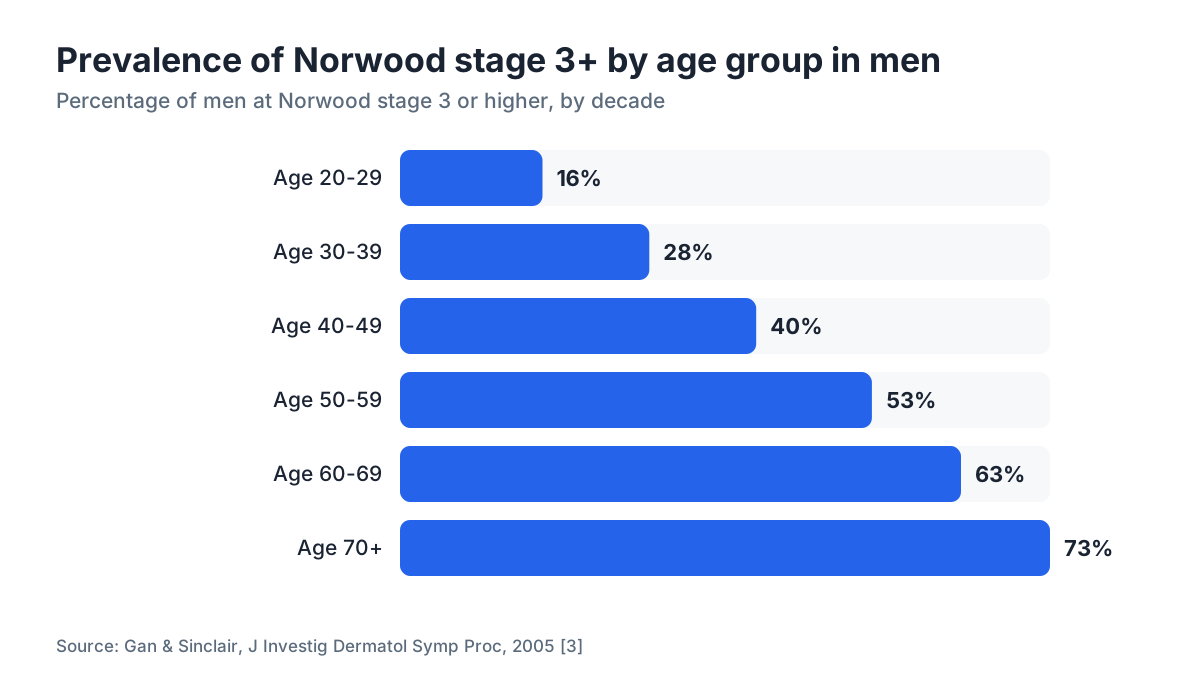
A 2005 prevalence study from Maryborough, Australia found that among men aged 40 to 49, roughly 40 percent had reached Norwood stage 3 or higher [3]. If you are in your late 30s or 40s and still have a full bridge, do not assume you are safe. Document your stage now, and recheck in 6 months.
Can women use this method to assess their hair loss?
The Norwood scale was built for men and maps the male pattern of temporal and vertex recession. Women almost always experience androgenetic alopecia differently: diffuse thinning over the crown that widens the center part, with the frontal hairline largely preserved. That is the Ludwig pattern.
Women can use the mirror-and-ruler method to measure part-width and crown density, but they should compare findings against the Ludwig scale, not Norwood. A healthy center part is typically 1 to 2 mm wide when hair is combed. A Ludwig Grade I shows visible widening of the center part. Grade II shows significant widening with less density overall. Grade III presents with near-complete frontal thinning [4].
Some women do show a Norwood-type recession pattern, particularly those with higher androgen levels. If you have noticeable temple recession alongside crown thinning, flag it to a dermatologist who specializes in hair loss. That presentation can have endocrine causes worth investigating beyond simple pattern baldness [4].
How accurate is self-staging compared to a clinical exam?
Honest answer: pretty accurate at the extremes, shakier in the middle.
Norwood 1 and 2 are easy to self-identify because you mostly need to decide whether recession is present at all. Norwood 6 and 7 are obvious to anyone. The tricky range is Norwood 3 to 5, where staging turns on the severity of crown involvement and the state of the bridge, both of which need good lighting and angles that are hard to replicate at home.
A 2017 study in the British Journal of Dermatology looked at inter-rater reliability of the Norwood scale among trained dermatologists and found moderate agreement (kappa around 0.5 to 0.6) [5]. Even professionals sometimes disagree by one stage. Your self-assessment is useful for tracking change over time and making broad treatment decisions. For surgical planning or clinical trials, a trained specialist is necessary.
To tighten your accuracy at home, take standardized photos every 3 to 6 months. Same lighting, same angles (front, both temples, and crown from directly above), same styling. Change over time tells you more than any single snapshot.
What does your Norwood stage mean for treatment options?
Your stage shapes which treatments are worth considering. Here is the honest breakdown.
Norwood 1 and 2: You may be in early androgenetic alopecia or you may just have a mature hairline. Finasteride and minoxidil for men get used at this stage mostly as prevention. If you are worried about a receding hairline, these are the stages when early treatment has the best odds of holding what you have.
Norwood 3 and 4: The evidence for both finasteride and minoxidil is strongest here. A 2-year placebo-controlled trial of finasteride (1 mg daily) found that 83 percent of men on the drug maintained or increased hair count versus 28 percent on placebo [6]. This is also where most surgeons say a hair transplant can give natural, lasting results with conservative graft counts. Read more about the finasteride and finasteride and minoxidil combination approach.
Norwood 5 and 6: Medications can still slow further loss, but the recoverable territory shrinks. Transplant surgery gets more complex because the donor supply on the sides and back has to cover a larger bald area. Most surgeons plan multiple sessions at this stage. Learn more about what a hair transplant involves at advanced stages.
Norwood 7: The permanent donor zone (sides and back of the head) is the only reliable hair source. Expectations need to stay realistic. Some men at this stage choose scalp micropigmentation over transplantation.
Whatever your stage, rule out non-androgenetic causes first. Telogen effluvium can mimic early crown thinning, and understanding what causes hair loss in your specific case matters before you spend money on anything.
DHT is the hormone that drives androgenetic alopecia. If you want the mechanism before you choose a treatment, the DHT blocker explainer covers it clearly.
How often should you recheck your Norwood stage?
Every 3 to 6 months during the first two years after you notice recession. Male pattern hair loss is progressive in most men, but the rate varies enormously. Some men move one Norwood stage every 5 years. Others jump two stages in under 18 months, especially men with a strong family history and early onset (before age 25).
If you are on finasteride or minoxidil, recheck at 6 months and 12 months to gauge response. The American Academy of Dermatology recommends at least 6 to 12 months of consistent use before you judge whether a treatment is working [7]. Patience is not optional here.
Build a habit: take a standardized overhead photo on the first day of each month. Front-facing, plus directly overhead. Store them in a labeled folder. You end up with objective evidence of change instead of bathroom-mirror impressions that shift with lighting and mood.
Myhairline.ai's free AI scan (/scan) can track photos over time and flag progression if you want an automated approach.
If you stage yourself at Norwood 4 or higher and have not yet talked to a board-certified dermatologist, that conversation is overdue. The AAD maintains a finder at aad.org.
Sources
- Norwood OT. Male pattern baldness: classification and incidence. South Med J. 1975;68(11):1359-1365.
- Headington JT. Transverse microscopic anatomy of the human scalp. Arch Dermatol. 1984;120(4):449-456.
- Gan DCC, Sinclair RD. Prevalence of male and female pattern hair loss in Maryborough. J Investig Dermatol Symp Proc. 2005;10(3):184-189.
- Ludwig E. Classification of the types of androgenetic alopecia (common baldness) in women. Br J Dermatol. 1977;97(3):247-254.
- Harries MJ et al. Reliability of the Hamilton-Norwood scale for grading androgenic alopecia in clinical practice. Br J Dermatol. 2017.
- Kaufman KD et al. Finasteride in the treatment of men with androgenetic alopecia. J Am Acad Dermatol. 1998;39(4):578-589.
- American Academy of Dermatology. Hair loss: diagnosis and treatment guidance.
- Olsen EA et al. A randomized clinical trial of 5% topical minoxidil versus 2% topical minoxidil and placebo in the treatment of androgenetic alopecia in men. J Am Acad Dermatol. 2002;47(3):377-385.
- Hamilton JB. Patterned loss of hair in man: types and incidence. Ann N Y Acad Sci. 1951;53(3):708-728.
- FDA. Minoxidil topical solution labeling.
- FDA. Finasteride (Propecia) product labeling.
- Lee WS, Lee HJ. Characteristics of androgenetic alopecia in Asian. Ann Dermatol. 2012;24(3):243-252.