
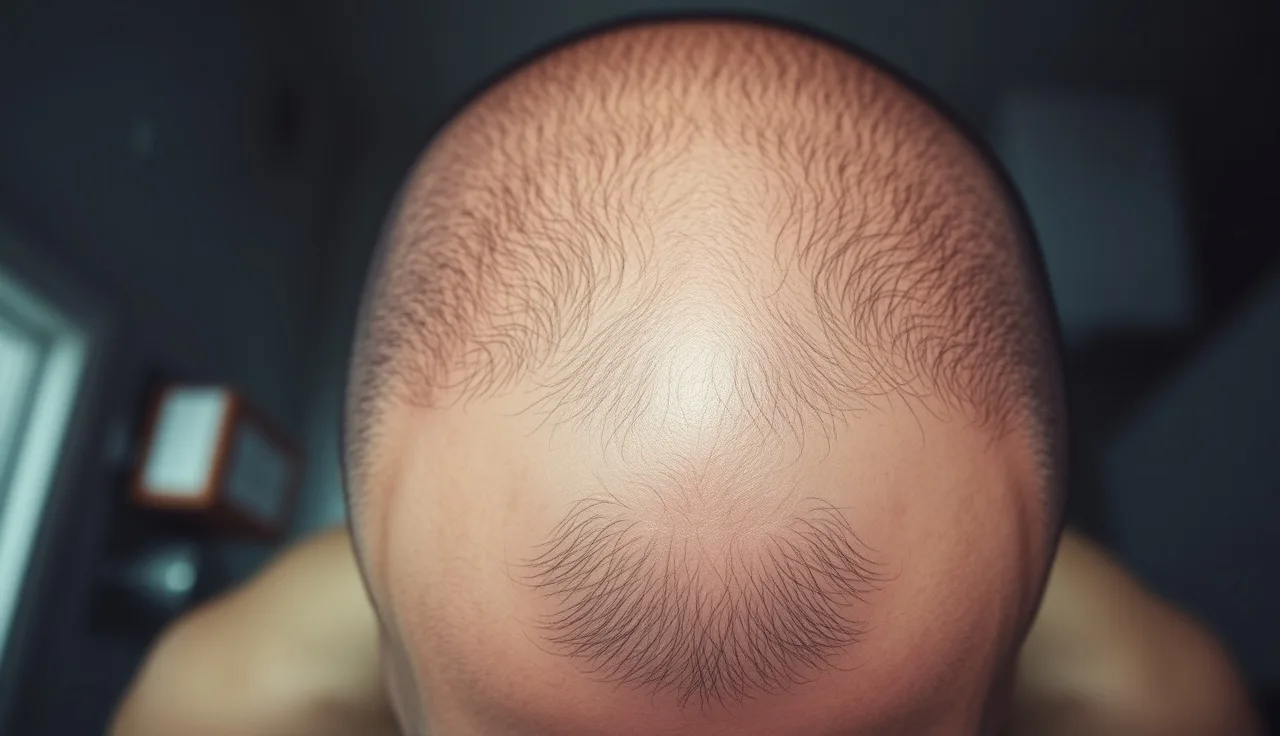
TL;DR: Norwood stage 4 is moderate-to-significant male pattern baldness: a deep M-shaped recession at the front combined with a bald patch at the crown, separated by a narrowing band of hair. You still have options. Finasteride can slow or stop further loss; minoxidil can thicken what remains. Hair transplants are viable but require careful donor planning at this stage.
What does Norwood stage 4 actually look like?
Norwood 4 sits roughly in the middle of the seven-stage scale that dermatologist James Hamilton published in 1951 and O'Tar Norwood revised in 1975 [1]. At this point you're past the early recession of stages 1 through 3 and well before the total crown loss of stages 6 and 7.
Two features define it. A deep horseshoe-shaped recession at the hairline, pulling back hard from the temples, plus a distinct bald patch at the crown (vertex). Between those two areas sits a band of hair that still crosses the top of the scalp, but it's visibly thinning and narrower than it was in earlier stages. That bridge is the key detail: in stage 5 it starts to break down; in stage 4 it holds, just barely.
There's also a variant called Norwood 4A. In the standard 4, the crown bald spot is separate from the frontal recession. In 4A, the recession sweeps straight back in a diffuse pattern without a distinct crown patch. The 4A pattern tends to leave fewer donor follicles available, which matters a lot if you're considering a hair transplant.
In photographs, stage 4 is the point where overhead lighting becomes unforgiving. You can no longer style your way around the loss with a simple part or product. That's not a vanity observation; it's a useful calibration for where you are on the scale and how urgently you may want to act on treatment.
How does stage 4 compare to other Norwood stages?
The table below maps all seven stages side by side so you can see exactly where 4 lands.
| Stage | Hairline | Crown | Bridge intact? | Typical age of onset |
|---|---|---|---|---|
| 1 | No recession | No loss | Yes | Teens/20s |
| 2 | Slight temples | None | Yes | 20s |
| 3 | Clear temples or vertex | Minor | Yes | 20s-30s |
| 3A/3V | M-shape or vertex spot | Early crown | Yes | 20s-30s |
| 4 | Deep M recession | Distinct crown patch | Yes, thinning | 30s-40s |
| 4A | Diffuse recession back | No distinct patch | Blurred | 30s-40s |
| 5 | Larger M | Larger crown | Narrow strip | 40s-50s |
| 6 | M joins crown | Extensive | Gone | 50s+ |
| 7 | Horseshoe only | Total top loss | Gone | 50s+ |
Approximately 40% of men show some degree of male pattern baldness by age 35, and that rises to roughly 65% by age 60 [2]. Stage 4 is common in the 35 to 50 range, though genetics can push it earlier or later.
One thing the scale doesn't capture: the density of hair remaining in the thinning zones. Two men can both be classified as stage 4 but have very different amounts of hair in that bridge area. That distinction matters enormously for treatment outcomes and transplant planning, so the Norwood stage is a starting point for a conversation, not a complete picture.
What causes hair loss to progress to stage 4?
The mechanism is the same one driving all stages of male pattern baldness (androgenetic alopecia): dihydrotestosterone, or DHT, binding to receptors in genetically susceptible hair follicles and shrinking them over successive growth cycles [3]. The follicles don't die outright. They miniaturize, producing progressively finer, shorter, and lighter hairs until they stop producing visible hair at all.
Your genetics determine both the overall pattern you'll follow and how fast you'll get there. The androgen receptor gene on the X chromosome is one of the most studied contributors, which is why people say you inherit the pattern from your mother's side. That's partially true, but the reality is messier: dozens of genetic variants across multiple chromosomes contribute to the risk [3].
DHT levels, testosterone-to-DHT conversion efficiency (controlled by the enzyme 5-alpha reductase), and scalp receptor sensitivity all vary by person. That's why two brothers with the same father can end up at very different Norwood stages at the same age.
If you want to understand the hormonal mechanics in more depth, see our explainer on dht blocker treatments, or start with the basics in what causes hair loss.
Can stage 4 hair loss be stopped or reversed?
Stopped, often yes. Reversed partially, sometimes. Fully reversed without a transplant, no.
The FDA has approved two treatments specifically for male pattern baldness: topical minoxidil and oral finasteride [4]. Both have real evidence behind them. Neither is a cure.
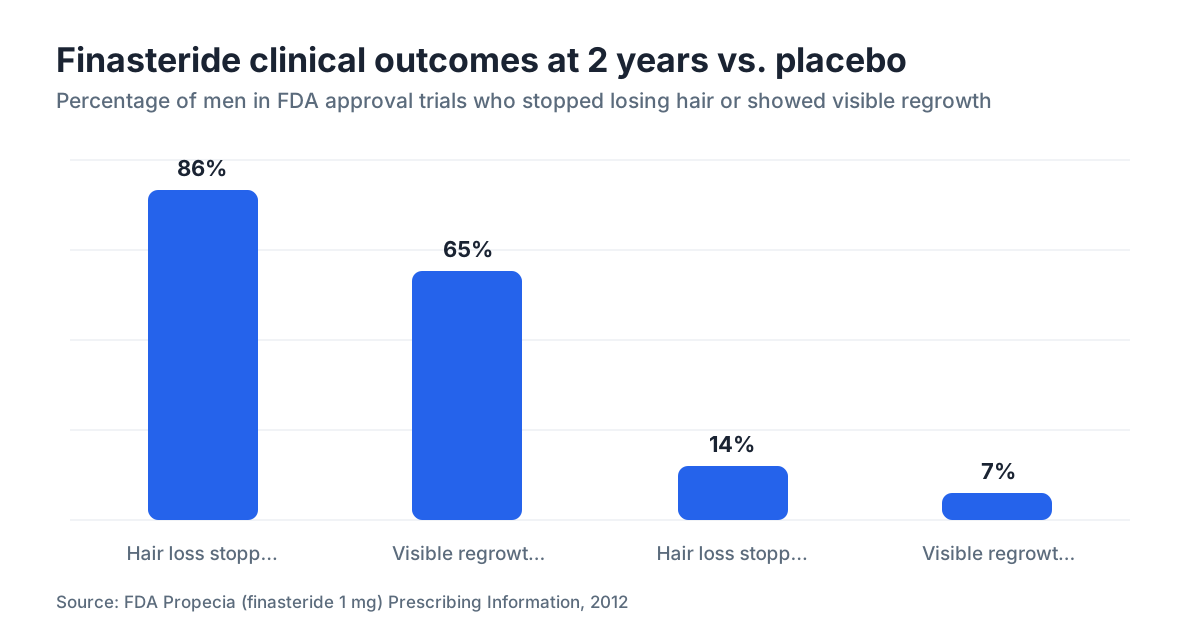
Finasteride (1 mg daily, brand name Propecia) works by inhibiting the 5-alpha reductase enzyme that converts testosterone to DHT. In the FDA approval trials, finasteride reduced scalp DHT by about 60% and stopped further hair loss in 86% of men over two years, with 65% showing visible regrowth [4]. That regrowth is real but usually modest at stage 4, because some follicles have already miniaturized past the point of recovery. The drug works best when started earlier. At stage 4 you've lost some of that advantage, but finasteride is still your most effective pharmacological tool for slowing progression.
Minoxidil (topical 5%, or the oral formulation) extends the anagen growth phase and increases follicle size. It doesn't address the hormonal cause of loss, so it works better as an adjunct to finasteride than as a standalone treatment at stage 4. The FDA-approved label for 5% topical minoxidil states it is "for use by men to regrow hair or slow further hair loss" [4]. Regrowth at stage 4 is possible in the thinning bridge area; the bald zones are harder. Learn more in our minoxidil for men guide.
Using both together is common and studied. One 2021 study in the Journal of the American Academy of Dermatology found the combination produced significantly greater hair density improvement compared to either agent alone [5]. Read about the combined approach in finasteride and minoxidil.
Nobody has clean long-term data on who will hold progress at stage 4 versus who will keep losing despite treatment. The honest answer: most men on finasteride slow down a lot, a minority stabilize completely, and a small fraction keep losing anyway.
Is a hair transplant a good option at stage 4?
Stage 4 is one of the most common entry points for transplant consultations, and it's a reasonable candidate stage, but it comes with real planning considerations.
A transplant moves donor follicles (typically from the permanent fringe zone at the back and sides of the scalp) to the thinning or bald areas. At stage 4, you have two target areas that need coverage: the frontal recession and the crown patch. The crown is demanding because it needs a large graft count and has a circular growth pattern that's hard to replicate naturally.
The donor supply problem is real. At stage 4 you still have reasonable donor density if your sides and back are strong, but you need to think about future loss. If you fill in the crown at stage 4 and then progress to stage 5 or 6, you'll have new bald areas and less donor hair left to address them. Experienced surgeons typically advise covering the frontal third first, and sometimes leaving the crown until your loss has stabilized on medication.
Graft counts for a stage 4 case typically run between 2,500 and 4,500 grafts depending on the size of the bald area, desired density, and whether both zones are being addressed [6]. Cost in the United States ranges widely, from roughly $4,000 to $15,000 or more for a case of this scale, depending on technique (FUT vs. FUE), clinic, and region [6].
Results take time. Transplanted hairs shed within 2 to 4 weeks, then regrow slowly. Most patients see mature results at 12 to 18 months post-procedure [6]. For a full breakdown of what the procedure involves and costs, see our hair transplant guide.
Myhairline.ai's free AI scan (/scan) can give you a quick read of your current Norwood stage and hairline pattern before you walk into a consultation, so you have a baseline reference.
What treatments are NOT worth your money at stage 4?
At stage 4 the urge to do something is strong, and the supplement and laser device market knows it.
Hair loss supplements with biotin, saw palmetto, or proprietary blends get marketed hard. The evidence is thin. Biotin deficiency is rare in men eating a normal diet, and supplementing it beyond sufficiency has no demonstrated hair benefit [7]. Saw palmetto shows weak DHT-inhibiting effects in some small studies but has never been compared head-to-head with finasteride in a rigorous trial at comparable doses.
Low-level laser therapy (LLLT) devices, combs, and helmets have FDA clearance (not approval) for hair loss, which means they cleared a safety review, not an efficacy one. The studies that exist are small, short, and industry-funded. At stage 4 with significant bald areas, no LLLT device is going to produce meaningful regrowth. As an adjunct, maybe. As a primary treatment at this stage, it's a stretch.
Platelet-rich plasma (PRP) injections are popular in clinics but the evidence is still inconsistent. A 2022 systematic review in Dermatologic Surgery found mixed results and noted that study quality was generally low [8]. It may help density in thinning areas, but the data don't support it as a standalone treatment for stage 4.
Shampoos marketed for hair loss are a waste of money if that's your only move. Ketoconazole shampoo (1% OTC, 2% prescription) has some limited evidence for reducing scalp DHT marginally, but the effect size is small and clinical studies are old. It's not a primary treatment.
For an honest breakdown of what evidence actually backs, see hair loss supplements.
How do doctors diagnose and confirm Norwood stage 4?
Diagnosing androgenetic alopecia at stage 4 is usually clinical: a dermatologist or hair loss specialist looks at your scalp pattern and matches it to the Norwood scale. There's no blood test or imaging that diagnoses the stage.
What a good clinician will also do is rule out other causes. Telogen effluvium (sudden diffuse shedding from stress, illness, or nutrient deficiency) can temporarily accelerate apparent hair loss and overlap with early pattern loss. A ferritin level, thyroid panel, and complete blood count are reasonable baseline labs if the presentation is ambiguous or the loss is unusually rapid.
Dermoscopy (a magnified look at the scalp) can show follicular miniaturization, perifollicular pigmentation, and anisotrichosis (hairs of very different diameters in the same area), all of which support the androgenetic diagnosis over other causes.
At a proper hair transplant consultation, the surgeon will assess donor density with either dermoscopy or a handheld densitometer, map the recession precisely, and often take standardized photographs in multiple lighting conditions. Those measurements drive graft count estimates and surgical planning far more than the Norwood stage number alone.
If you have a receding hairline and are trying to figure out your stage before seeing a doctor, overhead photos in natural light (not a mirror selfie) give the most accurate visual read.
What do finasteride and minoxidil actually do at stage 4 specifically?
Both drugs were studied across multiple Norwood stages in their FDA approval trials, so there is stage-specific data, though it's not always broken out cleanly in published summaries.
Finasteride's two-year Phase III trials showed that the drug's efficacy was strongest in men with vertex (crown) thinning compared to those with only frontal recession [4]. Stage 4, with its prominent crown patch, is therefore a relatively good candidate profile for finasteride. The drug can stop further crown enlargement in most users and sometimes produces visible crown density improvement over 12 to 24 months.
For the frontal recession at stage 4, finasteride is less dramatic. It tends to slow the march backward rather than recover significant hairline territory. That's a realistic expectation to have before you start.
Minoxidil's main contribution at stage 4 is thickening the hair in the remaining bridge zone, the area between the frontal recession and the crown patch. This area often has miniaturized but still-present follicles that respond to minoxidil by producing thicker, longer hairs. In the bald zones themselves, response is limited because the follicles are already dormant.
Oral minoxidil (low-dose, 0.625 mg to 2.5 mg daily) has emerged as an off-label option that some dermatologists now prescribe. A 2021 retrospective study in JAAD found meaningful hair density improvement in men at lower doses with fewer scalp side effects than topical formulations [9]. Our oral minoxidil article covers the evidence and side effect profile in detail.
Side effects matter when you're choosing a regimen. Finasteride carries a risk of sexual side effects (decreased libido, erectile dysfunction) in roughly 1 to 2% of users according to the FDA label, though post-marketing reports suggest the number may be higher in some populations [4]. Minoxidil's main risks are scalp irritation and, with oral formulations, fluid retention or unwanted facial hair growth. See minoxidil side effects for the full picture.
How fast does stage 4 progress without treatment?
There's no universal answer, because progression rate is largely genetically determined and varies widely between individuals.
The general pattern in untreated men: loss progresses fastest in the 20s and early 30s, then tends to slow (but not stop) through the 40s and 50s. Men who reach stage 4 by their mid-30s are more likely to eventually reach stage 6 or 7 than men who reach stage 4 at 50. Early arrival at a given stage is a signal of aggressive progression.
Family history is your best predictor. If your father and maternal grandfather both reached stage 6 or 7, you're at higher risk of significant ongoing progression. If male relatives stabilized at stage 4 or 5, that's a more favorable signal.
Without treatment, moving from stage 4 to stage 5 typically takes years, not months. But the timeline compresses under certain conditions: high physiological stress, illness, rapid weight loss, or medications that trigger shedding can accelerate apparent progression. This is where telogen effluvium can layer on top of baseline androgenetic loss and make things look worse faster than the underlying pattern alone would predict.
What does a realistic treatment plan look like at stage 4?
If you're at stage 4 and deciding what to do, here's how most evidence-based hair loss clinicians think about it.
Start with medication first if you haven't already. Finasteride at 1 mg daily is the foundation. If there are contraindications or you're worried about sexual side effects, discuss dutasteride (inhibits both isoforms of 5-alpha reductase) with your prescribing physician; it has stronger DHT suppression but is off-label for hair loss in the US [10]. Add topical 5% minoxidil twice daily or consider oral low-dose minoxidil.
Give medication at least 12 months before assessing regrowth. The first four months often involve a shedding phase as hairs cycle; this is normal and not a sign the treatment is failing.
After 12 to 18 months on medication, reassess. If you've stabilized, continue medication. If you want to address the remaining gaps surgically, that's when a transplant consultation makes sense, because the medication has given you a more stable base and the surgeon can plan around a predictable future loss trajectory.
Don't skip the medication step and go straight to surgery if you're 30 to 40 years old. A transplant without stopping underlying loss is expensive and eventually produces an unnatural result as the non-transplanted native hair keeps falling.
Some men also add ketoconazole shampoo or microneedling (dermarolling) as adjuncts. There's enough evidence that microneedling boosts minoxidil's effect to make it reasonable, though the protocol and needle depth matter [11]. Neither replaces the core pharmacological regimen.
At Myhairline, the free AI scan can map your recession pattern and estimate your stage as a starting reference before you see a dermatologist or hair restoration surgeon.
What should you ask a doctor at a stage 4 consultation?
Walking into a consultation better prepared means you get more useful information and you're less likely to be oversold on an expensive procedure before you've tried less invasive options.
Ask about your donor density and donor area quality. This is the most important variable for your transplant future, and a good consultant will have measured it or will measure it in front of you.
Ask whether the recommendation is to cover just the frontal zone or both frontal and crown. Be skeptical of any plan that promises complete crown coverage at stage 4 without discussing future loss risk.
Ask how many grafts are in the plan, and what graft count the surgeon considers the safe maximum to harvest from your donor area over your lifetime (most experienced surgeons estimate this at 6,000 to 8,000 grafts for an average donor, though it varies) [6].
Ask whether you're expected to continue medication after a transplant. The answer from any reputable surgeon should be yes, because the non-transplanted native hairs will keep being DHT-sensitive.
Ask about the surgeon's experience with stage 4 specifically, and ask to see unretouched before-and-after photos of patients at a similar stage with similar donor characteristics. Not a curated gallery on a website; actual patient comparisons.
Sources
- Norwood OT, 'Male pattern baldness: classification and incidence', Southern Medical Journal, 1975
- American Academy of Dermatology, Hair Loss
- Heilmann-Heimbach S et al., 'Meta-analysis identifies novel risk loci and yields systematic insights into the biology of male-pattern baldness', Nature Communications, 2017
- FDA Propecia (finasteride 1 mg) Prescribing Information
- Hu R et al., 'Combined treatment with oral finasteride and topical minoxidil in male androgenetic alopecia', Journal of the American Academy of Dermatology, 2021
- International Society of Hair Restoration Surgery, Practice Census
- National Institutes of Health Office of Dietary Supplements, Biotin Fact Sheet for Health Professionals
- Gupta AK et al., 'Platelet-rich plasma as a treatment for androgenetic alopecia', Dermatologic Surgery, 2022 systematic review
- Sinclair R et al., 'Oral minoxidil treatment for alopecia: a retrospective review', Journal of the American Academy of Dermatology, 2021
- Zhou Z et al., 'Dutasteride versus finasteride in men with androgenetic alopecia', comparative clinical evidence, PubMed
- Dhurat R et al., 'A randomized evaluator blinded study of effect of microneedling in androgenetic alopecia', Journal of Cutaneous and Aesthetic Surgery, 2013