TL;DR: Minoxidil drips when you apply too much at once, use the dropper on wet or freshly washed hair, or apply while standing upright too fast. Fix it by applying 1 mL at a time directly to a dry scalp in sections, keeping your head tilted slightly forward for 2-3 minutes, and switching to foam if liquid keeps running. Foam absorbs faster and is less likely to migrate.
Why does minoxidil keep running down your forehead?
Minoxidil solution is mostly propylene glycol, ethanol, and water. That combination is thin and flows exactly like water. When you squeeze too much out at once, it pools on the scalp surface before it can absorb, and then gravity does the rest.
The FDA-approved label for 5% minoxidil solution specifies a dose of 1 mL applied twice daily, which sounds small but is about 20 drops from a standard dropper [1]. Most people squeeze out more than that because the scalp looks dry and they want coverage. The extra liquid has nowhere to go except down your hairline.
Hair makes it worse, not better. If your hair is even slightly damp when you apply, the solution wicks along the shafts and spreads outward toward your temples and forehead. Sebum from an oily scalp does the same thing. The solution follows the path of least resistance, which is almost always off your head and onto your face.
Forehead skin is thin and absorbs propylene glycol well, which means you get facial redness, irritation, and sometimes a breakout pattern around the hairline that looks like acne but is actually a contact dermatitis reaction. A small percentage of users also notice unwanted facial hair growth in the areas where the liquid repeatedly runs [2]. That is not a rumor. It is a documented, dose-dependent effect that shows up more in women than men, and it is entirely avoidable with better technique.
How much minoxidil should you actually apply each time?
One mL. That is it. Not 1.5 mL because your vertex feels dry. Not 2 mL to speed results. One mL, twice a day, is the dose that produced statistically significant hair regrowth in the clinical trials that got 5% minoxidil approved, and doubling the dose in those trials did not double the results [1].
One mL from a standard dropper is roughly the size of a large pea sitting in your palm. If you have never measured it, do it once: fill the dropper to the 1 mL line and squirt it into a spoon. You will probably be surprised how little it is. That surprise is why most people over-apply.
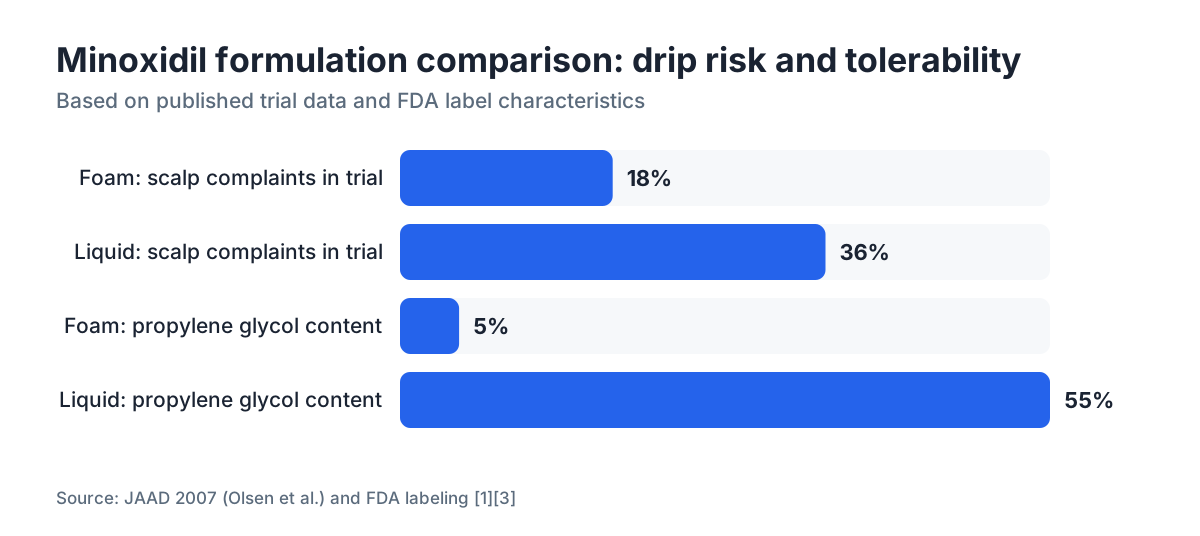
For foam, the dose is half a capful per application. Foam typically contains less propylene glycol than the liquid, which is part of why it drips less, but the active minoxidil concentration is the same [3]. The 2007 Rogaine foam study published in the Journal of the American Academy of Dermatology found equivalent efficacy between foam and solution at 24 weeks, with fewer scalp complaints in the foam group [3].
If you are using minoxidil for men at 5% concentration, the once-daily foam formulation is also approved, which cuts your total daily liquid load in half. Women's formulations are typically 2% solution or 5% foam; the 5% solution is not FDA-approved for women, though it is widely used off-label.
What application technique actually stops the dripping?
Sectioning is the single biggest fix. Instead of squirting all 1 mL onto one spot, divide your target area into four or five zones and apply a few drops to each. Let each mini-dose absorb for about 15-20 seconds before moving to the next section. The scalp soaks up small volumes almost immediately. It cannot keep up with a large pour.
Here is a step-by-step that works:
- Start with a completely dry scalp. If you showered, wait at least 30 minutes. Wet hair is the number-one cause of minoxidil migration.
- Tilt your head slightly forward over a sink or towel. Gravity becomes your friend instead of your enemy.
- Part your hair in the area you want to treat. Use the dropper tip to apply 4-5 drops directly onto the scalp skin, not the hair shaft.
- Move the part 1-2 cm and repeat. Three or four parts across a thinning crown or hairline will cover the zone without flooding any one spot.
- Use the dropper tip (or your fingertips if using foam) to spread gently. Not rubbing, just distributing.
- Stay tilted forward for at least 2 minutes. Gravity holds the solution against your scalp while it absorbs.
- Wash your hands thoroughly. Minoxidil absorbs through any skin it touches.
For foam, dispense half a capful onto your fingertips, not directly onto your scalp. The can is pressurized and will deliver too much at once if you try to apply it directly. Work it into the scalp in sections the same way.
One thing most people skip: the 4-hour rule. The FDA label says to let minoxidil dry for at least 4 hours before washing your hair or going to bed [1]. If you apply and then lie down immediately, it transfers to your pillowcase, your forehead, and your partner. Applying in the morning after breakfast rather than right before you leave is often the cleanest approach.
Is minoxidil foam less likely to drip than the liquid solution?
Yes, meaningfully so. Foam is an emulsion that turns into a liquid only when it warms on contact with your skin or fingertips. In the few seconds between dispensing and application, it stays as a foam and does not flow. That physical property alone eliminates most of the dripping problem.
Foam also contains far less propylene glycol than the standard solution. Propylene glycol is the main carrier that helps minoxidil penetrate, but it is also the main irritant for people who develop scalp redness or itching [4]. If you have been getting both dripping and irritation, switching to foam fixes both at once.
The tradeoff is cost. Foam is almost always more expensive per mL of minoxidil than liquid solution, especially generic brands. A 60-mL bottle of generic liquid 5% minoxidil typically runs $8-15 at major US retailers [prices vary; check current shelf pricing]. Foam in comparable volume often runs $20-35. The technique fix costs nothing.
If you want to understand the full minoxidil side effects profile before deciding on a formulation, that is worth reading separately. Dripping is a delivery problem, but some side effects are pharmacological and happen regardless of formulation.
Does it matter whether your hair is wet or dry when you apply?
Dry. Always dry. This is the instruction on the FDA label and it is there for two reasons [1].
Wet or damp hair shafts act as capillary tubes. Minoxidil solution wicks along them instantly and spreads far outside the target zone, including toward your face. The absorption rate also drops on wet skin, because the water creates a barrier between the minoxidil and the follicular openings. You end up with less drug reaching the follicle and more of it on your forehead.
Thirty minutes after a shower is probably the minimum safe waiting time for most people with thicker hair. If you have significant thinning and shorter hair, 20 minutes might be enough. The test is simple: run a finger across your scalp and if it comes away damp, wait longer.
Morning application after your hair has dried naturally overnight is about as close to ideal as most people can get. Evening application works too, as long as you give it the 4-hour window before bed. The gap between doses matters less than the consistency of taking them, according to the label guidance.
What should you do if minoxidil has already run onto your face?
Rinse the affected skin with plain water as soon as you notice. You do not need soap; water is enough to dilute and remove the surface liquid before much absorption happens. Pat dry, do not rub.
If you get regular low-level exposure, meaning it drips a little every time without you catching it, the skin around your hairline and temples will often turn chronically dry, slightly red, or bumpy. That is contact dermatitis from the propylene glycol, not an allergy to minoxidil itself in most cases [4]. Fixing the technique stops it. A short-term fragrance-free moisturizer helps the skin recover in the meantime.
Unwanted facial hair is a different problem. If you have been getting consistent minoxidil exposure on your cheeks or forehead for weeks or months, some degree of vellus hair (fine, light hair) may have started growing there. This is documented in clinical literature and is more common in women [2]. The good news is that it is reversible. Once you stop the exposure, the vellus hairs usually shed within 1-3 months as those follicles cycle back out of the anagen phase that the minoxidil stimulated. You do not need to stop minoxidil entirely, just stop getting it on your face.
Are there applicator tools that help with precision?
A few, though none are magic.
The dropper that comes with most liquid solutions is already reasonably precise if you use it at the scalp surface rather than holding it an inch above and letting it drip. Press the tip gently against a part in your hair and touch the scalp skin before you squeeze. The contact keeps the drop where you want it.
Syringe-style applicators with long, thin tips are sold separately and work well for people with a lot of remaining hair. The narrow tip can thread through hair and deliver drops directly to scalp skin. If you have used any dropper bottle eye drops before, the same principle applies.
Roller-ball applicators exist and some people swear by them for evenness, but they are harder to sanitize, tend to clog, and deliver inconsistent doses. The dropper with good technique beats them.
Foam applied with fingertips gives you the best tactile feedback of all the options. You can feel exactly where you are placing it and press it against the scalp rather than letting it sit on hair shafts. This is particularly useful for the hairline area, where precision matters most for avoiding forehead run-off.
If you are treating a receding hairline rather than the crown, precise application matters even more because the target zone is narrow and sits right at the border with forehead skin. The dropper-on-scalp technique with your head tilted forward is the most controllable approach there.
How long does minoxidil take to dry so it stops transferring?
Liquid solution takes between 2 and 4 hours to fully dry in most conditions, depending on how much you applied, your scalp temperature, ambient humidity, and air circulation. The FDA label states 4 hours as the minimum waiting period before washing [1]. That is conservative but honest.
Foam dries noticeably faster, often within 30-60 minutes for most users, because the water content is lower and it does not pool the way liquid does.
You can speed drying with a cool or low-heat setting on a hair dryer held at arm's length. Do not use high heat directly on the scalp. The point is to evaporate the water and ethanol carrier, not to bake your skin.
Sleeping with minoxidil that has not dried transfers it to pillowcases and from there to your face while you sleep. If you apply at night, give yourself the 4-hour window or use foam. Some people find a satin pillowcase reduces transfer even after the 4-hour mark because it is less absorbent than cotton.
If you are also taking finasteride and minoxidil together, the timing between the two does not interact, but giving the minoxidil time to dry before doing anything else in your routine keeps the product on your scalp where it belongs.
What if your scalp is too dry or too oily for minoxidil to absorb well?
Very dry, flaky scalps sometimes have a layer of dead skin or product buildup that acts as a barrier. Minoxidil sits on top instead of absorbing, and then it runs. A gentle salicylic acid shampoo used once or twice a week clears that buildup without over-stripping. Use it on days you are not applying minoxidil, or apply minoxidil at night and wash in the morning.
Oily scalps have the opposite problem. Excess sebum forms a water-repellent film that pushes water-based liquids to the edges of the scalp. If your scalp is visibly oily when you apply, a quick rinse with shampoo followed by full drying (30+ minutes) before application beats applying to an oily scalp.
A study published in the Journal of Investigative Dermatology found that scalp sulfotransferase enzyme activity is the main determinant of whether minoxidil converts to its active form (minoxidil sulfate) in the follicle [5]. That is a pharmacological variable you cannot easily change with technique, but sebum levels and dead skin buildup are things you can control. Worth addressing them first before you conclude the drug is not working for you.
If you are not sure whether your hair loss pattern is the kind that responds to minoxidil, a tool like the free AI hair analysis at MyHairline can help you figure out what you are actually dealing with before you commit to months of use.
Should you rub minoxidil in or just leave it?
Light spreading yes, vigorous rubbing no. The goal is to distribute the liquid across the target scalp zone without forcing it toward the edges where it can drip. Use the dropper tip or your fingertips to spread gently within the treated area.
Vigorous rubbing does two things you do not want: it pushes the liquid outward toward the hairline and forehead, and it can cause temporary scalp inflammation in some people. The liquid does not need mechanical help to absorb. Propylene glycol and ethanol are already good penetration enhancers [4].
For the scalp crown, spreading in small circles within the zone works well. For the hairline, a gentle patting motion to press the liquid against the skin is more controlled than rubbing. Stop at the hairline; do not continue the motion onto forehead skin.
Hands must be washed after. Not rinsed, washed. Minoxidil absorbs through palmar skin and low-level systemic absorption from hand contact is real, even if the doses are small [1].
Is oral minoxidil a better option if topical keeps causing problems?
It depends on why topical is causing problems. If the issue is purely application difficulty, run-off, and forehead irritation, fixing the technique almost always solves it and oral minoxidil is not necessary. But if you have tried every technique correction and still fight constant scalp irritation or impractical lifestyle constraints, oral is worth knowing about.
Oral minoxidil is not FDA-approved for hair loss (it is approved only for hypertension at much higher doses), but dermatologists widely prescribe it off-label in the 0.625-5 mg daily range for hair loss. A 2021 review in the Journal of the American Academy of Dermatology reported meaningful hair density improvement at 6 months with once-daily oral low-dose minoxidil [6].
The side effect profile is different with oral dosing. Fluid retention, heart rate changes, and body hair growth are more common than with topical, because the systemic exposure is higher. The American Academy of Dermatology recommends topical as the first-line route and oral only when topical is not tolerated or not effective [7].
The AAD guidance recommends topical minoxidil as a first-line treatment for androgenetic alopecia in both men and women [7]. That position reflects the weight of evidence and should anchor your decision. Try fixing topical application first. Oral is not simpler; it is just a different set of tradeoffs.
For people whose hair loss is partly driven by DHT and not responding to minoxidil alone, combining with a DHT blocker is often more productive than switching delivery routes.
How do you know if the dripping has been reducing minoxidil's effectiveness?
Honest answer: it is hard to know for certain. If you have been applying for 3-6 months with significant run-off, you were almost certainly delivering less than the full 1 mL dose to the scalp, because some percentage of each application ended up on your face or hairline skin rather than the follicle-dense scalp.
Under-dosing is one of the most common reasons minoxidil appears to fail in the first six months. The clinical trials used controlled topical application by trained staff. Real-world application is messier. A 2022 review in Dermatology and Therapy noted that poor technique and inconsistent application are underappreciated reasons for suboptimal outcomes in real-world minoxidil use [8].
If you have been at it for 6 months with run-off problems and seen little change, fixing technique and giving it another 4-6 months with proper application is a legitimate step before you conclude minoxidil does not work for you. The FDA trial data showed meaningful improvement at 16-24 weeks under controlled conditions [1]. The clock may have been running with degraded doses.
Shedding in the first 2-3 months of use is a known phenomenon (telogen effluvium triggered by the shift in follicle cycling) and is not a sign of failure [see telogen effluvium]. If you stopped because of early shedding, that is a different issue from technique. What causes hair loss in the first place matters here too; what causes hair loss is worth reading if you are not sure whether androgenetic alopecia is actually your diagnosis.
If you want an objective look at your hairline before and after technique correction, the free AI scan at MyHairline can give you a baseline to measure against.
Sources
- FDA, Rogaine 5% Minoxidil Topical Solution Label (DailyMed / accessdata.fda.gov)
- Messenger AG, Rundegren J. Minoxidil: mechanisms of action on hair growth. British Journal of Dermatology. 2004;150(2):186-194.
- Olsen EA et al. A randomized clinical trial of 5% topical minoxidil foam versus vehicle. Journal of the American Academy of Dermatology. 2007;57(5):767-774.
- Friedman ES, Friedman PM, Cohen DE, Washenik K. Allergic contact dermatitis to topical minoxidil solution: etiology and treatment. Journal of the American Academy of Dermatology. 2002;46(2):309-312.
- Buhl AE et al. Minoxidil sulfate is the active metabolite that stimulates hair follicles. Journal of Investigative Dermatology. 1990;95(5):553-557.
- Randolph M, Tosti A. Oral minoxidil treatment for hair loss: A review of efficacy and safety. Journal of the American Academy of Dermatology. 2021;84(3):737-746.
- American Academy of Dermatology, Hair Loss: Diagnosis and Treatment Guidelines
- Gupta AK, Venkataraman M, Talukder M, Bamimore MA. Relative efficacy of minoxidil and the 5-alpha reductase inhibitors in androgenetic alopecia treatment. Dermatology and Therapy. 2022;12(2):287-302.
- MedlinePlus (U.S. National Library of Medicine), Minoxidil Topical drug information
- U.S. National Library of Medicine, DailyMed labeling database (minoxidil topical)