

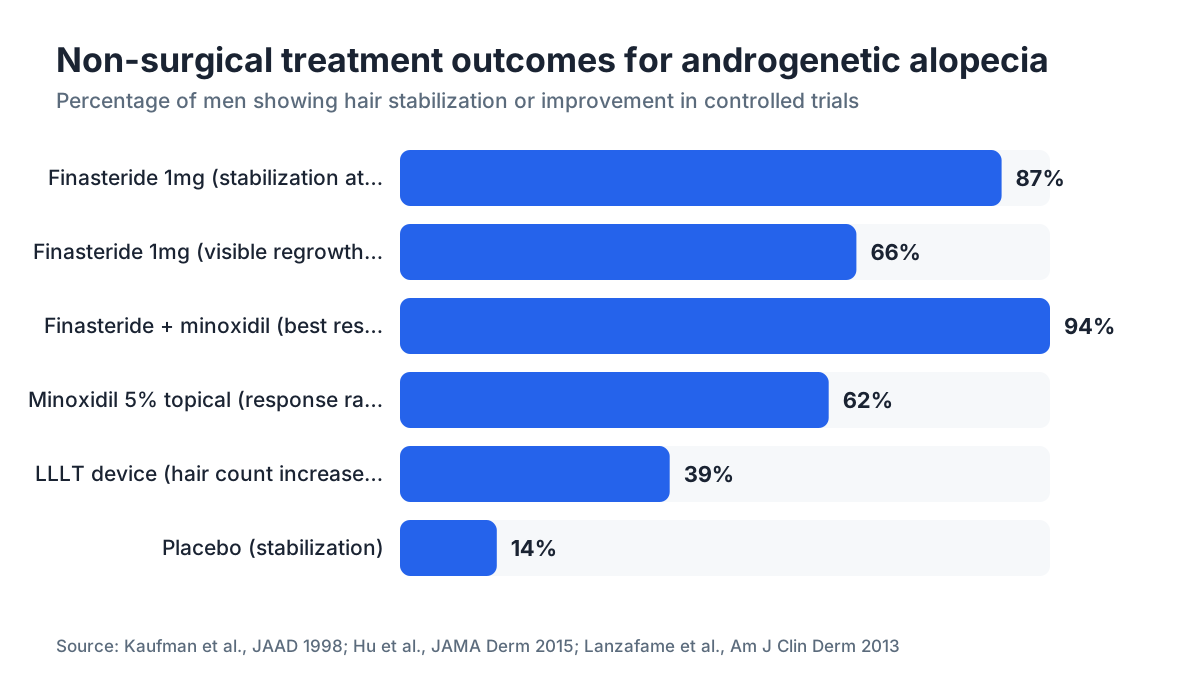
TL;DR: A Norwood 3 hairline is one of the most treatable stages without surgery. Finasteride halts further loss in roughly 87% of men and produces visible regrowth in about two-thirds. Minoxidil adds density at the temples and crown. Used together, they reverse measurable loss for a large share of men. No non-surgical treatment is guaranteed, and results depend heavily on how long you've been losing hair.
What does a Norwood 3 hairline actually look like?
The Norwood-Hamilton scale is the standard classification for male pattern hair loss, running from Type 1 (no recession) to Type 7 (near-total loss on top). A Norwood 3 sits at the third rung: deep recession at both temples forming an M or U shape, with the remaining forelock often thinning at the center. The temples may reach back to or past an imaginary vertical line through the outer corner of the eye. [1]
Norwood 3 also has a sub-type: Norwood 3 Vertex, where recession at the temples is accompanied by thinning at the crown. That matters for treatment planning because the crown and temples respond somewhat differently to the same medications.
This is the stage where a lot of men first admit something is happening. The hairline is clearly not where it was in high school, but the loss isn't catastrophic. Hair density on top is usually still reasonable. That's actually good news, because the follicles that remain are mostly alive and can respond to treatment. The further along the Norwood scale you go, the more follicles have permanently miniaturized and the harder non-surgical options work.
What causes a Norwood 3 hairline to recede?
Almost all Norwood 3 hairlines are driven by androgenetic alopecia (male pattern baldness). The mechanism is well understood: dihydrotestosterone (DHT), a byproduct of testosterone converted by the enzyme 5-alpha reductase, binds to androgen receptors in scalp follicles. In genetically susceptible men those follicles respond by producing progressively thinner, shorter hairs over successive growth cycles until they stop producing terminal hair entirely. [2]
Genetics sets the susceptibility. If your father and maternal grandfather both went significantly bald, your risk is high, but inheritance doesn't follow a simple pattern. DHT levels vary by individual too, which is part of why two brothers with similar genetics can end up at different Norwood stages at the same age.
Other things can push the hairline back faster. Chronic stress, significant calorie restriction, thyroid problems, and iron deficiency can all trigger telogen effluvium, a temporary shed that makes androgenetic alopecia look worse than it structurally is. Ruling those out with a basic blood panel (ferritin, TSH, CBC) before committing to a treatment plan is worth doing. You can read more about the full picture of what causes hair loss if you want the longer version.
Can finasteride stop a Norwood 3 from getting worse?
Yes, and it's the single most effective non-surgical tool available. Finasteride 1 mg daily inhibits type II 5-alpha reductase, cutting scalp DHT by roughly 60-70%. The clinical trials published in the Journal of the American Academy of Dermatology found that 83-87% of men taking finasteride stopped losing hair over two years, and about 66% showed measurable regrowth. Men on placebo continued to lose hair. [3]
A five-year follow-up of those same trials showed sustained benefit: 90% of finasteride users maintained or improved their hair count, versus continued decline in the placebo group. [3]
For a Norwood 3, that's meaningful. The recession you have doesn't necessarily deepen. Some men see the temples partially fill back in. Regrowth tends to be more modest at the temples than at the crown, but it happens.
Finasteride requires a prescription in the United States. It takes three to six months before you see any change, and the full benefit isn't visible until twelve months. Stop taking it and DHT rebounds, and hair loss resumes, usually within six to twelve months. That's the honest trade-off: this is a long-term commitment, not a course of treatment you finish. Read the detailed breakdown in our finasteride guide before starting, and talk to a doctor about whether the sexual side effect profile (affecting roughly 1-2% of users in trials) is acceptable for you. [3]
Does minoxidil actually regrow temple hair at Norwood 3?
Minoxidil is FDA-approved for hair loss, specifically as a topical solution at 2% and 5% concentrations. It works as a vasodilator and appears to prolong the anagen (growth) phase of the hair cycle. The FDA label for the 5% topical foam states the product is for "hereditary hair loss at the vertex of the scalp" in men. [4] Temple coverage is technically off-label, which doesn't mean it fails there, but it does mean the controlled trial data is thinner for the hairline than for the crown.
Practice experience and smaller studies suggest minoxidil does produce some improvement at the temples, particularly when recession isn't fully established (meaning follicles are still producing miniaturized vellus hairs rather than being completely dormant). At Norwood 3, that's often still the case.
Topical 5% minoxidil applied twice daily is the standard starting point. Oral minoxidil at low doses (0.625 mg to 2.5 mg) has gained traction as an alternative because application is easier and systemic absorption may reach follicles that topical application misses. A 2021 systematic review in the Journal of the American Academy of Dermatology found oral minoxidil effective for androgenetic alopecia at doses as low as 0.25 mg, with a favorable side effect profile at low doses. [5] Our oral minoxidil and minoxidil for men articles cover the dose differences in detail.
Expect the same timeline as finasteride: nothing visible for three to four months, real results around six months. Shedding in the first four to eight weeks is normal and reflects follicles entering a new growth cycle. And yes, like finasteride, you stop the drug and you lose the benefit.
What happens when finasteride and minoxidil are used together?
The combination beats either drug alone, and the evidence base is solid. A randomized controlled trial published in JAMA Dermatology compared four groups: finasteride only, minoxidil only, both together, and placebo. The combination group showed the greatest improvement in hair count and global photographic assessment at six months. [6]
Mechanically this makes sense. Finasteride removes the hormonal signal that's shrinking follicles. Minoxidil stimulates those same follicles to grow. They work on different pathways, so there's genuine additive benefit.
For a Norwood 3 man who starts both treatments early, it's reasonable to expect stabilization with a realistic shot at partial regrowth at the temples over twelve to eighteen months. "Fixable" in the sense of returning to a Norwood 1 hairline? Unlikely for most people. "Fixable" in the sense of halting progression and recovering meaningful density? Achievable for a large proportion of men. See our finasteride and minoxidil guide for dosing logistics and what to do if you get side effects from one but not the other.
How effective are non-drug options like laser therapy and PRP?
Two non-drug options have more than anecdotal evidence behind them: low-level laser therapy (LLLT) and platelet-rich plasma (PRP) injections.
LLLT devices (helmets, combs, caps) emit red light at wavelengths around 650-670 nm and appear to stimulate follicle metabolism. The FDA has cleared several devices for hair loss (clearance, not approval, meaning safety was evaluated but efficacy evidence is limited). A 2013 randomized trial in the American Journal of Clinical Dermatology found a 39% increase in hair count with an LLLT device versus placebo in men and women. [7] The effect is real but modest next to finasteride or minoxidil. LLLT is best used as an add-on, not a standalone treatment.
PRP involves drawing your blood, spinning it to concentrate platelets and growth factors, and injecting it into the scalp. It's not FDA-approved for hair loss, and the trial quality is inconsistent. A 2019 meta-analysis in Dermatologic Surgery reviewed multiple studies and found improvements in hair density and thickness, but noted high heterogeneity and lack of standardized protocols. [8] Results vary a lot by clinic and by individual. Cost runs $500 to $1,500 per session, and multiple sessions are typically needed. For a Norwood 3 man on a budget, medications come first.
Ketoconazole 2% shampoo has modest evidence as an adjunct. A small study found it comparable to minoxidil 2% in hair count changes, though that evidence base is thin. It's cheap, low-risk, and not unreasonable to add two or three times per week if you're already doing everything else. DHT blocker supplements like saw palmetto and biotin have far weaker evidence. Our hair loss supplements article goes through what's supported versus what's marketing.
How long does it take to see results without surgery?
This is the question that trips people up the most. The honest answer: plan for twelve months before you can fairly judge whether a non-surgical regimen is working.
Here's the rough timeline for finasteride plus minoxidil:
- Months 1 to 3: Nothing visible. Some people notice increased shedding from minoxidil, which is alarming but normal.
- Months 3 to 6: Shedding normalizes. Some users start to notice baby hairs or a reduced rate of loss.
- Months 6 to 12: The main window for visible regrowth. Photos taken at month 6 and month 12 are usually more informative than mirror checks.
- Months 12 to 18: Additional gradual improvement possible. Maximum benefit is usually reached somewhere in this range.
Patience is not optional. Men who quit at month four because they don't see results are doing exactly the wrong thing. The treatments are working below the surface before they're visible above it.
If you want an objective way to track, take standardized photos in the same lighting, same position, every four weeks. Or use a tool like the free AI analysis at MyHairline to get a baseline Norwood assessment you can compare against later. Subjective bathroom-mirror checks are genuinely unreliable.
When is a hair transplant still the better answer at Norwood 3?
Non-surgical treatments are not the right answer for every Norwood 3 man. A transplant may be the better primary choice if:
You've already been on finasteride for twelve or more months with no stabilization and continued recession. Medications that aren't working aren't going to suddenly start working.
You have a fast-progressing family history and you're under 25. Young men with aggressive loss patterns are tricky transplant candidates (more on this below), but the point is that medications alone may not keep pace.
You have significant thinning at the temples with follicles that are fully miniaturized and not responding to minoxidil. Dead follicles don't respond to drugs. A dermatologist can often assess this with a dermoscopy exam.
You simply want a faster, more definitive result and you're financially prepared for it. A Norwood 3 transplant typically requires 1,500 to 2,500 grafts to restore the temples, costing roughly $4,000 to $10,000 depending on technique (FUT vs. FUE) and geography. [9]
One caveat for young men: most experienced surgeons are reluctant to transplant a patient under 25 who's at Norwood 3 without a stable pattern and a plan to continue medication. If your natural loss continues after a transplant, you can end up with transplanted hair at the temples surrounding a progressively balding crown. That looks worse than the original problem. Our hair transplant article covers candidacy in detail.
The ideal for most Norwood 3 men is: start medications first, give them twelve months, then reassess. If you're stable and happy, you may never need surgery. If you're stable but want better density, a small transplant with continued medication backup is a reasonable next step.
Is a Norwood 3 hairline fixable for women too?
The Norwood scale is designed for men. Women rarely lose hair in the frontal M-shaped recession pattern; female pattern hair loss typically presents as diffuse thinning on the crown with a preserved frontal hairline (classified by the Ludwig scale). That said, women can recede at the temples, and some do reach a pattern that resembles Norwood 3.
For women, finasteride is not FDA-approved for hair loss and is contraindicated in women of childbearing potential due to teratogenicity. [10] Some dermatologists prescribe it off-label for post-menopausal women. Minoxidil 2% topical is FDA-approved for women; the 5% concentration is used off-label with dermatologist supervision. Spironolactone, an androgen blocker, is commonly used off-label in pre-menopausal women with androgenetic alopecia.
The bottom line: if you're a woman with recession resembling Norwood 3, the treatment options differ meaningfully from those for men, and a dermatologist visit matters more before starting anything.
What's the realistic honest verdict on fixing a Norwood 3 without surgery?
Here's a straight answer: Norwood 3 is the sweet spot for non-surgical treatment. You're losing hair, but not so much that the follicular infrastructure is gone. The medications we have work well at this stage.
Finasteride plus minoxidil gives most men a realistic shot at stopping the recession and recovering partial density at the temples. "Fixing" the hairline back to Norwood 1 is rare. Stopping it at Norwood 3 and possibly pulling it back to something closer to Norwood 2? That happens for a meaningful percentage of men who start early and stay consistent.
The treatments that don't work well: supplements with no serious trial evidence, shampoos that claim to block DHT systemically, and any topical product that doesn't include minoxidil or a clinically validated DHT inhibitor. Those are mostly a waste of money.
The honest ceiling: medications stop working for some people, and some people can't tolerate them. If you're one of those, surgery becomes the path to an actually restored hairline. But for most men reading this at Norwood 3, the right first move is a doctor visit, a prescription, and twelve consistent months. The answer usually becomes clear by then.
If you want to know exactly where you stand before booking a dermatologist, the free AI hair analysis at MyHairline can classify your current Norwood stage from photos and give you a baseline to work from.
Sources
- American Academy of Dermatology, Hair Loss Types: Alopecia
- National Library of Medicine, StatPearls: Androgenetic Alopecia
- Kaufman KD et al., Journal of the American Academy of Dermatology 1998; finasteride 1mg two-year and five-year trial results
- FDA, Rogaine (minoxidil 5% topical foam) prescribing information
- Randolph M, Tosti A, Journal of the American Academy of Dermatology 2021; oral minoxidil systematic review
- Hu R et al., JAMA Dermatology 2015; randomized controlled trial comparing finasteride, minoxidil, combination, and placebo
- Lanzafame RJ et al., American Journal of Clinical Dermatology 2013; LLLT randomized controlled trial
- International Society of Hair Restoration Surgery, Practice Census 2022
- FDA, Propecia (finasteride 1mg) prescribing label
- Caserini M et al., Journal of the American Academy of Dermatology 2016; topical finasteride randomized trial