TL;DR: Yes, topical minoxidil is FDA-approved for women at the 2% concentration and is generally safe for long-term use. The 5% formulation is used off-label and works better but carries a higher risk of unwanted facial hair. Oral minoxidil is also used off-label. Women who are pregnant or trying to conceive should not use minoxidil in any form.
What is minoxidil and how does it work in women?
Minoxidil started as a blood pressure pill in the 1970s. Patients on the oral version kept growing hair in places they weren't expecting, and researchers noticed. By 1988, the FDA approved a topical 2% solution for men, and a 2% formula specifically for women followed in 1991 [1]. The mechanism isn't fully understood even now, but the leading explanation is that minoxidil (or its active metabolite minoxidil sulfate) prolongs the anagen, or growth, phase of the hair cycle and widens miniaturized follicles [8].
Women lose hair differently than men. Female pattern hair loss (also called androgenetic alopecia or FPHL) usually shows as diffuse thinning across the top of the scalp, not a receding hairline in the classic M-shape. The Ludwig scale, rather than the Norwood scale, is the standard way to grade it. Minoxidil addresses the biology of miniaturizing follicles regardless of sex, which is why it works for both.
One thing that matters more in women than men: a good share of women are poor metabolizers of minoxidil. The drug needs the enzyme sulfotransferase (SULT1A1) in scalp follicles to convert into its active form. Studies suggest roughly 30 to 40 percent of people have low SULT1A1 activity and may see limited topical response [2]. If you've used topical minoxidil faithfully for 12 months and seen almost nothing, this could explain why, and it's worth a conversation with a dermatologist about oral minoxidil instead.
For a broader look at why hair thins in the first place, what causes hair loss is a good starting point before you commit to any treatment.
Is topical minoxidil FDA-approved for women?
Yes. The FDA approved Rogaine for Women (2% minoxidil topical solution) in 1991, making it one of only two drugs with an FDA indication for female pattern hair loss [1]. The approval was specifically for women with androgenetic alopecia at the vertex (crown) of the scalp.
The 5% topical solution and 5% foam are approved for men, not women. So when dermatologists recommend 5% to women, that is off-label prescribing, which is legal and common. The American Academy of Dermatology (AAD) guidelines on female pattern hair loss do name 2% minoxidil as a first-line treatment and acknowledge that 5% is frequently used [3].
Oral minoxidil is also off-label for hair loss in women. It was never studied or approved for that purpose, though its use has grown substantially since around 2020 as low-dose data emerged. You can read more about the oral route in detail over at oral minoxidil.
The practical takeaway: 2% topical is the only version with a direct FDA green light for women. Everything else is supported by evidence but used outside the approved label.
What do clinical trials say about safety in women?
The trials submitted for the 1991 FDA approval used 2% minoxidil twice daily versus placebo. A 32-week randomized controlled trial found that 13% of women using 2% minoxidil had minimal hair regrowth, 50% had moderate regrowth, and the drug was well-tolerated with mostly scalp-related side effects like dryness and irritation [1].
A later head-to-head trial compared 2% solution twice daily against 5% solution once daily in women. The 5% group showed greater increases in non-vellus hair count, and side effect profiles were similar except for a higher rate of hypertrichosis (unwanted facial hair) in the 5% group: about 3 to 5% of participants reported it, compared to under 1% with 2% [4].
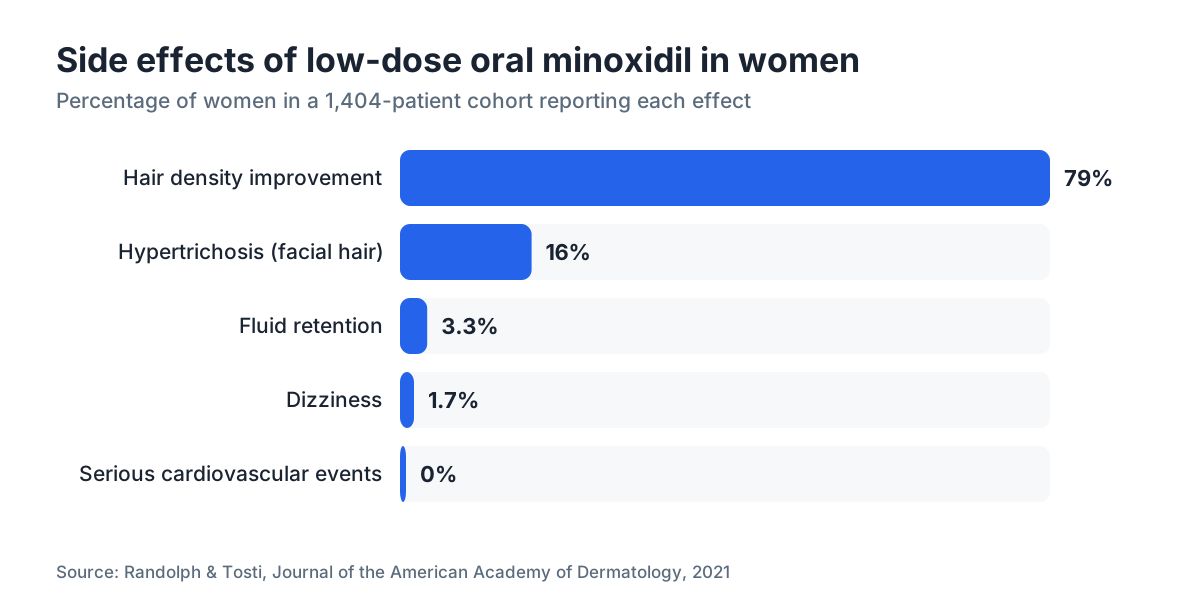
For oral minoxidil at low doses (0.25 mg to 2.5 mg daily), a 2021 retrospective study of 1,404 women published in the Journal of the American Academy of Dermatology found that 79% had improvement in hair density with the most common side effects being hypertrichosis (16%), fluid retention (3.3%), and dizziness (1.7%) [5]. No serious cardiovascular events were recorded in that cohort, though the study was retrospective and follow-up periods varied.
Long-term safety data beyond five years is thinner than you'd hope. Most trials run 24 to 48 weeks. The drug has been on the market for more than 30 years, however, and dermatologists have used it in women throughout that time without signals of serious systemic harm emerging at recommended topical doses.
Wanting to know more about the full side effect profile? The minoxidil side effects article covers both topical and oral in depth.
What are the real risks and side effects women should know about?
Let's be honest about what actually happens versus what's theoretical.
Hypertrichosis is the most common complaint. Unwanted hair growth, usually fine and light, can appear on the face, forehead, and occasionally the cheeks. It's more common with 5% than 2%, more common with oral than topical, and it usually fades when you stop. Some women find it maddening; others barely notice.
Shedding in the first 2 to 8 weeks is not a side effect in the alarming sense; it's the drug cycling out resting hairs to make room for new growth. If you stop because of early shedding, you've quit before the treatment had a chance to work. This is maybe the most common reason women abandon minoxidil too soon. If shedding continues past the 12-week mark and is heavy, that warrants a check-in with a doctor because you may be dealing with telogen effluvium on top of pattern loss.
Scalp irritation, dryness, and contact dermatitis occur in a small percentage of users. The propylene glycol in the liquid solution is usually the culprit. The foam versions use less of it, which is why some women with sensitive scalps do better with foam.
Systemic absorption from topical minoxidil is low. Blood pressure effects at 2% or even 5% topical doses are generally not clinically significant in healthy adults. That said, women who already have low blood pressure, use antihypertensive medications, or have heart disease should get a doctor's sign-off before starting, because any systemic absorption adds to existing pharmacological load.
Oral minoxidil carries more systemic risk than topical. Fluid retention and pericardial effusion are rare but real at higher doses. At the 0.25 to 2.5 mg range used for hair loss, the risk is much lower than at the antihypertensive doses of 10 to 40 mg, but it's not zero. A baseline blood pressure check and an EKG are reasonable before starting oral, particularly if you're over 50 or have any cardiac history.
Who should not use minoxidil?
Pregnant women. Full stop. Minoxidil is classified as FDA Pregnancy Category C (under the older system) and is associated with fetal harm in animal studies [1]. The FDA label for the women's product explicitly states it should not be used during pregnancy. If you become pregnant while using minoxidil, stop immediately and talk to your OB.
Women trying to conceive should also stop. The drug can remain in systemic circulation, and the safest approach is to discontinue before you start trying.
Breastfeeding is another contraindication. Minoxidil passes into breast milk. The FDA label recommends against use while nursing.
Women with scalp conditions, open wounds, or severe sunburn on the scalp should wait until the skin is healed. Absorption increases dramatically through compromised skin, which raises the risk of systemic effects.
Women with known cardiac conditions, especially those involving fluid retention, need medical clearance first. This applies most to oral minoxidil, but topical use should also be discussed with a cardiologist in these cases.
Women who are allergic to minoxidil or to propylene glycol (in liquid formulations) should avoid those forms. The foam is an option for propylene glycol sensitivity, but true minoxidil allergy means no form is appropriate.
Is 5% minoxidil safe for women, or should women stick to 2%?
Both concentrations are physically safe for most women. The question is tradeoffs.
The 5% strength produces better hair counts. A 2004 randomized controlled trial comparing the two found statistically significant advantages for 5% in total hair count at 48 weeks, without a meaningfully different systemic safety profile [4]. The hypertrichosis rate was higher, roughly three to five times more common than with 2%.
So if facial hair growth is something you'd find very distressing, starting at 2% makes sense. If your hair loss is significant and you're willing to manage some facial fuzz (which laser hair removal handles well), 5% gets you there faster.
Dermatologists who specialize in hair loss frequently start women at 5% foam once daily instead of 2% solution twice daily. Once daily is easier to stick to, the foam dries faster, and the hypertrichosis risk is lower than twice-daily 5% liquid. This isn't an officially studied regimen in the same way the trials were designed, but it reflects real clinical practice.
If you're considering how minoxidil compares to other options, the combination approach is covered in finasteride and minoxidil, though finasteride is used much more cautiously in women of reproductive age.
| Formulation | Approved for women? | Typical dose | Hypertrichosis risk | Evidence strength |
|---|---|---|---|---|
| 2% topical solution | Yes (FDA) | Twice daily | Low (<1%) | RCTs, FDA approval |
| 5% topical solution | Off-label | Once or twice daily | Moderate (3-5%) | RCTs |
| 5% topical foam | Off-label | Once or twice daily | Moderate | Observational + RCT |
| Oral 0.25-2.5 mg | Off-label | Once daily | Moderate (16%) | Retrospective cohort |
How long does minoxidil take to work, and how do you know it's working?
Expect nothing useful for the first two to three months. That's not a sign it's failing; that's how the hair cycle works. Follicles need to complete a cycle before new terminal hairs become visible.
Most women who respond see meaningful improvement between months four and six. The clinical trials showed continued improvement through 48 weeks in responders, which is why most dermatologists ask you to commit to a full year before deciding it isn't working.
The simplest way to track progress is to take a photo of your part line every four weeks under identical lighting. Subjective perception is unreliable because the change is gradual. Hair counts, scalp biopsies, and trichoscopy are clinical tools, but the at-home photo method catches the trend well enough to know whether you're responding.
One realistic caution: minoxidil maintains hair you keep and can regrow some of what you've lost, but it doesn't reverse advanced loss to the density you had at 25. Expectations matter here. Women with early-to-moderate FPHL respond better than those with longstanding, diffuse severe thinning.
If you want to get a clearer picture of where you currently stand before committing, MyHairline's free AI scan (/scan) can analyze your scalp photos and give you a baseline assessment of pattern and density.
What happens if you stop using minoxidil?
This is the part most product pages bury.
Minoxidil does not cure hair loss. It manages it. If you stop, the follicles it was keeping active return to their miniaturizing trajectory. Within three to six months of stopping, most women notice shedding and thinning returning to roughly where it would have been without treatment. Some describe it as losing a year's worth of ground quickly.
This isn't toxicity or withdrawal. It's just the natural course of androgenetic alopecia resuming. The drug doesn't damage follicles; it just stops propping them up.
If you're using minoxidil, think of it as a long-term commitment rather than a course of treatment. That's not a catastrophe, but you should understand it before you start. Some women stop for pregnancy, then restart afterward. That's reasonable, though you should expect a temporary shed when you discontinue and again when you restart.
Can women use minoxidil for hair loss causes other than pattern hair loss?
Minoxidil is approved specifically for androgenetic alopecia, but dermatologists use it off-label for several other types of hair loss.
For alopecia areata (patchy, autoimmune hair loss), topical minoxidil is sometimes added to other treatments like intralesional steroids to encourage regrowth in recovering patches. It's adjunctive, not the main treatment.
For traction alopecia and post-chemotherapy regrowth, topical minoxidil has some supporting evidence and is frequently recommended, though randomized trial data are thin.
For telogen effluvium, the evidence is weaker. Telogen effluvium is shedding triggered by a physical or emotional stressor, and it usually resolves on its own once the trigger is addressed. Some dermatologists prescribe minoxidil during a prolonged case to support the follicles. The telogen effluvium article explains the distinction between TE and pattern loss in detail, which matters because you'd treat them differently.
For scarring alopecias, minoxidil is generally not effective because the follicle itself is destroyed. Getting the diagnosis right before spending money on minoxidil is worth the effort.
How does minoxidil compare to other hair loss treatments for women?
Minoxidil is the most studied, most accessible first-line option. Everything else has more limited data, more complexity, or more restrictions.
Finasteride and dutasteride are DHT blockers used in men that can work in post-menopausal women off-label. They are absolutely contraindicated in women who are pregnant or may become pregnant because they cause genital birth defects in male fetuses [11]. Some dermatologists use low-dose finasteride in post-menopausal women with good results, but it's not a casual choice. More on the mechanism at dht blocker.
Spironolactone is an androgen receptor blocker that is used fairly widely in premenopausal women with FPHL, often alongside minoxidil. It's prescription-only and requires monitoring of potassium levels. Evidence is mostly from retrospective studies, not large RCTs.
Platelet-rich plasma (PRP) injections have growing evidence but variable quality control across clinics, high out-of-pocket cost (often $1,500 to $3,000 per year for maintenance), and no FDA approval.
Low-level laser therapy (LLLT) devices are FDA-cleared (not approved as a drug, but as a device). Evidence is modest and the effect size is smaller than minoxidil.
Hair transplants are an option for stable pattern loss but are surgical, expensive ($4,000 to $15,000 typically), and require adequate donor density, which can be a limiting factor for women with diffuse loss. More context at hair transplant.
For most women with FPHL, starting with topical minoxidil, evaluating the response at 12 months, and adding or switching based on that response is a reasonable sequence that most academic dermatology centers would endorse.
Practical tips for using minoxidil safely as a woman
Apply to a dry scalp. Wet hair dilutes the solution and spreads it beyond the target area, which increases the chance of facial drip and hypertrichosis. Wait at least four hours after washing before applying, or apply in the morning on yesterday's wash.
For the liquid: apply with the dropper directly to the part and scalp in sections, then spread gently with fingertips. Wash your hands after. Seriously. Accidental hand-to-face transfer is a common source of facial hair growth.
For the foam: dispense into a clean hand, let it solidify slightly, then work through the part. It's less drippy and easier to control.
Don't apply more than directed hoping for faster results. The follicle's sulfotransferase activity is the rate-limiting step, not the concentration on the skin. Doubling the dose does not double the effect and does raise the side effect risk.
If you're using minoxidil at night, let it dry completely before lying down on your pillow. Twenty to thirty minutes is usually enough. Pillowcase transfer to your face is real.
One more thing to think about: some hair loss supplements get stacked alongside minoxidil. Biotin supplementation, for example, is extremely common, but the evidence only supports it in people with a confirmed biotin deficiency. It won't add to minoxidil's effect.
The MyHairline AI scan (/scan) is worth doing before you decide on a regimen, because knowing your pattern and density baseline helps you set a realistic target and measure whether you're getting there.
Sources
- FDA, Rogaine for Women (minoxidil 2% topical solution) prescribing information
- Shorter K et al., British Journal of Dermatology, 2013, sulfotransferase enzyme activity and minoxidil response
- American Academy of Dermatology, guidelines for female pattern hair loss
- Olsen EA et al., Journal of the American Academy of Dermatology, 2004 to 2% vs 5% minoxidil in women
- Randolph M, Tosti A, Journal of the American Academy of Dermatology, 2021, low-dose oral minoxidil retrospective study (n=1,404 women)
- National Institutes of Health, MedlinePlus, minoxidil topical
- FDA, drug database, minoxidil approval history
- Messenger AG, Rundegren J, British Journal of Dermatology, 2004, minoxidil mechanism review
- Blume-Peytavi U et al., Journal of the European Academy of Dermatology and Venereology, 2011, S3 guideline on female pattern hair loss
- National Library of Medicine, ClinicalTrials.gov, minoxidil trials in women
- Mella JM et al., Journal of the American Academy of Dermatology, 2010, efficacy and safety of finasteride in women