
TL;DR: Topical minoxidil is the only over-the-counter hair regrowth treatment the FDA has approved for women. The 2% solution is the approved dose. The 5% foam is used off-label and has stronger evidence. Expect 16 to 24 weeks before visible regrowth. It slows or stops loss in most women and produces real regrowth in roughly 40 to 60% of those who stick with it.
What is topical minoxidil and how does it work in women?
Minoxidil started life as a blood pressure pill. Researchers noticed patients grew unexpected hair, and the topical version has been approved for scalp use since 1988 [1]. For women, the FDA cleared a 2% solution under the brand name Rogaine Women's, specifically for androgenetic alopecia. That's the pattern hair loss that shows up as a widening part or diffuse thinning across the crown, not the receding temples men get.
The mechanism isn't fully understood, which is worth admitting up front. The leading theory: minoxidil gets converted to minoxidil sulfate by an enzyme called sulfotransferase inside the hair follicle, and that prolongs the anagen (growth) phase while shortening the telogen (resting) phase. It also opens potassium channels in follicle cells and may improve blood flow around the follicle. The result is that hairs spend more time actively growing, and the follicle itself can partly recover from miniaturization.
Minoxidil doesn't restore follicles that have completely died. Think of it as keeping a weakened engine running, not building a new one. For women with recent or moderate thinning, that's often enough to make a real visible difference. For women with decades of loss and a scalp that's mostly scar tissue, it does very little.
If you're unsure what's actually driving your hair loss, understanding what causes hair loss first will tell you whether minoxidil is even the right tool.
Is topical minoxidil FDA-approved for women?
Yes. The FDA approved topical minoxidil 2% solution for women with androgenetic alopecia in 1991 [1]. That approval is specifically for the 2% concentration and specifically for female pattern hair loss. Not alopecia areata, not traction alopecia, not telogen effluvium.
The 5% concentration (both solution and foam) is approved only for men. Women use it, and many dermatologists recommend it, but that's off-label use. The American Academy of Dermatology (AAD) includes 5% minoxidil foam as an option for women in its practice guidelines, noting it may be more effective than 2% with a similar safety profile in practice [2]. The difference is FDA labeling versus what dermatologists actually prescribe.
Buy 2% off the shelf and you're using an on-label product. If a dermatologist tells you to use 5% foam once daily (the standard off-label protocol for women), that's legal and common, but the packaging won't match your instructions. Follow your doctor over the bottle label in that case.
What does the research actually say about results in women?
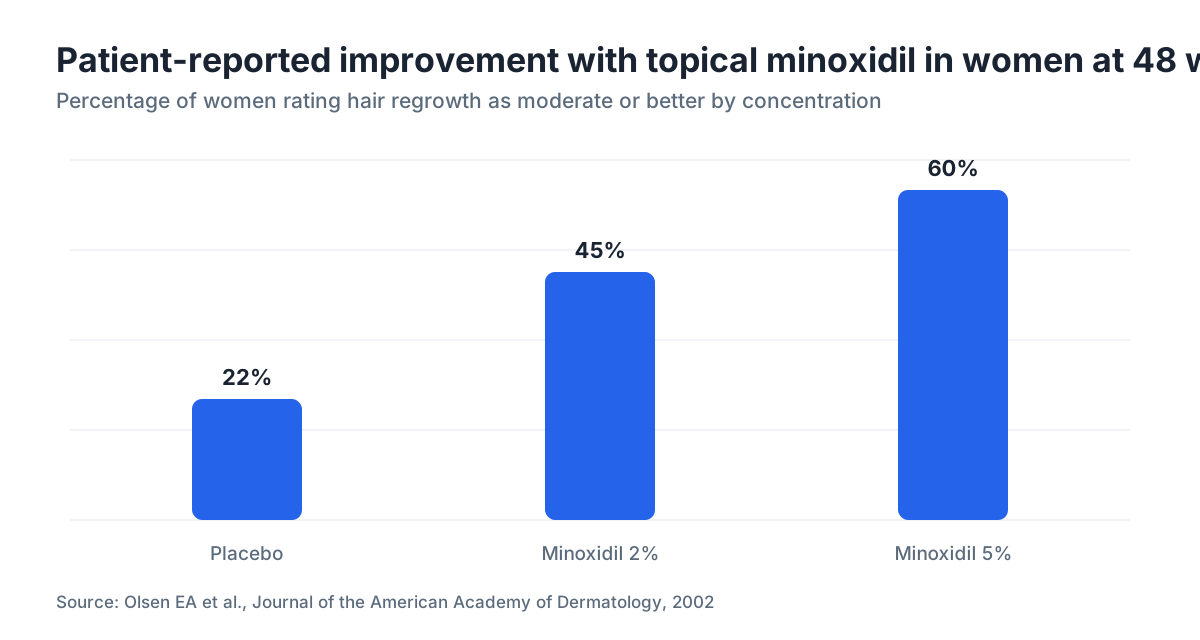
The registration trial submitted to the FDA tested 2% minoxidil solution in women with androgenetic alopecia over 32 weeks. The published results showed 2% minoxidil produced significantly more non-vellus hair regrowth than placebo, with about 60% of women in the active group rating their hair loss as minimal or stopped versus 40% in the placebo group [3]. The effect size sounds modest as a percentage but reads as meaningful on an actual head of hair.
A later randomized trial comparing 2% and 5% minoxidil solutions in women found the 5% solution produced significantly greater increases in total hair count at 48 weeks. The authors concluded that "5% topical minoxidil was clearly superior to 2% topical minoxidil on all efficacy assessments" in women with androgenetic alopecia [4].
The 5% foam studied in women shows similar or better tolerability than the solution, because the foam's propylene glycol-free formula causes less scalp irritation. A separate randomized trial found once-daily 5% foam was non-inferior to twice-daily 2% solution in women, with fewer scalp reactions [7].
Realistic expectations matter here. These studies measure hair count and patient-reported improvement. They don't promise a full head of hair. Women with Ludwig Stage I or early Stage II female pattern hair loss respond better than those with advanced loss. Nobody has great long-term data past five years on sustained use, but the general consensus is that stopping minoxidil reverses the gains within three to six months.
How long does topical minoxidil take to work for women?
Sixteen weeks is the minimum before most women see any real change in hair density [2]. Some women don't see visible results until 24 weeks (six months). That gap is long enough that a lot of people quit, assuming it isn't working, right when it's about to.
The first four to eight weeks often bring a shedding phase. This happens because minoxidil pushes resting telogen hairs out to make room for new anagen hairs entering the growth cycle. It looks alarming. It's actually a sign the drug is doing something. It stops on its own.
After that initial shed, new hairs start growing. They're thin and colorless at first, then thicken gradually. Peak response usually lands somewhere between six months and one year of consistent daily use.
After the one-year mark, the evidence for further gains gets weaker. Most women reach a plateau. The goal from there is maintenance: holding the ground you've gained. Stop, and the follicles revert to your pre-treatment baseline within roughly three to six months.
2% versus 5% minoxidil: which concentration should women use?
Short answer: 5% foam once daily is what most dermatologists now use in women, even though 2% is the FDA-approved label [2].
Here's a practical comparison:
| 2% Solution | 5% Solution | 5% Foam | |
|---|---|---|---|
| FDA approval (women) | Yes | No (off-label) | No (off-label) |
| Application | 1 mL twice daily | 1 mL twice daily | Half-capful once daily |
| Contains propylene glycol | Yes | Yes | No |
| Evidence in women | Strong (registration trials) | Stronger than 2% [4] | Strong, less irritation |
| Unwanted facial hair risk | Lower | Higher | Moderate |
Propylene glycol is the main culprit behind scalp irritation and allergic contact dermatitis in the solution formulas. The foam skips it, which is why many women tolerate it better. The once-daily dosing of 5% foam also helps people stay consistent.
Facial hair growth (hypertrichosis) is the main safety concern with higher concentrations. It happens because solution drips down the face, or women touch their scalp and then their face. The foam is less runny, which cuts the risk somewhat. Washing your hands right after and applying at night, so the product absorbs before it hits your pillow, helps too.
How do you apply topical minoxidil correctly as a woman?
Application technique matters more than most people think. Here's what the evidence supports:
Start with a dry or nearly dry scalp. Part your hair to expose the thinning area. Apply 1 mL of solution (one full dropper) or half a capful of foam directly to the scalp, not the hair. Spread it with your fingertips. The drug has to reach the scalp to reach the follicle. Rubbing it into your hair is wasted product.
For women using 5% foam once daily, night application is the most common recommendation. Let it dry fully before bed. If your scalp is still wet, product transfers to your pillow and you lose the dose.
Wash your hands right after application. Every time. Skipping this step is how minoxidil ends up on your face.
Don't wash your hair for at least four hours after applying. Most dermatologists say two hours minimum. Four is safer if you can manage it. If you wash your hair every day, apply after your morning shower and wait until the next morning to wash again.
Minoxidil is a maintenance drug. Missing one or two days now and then is fine. Taking a month off is not, because that's when the reversal starts. Build it into your routine the same way you'd take a daily medication.
If you're weighing this regimen against the pill, oral minoxidil has a different dosing profile and risk structure worth understanding on its own.
What are the side effects women should know about?
The most common side effects of topical minoxidil in women are scalp irritation (dryness, flaking, itching), contact dermatitis, and unwanted facial hair [5]. The full picture, including rarer systemic effects, is covered in detail in the minoxidil side effects article.
Scalp dryness and flaking hit a meaningful number of women, mostly those using solution formulas with propylene glycol. Switching to the foam usually clears it up.
Unwanted facial hair (hypertrichosis) is the side effect women ask about most. It affects roughly 3 to 5% of women in clinical trials with the 2% solution, and rates climb with 5% solution. The mechanism is simple: minoxidil drips or gets transferred to facial skin, and follicles there respond. Switching to once-daily foam and applying carefully reduces but doesn't eliminate the risk. The hair typically disappears within one to six months after stopping.
Systemic cardiovascular effects are rare with topical use because skin absorption is low, but they're possible. The FDA label warns that women who are pregnant or trying to become pregnant should not use minoxidil because of teratogenic risk [1]. Stop before you conceive.
Some women see the initial shedding phase and read it as the drug failing or making things worse. It's neither. It's part of the mechanism. If heavy shedding runs past three months, that's worth a conversation with a dermatologist to rule out a separate cause like telogen effluvium.
Who is topical minoxidil most likely to help?
Women most likely to see real results share a few traits. They have androgenetic alopecia (female pattern hair loss) as the confirmed diagnosis, not another cause. They caught the loss relatively early, while there are still functioning follicles to work with. They have a family history of pattern hair loss, which points to androgenetic origin. And they're consistent, meaning daily use for at least six months without interruption.
The AAD names female pattern hair loss as the primary indication [2]. Women with thinning along the part line or across the crown are the target group. The classic Ludwig Scale Stage I and II presentations respond better than Stage III, which is near-total crown loss.
Women unlikely to benefit include those with scarring alopecia (the follicle itself is destroyed), those whose loss is driven entirely by thyroid disease or iron deficiency (treat the underlying cause first), and women with complete loss in an area for many years.
Age matters less than people think. Postmenopausal women respond to minoxidil. The studies include women across a range of ages, and the evidence is not limited to younger women [8].
If your hair loss involves the hairline or temples on top of diffuse thinning, a broader look at what causes hair loss and whether a DHT blocker might add benefit alongside minoxidil is worth raising with a dermatologist.
Can women combine minoxidil with other hair loss treatments?
Yes, and combination therapy often beats minoxidil alone.
Finasteride is a 5-alpha reductase inhibitor that reduces DHT and is well-studied in men. In women it's used off-label, mostly in postmenopausal women, and the evidence for it in women is weaker than in men [6]. Read the full breakdown in the finasteride overview before assuming it applies to you. Premenopausal women should not take finasteride because of teratogenic risk.
Spironolactone is more often prescribed for premenopausal women with androgenetic alopecia. It's an anti-androgen that goes after one of the hormonal drivers. Pairing spironolactone with topical minoxidil is a common strategy in dermatology, and the combination makes mechanistic sense: one targets the hormonal trigger, the other stimulates the follicle directly.
Low-level laser therapy (LLLT) has some evidence behind it and is generally safe to layer with minoxidil. The effect sizes in trials are modest.
PRP (platelet-rich plasma) injections have a growing body of evidence, though the studies are small and protocols vary a lot.
Hair transplants are a surgical option for women with stable, long-standing androgenetic alopecia who haven't responded well to medical therapy. Women considering a hair transplant still have to use minoxidil after the procedure to protect existing non-transplanted hair.
One thing to sort out before spending money on multiple treatments: if you haven't done a proper baseline evaluation, you might be treating the wrong thing. A free AI hair analysis at MyHairline (myhairline.ai/scan) can help you understand your loss pattern before you commit to a regimen.
How much does topical minoxidil cost and where do you get it?
Generic 2% minoxidil solution for women runs roughly $8 to $20 for a one-month supply at most US pharmacies and online retailers. It's OTC, no prescription needed. Name-brand Rogaine Women's costs more, around $30 to $50 per month, for the same active ingredient.
Generic 5% minoxidil foam (technically labeled for men, used off-label by women) costs about $15 to $30 per month. Generic 5% solution is cheaper still, often under $15 per month.
If a dermatologist prescribes compounded minoxidil (a custom concentration or formula from a compounding pharmacy), the cost varies widely, typically $30 to $80 per month, and insurance rarely covers it.
Insurance does not cover OTC minoxidil. Some FSA and HSA accounts allow it. Check with your plan administrator.
There's no meaningful quality difference between generic and brand-name minoxidil at the same concentration. The active ingredient is identical. The vehicle (the liquid or foam base) differs slightly between products and can change how it feels on your scalp, so if you try one generic and hate the texture, another brand's foam might suit you better. That's the only real reason to pay more.
What happens if you stop using topical minoxidil?
The hair you gained will gradually fall out. This is one of the most important things to understand before you start.
Minoxidil doesn't cure androgenetic alopecia. It manages it. The follicles that responded stay dependent on the drug to keep an active growth phase. Stop, and they revert to their pre-treatment state over roughly three to six months [2].
This isn't unique to minoxidil. Most chronic disease treatments work this way. You wouldn't stop blood pressure medication because your blood pressure is normal, and the logic here is similar.
If you want to quit, tapering makes the shedding less dramatic than an abrupt stop. Moving to every-other-day dosing for a month first is one approach, though there's no strong published data on the best tapering schedule.
Starting minoxidil is effectively a long-term commitment. If that's not something you're ready for, knowing it upfront is genuinely useful. Some women decide the regimen isn't sustainable and choose to monitor their loss instead, or pursue options like hair loss supplements with more modest evidence but fewer maintenance obligations.
Is topical minoxidil safe during pregnancy or breastfeeding?
No. Do not use minoxidil if you're pregnant, trying to become pregnant, or breastfeeding.
The FDA label for minoxidil 2% solution states it is contraindicated in pregnancy [1]. Minoxidil is a vasodilator, and animal data suggests developmental toxicity. Human safety data is limited, which means the cautious answer is to stop before trying to conceive.
If you become pregnant while using topical minoxidil, stop right away and tell your OB. A single application is unlikely to cause harm given low systemic absorption, but continued use carries unknown risk.
For breastfeeding: minoxidil does pass into breast milk. The FDA label recommends against use while nursing. There are no adequate studies on infant effects from breastfeeding exposure, so the conservative position is to avoid it.
Women who pause minoxidil during pregnancy and nursing should expect some shedding of previously regrown hair during that window. Most dermatologists advise restarting as soon as breastfeeding ends.
What's the difference between topical minoxidil for women versus men?
The approved concentration differs: 2% is the women's label, 5% is the men's label. Beyond that, it's the same molecule working the same way in the same type of follicle.
Women are advised to use once-daily 5% foam or twice-daily 2% solution. Men typically use once-daily 5% foam or twice-daily 5% solution. The gap in approved concentrations comes from the original clinical trial designs in the 1980s and 90s, not from any finding that women respond better to lower doses. Later research shows women benefit from 5% too [4].
The hair loss pattern differs. Men tend to lose hair at the temples and crown in the classic Norwood pattern. Women tend to lose diffusely across the top with a widening part. That changes where you apply the product, not the product itself. The full breakdown of minoxidil for men covers the male-specific protocol and evidence.
One real biological difference: women are more sensitive to the hypertrichosis side effect at equivalent doses, which is part of why the women's label specifies 2%. The 5% foam's once-daily dosing keeps total daily exposure lower than twice-daily 5% solution, which helps manage that risk.
Sources
- FDA, Rogaine Women's (minoxidil 2% topical solution) label
- American Academy of Dermatology, Hair Loss Treatment Guidelines
- DeVillez RL et al., "Androgenetic alopecia in the female," Archives of Dermatology, 1994
- Olsen EA et al., "A randomized clinical trial of 5% topical minoxidil versus 2% topical minoxidil and placebo in the treatment of androgenetic alopecia in men and women," Journal of the American Academy of Dermatology, 2002
- MedlinePlus (U.S. National Library of Medicine), Minoxidil Topical
- Blumeyer A et al., "Evidence-based (S3) guideline for the treatment of androgenetic alopecia in women," Journal of the German Society of Dermatology, 2011
- Blume-Peytavi U et al., "A randomized, single-blind trial of 5% minoxidil foam once daily versus 2% minoxidil solution twice daily in the treatment of female pattern hair loss," Journal of the American Academy of Dermatology, 2011
- Shapiro J, "Hair loss in women," New England Journal of Medicine, 2007
- National Institutes of Health, MedlinePlus, Androgenetic Alopecia
- FDA Drug Approval History, Minoxidil