

TL;DR: A maturing hairline moves back slightly and evenly in your late teens to mid-20s, settles, and stops. A receding hairline keeps moving, often asymmetrically, driven by DHT attacking follicles. The signals that separate them are age of onset, pattern shape, whether it's still progressing, and whether the temples are being pulled backward unevenly.
What is a maturing hairline?
Most boys have what dermatologists call a juvenile hairline: a low, rounded arch that sits right at the top of the forehead with almost no temples visible. That hairline was never meant to stay there. Somewhere between ages 17 and 29, it shifts upward and backward by roughly a centimeter, the corners fill in slightly less than the center, and the overall shape becomes slightly more rectangular. That shift is a maturing hairline. It is a normal developmental change, the same way a boy's jawline becomes more defined in his 20s.
The American Academy of Dermatology distinguishes a maturing hairline from male pattern baldness specifically because the maturing process stops [1]. The temples may recede a little, the hairline lifts slightly, and then it holds. If you photograph yourself every few months for a year and the hairline is in the same place it was six months ago, that is a mature hairline doing its job.
About 96% of white men experience some degree of hairline recession over a lifetime, but not all of it is pathological [2]. A lot of it is just this normal maturation in the 20s that gets confused for the early stages of male pattern baldness. The confusion is understandable and extremely common.
What makes a hairline actually receding?
A truly receding hairline does not stop. It keeps moving because the underlying cause, DHT (dihydrotestosterone) binding to androgen receptors in genetically sensitive follicles, is ongoing. Those follicles miniaturize progressively: each growth cycle produces a slightly thinner, shorter hair until the follicle produces nothing visible at all [3].
Pattern recession usually starts at the temples, producing the classic "M" shape, but it can also thin across the crown at the same time. Over time the two areas connect and the hairline moves further back. That progression is what separates a receding hairline from a maturing one. A maturing hairline might produce a mild M shape once and then stay there. A receding hairline deepens that M year over year.
Miniaturization is the biological fingerprint. If you look closely at hairs along your hairline and they are noticeably finer and shorter than the hairs two inches behind them, that is miniaturization, and it points toward androgenetic alopecia rather than normal maturation [3]. A dermatologist can confirm this with a dermoscopy exam in about five minutes.
See the receding hairline guide for a full breakdown of what pattern recession looks like at each Norwood stage.
Is my hairline receding or maturing? The key differences side by side
Here is the most practical comparison you can make without seeing a doctor:
| Feature | Maturing hairline | Receding hairline |
|---|---|---|
| Age of onset | Typically 17-29 | Can begin late teens; often visible by 25-30 in men with strong genetic risk |
| Movement | Lifts and stops | Keeps moving over months and years |
| Shape | Roughly even across the front; mild temple recession | Deepening M or V shape; temples pull back asymmetrically |
| Hair density at hairline | Normal thickness | Hairs become finer, shorter (miniaturization) |
| Crown involvement | None | Often thins at crown simultaneously |
| Family history | Not necessarily relevant | Strong predictor; maternal grandfather's hairline is informative but not deterministic |
| Response to stress/illness | May temporarily shed (telogen effluvium) but returns | Loss continues even without stressors |
| Scalp visibility | Not increased | Scalp shows through at temples or crown |
The single most useful test you can run yourself: take a good photo in consistent lighting today, then take another in three months. If the hairline has moved, it is more than maturing. If it is exactly the same, you are likely dealing with a mature hairline that has already settled.
Worth knowing: a maturing hairline rarely pulls the temples back past the point where a line drawn from the outer corner of your eye to the top of your scalp would cross the hairline. If recession goes clearly behind that reference line, that is past what normal maturation does for most men [1].
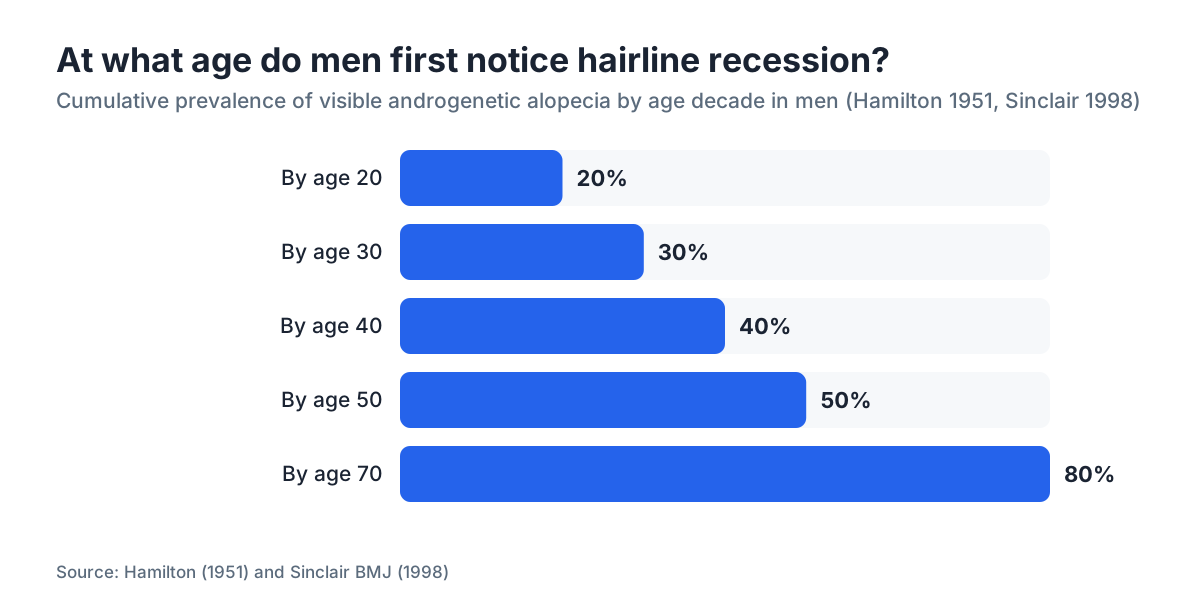
At what age does a hairline typically mature?
Most of the movement happens between ages 17 and 25. By 29, a maturing hairline has usually settled into its adult position and does not move again without pattern baldness involvement [1].
If you are 22 and your hairline moved slightly last year but seems stable now, that is almost certainly normal maturation. If you are 35 and your hairline started moving two years ago, that is a different situation entirely. Age of onset matters enormously in this call.
There is a rough rule dermatologists use: any significant hairline movement that begins after age 30 is treated as androgenetic alopecia until proven otherwise. Below 25, the differential is genuinely harder and requires tracking over time.
Women can also have a maturing hairline, though it is less dramatic. Female pattern hair loss tends to present as diffuse thinning across the part rather than a receding frontal hairline, so the maturing vs. receding distinction is mostly a male concern. If you are a woman with a noticeably receding frontal hairline, that warrants a dermatology visit sooner rather than later because causes like traction alopecia or frontal fibrosing alopecia need to be ruled out.
How does DHT drive recession while sparing a maturing hairline?
The follicles along your frontal hairline are genetically programmed either to be sensitive to DHT or not. DHT is converted from testosterone by the enzyme 5-alpha reductase. It binds to androgen receptors in susceptible follicles and shortens the anagen (growth) phase of the hair cycle, producing progressively finer hairs with each cycle until the follicle goes dormant [3].
A maturing hairline involves no miniaturization because those follicles are not sensitive to DHT. The hairline shifts for reasons that are not fully understood but are probably tied to changes in scalp tension and hormonal shifts during puberty, not follicle destruction.
This distinction is why finasteride, which blocks 5-alpha reductase and cuts scalp DHT by roughly 60-70%, can halt androgenetic alopecia but does nothing to a maturing hairline. The maturing hairline is not DHT-driven [4]. If you take finasteride and your hairline still moves, that tells you the movement was pathological.
For a closer look at DHT's mechanism and how DHT blockers work, that guide covers the pharmacology in plain language. And if you are wondering about causes beyond genetics, the what causes hair loss article covers the full differential including telogen effluvium, which can temporarily exaggerate a hairline shift and confuse the picture.
Can you tell the difference at home without a doctor?
Yes, with some limits. The photo method is the most reliable self-assessment: same lighting, same camera distance, same angle, every 8-12 weeks. Three stable check-ins in a row (roughly six to nine months of data) is good evidence of a settled mature hairline.
You can also look at hair thickness at the hairline. Use good lighting and compare hairs right at the edge to hairs two inches back on the top of your scalp. If the edge hairs are obviously finer or shorter, miniaturization is likely happening.
The wet hair test is anecdotal but some people find it useful: wet your hair and comb it flat. Scalp visibility through wet hair at the temples or crown, where there was none before, can point to real density loss.
What you cannot reliably judge at home is whether the follicles themselves are intact or miniaturizing. That requires a dermoscopy exam or, in some clinics, a phototrichogram (a computerized hair density scan). If you are genuinely uncertain after tracking for six months, a dermatologist visit is the right call. It is a single appointment and it removes the guesswork.
The free AI scan at MyHairline can give you a starting baseline on hairline position and shape from your photos, which helps the tracking process before you decide whether to see a doctor.
What Norwood stage separates maturing from early pattern loss?
The Norwood-Hamilton scale is the standard classification for male pattern baldness. Norwood I is the juvenile or early mature hairline. Norwood II is a slight recession at the temples, which is where things get ambiguous: this can be either a fully mature hairline or very early androgenetic alopecia [5].
Norwood III is the first stage the scale's authors classified as "baldness". It shows clearly deeper temple recession and often some thinning at the crown (the IIIa and IIIvertex variants). If you are at Norwood III and you are under 25, that is early pattern loss, not maturation.
The practical takeaway: Norwood I and II are ambiguous territory. Norwood III and above is pattern loss. If you are trying to self-assess, find a Norwood scale image (the American Hair Loss Association publishes one) and be honest about which stage matches your current hairline, then track whether it moves.
| Norwood Stage | Description | Likely cause |
|---|---|---|
| I | Juvenile or mature hairline, no recession | Normal |
| II | Slight temple recession | Maturation OR very early AGA |
| III | Clearly deeper temples, possible crown thinning | Androgenetic alopecia |
| IV-VII | Progressive frontal and crown loss | Androgenetic alopecia |
AGA = androgenetic alopecia (pattern baldness).
When should you actually start treatment?
Here is a direct opinion rather than a hedge: if you are 25 or older, your hairline has moved in the last 12 months, and you see miniaturization at the hairline, starting treatment sooner rather than later is almost always the right call. Androgenetic alopecia is much easier to slow than to reverse. The follicles you keep are worth more than the follicles you try to recover.
The FDA has approved two treatments for male pattern baldness: topical minoxidil (approved 1988) and finasteride 1mg oral (approved 1997) [4][6]. Both work. Neither is a cure. Minoxidil extends the anagen phase and increases follicle size; finasteride reduces DHT. Used together, they beat either one alone [7].
The finasteride and minoxidil combination guide covers the evidence for using both. The minoxidil for men article covers dosing and what to expect in the first six months. If side effects worry you, the minoxidil side effects page is thorough and honest about the actual incidence rates from clinical trials.
If you are tracking and genuinely unsure whether treatment is warranted yet, the right move is to track for one more defined period (say, three months) and decide on data, not anxiety. Starting finasteride because you are scared is different from starting because you have documented progression. The former can lead to nocebo effects; the latter is a rational medical decision.
One thing worth flagging: if your hairline shift happened fast, over weeks rather than months, and you have also been under extreme stress or lost significant weight recently, consider telogen effluvium as a cause. TE can produce dramatic but reversible shedding that mimics a receding hairline temporarily.
Does a maturing hairline ever need treatment?
No. A maturing hairline is not a medical condition and does not require treatment. The follicles are healthy; the hairline just moved to its adult position.
Some men do not like how their mature hairline looks, especially if it noticeably changed their appearance from their teenage years. That is a cosmetic concern, not a medical one, and there is nothing wrong with saying so. Options for cosmetic adjustment include hairline lowering surgery (done by plastic surgeons, not dermatologists) or scalp micropigmentation, which tattoos the appearance of hair follicles. Neither is the same as treating hair loss.
Where this matters in practice: do not start finasteride or minoxidil for a maturing hairline. Finasteride carries real side effect risks, low in incidence but real, and there is no benefit to taking it if your hairline is not DHT-driven. The finasteride guide covers the side effect profile in detail so you can make an informed decision.
What about women: can their hairline mature or recede differently?
Women do not go through the same juvenile-to-mature hairline transition that men do. Female hairlines are generally stable from puberty onward. So if a woman notices her hairline receding or her temples becoming more visible, that is not normal maturation and deserves investigation.
Female pattern hair loss (androgenetic alopecia in women) typically presents as a widening center part and diffuse thinning over the crown, with the frontal hairline often preserved [10]. A noticeably receding frontal hairline in a woman is more likely to indicate frontal fibrosing alopecia (an autoimmune-driven scarring condition), traction alopecia from hairstyling, or less commonly female pattern loss.
FDA-approved treatments for female pattern hair loss include topical minoxidil 2% and 5% [6]. Finasteride is not FDA-approved for women and is contraindicated in women who are or may become pregnant due to teratogenic risk [4]. A dermatology visit is more urgent for women with a receding hairline than for men sitting in the ambiguous Norwood I-II range.
What if I'm not sure? How to track your hairline properly
Set up a consistent photo protocol. Use the same phone camera, the same room, the same lighting (daylight from a window is ideal, not overhead fluorescent which throws shadows), and the same distance from the mirror. Take three angles: straight on, left three-quarter view, right three-quarter view. Label each with the date.
Repeat every 8 weeks. After four rounds (about six months) you will have enough data to see whether there is real movement. This beats trying to compare old vacation photos where the angle and lighting are always different.
If you see movement over that period, book a dermatology appointment. Bring your photo series. A dermatologist can run a dermoscopy exam to check for miniaturization and can order bloodwork to rule out thyroid issues, iron deficiency, or other systemic causes that can speed up or mimic pattern loss.
MyHairline's AI scan can give you a baseline hairline analysis from your photos and track changes over time, which makes your dermatology appointment more efficient by giving you documented progression data before you walk in.
If tracking shows no movement but you are still worried, that worry might be worth examining on its own. Hair anxiety is real and can affect quality of life independently of actual hair loss. Body dysmorphic disorder sometimes shows up around hair concerns. If anxiety about your hairline is out of proportion to what you actually see in photos, talking to a mental health professional is not a bad idea.
Sources
- American Academy of Dermatology, Hair loss types: Androgenetic alopecia
- Hamilton JB, Patterned loss of hair in man; types and incidence, Annals of the New York Academy of Sciences, 1951
- Messenger AG, Sinclair R, Follicular miniaturization in female pattern hair loss, British Journal of Dermatology, 2006
- U.S. Food and Drug Administration, Propecia (finasteride) prescribing information
- Norwood OT, Male pattern baldness: classification and incidence, Southern Medical Journal, 1975
- National Library of Medicine, MedlinePlus: Minoxidil topical
- Hu R et al., Combined treatment with oral finasteride and topical minoxidil in male androgenetic alopecia, Journal of Dermatology, 2015
- Sinclair R, Male pattern androgenetic alopecia, British Medical Journal, 1998
- American Hair Loss Association, Men's hair loss: introduction
- Shapiro J, Clinical practice: hair loss in women, New England Journal of Medicine, 2007
- Trüeb RM, Telogen effluvium, Seminars in Cutaneous Medicine and Surgery, 2009
- National Library of Medicine, MedlinePlus: Hair loss