
TL;DR: A dermatologist is the right first stop for a receding hairline, not a general practitioner and not a hair salon. They can diagnose the cause with a scalp exam and blood work, then prescribe proven treatments like finasteride or topical minoxidil. Earlier you go, the more hair you keep. Most people wait too long.
What is a receding hairline, exactly?
A receding hairline is a pattern of hair loss where the frontal hairline moves backward from the forehead, usually starting at the temples. The result is an M-shaped or V-shaped hairline that becomes more pronounced over time. It is the earliest visible sign of androgenetic alopecia, which is the clinical name for male-pattern or female-pattern hair loss, the most common form of hair loss in the world.
Hair at the temples and the front of the scalp is genetically more sensitive to a hormone called dihydrotestosterone (DHT). DHT gradually shrinks hair follicles, shortens their growth cycle, and eventually stops them producing visible hair altogether. The process is called follicle miniaturization. Once a follicle fully miniaturizes, it rarely recovers, which is why early treatment matters so much more than most people realize.
A receding hairline is not the same as general thinning across the scalp, though the two can happen together. It is also not the same as telogen effluvium, where hair sheds diffusely after stress, illness, or a hormonal shift. Telling them apart is one of the most important things a dermatologist does at that first appointment.
For a detailed overview of the full spectrum of what drives hair loss, the what causes hair loss guide covers the main categories with the underlying biology.
How common is a receding hairline and who gets one?
Androgenetic alopecia, the primary driver of a receding hairline, affects approximately 50 million men and 30 million women in the United States [1]. Around 25% of men who have it start losing hair before age 21, and roughly 50% show visible hair loss by age 50 [1]. By age 70, that figure climbs to about 80% of men [2].
Women can also develop a receding hairline, though it tends to present differently. Female-pattern hair loss usually causes diffuse thinning at the crown with the frontal hairline relatively preserved, but a subset of women, particularly post-menopausal women, do experience genuine frontal recession. Women with polycystic ovary syndrome (PCOS) or thyroid disorders are at higher risk because of hormonal effects on follicles.
Genetics are the biggest predictor. If your father or maternal grandfather lost hair early, your odds go up, but the inheritance pattern is polygenic, meaning multiple genes contribute, so family history is a signal and not a sentence. Race also influences prevalence: androgenetic alopecia is more common in white men than in Asian or African men, though all groups are affected [2].
The Norwood scale classifies male-pattern hair loss into seven stages, with Norwood 1 being a mostly intact hairline and Norwood 7 being a horseshoe of hair at the sides and back. A receding hairline typically corresponds to Norwood stages 2 through 4. See the full receding hairline breakdown for photographs and stage-by-stage detail.
Why a dermatologist and not your GP or a trichologist?
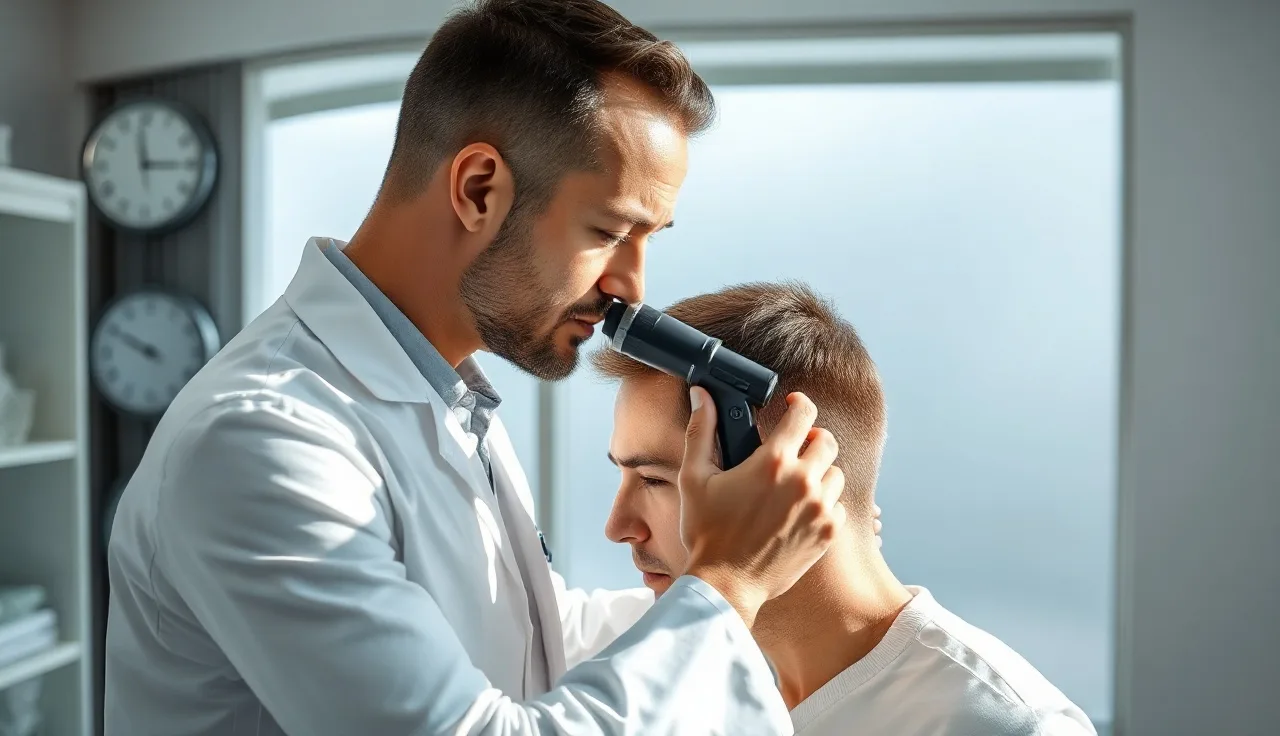
General practitioners can order basic blood work and prescribe finasteride, but most don't have the tools or training to differentiate between the dozen or so conditions that cause hair loss. A dermatologist is a board-certified physician with specialized training in skin, hair, and nail disorders. Many run dedicated hair clinics and use dermoscopy (a magnified, polarized-light examination of the scalp) to evaluate follicle density and miniaturization patterns without a biopsy.
A trichologist, by contrast, is not a licensed physician in the United States. The credential is privately issued, training varies enormously, and trichologists cannot legally prescribe medications or order lab tests. They can be useful for discussion and for some scalp treatments, but they are not the right person to rule out medical causes of hair loss.
The American Academy of Dermatology (AAD) specifically recommends seeing a board-certified dermatologist if you notice hair loss, because some causes, like alopecia areata, scarring alopecias, or nutritional deficiencies, require medical treatment that only a licensed physician can provide [3]. The AAD also notes that "the earlier you treat hair loss, the better the results" [3], which is the most practically important sentence in their guidance.
If you are unsure how bad your hairline has gotten, tools like the free AI scan at MyHairline can give you a quick visual staging before you book an appointment, which helps you walk in with a clearer picture of where you are on the Norwood scale.
What does a dermatologist actually do at a hair loss appointment?
Expect the appointment to run 30 to 60 minutes if it is focused on hair loss. The dermatologist will take a history covering when you first noticed recession, any changes in diet, stress, medications, or illness in the past 6 to 12 months, and your family history on both sides.
The physical exam usually includes a pull test (gently pulling about 60 hairs and counting how many come out), a dermoscopic exam of the scalp, and sometimes a trichoscopy (video dermoscopy that lets the doctor measure follicle diameter digitally). A follicle producing a hair shaft thinner than 0.04 mm in diameter is considered miniaturized [4].
Blood work is common but not always ordered on the first visit. The typical panel for hair loss includes:
| Test | What it rules out |
|---|---|
| TSH (thyroid-stimulating hormone) | Hypothyroidism or hyperthyroidism |
| Ferritin (stored iron) | Iron-deficiency, a frequent trigger of shedding |
| Complete blood count (CBC) | Anemia |
| Testosterone + free testosterone | Hormonal imbalances, especially in women |
| DHEA-S | Adrenal androgen excess |
| Vitamin D | Deficiency linked to follicle cycling |
| ANA (antinuclear antibody) | Autoimmune conditions if scarring is suspected |
A scalp biopsy is reserved for cases where the diagnosis is unclear after clinical and dermoscopic exam. It is a minor in-office procedure under local anesthesia, and pathology results usually come back within 1 to 2 weeks.
By the end of the visit the dermatologist should give you a working diagnosis and a treatment plan, more than "let's watch it." If they say that without an explanation, it is fair to ask exactly what they are watching for and over what timeframe.
What treatments can a dermatologist prescribe for a receding hairline?
The two treatments with the most evidence for androgenetic alopecia are minoxidil and finasteride. A dermatologist can prescribe both, explain the tradeoffs, and monitor you over time.
Minoxidil is FDA-approved for hair loss in both the topical form (2% and 5% solutions or foam) and, more recently, as a low-dose oral prescription. It works by prolonging the hair follicle's growth phase and increasing blood flow to the scalp. It does not block DHT, so it does not address the root cause in androgenetic alopecia, but it meaningfully slows loss and regrows some hair for many users. A Cochrane review of minoxidil trials found that 5% topical minoxidil was more effective than 2% and that user-reported outcomes generally favored treatment over placebo [5]. The minoxidil for men guide covers dosing and real-world results in detail.
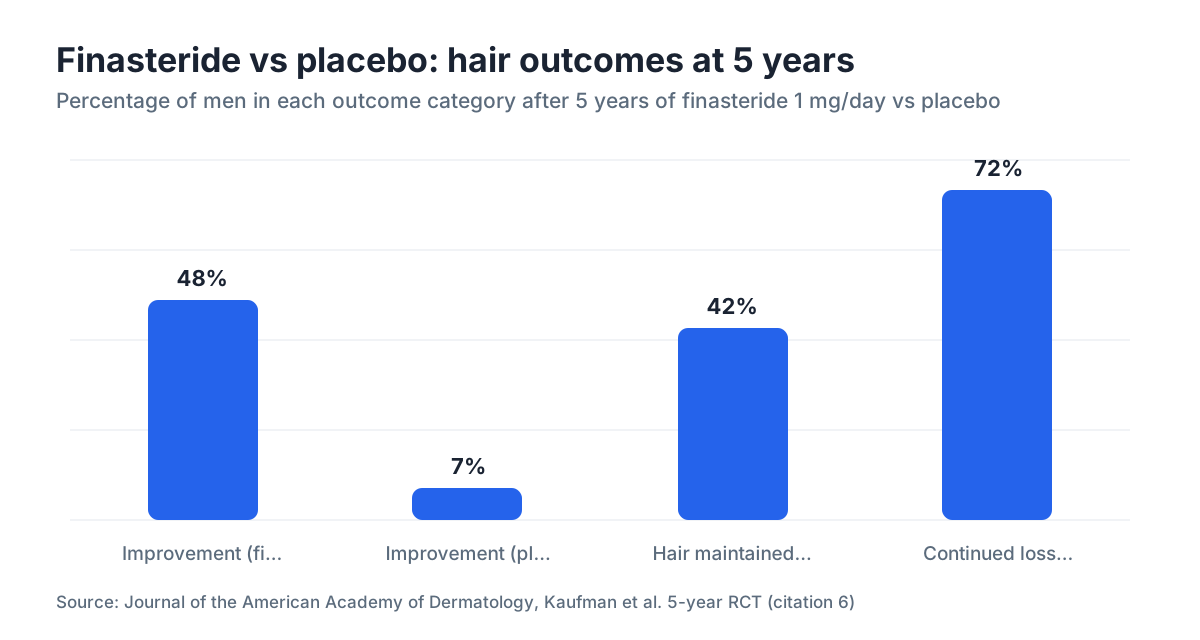
Finasteride is an oral 5-alpha reductase inhibitor that blocks the conversion of testosterone to DHT. It is FDA-approved for men at 1 mg/day (Propecia and generics) for hair loss. A 5-year randomized controlled trial published in the Journal of the American Academy of Dermatology found that 48% of men taking finasteride showed improvement in hair count compared with 7% in the placebo group, and 42% maintained their hair versus 72% of placebo recipients who continued to lose hair [6]. Those numbers are worth sitting with. Finasteride is not FDA-approved for women who could become pregnant because of teratogenicity risk; post-menopausal women are sometimes prescribed it off-label. The full finasteride article covers efficacy, risks, and the sexual side effect data honestly.
Low-dose oral minoxidil (0.25 mg to 2.5 mg daily for women, 2.5 mg to 5 mg for men) has emerged as a practical alternative for people who struggle with topical compliance. A 2022 review in the Journal of the American Academy of Dermatology Innovations found it effective and generally well tolerated, with fluid retention and unwanted body hair as the main concerns [7]. Read more in the oral minoxidil overview.
Combination therapy with finasteride plus minoxidil together outperforms either drug alone in head-to-head comparisons. A 2021 randomized trial published in JAMA Dermatology found significantly greater increases in total hair count with the combination than with either agent alone [8]. The finasteride and minoxidil article summarizes that trial's specific numbers.
Platelet-rich plasma (PRP) is an in-office procedure where the dermatologist draws your blood, concentrates the growth-factor-rich plasma, and injects it into the scalp. Evidence is genuinely promising but not conclusive. The AAD considers it a treatment option while noting that larger randomized trials are still needed [3].
Low-level laser therapy (LLLT) devices are FDA-cleared (not FDA-approved, an important distinction) for promoting hair growth. Evidence is modest. A dermatologist may suggest it as an adjunct but is unlikely to recommend it as a primary treatment.
DHT blockers is an umbrella term covering finasteride, dutasteride, and some topical formulations. A dermatologist can discuss which is appropriate for your situation.
For people whose recession is advanced and medical therapy has not been enough, a dermatologist can refer to or work alongside a hair transplant surgeon. Modern follicular unit excision (FUE) transplants have high satisfaction rates but are expensive ($4,000 to $15,000 depending on graft count and geographic market) and are not reversible, so they require careful patient selection. The hair transplant guide covers candidacy and realistic expectations.
What about supplements and over-the-counter products?
The supplement aisle is full of products marketed for hair loss. Most of the evidence behind them is weak.
Biotin is the most heavily marketed. Unless you have a documented biotin deficiency (rare in people eating a normal diet), adding more does not help hair grow. High-dose biotin can also interfere with thyroid and troponin lab tests, which is a real clinical problem the FDA has warned about [9].
Saw palmetto is a botanical 5-alpha reductase inhibitor. It has some small trial evidence suggesting modest benefit, but effect sizes are much smaller than finasteride and no large randomized trial supports it as a primary treatment. A dermatologist will usually say it is not harmful but not impressive either.
Nutritional deficiencies that are documented (low ferritin, low vitamin D, low zinc) are worth correcting, and doing so can help if deficiency was contributing to shedding. But taking high-dose vitamins when you are already sufficient does nothing and, in some cases, causes harm.
For a full breakdown of what the evidence says, the hair loss supplements article separates the useful from the waste of money.
How do you find a good dermatologist for hair loss?
Start with the AAD's Find a Dermatologist tool at aad.org, which lets you filter by specialty. Look for a physician who lists hair disorders or hair loss as a specific focus area. General dermatologists handle a lot of acne and skin cancer; hair is a subspecialty, and volume matters for skill.
Academic medical centers and university hair clinics often have the most up-to-date protocols, though wait times can be long. Private dermatology practices focused on hair often have shorter waits and more time per appointment.
Questions worth asking before or at the appointment:
- Do you use dermoscopy for hair loss evaluation?
- How many hair loss patients do you see per month?
- Do you prescribe oral minoxidil if appropriate?
- What does your follow-up schedule look like?
Insurance coverage varies. The initial consultation is usually covered if you go to an in-network provider, but some treatments (PRP, certain medications) may not be. Call the office before you go.
Telehealth platforms now offer legitimate dermatologist consultations for hair loss, and for someone who clearly has androgenetic alopecia (classic pattern, family history, no red flags), a telehealth visit can be a fast and affordable way to get a prescription for finasteride or topical minoxidil. For anything atypical, a physical visit is better because the dermoscopic exam cannot be done remotely.
When should you actually go, and how urgent is this?
The single most important thing to understand is that hair follicle miniaturization is partially reversible early and largely irreversible late. Medical therapy can slow or stop loss and regrow some hair, but it cannot bring back follicles that have been destroyed for years. The window matters.
Go soon if:
- Your hairline has moved noticeably in the last 6 to 12 months
- You are under 30 and already showing significant recession
- Hair loss is patchy, sudden, or accompanied by scalp itching, pain, or redness (these can indicate alopecia areata or a scarring alopecia that needs urgent treatment)
- You are losing hair over the entire scalp, more than the front (possible telogen effluvium or another systemic cause)
- A female with no family history of pattern baldness who develops recession (hormonal workup is warranted)
You can monitor for a few months if the change is very subtle and you want to document it with photos first, but "monitoring" without treatment means ongoing loss for most people with androgenetic alopecia. Loss is rarely static.
Fast, sudden shedding of clumps of hair is a separate situation and warrants a prompt visit regardless of the pattern.
If cost is a barrier, community health centers and Federally Qualified Health Centers (FQHCs) offer sliding-scale dermatology services in many states. The HRSA health center finder at findahealthcenter.hrsa.gov can locate one near you [10].
What should you expect from treatment and how long does it take?
Treatment for a receding hairline is almost always long-term. This is not a course of antibiotics with a defined end date. If you stop using minoxidil or finasteride, the hair loss you prevented will resume within months to a year.
Timeline reality for the most common treatments:
| Treatment | When you might see results | Maximum effect |
|---|---|---|
| 5% topical minoxidil | 3 to 6 months | 12 months |
| Oral minoxidil 2.5-5 mg | 3 to 6 months | 12 months |
| Finasteride 1 mg/day | 6 to 12 months | 18 to 24 months |
| Finasteride + minoxidil combined | 3 to 6 months | 12 to 18 months |
| PRP (series of 3 to 4 sessions) | 3 to 6 months | 12 months |
Initial shedding with minoxidil in the first 4 to 8 weeks is common and normal. The drug pushes resting follicles into the growth phase, and old hairs shed before new ones come in. Many people stop at this point thinking the treatment is making things worse. It usually isn't.
Photographs taken every 3 months in consistent lighting are the best way to track progress objectively. Hair changes slowly and your eyes adjust to what you see in the mirror every day.
If treatment is not working after 12 months of consistent use, a follow-up dermatology visit is the right move, not a switch to an unproven product. The dermatologist can check whether you are using the product correctly, order labs, or discuss additional options.
Are there things that might make a receding hairline worse?
Some habits and exposures genuinely accelerate hair loss, and some are overstated.
Cigarette smoking is associated with increased risk and severity of androgenetic alopecia in multiple studies, likely through oxidative stress and reduced scalp microcirculation [11].
Chronic psychological stress elevates cortisol, which can push follicles into the resting phase and trigger telogen effluvium, a different type of shedding that can happen on top of pattern loss.
Diet matters mainly when it creates deficiencies. A calorie-restricted diet, especially crash dieting, can trigger significant shedding months later. Protein intake below about 0.8 g per kilogram of body weight is associated with increased hair loss in clinical observation, though specific RCT data are limited.
Certain medications accelerate hair loss as a side effect, including some antidepressants, blood pressure drugs, cholesterol medications, and chemotherapy agents. If a medication is the suspected cause, a dermatologist can help weigh the tradeoffs with your prescribing physician.
For the creatine question that comes up constantly: the evidence is limited to one small study in rugby players that showed elevated DHT-to-testosterone ratios with creatine loading, not actual measured hair loss. The does creatine cause hair loss article covers what that study actually showed and why the conclusion is not as scary as headlines suggested.
Tight hairstyles (braids, ponytails worn at high tension for years) can cause traction alopecia, a scarring type of loss at the frontal hairline that can mimic androgenetic recession. A dermatologist can differentiate these with a clinical exam.
What does a receding hairline cost to treat over time?
Cost is a real factor and nobody should pretend it isn't. Generic finasteride runs roughly $15 to $30 per month without insurance in the US, though GoodRx and similar discount programs can bring it lower. Branded Propecia costs significantly more and offers no benefit over generics. Generic topical minoxidil (5% solution) runs $5 to $20 per month. Oral minoxidil is a prescription and typically costs $15 to $40 per month depending on dose and pharmacy.
PRP sessions range from $500 to $2,500 each, and most protocols call for 3 to 4 initial sessions plus maintenance every 6 to 12 months. Few insurers cover it.
A hair transplant is a one-time surgical cost, but not a small one. FUE transplants in the US average $8,000 to $15,000 for a typical session, with some cases requiring two sessions. FUT (strip) transplants are generally less expensive per graft. Neither is covered by health insurance because they are classified as cosmetic.
For most people with early to moderate recession, a dermatology consultation (often covered by insurance) plus generic finasteride plus topical minoxidil is the best value approach, well under $100 per month for two proven treatments.
MyHairline's free AI scan at myhairline.ai/scan can help you assess your current stage before spending money anywhere, giving you a starting point for that conversation with a dermatologist.
Sources
- American Academy of Dermatology, Hair Loss Overview
- American Academy of Dermatology, Hair Loss Types: Androgenetic Alopecia
- American Academy of Dermatology, Hair Loss Diagnosis and Treatment
- Journal of Investigative Dermatology Symposium Proceedings, Dermoscopy in Hair Disorders
- Cochrane Database of Systematic Reviews, Minoxidil for Androgenetic Alopecia
- Journal of the American Academy of Dermatology, 5-year finasteride RCT (Kaufman et al.)
- JAAD International, Low-dose oral minoxidil review 2022
- JAMA Dermatology, Combination finasteride and minoxidil RCT 2021
- HRSA Health Center Program, Find a Health Center
- Archives of Dermatology, Smoking and androgenetic alopecia association study