TL;DR: Minoxidil 5% is an FDA-approved topical treatment for androgenetic alopecia. In clinical trials, roughly 40 to 60% of men see moderate to dense regrowth after 48 weeks of twice-daily use. It works best on the crown, less so on the hairline. You have to keep using it or the regrowth falls out within months.
What is minoxidil 5% and how does it work?
Minoxidil is a vasodilator. That's its whole origin story: it was developed in the 1960s as an oral drug for severe hypertension, and patients kept growing unexpected hair. Researchers noticed, reformulated it as a topical, and the FDA approved it for hair loss in 1988. [1]
The 5% concentration is the higher of the two standard topical strengths (2% is the other). For men, 5% is what the FDA label recommends. For women, the approved dose is 2%, though off-label 5% use in women is studied and practiced.
How does it actually work? Honestly, the mechanism isn't completely nailed down even now. What we know: minoxidil shortens the telogen (resting) phase of the hair cycle and prolongs anagen (active growth), increasing the size of miniaturized follicles. [2] It's also a potassium channel opener, which may increase blood flow and oxygen delivery to follicles, but whether that's the primary driver of regrowth or a secondary effect is still debated.
What it doesn't do: it doesn't block dihydrotestosterone (DHT), the androgen most responsible for male pattern baldness. That's what finasteride does. Minoxidil and DHT-blockers work through entirely different pathways, which is why combining them often produces better results than either alone. More on that later.
What do clinical trials actually show for 5% minoxidil?
The most-cited trial compared 5% minoxidil foam, 2% minoxidil solution, and placebo in men with androgenetic alopecia over 48 weeks. The 5% foam group showed a mean increase of 12.8 hairs per cm² in the target zone, compared to 9.4 hairs per cm² for 2% and essentially no change with placebo. [3] That difference is statistically significant but modest in absolute terms. Hair counts don't always map neatly onto how someone looks in the mirror.
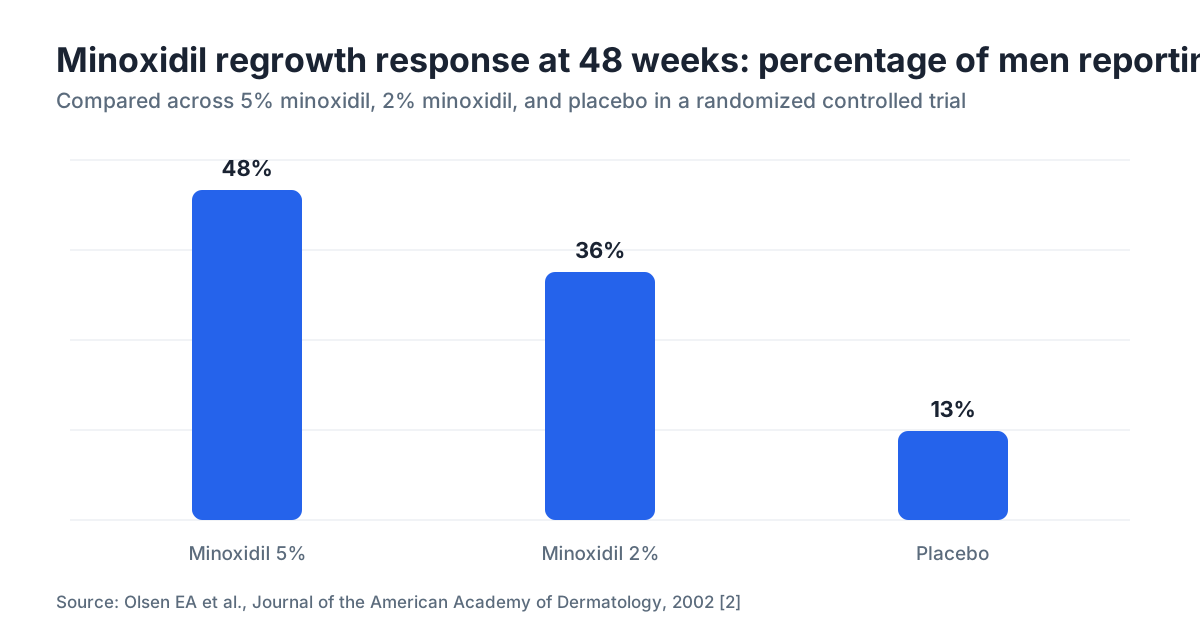
A separate Rogaine-era trial found that after 48 weeks, about 48% of men using 5% topical minoxidil rated their regrowth as moderate to dense, versus 36% in the 2% group and 13% in the placebo group. [2] So yes, 5% outperforms 2%, but neither formulation delivers full restoration for most people.
The crown responds better than the hairline. That pattern appears consistently across trials. If your concern is a receding hairline, minoxidil alone is unlikely to rebuild your temples significantly, though it can slow further recession.
Shedding in the first 2 to 8 weeks is normal and documented. It reflects follicles being pushed out of telogen simultaneously. If you stop because of early shedding, you're quitting at exactly the wrong moment. See the telogen effluvium article for more detail on why this happens.
Long-term data beyond 1 year is thinner. A 5-year open-label study found that men who continued treatment maintained most of their regrowth, but some slow attrition was noted after year 1 as the underlying miniaturization process continues. [4] Minoxidil doesn't stop the cause. It competes with it.
How does minoxidil 5% compare to 2% and other strengths?
| Formulation | Approved use | Typical regrowth vs placebo | Application |
|---|---|---|---|
| Minoxidil 2% solution | Men and women (FDA) | ~36% moderate/dense (men) | Twice daily |
| Minoxidil 5% solution | Men (FDA) | ~48% moderate/dense (men) | Twice daily |
| Minoxidil 5% foam | Men (FDA) | Similar to 5% solution | Twice daily |
| Minoxidil 5% foam once daily | Men (off-label/studied) | Non-inferior in some trials | Once daily |
| Oral minoxidil 2.5 to 5 mg | Off-label, dermatologist-directed | Growing evidence, systemic reach | Once daily |
The foam formulation was developed partly to reduce scalp irritation from propylene glycol, the carrier used in the solution. Some people tolerate the foam better. Efficacy data suggests the two are roughly equivalent. [3]
Oral minoxidil is a different conversation. Doses between 0.25 mg and 5 mg daily show meaningful regrowth in trials, with some evidence of superior systemic follicle stimulation because absorption is consistent. The tradeoff is systemic side effects including fluid retention, lowered blood pressure, and hypertrichosis (unwanted body and facial hair). It's not a casual OTC swap. You need a prescribing doctor.
For the average man starting treatment, 5% topical is the right entry point. Better than 2%. Simpler and safer than oral. Widely available without a prescription.
Who is the best candidate for minoxidil 5%?
Men with early to moderate androgenetic alopecia get the best results. The Norwood scale helps here: Norwood II through V tends to respond better than Norwood VI or VII, where the bald area is large and follicles may have been dormant too long to reactivate. [4]
Age matters somewhat. Men under 40, with hair loss that began relatively recently, and who still have some miniaturized (thin, vellus-like) hairs rather than complete follicle absence tend to see better outcomes. Miniaturized follicles are alive. Completely absent follicles aren't coming back with any topical treatment.
People with diffuse thinning across the crown often see the clearest before/after improvement because the target zone is large and accessible. People whose primary concern is a single bald spot or frontal hairline recession tend to be more disappointed.
Minoxidil is not a good standalone answer for pattern baldness if you're already significantly bald. At that point, the realistic options are combining it with finasteride or a DHT blocker, considering a hair transplant, or both. See the finasteride and minoxidil comparison for how the combination stacks up against either alone.
Women can use 5% minoxidil off-label, and some trials support it, but the FDA's approved dose for women is 2%. Women with cardiovascular conditions or who are pregnant should not use it. The FDA label specifically warns against use in pregnancy. [1]
How do you apply minoxidil 5% correctly?
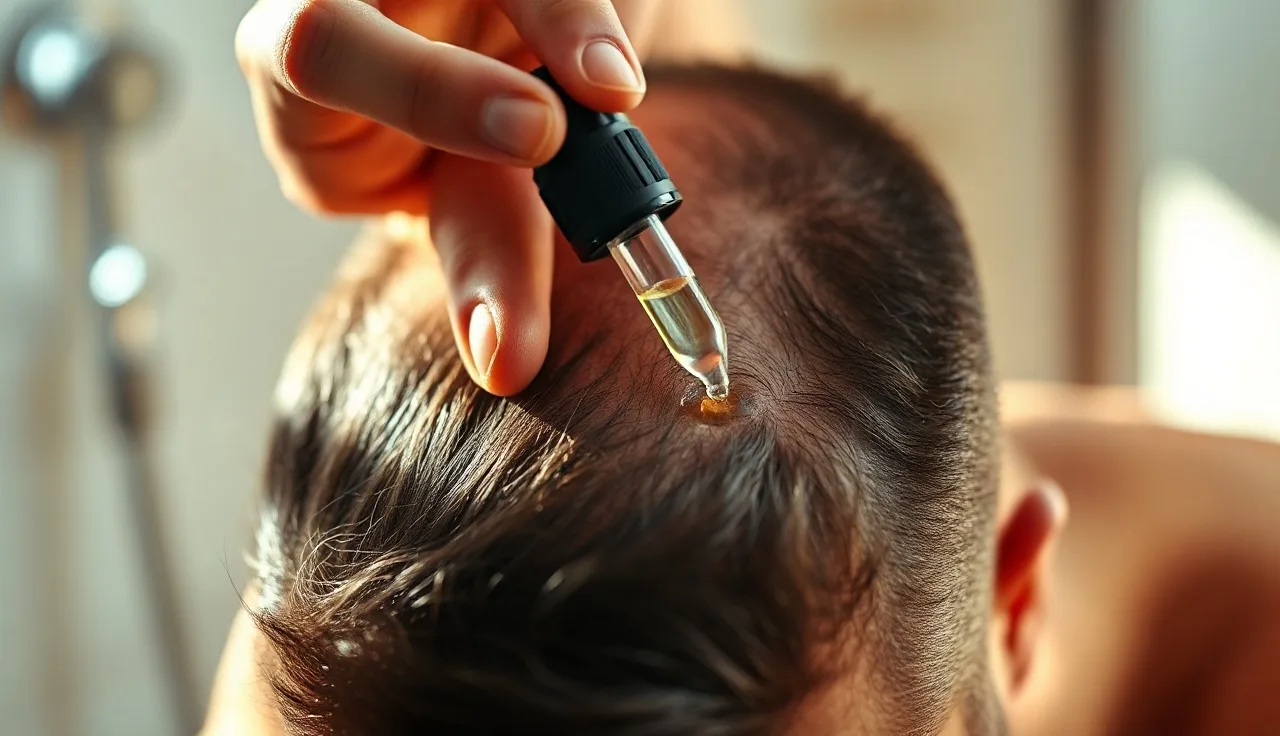
The FDA-approved dosing is 1 mL of solution or half a capful of foam applied directly to the dry scalp twice daily, spaced roughly 12 hours apart. [1] Not to the hair. To the scalp skin where the thinning is.
Application steps that actually matter:
- Part the hair to expose the scalp. Don't just drizzle it on top of your hair; it won't absorb.
- Apply to the affected area and spread with your fingertips.
- Wash your hands immediately. Minoxidil on your hands means minoxidil on your face and anywhere else you touch.
- Let it dry fully before lying down or putting on a hat. This takes 2 to 4 hours for the solution; the foam dries faster.
- Don't apply to irritated, sunburned, or broken skin. Absorption increases sharply and side effects follow.
Do you need to shampoo it out? No. It doesn't need to be washed off. Daily shampooing while using minoxidil is fine but not required. The drug isn't in the hair shaft, it's acting at the follicle level in the dermis.
Missing a dose occasionally won't undo your progress. Missing weeks at a time will. Consistency is the whole game with this drug.
When will you see results, and what does the timeline look like?
Weeks 1 to 8: you may see increased shedding. This is documented in trials and is a positive sign that follicles are cycling. Don't stop.
Months 2 to 4: the earliest fine regrowth sometimes appears in this window, though many people notice nothing visible yet. Photographs under consistent lighting are more reliable than mirror-checking.
Months 4 to 6: meaningful new hair growth starts becoming visible for responders. This is when most people first think "okay, something is actually happening."
Months 6 to 12: peak response period for most users. The 48-week timeframe in clinical trials isn't arbitrary. That's roughly when the drug's effect plateaus. [3]
After 12 months: maintenance. The drug is now holding what it achieved. The underlying miniaturization process continues slowly, which is why adding a DHT blocker matters for long-term outcomes in men with genetic hair loss.
If you see zero change at 12 months, you're likely a non-responder. Somewhere between 30 and 40 percent of men don't respond significantly, based on trial placebo-adjusted response rates. That's a real number. It's not a failure on your part. The drug just doesn't work for everyone.
What are the side effects of minoxidil 5%?
The most common side effect is scalp irritation: itching, dryness, flaking. This happens more with the solution (which contains propylene glycol) than the foam. Switching to foam resolves it for many people.
Systemic absorption does occur with topical minoxidil, though it's low. About 1.4% of a topical dose is absorbed systemically in studies. Still, this is enough to occasionally cause blood pressure changes, heart palpitations, or fluid retention, especially in people with existing cardiovascular conditions. [1]
Unwanted facial or body hair (hypertrichosis) is a real and underreported side effect, particularly in women using 5% and in men who get the drug on their forehead, temples, or pillow. Wash your hands, let the scalp dry, and sleep on a clean pillowcase.
Contact dermatitis is possible. If your scalp becomes severely inflamed or you develop a rash, stop and see a dermatologist.
The full side effect profile, including rare cardiovascular events and what to watch for, is covered in the dedicated minoxidil side effects article. Read it before you start.
Alcohol and minoxidil: the solution formulation contains alcohol, which can sting on broken skin and may contribute to dryness. This isn't a drug interaction, just a tolerability consideration.
Drug interactions worth knowing: concurrent use with other topical vasodilators or blood pressure medications may increase hypotensive effects. Tell your doctor everything you're taking.
Is minoxidil 5% more effective combined with finasteride?
Yes, by a meaningful margin. A 2015 randomized trial published in Dermatology and Therapy found that the combination of 5% topical minoxidil plus oral finasteride 1 mg produced significantly greater hair count improvements than either drug alone. [5] The mechanisms are genuinely complementary: minoxidil stimulates the follicle directly and prolongs anagen; finasteride reduces DHT, addressing the hormonal cause.
If you're a man with androgenetic alopecia and you're willing to take an oral medication, adding finasteride to your minoxidil routine is probably the single most effective non-surgical intervention available. The finasteride and minoxidil breakdown goes deep on the dosing, evidence, and tradeoffs.
For men who don't want to take finasteride (side effect concerns, cost, preference), minoxidil alone is still a reasonable choice. Partial regrowth and slowed progression are real outcomes. Don't let the perfect be the enemy of the useful.
If you're unsure where your hair loss stands and want a baseline picture before committing to a regimen, the free AI scan at MyHairline can map your thinning pattern and flag which Norwood stage you're likely at, which helps calibrate expectations before you spend money.
How much does minoxidil 5% cost and where can you buy it?
Minoxidil went off-patent years ago. Generic 5% topical minoxidil is widely available over the counter at pharmacies and online for roughly $10 to $25 for a one-month supply, depending on the retailer and formulation. [6] Brand-name Rogaine costs more, around $30 to $50 per month, for identical active ingredients.
The foam runs slightly more expensive than the solution per month of supply, but the price difference is small. If the solution irritates your scalp, the extra $5 to $10 per month for foam is a reasonable trade.
Prescription versions aren't necessary for the standard 5% topical product. But if you're considering compounded formulations (higher concentrations, combination products with finasteride or tretinoin), those require a prescription and typically cost $50 to $100 or more per month through telehealth platforms.
Subscription services and telehealth companies often bundle minoxidil with other treatments. Read what you're actually buying before subscribing. Some bundles are good value. Others are paying a brand premium for a generic drug.
What happens if you stop using minoxidil 5%?
All regrowth is lost within 3 to 6 months of stopping. This is documented consistently across trials and is the most important thing to understand before starting. [2]
This happens because minoxidil doesn't change the underlying genetics of your hair follicles. The moment you remove the drug's stimulatory effect, the follicles return to their natural miniaturization trajectory. Any hair that regrew because of minoxidil will fall out. You'll also lose whatever slowing effect the drug had on continued loss.
Some people try minoxidil, see good results, assume the problem is solved, stop using it, and then think the hair loss "came back." It didn't come back. It was always there. The drug was managing it.
This permanence question is why starting minoxidil is a long-term commitment, not a trial to see if it's worth it. You should be prepared to use it indefinitely, or to replace it with another long-term treatment, before you start.
If your goal is a one-time fix, a hair transplant is the more appropriate conversation. Transplanted hair follicles from donor zones are genetically resistant to DHT and don't require ongoing topical maintenance (though many transplant patients still use minoxidil to protect non-transplanted hair).
Does minoxidil 5% work for women?
The FDA approved 2% minoxidil for women with androgenetic alopecia in 1991 and the 5% foam for women in 2014. [1] So yes, there is FDA-approved 5% minoxidil for women, specifically the foam formulation.
Trial data in women is less extensive than in men. A study published in the Journal of the American Academy of Dermatology found that women using 5% foam once daily had statistically significant improvements in hair count and patient-reported outcomes compared to placebo over 24 weeks. [7]
Women generally respond to minoxidil across a wider area of the scalp than men, partly because female pattern hair loss often presents as diffuse thinning across the top rather than a defined receding pattern. That actually favors topical response.
The hypertrichosis risk is higher in women, especially with 5%. Unwanted facial hair growth is the most common reason women discontinue. Careful application, hand-washing, and allowing full drying before touching your face or lying down reduces this significantly.
Women who are pregnant or may become pregnant should not use minoxidil. The FDA label carries a clear warning. Animal studies showed fetal harm, and there are no adequate human pregnancy studies. [1] Contraception should be reliable if you're a woman of childbearing age using this drug.
Is minoxidil 5% safe for long-term use?
The FDA approved minoxidil for topical hair loss use in 1988. That's over 35 years of post-market safety data. The general safety record for topical use in healthy adults is good. [1]
For most people without underlying cardiovascular disease, twice-daily topical application at the 5% dose doesn't cause meaningful systemic effects. Blood pressure changes from topical application in normotensive adults are typically small and subclinical.
That said, the FDA label recommends medical consultation before use if you have heart disease, hypertension, or kidney disease. Low blood pressure and water retention are documented with systemic minoxidil. Topical exposure is much lower but nonzero.
The American Academy of Dermatology's guidelines list topical minoxidil as a first-line treatment for androgenetic alopecia with a Grade A evidence recommendation, meaning strong evidence from randomized controlled trials. [8]
Long-term scalp health: some people develop chronic scalp dryness or seborrheic dermatitis-like symptoms with years of daily solution use. Switching to foam or occasionally rotating to every-other-day use (off-label, not FDA-approved) may help tolerability without fully sacrificing efficacy in established responders.
What causes hair loss in the first place, and does minoxidil address the root cause?
Androgenetic alopecia, the most common form of hair loss in both men and women, is driven by genetic sensitivity of hair follicles to DHT. DHT binds to androgen receptors in susceptible follicles, shortening the anagen phase and gradually miniaturizing the follicle over years of cycles until it stops producing visible hair. [9]
Minoxidil does not block DHT or modify androgen sensitivity. It works downstream, at the level of the follicle, promoting growth despite the continued DHT environment. This is why it works and why it stops working the moment you stop using it.
Other causes of hair loss, including telogen effluvium, thyroid disorders, nutritional deficiencies, and medication side effects, don't have the same mechanism, and minoxidil is less clearly effective for those. If you're not sure what's driving your hair loss, the what causes hair loss overview is a useful starting point.
For a complete picture of your own pattern and severity, the free AI scan at MyHairline uses photo analysis to map your thinning and suggest likely Norwood stage, which helps you have a more informed conversation with a dermatologist.
Sources
- FDA, Rogaine (minoxidil 5%) approved labeling
- Olsen EA et al., Journal of the American Academy of Dermatology, 2002 to 5% minoxidil vs 2% minoxidil in men
- Olsen EA et al., Journal of the American Academy of Dermatology, 2007 to 5% foam vs 2% solution randomized trial
- Olsen EA, Weiner MS, 5-year minoxidil open-label study, Journal of the American Academy of Dermatology, 1987
- Hu R et al., Dermatology and Therapy, 2015, minoxidil plus finasteride combination trial
- GoodRx, minoxidil 5% solution price range
- Blume-Peytavi U et al., Journal of the American Academy of Dermatology, 2011 to 5% foam once daily in women
- American Academy of Dermatology, Clinical Practice Guidelines, androgenetic alopecia
- Blumeyer A et al., European Dermatology Forum guidelines on androgenetic alopecia, DHT mechanism
- FDA, MedWatch drug approval history, minoxidil topical 1988 original NDA