TL;DR: Amazon sells dozens of minoxidil products, but only topical 2% and 5% minoxidil are FDA-approved for hair loss. Buy brands that list minoxidil as the sole active ingredient on the Drug Facts panel. Avoid the recalled Tomum brand. Generic Kirkland or Equate solution works the same as Rogaine and costs about $5 a month.
Is minoxidil on Amazon safe and legitimate?
It can be. You just have to read the label instead of the listing.
Amazon is a third-party marketplace. The same listing can ship from Amazon's own warehouse, a third-party seller, or a gray-market reseller depending on who holds the buy box that day. Topical minoxidil went generic in the early 1990s, so real versions are cheap and everywhere. Counterfeit minoxidil is not really the danger here. The danger is mislabeled or recalled product slipping through, plus "hair regrowth" supplements that borrow minoxidil's name recognition without containing a milligram of the drug.
Real minoxidil has a Drug Facts panel on the box, not a Supplement Facts panel. The active ingredient line reads "Minoxidil 2%" or "Minoxidil 5%" and nothing else. If a product lists minoxidil under "Other Ingredients" or hides it in a proprietary blend, it is not an FDA-approved drug and you have no idea what dose you are getting [1].
Here is a clean rule: FDA-approved OTC minoxidil comes as a 2% solution for women, a 5% solution or foam for men, applied twice daily [1]. Any product that strays from those concentrations without a prescription is operating outside FDA approval.
What happened with the Amazon Tomum minoxidil recall?
Tomum brand 5% minoxidil topical solution, sold mostly through Amazon, was recalled after failing quality testing. The FDA classified it Class II, meaning the product could cause temporary health problems but was unlikely to cause serious harm. The cited reason was failure to meet quality standards on potency and sterility [2].
If you bought Tomum and still have it, stop using it. Contact the seller for a refund and dispose of the bottle.
The recall is a clean lesson in how this marketplace works. Any seller can spin up a listing, slap a house name on a generic formula, and start shipping. The FDA does not pre-approve OTC drug products before they reach shelves. It relies on post-market surveillance and consumer complaints to catch problems, so by the time a recall lands, thousands of units are already sitting in bathrooms.
The safe move is to buy brands with years on the market: Rogaine (Johnson & Johnson), Kirkland Signature (Costco's house brand, sold widely on Amazon), or store brands like Equate that have a track record. Skip any minoxidil brand you have never heard of, especially one with fewer than 500 reviews and no US manufacturer address on the packaging.
Which minoxidil products on Amazon are FDA-approved?
FDA approval for OTC minoxidil covers two concentrations and two delivery forms [1]:
| Product Type | Concentration | Approved For | Typical Amazon Price (2024) |
|---|---|---|---|
| Topical solution | 2% | Women (and off-label men) | $8 to $20 for 2-month supply |
| Topical solution | 5% | Men | $10 to $25 for 2-month supply |
| Topical foam | 5% | Men | $20 to $40 for 2-month supply |
| Topical foam | 2% | Women | $20 to $35 for 2-month supply |
Rogaine is the original and the most recognized name, but multiple generics are bioequivalent to it. Kirkland Signature 5% minoxidil solution is one of the most reviewed products on Amazon, often past 20,000 reviews, and runs roughly $25 to $30 for a six-month supply. That works out to about $4 to $5 a month. Same active ingredient as Rogaine, about one-fifth the price.
Foam draws fewer scalp-irritation complaints because it uses less propylene glycol, the usual irritant in the liquid [10]. If the liquid left you itching or flaking, the foam is worth the higher price.
Prescription oral minoxidil (0.625 mg to 5 mg tablets) is not sold OTC and should never show up on Amazon. If you see it, that is a red flag on the seller. Learn more about oral minoxidil and why some dermatologists prescribe it off-label for hair loss.
How does minoxidil actually work for hair loss?
Minoxidil started as an oral blood pressure drug in the 1970s. Patients grew unwanted hair (hypertrichosis) as a side effect, which pushed researchers to test topical versions on people with androgenetic alopecia [4].
The exact mechanism is still not settled. The leading explanation is that minoxidil opens potassium channels and widens blood vessels in the scalp, then prolongs the anagen (growth) phase of the hair cycle and may directly push follicle cells to divide [4]. Messenger and Rundegren, in the British Journal of Dermatology (2004), concluded that its precise action on the follicle "remains to be elucidated."
What minoxidil does not do is block dihydrotestosterone (DHT), the androgen shrinking follicles in men with a genetic predisposition. That is why it works better as a thickness maintainer than a heavy-duty regrowth drug for people with real DHT-driven loss. Pairing it with a DHT blocker like finasteride is the most evidence-backed route for men with androgenetic alopecia [5].
The American Academy of Dermatology lists minoxidil as a first-line treatment for androgenetic alopecia in men and women, and calls it the only FDA-approved topical hair loss treatment you can buy without a prescription [3].
Does generic minoxidil from Amazon work as well as Rogaine?
Yes, as long as the active ingredient and concentration match. A 5% minoxidil solution is a 5% minoxidil solution.
Generic products sold under the FDA's OTC drug monograph must contain the same active ingredient at the same concentration as the reference product [1]. The inactive ingredients differ (propylene glycol, ethanol, and water in the liquid; isobutane propellant and other agents in the foam), but those change how it feels and how well you tolerate it, not whether it works.
A 2002 randomized trial by Olsen and colleagues in the Journal of the American Academy of Dermatology found 5% topical minoxidil produced significantly greater hair counts than 2% in men with androgenetic alopecia [7]. Concentration is the lever that matters. Brand name is not.
One real caveat: manufacturing quality beats branding. A legitimate maker following FDA Current Good Manufacturing Practice regulations turns out a consistent product [8]. The Tomum recall was a quality control failure, not a fake ingredient. Stick to brands with a verifiable US manufacturer and a market history.
For a man dealing with a receding hairline or early loss, generic 5% solution at $4 to $5 a month is a sane place to start before you spend more on branded or prescription options.
How do you use minoxidil correctly to actually see results?
Technique matters more than most people think. Apply it wrong and you dilute the dose and grow hair where you don't want it.
For liquid solutions, the dropper delivers 1 mL per dose. Apply it to a dry scalp, not to hair, spread it with your fingertips, and leave it at least four hours before washing. Never apply to wet hair. Water dilutes the concentration and increases runoff onto your face and neck, which can grow unwanted facial hair.
For foam, dispense half a capful onto your fingers (it melts fast in warm hands), part your hair to reach the scalp, and work it in. Same four-hour rule.
Both forms go on twice a day, about 12 hours apart. The FDA monograph specifies twice-daily application for the OTC product [1]. Some studies suggest once-daily 5% is nearly as effective, but the label says twice daily and that is what the approval rests on.
Expect shedding in the first four to eight weeks. This is telogen effluvium: minoxidil accelerates resting hairs into the growth phase, so old hairs drop out to make room. It passes. Read up on telogen effluvium before you start so early shedding doesn't scare you into quitting.
Results take patience. Most trials measure outcomes at 16 to 24 weeks, and the AAD advises using minoxidil for at least 12 months before deciding whether it works [3]. Stop sooner and you'll almost certainly conclude it failed when really you cut it short.
One more thing, and it's the part people hate. Stop using minoxidil and the hair it maintained sheds within three to six months. This is a commitment, not a course.
What are the real risks and side effects of minoxidil?
Topical minoxidil is generally well tolerated, but it carries real side effects worth knowing before you buy.
Scalp irritation is the most common: itching, dryness, redness, flaking. It usually comes from propylene glycol in the liquid, not from minoxidil itself. Switching to foam clears it up for most people [10].
Unwanted facial hair is next, especially in women. It happens when solution runs off the scalp during application. Careful technique cuts it down a lot: dry scalp, no washing for four hours, keep it off the hairline.
Cardiovascular effects are rare with topical use but real. Minoxidil is a vasodilator, and systemic absorption from the topical is low but not zero. People with heart disease, low blood pressure, or who are pregnant should talk to a doctor before using it [1].
Get the full rundown on minoxidil side effects before starting, especially if you have any underlying condition. For the clinical data on what's approved for men specifically, minoxidil for men goes deeper.
How do you spot fake or unsafe minoxidil on Amazon?
Run these five checks before you click "Add to Cart."
-
Find the Drug Facts panel. Every real OTC minoxidil has one. It lists the active ingredient, concentration, indications, directions, and warnings in a standard format. Only a Supplement Facts panel or a loose ingredient list? Skip it.
-
Check the NDC number. Legitimate OTC drug products carry a National Drug Code registered with the FDA. Search the product's NDC in the FDA NDC Directory to confirm it's real [6].
-
Look at the seller. "Ships from and sold by Amazon" is lower risk than a no-review third-party seller shipping from overseas.
-
Check the recall list. The FDA posts current recalls at FDA Recalls [2]. Search the brand name before buying anything unfamiliar.
-
Price-check against a known good product. Kirkland 5% solution runs about $25 to $30 for six months. An unknown brand charging $60 for the same volume, or $3 for something that looks too cheap to be real, is waving a flag either way.
If you're already on a minoxidil product and want to know whether your loss pattern is the type that responds to it, MyHairline's free AI scan (/scan) analyzes your hairline and gives you a starting point before you lock into a long regimen.
Is it worth combining minoxidil with finasteride?
For men with androgenetic alopecia, the evidence favors combining them.
A randomized study by Hu and colleagues in Dermatologic Therapy (2015) found men using both 5% topical minoxidil and 1 mg oral finasteride had significantly better hair density at 12 months than men on either drug alone [5]. The logic holds up: minoxidil pushes growth at the follicle, finasteride cuts the DHT that's shrinking those same follicles.
Neither is a cure. Finasteride needs a prescription in the US. If you start with Amazon minoxidil and it isn't enough on its own, adding finasteride through a dermatologist or telehealth platform is the logical next step. Read more on finasteride and minoxidil together.
For women, finasteride is generally off the table because of teratogenicity risk, and the combination data is thinner. Women are usually treated with topical minoxidil alone, sometimes with spironolactone or another anti-androgen if the cause is hormonal.
Not sure what's actually driving your loss? Start with what causes hair loss before you buy anything.
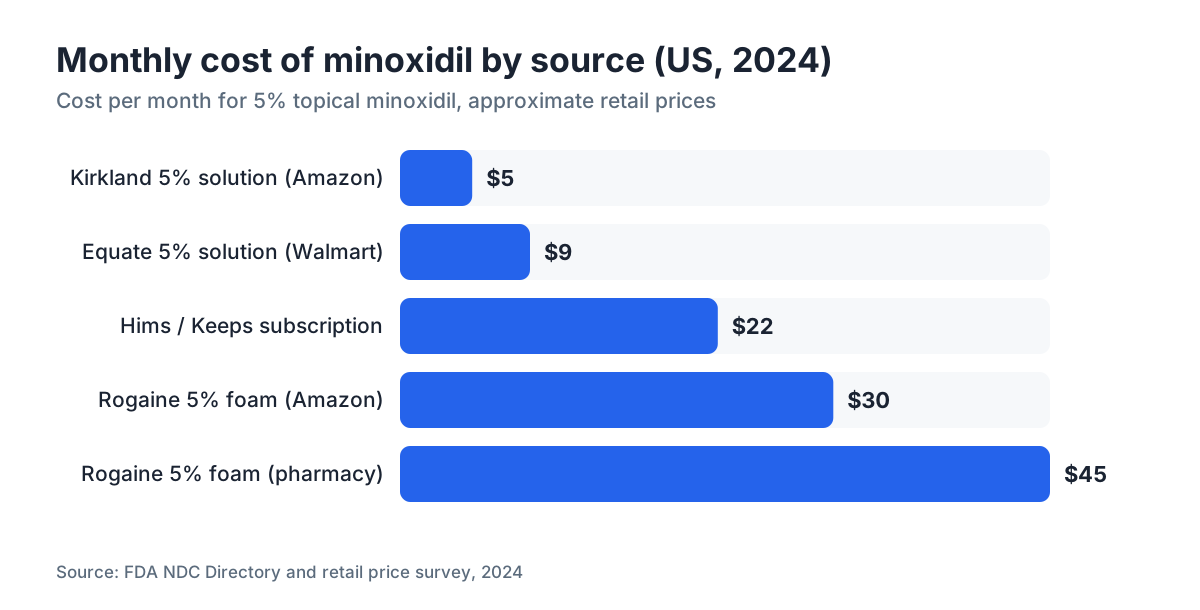
How much does minoxidil cost on Amazon compared to other sources?
Amazon is usually the cheapest source for generic minoxidil. Not always, but usually.
| Source | Product | Approx. Monthly Cost |
|---|---|---|
| Amazon (Kirkland 5% solution) | 6-month supply | $4 to $5/month |
| Amazon (Rogaine 5% foam) | 3-month supply | $25 to $35/month |
| Walmart / Target (Equate brand) | 2-month supply | $8 to $10/month |
| Hims / Keeps (telehealth) | Monthly subscription | $15 to $30/month |
| Dermatologist office / pharmacy | Branded Rogaine | $35 to $50/month |
Kirkland Signature 5% solution is consistently one of the lowest per-unit options anywhere, with enough market history to trust the manufacturing. The six-bottle set is the cheapest way to buy.
Telehealth costs more but bundles a physician consult, which earns its keep if you also want finasteride or clinical guidance on whether minoxidil fits your type of loss. Paying $20 a month for a subscription with a doctor attached beats a standalone dermatology visit in most US cities.
Hair loss supplements on Amazon are a separate animal. Most contain no minoxidil and lean on biotin, saw palmetto, and other ingredients with far weaker evidence. Don't confuse them with the drug. If you're curious what actually backs those ingredients, read hair loss supplements.
When should you consider a hair transplant instead of minoxidil?
Minoxidil works only where there's still living follicular tissue. It cannot revive follicles that have been permanently miniaturized and scarred over. That's why it helps early-to-mid stage androgenetic alopecia far more than advanced loss.
At Norwood 5 or higher, large stretches of scalp may hold follicles too far gone to respond. That's when a hair transplant becomes worth a serious talk. Modern FUE and FUT can look natural, but they're expensive ($4,000 to $15,000 depending on clinic and graft count) and they don't stop ongoing loss in the areas you didn't transplant. Most surgeons want patients on medical therapy (minoxidil, finasteride, or both) before and after surgery to protect the hair they're not moving.
The honest version: minoxidil is a maintenance drug. It slows the process. For people with heavy loss it may not carry the load alone, but it's the right first step for almost everyone before a procedure enters the conversation.
Sources
- FDA, OTC Minoxidil Drug Monograph (21 CFR Part 358)
- FDA, Recalls, Market Withdrawals, and Safety Alerts
- American Academy of Dermatology, Hair Loss: Diagnosis and Treatment
- Messenger AG, Rundegren J, 'Minoxidil: mechanisms of action on hair growth', British Journal of Dermatology, 2004
- Hu R et al., 'Combined treatment with oral finasteride and topical minoxidil in male androgenetic alopecia: a randomized and comparative study on efficacy and safety', Dermatologic Therapy, 2015
- FDA, National Drug Code Directory
- Olsen EA et al., 'A randomized clinical trial of 5% topical minoxidil versus 2% topical minoxidil and placebo in the treatment of androgenetic alopecia in men', Journal of the American Academy of Dermatology, 2002
- FDA, Current Good Manufacturing Practice (CGMP) Regulations
- Ingprasert S et al., 'Efficacy and safety of minoxidil 3% lotion for beard enhancement', Journal of Dermatology, 2016
- AAD, 'Minoxidil topical: uses, side effects, interactions', American Academy of Dermatology