TL;DR: Minoxidil 5% topical solution or foam is FDA-approved for androgenetic alopecia in men and used off-label in women. In a 48-week trial it beat 2% minoxidil, with men averaging 45% more regrowth. Expect 4 to 6 months before you can judge it. Stop using it and the gains fade in 3 to 6 months. It boosts blood flow to follicles. It does not block DHT.
What exactly is minoxidil 5% and how does it work?
Minoxidil started life as an oral blood pressure drug in the late 1970s. Patients taking it grew unexpected body hair. That side effect became the product. The FDA approved topical minoxidil 2% for men in 1988, and the 5% solution followed in 1991. [1]
At the follicle, minoxidil is a potassium channel opener. It widens blood vessels near the scalp, which raises blood flow and oxygen delivery to hair follicles. It also shortens the telogen (resting) phase and stretches the anagen (growth) phase, so hairs spend more time actively growing. What it does not do is block DHT, the androgen that shrinks follicles in the first place. That distinction changes what you should reach for. If DHT is the fire, minoxidil is a better hose. It does not turn off the ignition. For the DHT side of things, see our explainer on DHT blockers.
The 5% concentration puts down roughly twice the active drug per application versus 2%. It comes as a liquid solution (which contains propylene glycol and alcohol) and as a foam (which usually skips the propylene glycol, so it suits people who get scalp irritation from the solution).
Is minoxidil 5% FDA-approved, or is this an off-label use?
For men, it's approved. For women, it depends on the format. The FDA approved 5% topical minoxidil for men with androgenetic alopecia (male-pattern baldness). The label covers the crown area and calls for twice-daily application of 1 mL of solution or half a capful of foam. [1]
Women are the messier case. The FDA has approved topical minoxidil 2% for women. The 5% foam was later approved for women's hair loss too, at once-daily dosing. [2] The 5% solution carries a label warning against use in women in some formulations, mostly because early trials dosed women on 5% solution twice daily and flagged facial hair growth. In practice, many dermatologists recommend 5% solution for women off-label at once-daily dosing, and the American Academy of Dermatology (AAD) lists minoxidil as a first-line treatment for female-pattern hair loss. [3]
Short version: 5% foam once daily has a clean FDA approval for both sexes. 5% solution for women is off-label but common in the clinic.
How does minoxidil 5% compare to 2% for hair regrowth?
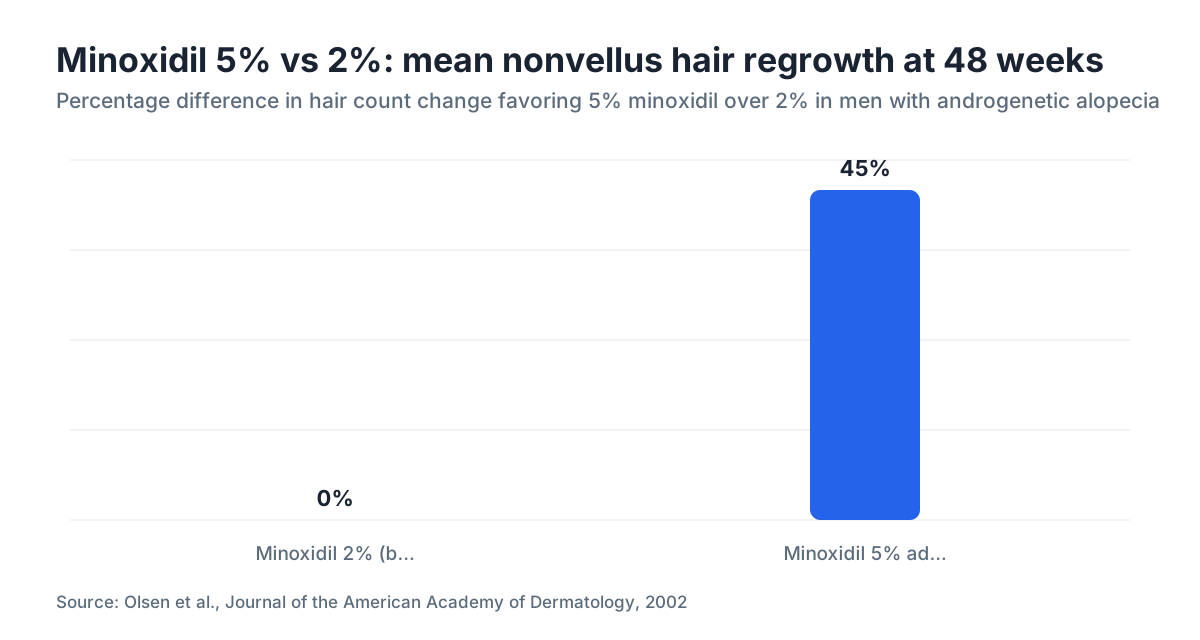
The cleanest head-to-head comes from a 48-week randomized controlled trial in the Journal of the American Academy of Dermatology. Men on 5% minoxidil solution grew 45% more hair than men on 2% solution, with mean nonvellus hair counts at week 48 significantly higher in the 5% group. The 5% group also noticed regrowth sooner. [4]
For women, 5% foam once daily has tested about even with or slightly better than 2% solution twice daily, and the foam group tolerated it better. [2]
Here's the practical read. If you're a man, there's little reason to start at 2% unless your scalp is sensitive. If you're a woman worried about side effects, starting at 2% and stepping up is fine, though many clinicians now put women straight on 5% foam once daily.
| Product | Approved sex | Dosing schedule | vs. 2% efficacy |
|---|---|---|---|
| Minoxidil 5% solution | Men (FDA); women (off-label) | 1 mL twice daily | ~45% more regrowth [4] |
| Minoxidil 5% foam | Men and women (FDA) | ½ cap once daily (women), twice daily (men) | Comparable or better [2] |
| Minoxidil 2% solution | Men and women (FDA) | 1 mL twice daily | Baseline |
| Minoxidil 2.5 mg oral | Off-label (both) | Once daily pill | See oral section below |
How long does minoxidil 5% take to actually work?
Four to six months before you can fairly judge it. That's not marketing softening the timeline, that's the biology. Minoxidil first shoves resting hairs into a new growth cycle, so the first thing many people notice at weeks 4 to 8 is more shedding. That shedding means the drug is working, not failing.
The trial timeline runs like this. The 48-week Olsen trial found statistically significant differences between the 5% and 2% groups around week 16, and the gap widened through week 48. [4] Density gains can keep coming for up to a year with steady use.
Around the 12-month mark most people plateau. Minoxidil holds what it gained and may slow further loss, but new regrowth doesn't continue indefinitely. Stop using it and the hairs that responded slide back to their miniaturized state within 3 to 6 months. There's no permanent fix here. That's a known limit, not a hidden catch.
If the shedding at weeks 4 to 8 rattles you, read our breakdown on telogen effluvium to see what's happening at the follicle.
What are the side effects of minoxidil 5%?
Most side effects are local: scalp itching, dryness, flaking, and contact dermatitis. These show up more with the solution (blame the propylene glycol) than with the foam. [5] Switching from solution to foam clears the irritation for most people.
The systemic effects people fear are real but uncommon at topical doses. Unwanted facial or body hair growth (hypertrichosis) turns up more often in women, especially at higher concentrations. [5] It usually fades after stopping or dropping the concentration.
Cardiovascular effects, including fluid retention, rapid heartbeat, and low blood pressure, sit on the FDA label but are rare with topical use because absorption through intact scalp skin is low. The FDA label notes that "less than 2% of applied minoxidil is expected to reach the systemic circulation" under normal use. [1] People with known cardiovascular disease should talk to a doctor first.
The early shedding (that telogen effluvium effect) is normal and temporary. Shedding that keeps going past 12 weeks without settling is worth a dermatology visit.
For a full breakdown with frequency data, see minoxidil side effects.
Who should use minoxidil 5%, and who should probably use something else?
Minoxidil 5% is the right first move for men with androgenetic alopecia at Norwood stages 2 through 5, with the strongest evidence in crown and vertex thinning. It does less for a badly receded hairline, though it can slow the recession. [3]
For women with diffuse thinning (female-pattern hair loss), 5% foam once daily is a reasonable first-line pick, and the AAD backs it. [3]
Who won't get much from 5% topical minoxidil: people with slick-bald patches where follicles have been gone for years, people who already stopped responding after years of use, and anyone whose loss comes from something other than androgenetic alopecia (thyroid disorders, iron deficiency, scalp scarring conditions). In those cases, treating the actual cause beats adding minoxidil. Our article on what causes hair loss covers the diagnostic side.
If your problem is a receding hairline, minoxidil slows it but rarely reverses real frontal recession alone. Most dermatologists pair it with finasteride for better hairline results. More on that pairing next.
Should you combine minoxidil 5% with finasteride?
Yes, for many men, because the two drugs hit different mechanisms. Finasteride blocks the conversion of testosterone to DHT, cutting the hormonal signal that shrinks follicles. Minoxidil improves blood flow and stretches the growth phase. They don't overlap, so the effect adds up.
A 2021 randomized controlled trial in JAMA Dermatology found that combining oral minoxidil 0.25 mg with oral finasteride 2.5 mg produced significantly greater density gains than either drug alone over 24 weeks. [6] That was oral formulations, but the additive logic carries to topical minoxidil plus oral finasteride, which is the pairing you'll see most in practice.
The AAD guideline for men with androgenetic alopecia lists both drugs as first-line and says combination use is appropriate. [3]
Finasteride brings its own risks (sexual side effects in roughly 1 to 2% of trial users, though the post-marketing picture is debated). It's prescription-only. The full tradeoff sits in our finasteride and minoxidil piece and the standalone finasteride article.
What's the difference between topical minoxidil 5% and oral minoxidil 2.5 mg?
Topical delivers the drug to the scalp with low systemic absorption. Oral sends it through your whole bloodstream. Oral minoxidil for hair loss is entirely off-label in the US, prescribed from 0.625 mg to 5 mg per day, with 2.5 mg a common middle dose for men and 1.25 mg for women. [7] There is no FDA-approved oral minoxidil hair loss indication.
The main draw of oral is compliance. One small pill beats coating your scalp with liquid or foam every day without missing spots. Oral also reaches every follicle on the scalp evenly.
The tradeoffs matter. Systemic absorption is far higher, so side effects run more common and more pronounced, especially fluid retention (swelling around the eyes or ankles), a faster heart rate, and hypertrichosis. A 2021 systematic review in JAAD found that at low oral doses (0.25 to 5 mg), the most common adverse effects were hypertrichosis (reported in up to 37% of patients) and fluid retention (up to 7%). [7]
For most people starting out, topical 5% is the safer first step. Oral makes sense if application is a compliance barrier or if topical hasn't delivered after 12 months. Our full comparison lives in the oral minoxidil article.
Minoxidil 2.5 mg oral sits in a middle zone: enough drug to reach spots topical misses, but low enough to keep side effects manageable for most patients in current low-dose studies.
How do you apply minoxidil 5% correctly to maximize results?
Application matters more than people think. The trials that proved efficacy used specific protocols, and drifting from them probably costs you results.
For the 5% solution: part your hair over the thinning area, apply 1 mL directly to the scalp (not the hair) with the dropper, and spread it lightly with your fingertips. Don't rinse for at least 4 hours. Wash your hands hard afterward, because transfer to the face grows facial hair.
For the 5% foam: apply half a capful to a dry or slightly damp scalp, not a wet one. Work it in with your fingers. The foam dissolves fast and feels less greasy than the solution.
Apply either form to a dry or towel-dried scalp, never a soaking one, because water dilutes the drug and cuts absorption. Let it dry fully before you sleep on it if you dose at night. Pillowcase transfer onto the face is a real cause of unwanted facial hair in women.
Timing: twice daily is the approved dosing for solution (men) and legitimate for foam in men. Women on 5% foam are approved for once daily. Skip doses regularly and efficacy drops, because the drug needs steady presence at the follicle.
Want a clear picture of where your thinning stands before you start? MyHairline's free AI scan (/scan) maps your hairline and gives you a baseline to measure against.
Storage matters too. Keep the foam cool; excess heat kills the propellant and the can won't dispense right. The solution stores at room temperature away from direct light.
What does minoxidil 5% cost, and is the generic as good as Rogaine?
Generic works as well as Rogaine on efficacy, and it costs a fraction as much. Rogaine, the branded 5% minoxidil foam, runs about $35 to $50 for a one-month supply (two 2.07 oz cans) at major pharmacy chains. [8] Generic 5% foam and solution from Kirkland (Costco's house brand) or pharmacy-label generics run $15 to $25 for a several-month supply.
The FDA requires generic topical drugs to show pharmaceutical equivalence: same active ingredient, same concentration, same dosage form. Minoxidil generics that clear this give you the same active molecule. The inactive ingredients differ (different foam bases, say), and for a small share of people that matters for skin tolerance, but there's no clinical evidence that branded Rogaine outperforms a properly made generic. [9]
Kirkland 5% solution (the big three-bottle packs at Costco) is widely used and has a long track record. Same concentration as the branded product.
Over a year of twice-daily use, brand versus generic is a several-hundred-dollar gap. Unless you reacted to a generic that the brand fixes, generic is the sensible choice.
When does minoxidil stop being enough and a hair transplant become worth considering?
Minoxidil does nothing for dead follicles. If a patch of scalp has been slick bald for years and scar tissue has replaced the follicles, no amount of minoxidil brings hair back there. That's when a hair transplant enters the picture.
Transplants don't replace the medication. Most surgeons tell you to keep using minoxidil (and finasteride if it fits) after surgery to protect the native hairs around the grafts. Quit, and you end up with islands of transplanted hair ringed by thinning native hair, which looks off over time.
The money gap is wide. Topical minoxidil costs maybe $200 to $400 a year. A follicular unit extraction (FUE) transplant costs $4,000 to $15,000 or more depending on graft count. For most people, minoxidil should fail or clearly fall short of your goals before surgery becomes the right call.
Men at Norwood stage 6 or 7 who want real coverage rarely get there on medication alone. That's a more honest conversation to have with a transplant surgeon.
MyHairline's AI scan (/scan) is one place to start if you're unsure of your Norwood stage or whether your pattern points toward medication or surgery.
Does minoxidil 5% work for everyone, and what predicts a good response?
No. Roughly 30 to 40% of consistent users see no meaningful regrowth. [4] Response varies with a few factors researchers have pinned down.
The big one is the enzyme sulfotransferase, specifically SULT1A1. Minoxidil is a prodrug that follicle enzymes have to convert into its active form, minoxidil sulfate. People with low scalp sulfotransferase activity respond poorly. Commercial tests (like a urinary sulfotransferase activity test) exist, but they aren't standard clinical practice yet and their predictive accuracy is debated. [10]
Other predictors of a better response: earlier-stage loss (Norwood 2 to 4 does better than 5 to 7), shorter duration of loss (follicles that have been shrinking for less time are more recoverable), and location (crown and vertex beat the frontal hairline in most studies). [3]
Age plays in. Younger men often respond better because their follicles are more intact. It's not a hard rule. Some men in their 50s respond well, especially if their donor areas stayed dense.
Consistency is the predictor you actually control. Missing applications is the single most common reason clinicians see in people who had the potential to respond and didn't.
Sources
- FDA, Minoxidil Topical Solution 5% prescribing information (NDA 019501)
- FDA, Rogaine 5% Foam approval for women (NDA 021812)
- American Academy of Dermatology, Clinical Guidelines: Hair Loss
- Olsen EA et al., "5% minoxidil vs 2% in androgenetic alopecia," Journal of the American Academy of Dermatology, 2002
- FDA MedWatch, Minoxidil Topical Side Effects Summary
- Hu R et al., "Combination oral minoxidil and finasteride vs monotherapy," JAMA Dermatology, 2021
- Randolph M, Tosti A, "Oral minoxidil treatment for hair loss," Journal of the American Academy of Dermatology, 2021
- Walgreens Pharmacy, Rogaine 5% Foam product listing
- FDA, Generic Drugs program (Office of Generic Drugs)
- Buhl AE et al., "Minoxidil sulfate is the active metabolite that stimulates hair follicles," Journal of Investigative Dermatology, 1990