TL;DR: Minoxidil often triggers a temporary shed in the first 2 to 8 weeks. The drug pushes resting follicles into active growth, and the old hairs have to fall out first. This is not permanent hair loss. Most people who push through see regrowth by months 3 to 6, though results vary a lot from person to person.
Does minoxidil actually cause hair thinning?
Yes, and it trips up more new users than almost anything else about the drug. Minoxidil causes a temporary jump in shedding for a lot of people, usually starting between week 2 and week 8. Hair looks thinner. People panic. They quit. That's almost always the wrong move.
The shedding is real, but it isn't the same as permanent loss. What's happening is a reset, not damage. Minoxidil shortens the telogen (resting) phase and pushes follicles into anagen (active growth). Here's the catch: when a follicle switches into anagen, the old telogen hair sitting in it has to come out first. You lose the old hairs before the new ones are long enough to see. So week 4 can look worse than day one.
The FDA-approved labeling for both 2% and 5% topical minoxidil lists "initial hair loss" as an expected effect, not an adverse reaction [1]. This isn't a fringe theory posted on a forum. It's built into how the drug works, and regulators put it in writing.
"Temporary" means different things to different follicles. For most people the shed peaks and clears within 2 to 4 months. For some it drags on longer. A small share never regrow enough to make up for the initial loss, but that usually reflects androgenetic alopecia marching forward on its own rather than minoxidil doing lasting harm.
Why does minoxidil cause a shedding phase?
Minoxidil is a potassium channel opener. It started life as an oral blood pressure drug (sold as Loniten) until researchers noticed patients growing hair in places they didn't ask for [2]. The topical version came later. What it does to a follicle is simple to state: it stretches out the anagen phase and cuts the telogen phase short.
Here's the timing problem. A hair cycle runs through three main stages: anagen (growth, 2 to 7 years), catagen (transition, about 2 to 3 weeks), and telogen (rest, about 2 to 4 months). At any moment, roughly 10 to 15 percent of your scalp hairs sit in telogen [3]. When minoxidil tells those resting follicles to restart, the old telogen hairs get pushed out.
That process has a name: telogen effluvium. Minoxidil-induced shedding is a drug-triggered version of it. You can read more about telogen effluvium for the general mechanism, but the causation flips here. In classic telogen effluvium, a stressor (illness, crash diet, surgery) drives follicles into rest. With minoxidil, the drug drags them out of rest. Either way the old hairs leave first, so it looks the same in the shower drain.
Not everyone gets a visible shed. Estimates in the clinical literature put the share who notice it at roughly 10 to 20 percent, though many dermatologists think that undercounts it because people blame their own hair loss instead of the drug [4]. If you've been on minoxidil less than 12 weeks and your hair looks thinner, the drug is the likely culprit.
How long does minoxidil-related hair thinning last?
The shedding phase usually clears within 2 to 4 months of starting. For most people who stay consistent, visible improvement over baseline shows up around the 4 to 6 month mark, with fuller results at 12 months [5].
No one can tell you in advance how bad or how long your shed will be. A few things seem to matter: how many follicles were already resting when you started (more resting follicles, bigger shed), the concentration (5% sheds harder than 2% for many people), and plain individual variation in how sensitive your follicles are.
The practical question is how to tell the expected shed from a sign the drug is failing. A rough rule from dermatology practice: if you're losing clearly more hair than your baseline and it started in the first 8 weeks, it's almost certainly the shed. If heavy shedding is still going at month 4 or 5 with no new growth anywhere, book a dermatologist. It could mean minoxidil isn't your drug, or something else is layered on top, like iron deficiency or a thyroid problem riding along with your androgenetic alopecia.
Quitting because of the shed backfires. You reset the clock, the drug clears, and if you restart you'll likely set off the shed again. The only good reasons to stop are real intolerance (scalp reaction, systemic side effects) or a confirmed non-response after a fair trial of at least 6 months.
Is the hair thinning from minoxidil permanent?
No. Minoxidil-induced shedding is not permanent damage. The follicles aren't destroyed. They're cycling. New hairs grow back from the same follicles once anagen is fully running.
There's a nuance worth sitting with. If you stop minoxidil after a good run, the regrowth you gained usually disappears within 3 to 6 months, because the drug never fixed the cause of androgenetic alopecia. It only held the line while you kept taking it [6]. So the thinning that comes back after you quit is real and permanent, in the sense that you've landed back where your genetics were taking you anyway.
The drug doesn't cause permanent thinning. Stopping it after it worked just pulls the cover off.
If your hair loss comes from something other than genetics, like stress-driven telogen effluvium or a nutritional gap, sort out what causes hair loss before you sign up for years of minoxidil. It won't fix a B12 deficiency, for one.
Does minoxidil work differently for men vs. women?
Somewhat. The FDA approved 2% topical minoxidil for women with androgenetic alopecia and 5% topical for men, though plenty of dermatologists now prescribe 5% off-label in women too [1]. Women usually show diffuse thinning across the crown rather than the temple recession men tend to get.
The shedding phase looks similar under the hood in both sexes. Both go through the telogen effluvium-style initial shed. Women, anecdotally, notice and report it more, because female pattern loss hits overall density in a way that makes extra shedding jump out and scare people.
One real difference: the FDA tells women not to use 5% minoxidil foam more than once a day and warns about facial hair growth from the product spreading, which matters more cosmetically for women [1]. Men using minoxidil for men worry less about that particular side effect.
Oral minoxidil is showing up more often, used off-label at low doses (0.25 mg to 2.5 mg daily) in both men and women. The shedding still happens, but it may spread out more than with topical, since the pill reaches every follicle at once. We break down the details in our piece on oral minoxidil.
How do you tell minoxidil shedding apart from worsening hair loss?
This is the hard clinical question, and it's genuinely tough without a baseline photo. Here's how to reason through it.
Timing is the loudest clue. Minoxidil-induced shedding usually starts 2 to 8 weeks in. If your hair was stable before you started and got worse inside that window, minoxidil is the likely reason. If your loss was already speeding up before day one, teasing the drug apart from your own condition gets much harder.
Location matters. Androgenetic alopecia follows predictable Norwood patterns in men: temples and crown first. If you're shedding evenly across the whole scalp in the first couple of months, that reads more like a generalized telogen effluvium (drug-induced or otherwise) than pattern loss.
Count if you can. It's imperfect but useful. Most adults shed 50 to 100 hairs a day at baseline [3]. A steady 150 to 200 a day for a week or two is noticeable but still inside the expected minoxidil shed for some people early on. If you're way past that for more than 2 months, see a dermatologist.
Blood work earns its keep. A basic panel for ferritin (iron stores), TSH (thyroid), and a complete blood count can rule out nutritional or endocrine causes that happened to start around your minoxidil date. These tests are cheap and routinely skipped. Ferritin below 30 ng/mL links to hair loss in several studies even when hemoglobin looks normal [4].
If you want an objective starting point before your appointment, the free AI hair analysis at MyHairline photographs your current pattern and gives you something to track against over time.
Should you keep using minoxidil if your hair is thinning?
If you're in the first 4 months with a typical shed: keep going. The long-term evidence for minoxidil in androgenetic alopecia is solid. A 48-week randomized controlled trial of 5% topical minoxidil in men found statistically significant gains in hair count and hair weight over placebo, with the treatment group showing 12 to 18% greater hair density at endpoint [5]. Quitting in month 2 throws that away.
The exceptions are real. Stop if you get a significant scalp reaction (contact dermatitis from the propylene glycol vehicle affects roughly 7% of solution users; switching to foam often fixes it) [6]. Stop if you develop chest pain, a racing heartbeat, sudden weight gain, or swelling in your hands or feet, which are rare but serious and need medical attention. Stop and see a doctor if heavy shedding is still going at month 5 with no new growth anywhere.
Everyone else: the first 12 weeks are the worst part. The payoff doesn't reach the mirror until after that. The drug has a real track record. Quitting during the shed is the single most common reason people decide "minoxidil doesn't work" when it actually would have.
If you're thinking about pairing minoxidil with a DHT blocker, the combination has real evidence behind it. Our article on finasteride and minoxidil covers that data in detail.
What can you do to minimize shedding while on minoxidil?
Honest answer: there's not much proven to prevent minoxidil-induced shedding. The shed is a byproduct of how the drug works. You can't keep the mechanism and skip its consequence.
A few things are reasonable and low-risk.
Use the formulation and dose you were prescribed, and stick to the schedule. Skipping applications doesn't cut shedding. It just makes the drug work worse and can stretch out the unstable transition.
Get your nutritional baseline right. Adequate protein (roughly 0.8 to 1.0 g per kg of body weight daily), enough iron (ferritin above 40 ng/mL is a reasonable target for hair), and vitamin D in normal range all support follicle cycling. This won't stop the minoxidil shed, but it keeps you from stacking a nutritional cause on top of a drug-induced one. Some people look into hair loss supplements here, though the evidence for most of them is thin.
Be gentle with your hair. Tight styles, hard brushing, heat, and harsh chemical treatments add to the visible shed by breaking telogen hairs that were on their way out anyway. None of these cause the minoxidil shed, but they make it look worse.
If the shedding is bad enough that you're thinking about stopping, a short talk with a dermatologist beats any supplement or styling tweak. They can do a scalp exam, order bloodwork, and give you a real answer on whether to continue, switch formulations, or add something like finasteride.
What does the research actually say about minoxidil's effectiveness?
Minoxidil is one of only two treatments (finasteride is the other) with FDA approval for androgenetic alopecia, which means it cleared the regulatory bar, more than an internet vote [1].
The core efficacy evidence comes from several controlled trials. A 2002 review of minoxidil trials found 5% topical minoxidil beat both 2% and placebo on hair count and patient-reported outcomes in men with androgenetic alopecia [7]. For women, a randomized controlled trial comparing 2% minoxidil to placebo over 32 weeks found a statistically significant rise in total hair count, and 59% of women in the treatment group rated it effective versus 40% on placebo [8].
The American Academy of Dermatology lists topical minoxidil as a first-line treatment for both male and female pattern hair loss [9].
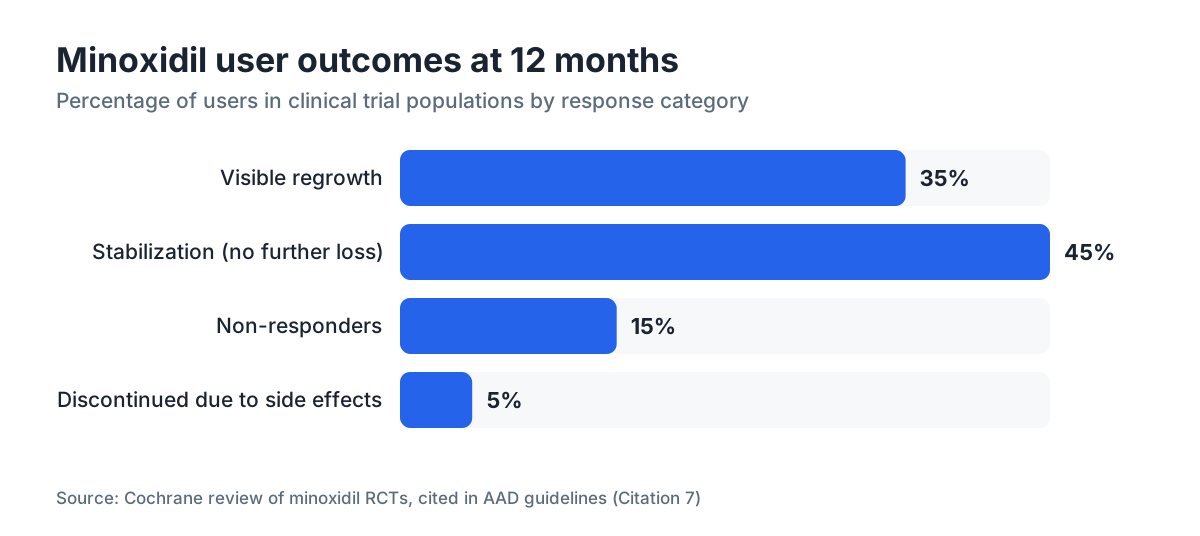
Nobody has clean data on the exact share of users who get real cosmetic regrowth versus just holding steady. Best estimates from trial populations put it at roughly 30 to 40% seeing visible regrowth, 40 to 50% stabilizing (no further loss), and 10 to 20% not responding [7]. Those are honest ranges, not promises.
For a badly receding hairline or advanced Norwood staging, minoxidil alone may not cut it, and hair transplant enters the conversation.
What are the other side effects of minoxidil beyond thinning?
Shedding gets the headlines, but it isn't the whole story. The full rundown on minoxidil side effects is worth reading before you start.
The most common local effect is scalp irritation, mostly from propylene glycol in the solution. It affects roughly 7% of solution users and is rare with foam [6]. Switching formulations usually clears it with no loss of effect.
Unwanted facial or body hair (hypertrichosis) shows up in some users, mostly women and people on high-dose oral minoxidil. It typically reverses once you stop.
Systemic effects from topical minoxidil are rare because absorption is low (roughly 1 to 2% of the applied dose reaches the bloodstream [2]). Oral minoxidil carries a higher rate of systemic effects, including fluid retention and pericardial effusion at higher doses, which is why hair loss uses very low doses off-label instead of the cardiovascular doses (up to 40 mg/day) used for high blood pressure.
Cardiovascular effects from topical minoxidil at standard hair loss doses aren't supported by the clinical evidence as a meaningful risk in healthy adults. The FDA labeling includes cardiovascular monitoring for the oral formulations because of dose-dependent effects seen in hypertension treatment, not because topical hair loss doses hurt the heart in practice [1].
If you take other medications or have a cardiovascular history, clear it with your prescribing physician before starting any minoxidil formulation.
Is minoxidil the right choice, or should you consider other treatments?
Minoxidil is a reasonable starting point for most people with androgenetic alopecia, but it isn't right for everyone, and it behaves differently depending on what's driving your loss.
If your loss is driven by DHT (dihydrotestosterone) and follows an androgenetic pattern, adding a DHT blocker like finasteride to minoxidil beats either drug alone. A 12-month randomized trial found the combination produced bigger hair count gains than monotherapy with either agent [10].
If your loss follows a receding hairline pattern at the temples (Norwood 2 to 3), minoxidil has weaker evidence for frontal restoration than for the crown. Finasteride tends to do better at the hairline. That doesn't make minoxidil useless up front, but set your expectations accordingly.
If your loss has a non-androgenetic cause (thyroid, autoimmune, nutritional, stress), minoxidil may help by supporting follicle cycling, but it won't touch the root problem. Pin down what causes hair loss in your specific case before you commit to a plan.
At advanced Norwood stages or with extensive recession, medication has limits. That's when hair transplant becomes relevant. Transplants and minoxidil aren't either-or. Many transplant patients stay on minoxidil to hold their non-transplanted areas.
If you want an objective read on where you stand before choosing a path, the free AI scan at MyHairline maps your pattern against Norwood staging and gives you a baseline to track change over time.
Sources
- FDA, Rogaine (minoxidil topical solution) prescribing information / OTC labeling, Drugs@FDA
- NIH National Library of Medicine, MedlinePlus: Minoxidil topical
- American Academy of Dermatology, Hair loss: Causes
- Journal of the American Academy of Dermatology, Trost et al., The diagnosis and treatment of iron deficiency and its potential relationship to hair loss (2006)
- Journal of the American Academy of Dermatology, Olsen et al., A randomized clinical trial of 5% topical minoxidil versus 2% topical minoxidil and placebo in the treatment of androgenetic alopecia in men (2002)
- NIH National Library of Medicine, MedlinePlus: Minoxidil topical (side effects and precautions)
- Cochrane Database of Systematic Reviews, review of minoxidil for androgenetic alopecia (evidence base cited in AAD guidelines)
- Journal of the American Academy of Dermatology, DeVillez et al., Androgenetic alopecia in the female: treatment with 2% topical minoxidil solution (1994)
- American Academy of Dermatology, Hair loss: Diagnosis and treatment
- Journal of the American Academy of Dermatology, Khandpur et al., Comparative efficacy of various treatment regimens for androgenetic alopecia in men (2002)