
TL;DR: The yellow flakes from minoxidil are dried propylene glycol and oxidized minoxidil mixed with sebum and dead skin. They're not dandruff and they're not dangerous, but a thick layer can slow how much drug gets in. Washing two to three times a week with a salicylic acid shampoo, a dry pre-wash massage, and switching to foam if it's bad clears it for most people. You never have to stop the drug.
What exactly are the yellow flakes from minoxidil?
They're not dandruff. Topical minoxidil liquid uses propylene glycol as its main carrier, and propylene glycol does not fully absorb into skin. It sits on the scalp surface, traps sebum, collects dead cells, and dries into a yellowish, waxy film. That film flakes off. That's the residue nearly every liquid user recognizes.
Propylene glycol makes up roughly 50 percent of most standard 5% minoxidil liquid formulations [1]. That's a lot of carrier for your scalp to process twice a day. Foam, by contrast, uses alcohol and water with little or no propylene glycol, which is the whole reason it leaves so much less behind [2].
The yellow tint comes from the minoxidil molecule oxidizing slightly as it meets air and skin oils. It's cosmetically annoying and nothing more. It is not an infection, it is not seborrheic dermatitis (though minoxidil can worsen existing sebderm, and that's a separate problem), and it does not mean the treatment is failing.
Some people confuse this buildup with minoxidil crystals. When the liquid dries fast on thin hair or exposed scalp, the drug itself can crystallize into white or pale yellow flecks. Those crystals are minoxidil, not carrier. The removal approach is the same either way.
Does minoxidil buildup actually harm hair growth?
Mild buildup probably does nothing to your results. Heavy, persistent buildup is a different story.
Minoxidil has to cross the stratum corneum to reach the dermal papilla cells in the follicle [3]. A thick layer of dried propylene glycol and sebum on top of the skin is a physical barrier. It doesn't block everything, but it likely trims absorption enough to matter over months, especially along the hairline where the skin is thinner and you tend to apply the most.
The better-documented problem is behavioral. A 2021 review in the Journal of the American Academy of Dermatology described scalp irritation and buildup-related discomfort as major drivers of people quitting topical minoxidil [4]. People stop because their scalp feels constantly flaky and irritated, not because the drug stopped working.
So the harm splits two ways. One part is direct (reduced absorption when buildup is heavy). One part is behavioral (you give up because your scalp is a mess). Both are fixable.
How do you remove minoxidil buildup and flakes without stopping treatment?
The protocol adds about five minutes to your normal wash and works for most people inside one to two weeks.
Pre-wash dry massage: Before any water, massage your scalp with your fingertips for two to three minutes. This mechanically loosens dried propylene glycol and dead skin. No water, no oil. Just friction.
Salicylic acid or clarifying shampoo: Use a shampoo with 1 to 3% salicylic acid, or a clarifying shampoo, two to three times a week [5]. Salicylic acid dissolves keratin-based buildup and sebum. Work it into the scalp itself, not the lengths, and leave it on two to three minutes before rinsing. The FDA recognizes salicylic acid as safe and effective for OTC scalp treatment at up to 3% [5].
Timing the wash around your dose: Apply minoxidil, wait at least four hours (overnight is ideal on a twice-daily schedule), then wash. The bulk of minoxidil's skin absorption happens in the first one to four hours after application [3]. Wash too soon and you genuinely lose drug. Wash four or more hours out and you strip the residue without giving up much of anything.
Rinse like you mean it: Propylene glycol is water-soluble. A real two-minute scalp rinse takes it off. Most people rinse for thirty seconds and wonder why the flakes come back.
For severe buildup, a diluted apple cider vinegar rinse (one part ACV to three parts water) on the scalp for five minutes before shampooing can help. Nobody has studied this in minoxidil users specifically, but ACV's acidity (pH around 3) breaks down alkaline soap film and softens dried residue. Once a week, no more. Go harder and you'll just irritate the skin.
If you're tracking your full list of minoxidil side effects, heavy flaking is worth logging, but it almost never means you should quit the drug.
Should you switch from liquid to minoxidil foam to prevent flakes?
For most people fighting persistent buildup, yes. It's the single most effective change you can make.
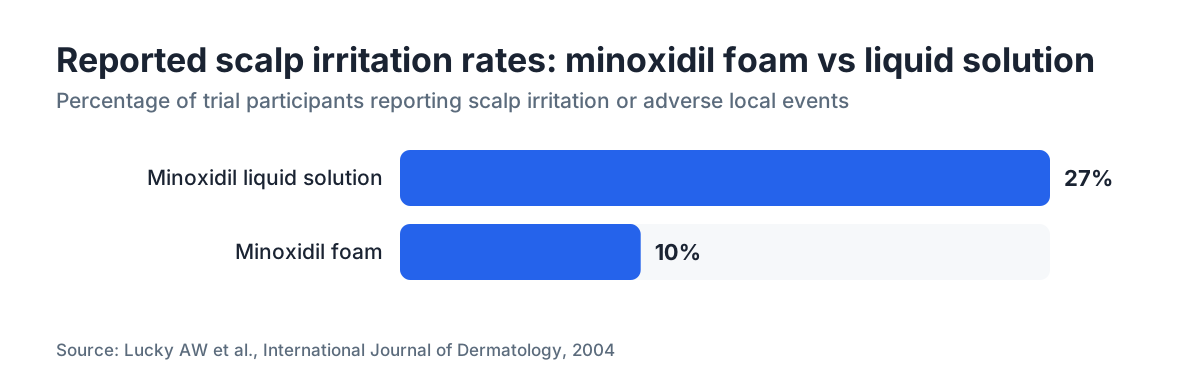
Minoxidil foam (5% for men, 5% or 2% for women depending on the product) skips propylene glycol in most major formulations. The carrier evaporates almost fully within minutes [2]. Trials comparing foam to solution found the same hair regrowth, with foam users reporting far less scalp irritation and residue [6].
Foam runs a little more than generic liquid. Propylene glycol-free liquid formulations from some compounding pharmacies are another route, often cheaper, though they aren't FDA-approved as finished products the way branded foam is [7].
On a compounded minoxidil with a finasteride combination (common in the finasteride and minoxidil conversation), check whether propylene glycol is in the base. A lot of compounders use it because it's cheap and works as a penetration enhancer. You can ask for a propylene glycol-free version.
Men wanting the full picture on topical options can start with minoxidil for men.
What's the difference between minoxidil flakes and seborrheic dermatitis?
This trips people up constantly, and it matters because the fix is different for each.
Minoxidil flakes are waxy, yellowish, and worst where you apply the most, usually the crown and hairline. They sit on the scalp surface in visible clumps and often feel a little sticky before they shed.
Seborrheic dermatitis makes flakes too, but they run whiter or silvery, come with redness and visible inflammation, and trace back to an overgrowth of Malassezia yeast [8]. Sebderm flakes cover the whole scalp, more than your application zones, and the itch is more stubborn than the mild sting of propylene glycol.
Here's the tricky part. Propylene glycol in the liquid can worsen underlying sebderm. If you had mild, controlled dandruff before minoxidil and it exploded after, that's likely propylene glycol feeding a Malassezia problem you already had [8]. The standard dermatology move then is a ketoconazole shampoo (1% OTC, 2% prescription) twice a week alongside your clarifying washes [9]. The American Academy of Dermatology names ketoconazole shampoo as a first-line treatment for seborrheic dermatitis [9].
If you truly can't tell what's on your scalp, a dermatologist can look under a dermatoscope for thirty seconds and settle it.
Does minoxidil buildup cause hair loss or shedding?
Minoxidil causes a well-documented shedding phase, usually starting two to eight weeks in and lasting up to three months [10]. That's telogen effluvium. The drug pushes resting hairs into growth early, so the old hairs let go to make room. It's temporary and it's a sign the drug is doing its job. The full breakdown is at telogen effluvium.
Buildup itself doesn't cause shedding in the clinical sense. There's a practical overlap, though. If heavy buildup irritates your scalp enough to trigger chronic inflammation, that inflammation can push follicles into a stress shedding pattern. This is uncommon and takes real, sustained irritation to happen.
Shedding a lot and unsure whether to blame the buildup or the drug? The drug's early shedding phase is far more likely. Clean up the buildup for absorption and comfort, but don't read the shedding as a sign you're doing something wrong.
How often should you wash your hair when using minoxidil?
Two to three times a week is the sweet spot. Wash daily and you strip the scalp's natural oils, which can spike reactive sebum and, oddly, make the buildup cycle worse. Wash once a week and the residue compounds past the point where one session can clear it.
Two to three washes with a salicylic acid or clarifying formula, alternated with a mild moisturizing shampoo on off days if your scalp runs dry, keeps things balanced for most users.
Apply minoxidil twice daily as most labels direct [1] and you're depositing residue roughly fourteen times a week. At two to three washes, each one has to do real work. Take the pre-wash massage seriously and don't rush the rinse.
Oily scalps can handle daily washing with a very gentle formula. The trick is picking one that doesn't dump conditioners or silicones back onto the scalp, which just lays down a fresh layer of buildup.
Can you use oils or conditioners on a scalp with minoxidil buildup?
Oils before your minoxidil dose are a problem. Any oil on the scalp cuts minoxidil penetration, because the drug in solution moves through an aqueous-to-lipid gradient and a heavy oil fights that. You're working against yourself.
Oils as an occasional pre-wash treatment are a different matter. Castor, jojoba, or coconut oil applied for thirty minutes before shampooing and then washed out completely can help loosen dried propylene glycol, and they're gone by the time you dose, so they don't touch absorption.
Conditioner belongs on the hair lengths, not the scalp. The habit of massaging conditioner into the roots is a big source of buildup for everyone, minoxidil or not. Scalp skin doesn't need conditioner the way the hair shaft does.
If minoxidil foam's alcohol dries your scalp out, a few drops of a light non-comedogenic oil (jojoba or squalane) the morning after an evening dose can soothe it without meaningfully interfering with the next evening's application.
Are there ingredients in shampoos that make minoxidil buildup worse?
Yes. A few categories to watch.
Sulfate-free shampoos are the default recommendation now, and they're fine for hair health. But sulfates clean well precisely because they're strong surfactants. Some people with heavy buildup do better using a sulfate shampoo once or twice a week for scalp cleaning, then sulfate-free the rest of the time. That's not a blanket rule, but it's worth knowing.
Silicones (dimethicone, cyclomethicone, amodimethicone on the label) deposit on the scalp and stack up over time. A product sold as a "scalp treatment" or "thickening shampoo" can be loaded with them. Read the back label.
Shampoos with heavy moisturizers baked in, like shea butter or argan oil, coat the scalp the same way conditioner does. Great for dry hair. Counterproductive on a minoxidil-laden scalp.
Anti-residue and clarifying shampoos often use EDTA (ethylenediaminetetraacetic acid) to chelate mineral deposits, or citric acid to break down alkaline residue. Either one is useful once a week for heavy buildup.
When should you see a dermatologist about minoxidil scalp buildup?
Most buildup clears with the routine above in two to four weeks. If it doesn't, or if any of the following show up, book a dermatologist.
Visible redness, real swelling, or skin that's cracking. Scaling that spreads onto your forehead, ears, or neck (that pattern is sebderm or psoriasis, not minoxidil residue). Pain instead of mild itch. A cycle where you've stopped and restarted minoxidil several times over scalp intolerance and it comes back worse each time.
A dermatologist can tell you whether you have seborrheic dermatitis, a propylene glycol contact allergy (real, less common), or psoriasis that minoxidil is stirring up. Propylene glycol contact allergy affects a meaningful minority; if your scalp stays red and irritated more than flaky, that's worth patch testing. Switching to a propylene glycol-free formulation often clears it completely [2].
If scalp health is one of several hair concerns you're tracking, the MyHairline free AI scan gives you a baseline read on visible scalp condition and hairline pattern before your appointment, which helps you describe what you're seeing.
Still deciding whether minoxidil is even the right tool for you? Start with what causes hair loss.
Does the buildup problem get better or worse over time with continued use?
It tends to plateau. The first few weeks usually produce the heaviest buildup, because your scalp hasn't adjusted its sebum output and you haven't dialed in a routine. Most people find their rhythm by month two.
It never fully disappears while you're on propylene glycol-based liquid. That's chemistry. The propylene glycol is always there, always accumulating between washes. What changes is that your routine gets efficient enough to keep pace.
Long-term liquid users who switch to foam often describe the difference as night and day in how the scalp feels. That's not a knock on liquid. Liquid works. But if you're two years in and still fighting flakes, try the foam.
Adding finasteride or another DHT blocker to your routine? The scalp discipline you build managing minoxidil buildup carries over. A clean, well-maintained scalp is a better base for any topical.
Sources
- FDA, Rogaine (minoxidil topical solution 5%) prescribing information label
- FDA, Rogaine Foam (minoxidil topical aerosol 5%) prescribing information
- Messenger AG, Rundegren J. Minoxidil: mechanisms of action on hair growth. British Journal of Dermatology 2004;150(2):186-194
- Shapiro J et al. Journal of the American Academy of Dermatology, 2021 review on androgenetic alopecia treatment adherence
- FDA OTC Monograph, Dandruff, Seborrheic Dermatitis, and Psoriasis Drug Products for OTC Human Use
- Lucky AW et al. International Journal of Dermatology 2004;43(1):62-66. Minoxidil foam vs solution RCT
- FDA, Compounding and the FDA: Questions and Answers
- Borda LJ, Wikramanayake TC. Seborrheic Dermatitis and Dandruff: A Comprehensive Review. Journal of Clinical and Investigative Dermatology 2015;3(2)
- American Academy of Dermatology, Seborrheic Dermatitis: Diagnosis and Treatment
- Olsen EA et al. Minoxidil: mechanisms of action on hair growth. Journal of the American Academy of Dermatology 2002;47(3):377-385
- National Center for Biotechnology Information, StatPearls: Propylene Glycol Toxicity