

TL;DR: Norwood 1 means your hairline is essentially unchanged from your late-teen baseline. You haven't lost hair yet. Whether you will depends heavily on genetics and age. Most dermatologists don't recommend starting medication at Norwood 1, but monitoring every 6-12 months, knowing your family history, and understanding your options puts you in the best position if things do progress.
What does Norwood 1 actually mean?
The Norwood-Hamilton scale is the standard classification system for male pattern hair loss. Norwood 1 sits at the very bottom: a full hairline with no visible recession and no significant thinning on the crown. It's the baseline adult hairline. The scale runs from 1 through 7, and the jump to Norwood 2 involves only a slight recession at the temples, so the gap between "fine" and "early loss" is not enormous. [1]
When Hamilton published the original classification in 1951 and Norwood revised it in 1975, the goal was to give clinicians a shared language for describing male androgenetic alopecia (AGA). If a dermatologist calls you Norwood 1, they are not diagnosing a problem. They are saying your hairline is still intact. [1]
The confusion for most people is that Norwood 1 can mean two very different things: you're 22 and your hair is exactly as it's always been, or you're 35 and have been carefully watching for three years. The number is just a snapshot. It doesn't tell you which direction you're heading or how fast. That's the part that actually matters if you're anxious about the future.
Am I actually at risk, or am I just anxious?
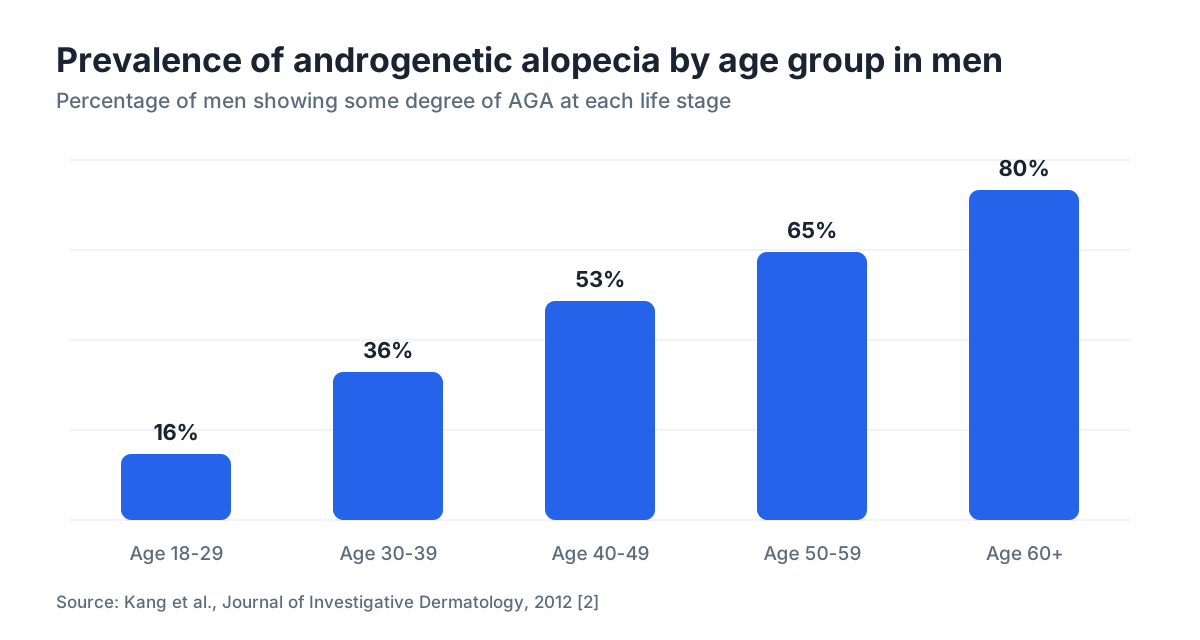
Both things can be true at once. But let's look at the real numbers. Androgenetic alopecia affects roughly 50% of men by age 50, and the prevalence rises with age. A population study published in the Journal of Investigative Dermatology found that about 16% of men aged 18-29 showed some degree of AGA, climbing to around 53% by ages 40-49. [2] So if you're young and at Norwood 1, you genuinely don't know yet which half of the population you're going to land in.
Family history is your single most informative signal. AGA is polygenic, meaning it's influenced by many genes, but the androgen receptor gene on the X chromosome (inherited from your mother's side) is one of the strongest contributors. The often-repeated rule that hair loss comes from your mother's father is a real signal, not a myth, though your father's side matters too. [3] If both your maternal grandfather and your father are significantly bald, your odds of following suit are meaningfully higher than if neither showed significant loss.
Age at which you start noticing concern also matters. If you're 19 and already anxious about your hairline, that's worth paying attention to because early-onset AGA tends to progress more aggressively than loss that begins after 35. [2] If you're 40 and still at Norwood 1, the pace of any future change is likely to be slower.
Other factors can cause temporary shedding that looks alarming but isn't androgenetic at all. Stress, illness, crash dieting, and thyroid problems can all trigger telogen effluvium, which is a diffuse shed that typically reverses on its own. Understanding what causes hair loss in your specific situation is the first step before worrying about a Norwood progression that may not be happening.
How do I know if my hairline is changing?
The most reliable method is baseline photography. Take a consistent set of photos today: front facing under the same light, overhead, left and right 45-degree angles. Note the date. Repeat every six months. This is what dermatologists do in clinical practice, and it costs you nothing.
Look for the position of your hairline relative to fixed reference points, like the outermost crease of your forehead wrinkles or the top of your ears in profile. Recession at the temples is the earliest and most common first sign of AGA in men. Diffuse thinning on the crown is the second. [1] If your photos at six months look identical to your baseline, that's genuinely reassuring. If you can see a shift, that's real information worth bringing to a dermatologist.
Some people try to track miniaturization, the process where terminal hairs progressively thin into shorter, finer vellus hairs under the influence of dihydrotestosterone (DHT). You can't see this clearly with the naked eye. A dermatologist can do a trichoscopy (dermoscopy of the scalp) and look for follicle diameter variation greater than 20%, which is a diagnostic marker for AGA. [4] This is worth getting if you're genuinely unsure whether your hairline is moving.
A receding hairline looks like a specific pattern: bilateral recession at the temples forming an M-shape. If your photos are showing that, you've likely moved to Norwood 2. If your frontal hairline is holding but you're seeing more scalp through the crown in overhead photos, that's a different AGA sub-pattern. Both are treatable, but the timelines and strategies differ slightly.
What does the Norwood progression actually look like over time?
Progression is not linear or guaranteed. Some men stay at Norwood 2 for decades. Others move from Norwood 2 to Norwood 5 within ten years. A study that followed men over five years found that early-onset AGA (beginning before age 30) was associated with faster and more extensive progression than later-onset cases. [2]
The table below gives you a rough picture of where men end up by age cohort, based on population prevalence data.
| Age range | % of men with some AGA |
|---|---|
| 18-29 | ~16% |
| 30-39 | ~36% |
| 40-49 | ~53% |
| 50-59 | ~65% |
| 60+ | ~80%+ |
Source: Norwood 1975 scale and Kang et al. population estimates [1][2]
Being at Norwood 1 at age 25 doesn't tell you if you'll be at Norwood 3 at 35 or still at Norwood 1 at 45. What it does tell you is that you have time. The treatments that slow progression work best when started early, which is exactly why the question you're asking now is the right one to ask.
Should I start finasteride or minoxidil at Norwood 1?
This is the most practical question, and the honest answer is: probably not finasteride at Norwood 1, but the decision is genuinely individual. Here's why.
Finasteride (1 mg daily, brand name Propecia) is FDA-approved for male AGA. It works by inhibiting 5-alpha reductase type 2, the enzyme that converts testosterone to DHT. Clinical trials showed it halted progression in roughly 83% of men and regrew measurable hair in about 66% over two years. [5] Those are strong numbers. But the drug carries real side effects for a minority of users, including reduced libido, erectile dysfunction, and ejaculatory disorders, reported in roughly 3.8% of men in the original trials, though post-marketing reports and longer-term surveys suggest the incidence of persistent effects may be higher. [5][6]
Starting a medication with those risks before you have confirmed, ongoing hair loss is a meaningful tradeoff. Most dermatologists and the American Academy of Dermatology guidelines reserve finasteride recommendations for men with documented AGA, meaning visible, progressing loss. [7] If you're at Norwood 1 with no confirmed movement, you'd be accepting real risk to prevent something that may not happen to you. If you have a strong family history and your dermatologist documents early miniaturization on trichoscopy, starting early gives the drug the most surface area to work with.
You can read the full breakdown of how the drug works, dosing, and the side effect picture in our finasteride guide. Also worth knowing: combining finasteride with minoxidil shows stronger outcomes than either alone in multiple trials, which is covered in detail in the finasteride and minoxidil guide.
Topical minoxidil is a lower-stakes starting point. It's FDA-approved for male AGA as a 2% or 5% topical solution or foam, applied once or twice daily. [8] It doesn't block DHT; it extends the anagen (growth) phase and may improve follicle blood supply. Side effects are mostly local: scalp irritation, and an initial shed in the first 4-8 weeks that scares people into stopping. The minoxidil for men article covers the full protocol. At Norwood 1, the argument for topical minoxidil is stronger than for finasteride because the risk profile is gentler, though you'd be treating something that may not progress, which is worth factoring into your decision.
Oral minoxidil at low doses (0.625-2.5 mg daily) is an increasingly popular off-label option that some dermatologists prefer for its consistency. It has its own side effect profile, mainly fluid retention and body hair growth, so it warrants a separate conversation with a prescriber.
Are DHT blockers like saw palmetto worth trying at Norwood 1?
Saw palmetto is the most popular OTC supplement marketed as a DHT blocker. It inhibits 5-alpha reductase, similar in mechanism to finasteride but with much weaker potency and far less clinical evidence. A small randomized trial (n=100) published in the Journal of Alternative and Complementary Medicine found saw palmetto moderately effective vs. placebo, but the evidence base is nowhere near what exists for finasteride. [9]
If you're at Norwood 1 and not ready for prescription treatment, a supplement like saw palmetto is low risk and low cost. It's probably not doing much. But it's also not dangerous, which is more than can be said for some of the products marketed to anxious men online. The hair loss supplements article separates the plausible from the pointless.
Biotin, collagen, and most "hair growth vitamins" have little to no evidence for AGA. They may help if you have an actual nutritional deficiency, but for most men eating a reasonably varied diet, they're not going to change your Norwood trajectory. Spend your money on baseline bloodwork instead: checking ferritin, thyroid (TSH), and vitamin D is actually useful because deficiencies in those markers can cause diffuse shedding on top of any genetic predisposition.
What lifestyle changes actually have evidence behind them?
Hair loss is mostly genetic and hormonal, and no lifestyle change will override a strong genetic program. That said, a few things are worth doing because they cost nothing and have at least some evidence.
Sleep and chronic stress management matter more than most people realize. Cortisol chronically elevated by poor sleep and persistent stress can push more hairs into the telogen (resting/shedding) phase. This isn't androgenetic alopecia, but it can make existing AGA look worse and is entirely reversible if addressed. [3]
Nutrition: adequate protein intake (roughly 1.2-1.6 g per kg of bodyweight daily, per sports nutrition guidance) supports hair structure since hair is essentially keratin. Iron-deficiency is a well-documented cause of diffuse shedding in both men and women, so if you're vegetarian or have had a blood loss event, checking ferritin is worth doing before attributing any shed to AGA. [3]
Scalp hygiene: there's no evidence that shampooing frequency causes or prevents AGA. Use what works for your scalp without building in anxiety around washing. Some people convince themselves they're preventing loss by shampooing less, but sebum buildup and dandruff can cause scalp inflammation, which is not helpful.
Creatine is a separate concern that many young men bring up. There is one 2009 study suggesting creatine supplementation raised DHT levels in rugby players by about 56% over three weeks. [10] That study has not been replicated in a way that firmly establishes a causal link to hair loss, but if you have strong genetic risk and are taking creatine, it's a reasonable variable to consider. The full picture is in the does creatine cause hair loss article.
When should I actually see a dermatologist?
Now, if you're anxious about it. Not because something is wrong, but because a board-certified dermatologist (ideally one who specializes in hair disorders) can do things you can't do at home. They can perform trichoscopy to look for early miniaturization, rule out non-AGA causes like scalp psoriasis or seborrheic dermatitis, and give you a genuinely calibrated risk assessment based on your family history and scalp examination.
If your baseline photos at six months show no change and your dermatologist sees no miniaturization, you can relax somewhat and simply monitor. If they do see miniaturization, you've detected it as early as possible, which is exactly where treatment works best.
The American Academy of Dermatology recommends seeing a dermatologist for hair loss concerns rather than self-diagnosing, particularly before starting any systemic treatment. [7] That's reasonable advice. A lot of men spend money on treatments they don't need, or avoid treatments that would genuinely help, because they never got a proper baseline assessment.
If you want a quick structured starting point before booking an appointment, the free AI scan at MyHairline (myhairline.ai/scan) can analyze photos of your hairline, estimate your Norwood stage, and flag patterns worth discussing with a clinician. It's not a diagnosis, but it gives you something organized to bring to your appointment.
What if I'm at Norwood 1 but I've noticed shedding?
Shedding and recession are different things, and conflating them is one of the most common sources of anxiety in men researching hair loss. Losing 50-100 hairs per day is completely normal physiology. Hair follicles cycle independently through growth (anagen), transition (catagen), and rest/shed (telogen) phases. You're always losing some hair. [3]
If you're noticing what feels like increased shedding but your hairline and density look the same in photos, the most likely explanation is either normal variation in your awareness, or a temporary telogen effluvium triggered by a stressful event, illness, or dietary change in the past 3-4 months. Telogen effluvium characteristically peaks 2-4 months after the triggering event and typically resolves within 6 months without treatment. [3]
If shedding is combined with visible thinning or recession in photos, then it may represent active AGA and warrants a dermatologist visit. But don't let perceived shedding alone push you into starting prescription treatment before you have evidence of actual structural loss.
Is hair transplant an option at Norwood 1?
No. And any surgeon who suggests otherwise is not looking out for you.
Hair transplant surgery moves follicles from your donor zone (the permanent fringe at the back and sides of your scalp) to areas of loss. At Norwood 1 there are no areas of loss to fill. Beyond that, if you're young and still progressing, a transplant planted today could be surrounded by receded native hair in ten years, producing an unnatural island pattern that requires further surgery to address. [11]
Reputable surgeons require candidates to have stabilized loss or to be on maintenance medication before transplanting. Getting assessed for a hair transplant makes more sense if you've progressed to Norwood 3 or beyond and your loss has been stable for at least a year.
The honest position: at Norwood 1, your job is to monitor, get a baseline, understand your risk, and make a thoughtful decision about whether prophylactic treatment makes sense for your situation. Surgery is not part of that conversation yet.
What's the realistic best-case and worst-case outcome if I do nothing?
Best case: you stay at Norwood 1 indefinitely, or progress so slowly over 30 years that it barely affects how you look. This happens. Plenty of men in their 50s have a hairline that's moved only minimally from their 20s baseline.
Worst case: you have aggressive early-onset AGA, you don't monitor it, and by the time you notice visible change you're already at Norwood 4 or 5. At that point, treatments still work but you've lost ground you can't fully recover. Finasteride and minoxidil halt and partially reverse loss but they can't fully restore a significantly receded hairline without transplant surgery. [5][8]
The middle path, which is what most evidence-informed practitioners suggest, is: do nothing pharmacologically right now unless you have documented progression, but start monitoring rigorously so you can act quickly if things change. The window between "early loss" and "significant loss" is usually years wide. You have time to make a good decision. Don't let anxiety push you into either extreme: panicked early treatment or denial-based inaction.
Sources
- Norwood OT. Male pattern baldness: classification and incidence. Southern Medical Journal, 1975
- Kang H et al. Prevalence and risk factors of androgenetic alopecia. Journal of Investigative Dermatology, 2012
- Rudnicka L et al. Trichoscopy: dermoscopy of the hair and scalp. Journal of the American Academy of Dermatology, 2008
- Irwig MS. Persistent sexual side effects of finasteride: could they be permanent? Journal of Sexual Medicine, 2012
- American Academy of Dermatology Association. Hair loss: diagnosis and treatment
- Prager N et al. A randomized double-blind trial of saw palmetto versus finasteride for androgenetic alopecia. Journal of Alternative and Complementary Medicine, 2002
- van der Merwe J et al. Three weeks of creatine monohydrate supplementation affects dihydrotestosterone to testosterone ratio. Clinical Journal of Sport Medicine, 2009
- International Society of Hair Restoration Surgery. Hair transplant patient information and guidelines