
TL;DR: The biggest shift in alopecia treatment in decades is JAK inhibitors: baricitinib and ritlecitinib are now FDA-approved for alopecia areata and can regrow scalp hair in roughly 30-40% of patients who respond. For androgenic alopecia, oral minoxidil and high-dose finasteride formulations are expanding options. No single treatment works for everyone, and none is a cure.
What are the newest approved treatments for alopecia right now?
JAK inhibitors are the only genuinely new drug category to reach FDA approval for alopecia, and they treat alopecia areata specifically. Before 2022, the only real options for severe areata were off-label corticosteroids and older immunosuppressants that worked inconsistently and carried real risks. That changed fast.
Baricitinib (brand name Olumiant) was approved by the FDA in June 2022 for adults with severe alopecia areata, making it the first drug ever specifically approved for the condition [1]. Ritlecitinib (Litfulo) followed in June 2023, and it covers a broader age range, down to patients 12 and older [2]. Both block JAK (Janus kinase) pathways that drive the autoimmune attack on hair follicles in areata.
For androgenic alopecia (the pattern baldness most men and women deal with), there's no blockbuster new approval yet. But the practical landscape has shifted, with oral minoxidil gaining traction in dermatology clinics and newer combination approaches under study. The word "new" does a lot of heavy lifting in hair loss marketing. Below, we separate real regulatory milestones from things that are just new to your Instagram feed.
How do JAK inhibitors work for alopecia areata?
Alopecia areata is an autoimmune condition. The immune system mistakenly targets hair follicles, collapsing the growth cycle without permanently destroying the follicle. That's the hopeful part: the follicle is still there, just suppressed.
JAK inhibitors block intracellular signaling proteins (JAK1, JAK2, JAK3, and TYK2) that immune cells use to coordinate the attack. Interrupt those signals and follicles can wake back up. The FDA's label for baricitinib describes it as a "Janus kinase (JAK) inhibitor" and notes it "inhibits JAK1 and JAK2" [1].
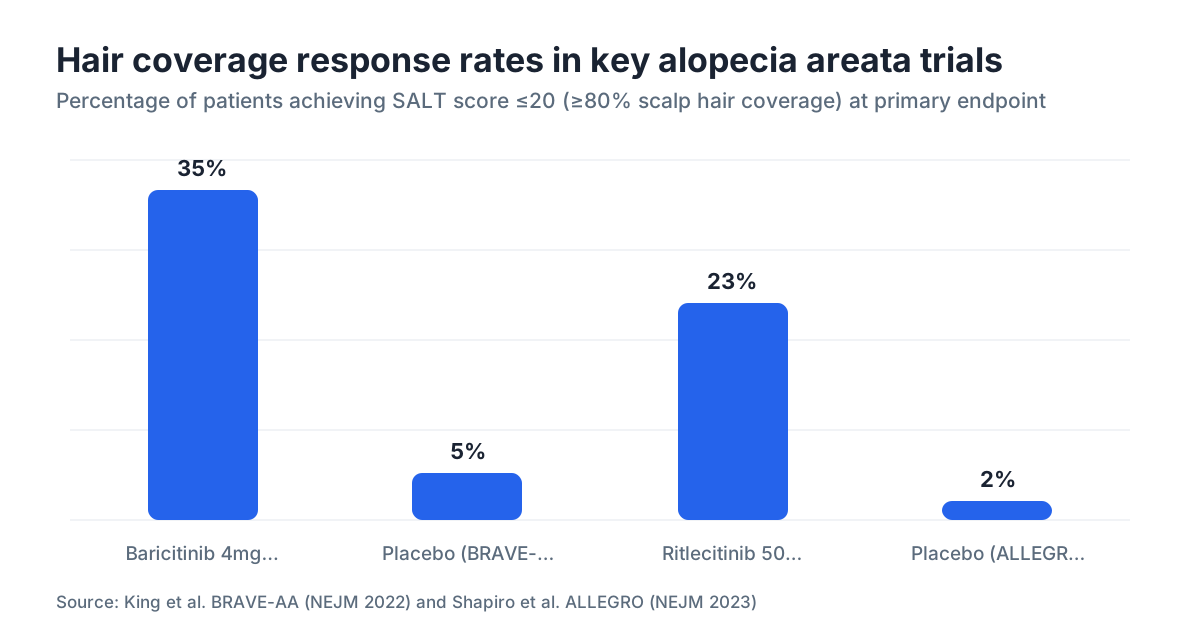
The BRAVE-AA1 and BRAVE-AA2 phase 3 trials enrolled 1,200 adults with severe alopecia areata. At the 4mg dose, about 35% of patients achieved a SALT score of 20 or below (meaning 80% or more scalp hair coverage) at 36 weeks, compared to roughly 5% on placebo [3]. That's a real signal. But 35% responding also means 65% do not reach that threshold, so expectations need calibrating.
Ritlecitinib works similarly but targets JAK3 and TEC-family kinases. In its ALLEGRO phase 2b/3 trial, 23% of patients on the 50mg dose achieved a SALT score of 20 or below at week 24, versus about 2% on placebo [4]. That's a lower absolute responder rate than baricitinib, though comparing across separate trials is imperfect.
Both drugs require continuous use. Hair tends to fall again if you stop. That isn't buried in the fine print; it's the current biological reality of autoimmune hair loss.
What are the risks and side effects of JAK inhibitors for hair loss?
This is where the conversation gets serious, and where you should read the label more carefully than the press release.
Both baricitinib and ritlecitinib carry FDA boxed warnings (the strongest warning type) for serious infections, malignancy, major adverse cardiovascular events, thrombosis, and mortality [1][2]. These warnings originate largely from data in rheumatoid arthritis populations, who are older and have more comorbidities, but the FDA applies them across JAK inhibitor class labeling.
In the alopecia areata trials specifically, the safety profile was more favorable, likely because the study populations were younger and healthier. But "more favorable" is not the same as "safe for everyone." Common side effects in the trials included headache, acne, and upper respiratory infections. Baricitinib also showed some elevation in lipid levels.
The practical upshot: these are not drugs to start without a dermatologist or rheumatologist supervising. You'll need baseline bloodwork and periodic monitoring. Anyone with a history of blood clots, active infection, or immune compromise needs a careful conversation before starting.
The cost is also real. Without insurance, baricitinib runs roughly $2,500 to $3,000 per month at retail pharmacy prices (Eli Lilly patient assistance programs exist, and insurance coverage for severe areata is improving but inconsistent). Ritlecitinib is similarly priced.
Is there a new treatment for androgenic alopecia (male and female pattern hair loss)?
Nothing truly new has been FDA-approved specifically for androgenic alopecia since topical minoxidil and oral finasteride became standards, but the way existing drugs get used has changed a lot.
Oral minoxidil is the biggest shift in androgenic alopecia management over the last five years. It's still off-label for hair loss (minoxidil tablets are FDA-approved for severe hypertension, not baldness), but multiple randomized controlled trials now support its use at low doses, typically 0.25mg to 2.5mg daily for women and 2.5mg to 5mg for men [5]. A 2021 review in the Journal of the American Academy of Dermatology found consistent efficacy signals across the available trials, with hair density improvements comparable to topical minoxidil in some studies. The side effect profile at low doses (fluid retention, hypertrichosis on the face and body) is manageable for most people, though you should understand it before starting. See oral minoxidil for a full breakdown.
For men, high-dose topical finasteride with a penetration enhancer (propylene glycol or similar vehicles) is being prescribed more frequently to reduce systemic DHT suppression compared to oral finasteride. The evidence is still thinner than for oral finasteride, but several small trials show meaningful scalp DHT reduction with lower blood DHT levels. If you're worried about finasteride's systemic side effects, reading the finasteride detail first matters.
Copeptin, clascoterone (Winlevi), and other anti-androgen topicals are also under study. Clascoterone is FDA-approved for acne, and some dermatologists use it off-label for androgenic alopecia, particularly in women who can't take oral anti-androgens. The data in hair loss is still early.
For a receding hairline specifically, the combination of finasteride and minoxidil together remains the strongest evidence-backed approach we have.
Is there a new treatment for CCCA alopecia?
Central centrifugal cicatricial alopecia (CCCA) is a scarring alopecia that mostly affects Black women, causing permanent hair loss from the crown outward. It's both underdiagnosed and understudied. The honest state of CCCA treatment in 2025 is that there is no FDA-approved drug specifically for it, and no major new approval is imminent.
What has changed is research attention. A 2019 study published in the New England Journal of Medicine found that pathogenic variants in the PADI3 gene, involved in hair shaft formation, were significantly more common in women with CCCA than in controls [6]. That's a real clue for future targeted therapy, though turning a genetic finding into a drug takes years.
Current standard management focuses on stopping inflammation and scarring before follicle destruction is complete. Dermatologists typically use intralesional corticosteroid injections, topical or oral antibiotics (doxycycline, for anti-inflammatory rather than antimicrobial effect), hydroxychloroquine, and strict avoidance of traction and chemical processing. Topical minoxidil is sometimes added to preserve remaining follicles.
Platelet-rich plasma (PRP) injections are being used off-label for CCCA by some dermatologists, but the published evidence specifically in CCCA is sparse. A few small case series exist. No large RCT has been completed.
If you have CCCA, early diagnosis matters more than any single treatment, because scarring alopecia is irreversible once the follicle is gone. A board-certified dermatologist with experience in hair disorders (trichology subspecialty) is the right starting point, not a general practitioner or a hair clinic primarily selling transplants.
What's the difference between alopecia areata treatments and androgenic alopecia treatments?
These are fundamentally different diseases, which is why their treatments barely overlap.
Alopecia areata is autoimmune. The follicle is alive but under attack by your own immune cells. The goal of treatment is to stop that attack. JAK inhibitors, corticosteroids, and older immunosuppressants all work through immune modulation. What causes hair loss has more on the different mechanisms.
Androgenic alopecia is driven by dihydrotestosterone (DHT) sensitivity in genetically predisposed follicles. The follicles miniaturize over time in response to DHT signaling. The goal of treatment is either blocking DHT (finasteride, dutasteride, saw palmetto) or stimulating follicle activity independent of hormones (minoxidil). See DHT blocker for more on how that pathway works.
The table below shows how the two conditions compare across the main treatment dimensions.
| Feature | Alopecia Areata | Androgenic Alopecia |
|---|---|---|
| Cause | Autoimmune | DHT sensitivity + genetics |
| Follicle status | Alive, suppressed | Progressively miniaturizing |
| FDA-approved drugs | Baricitinib, ritlecitinib | Minoxidil (topical), finasteride (men) |
| Newest approvals | 2022, 2023 | No new approvals since 1997 |
| Hair regrowth possible? | Yes, if caught in time | Partial, mainly slows loss |
| Treatment stops = outcome | Hair often falls again | Hair loss often resumes |
Telogen effluvium is a third, separate category, triggered by stress, illness, or nutritional deficiency, and it often resolves without drug treatment. More on that at telogen effluvium.
What does the research say about PRP, exosomes, and other emerging therapies?
Platelet-rich plasma (PRP) gets heavy marketing attention, and the evidence is genuinely mixed. A 2019 systematic review in the Journal of the American Academy of Dermatology looked at 19 randomized controlled trials of PRP for androgenic alopecia and found "significant heterogeneity" in preparation methods, making firm conclusions difficult, though the majority of trials showed improvements in hair count and density versus control [7]. The problem is standardization. How PRP is prepared, how it's injected, and how often all vary enormously between clinics. You're not buying a standardized drug. You're buying a procedure whose quality depends heavily on the operator.
Exosome therapy sits further back in the evidence chain. Exosomes are extracellular vesicles derived from stem cells that may carry growth-promoting signals. A handful of small pilot studies show interesting signals for hair growth, but no phase 3 RCT has reported results, and the FDA has warned about unapproved exosome products. In 2019, the FDA and CDC warned of serious adverse events from exosome products sold for various conditions [8]. That warning is still relevant context when a clinic pitches you on exosome injections.
Low-level laser therapy (LLLT) has FDA clearance (not approval, clearance, a lower bar) as a device for hair loss. The evidence suggests modest density improvements, particularly in men with early androgenic alopecia. It's unlikely to produce dramatic regrowth but probably isn't harmful.
Microneedling combined with topical minoxidil shows genuinely promising signals. A 2018 randomized trial published in the International Journal of Trichology found the minoxidil plus microneedling group had significantly higher hair counts than the minoxidil-alone group after 12 weeks [9]. It's worth watching, and it's relatively low risk if done by someone competent.
Are there any new treatments for alopecia that are in clinical trials right now?
Several. The pipeline is more active than it's been in years.
Deuruxolitinib is a JAK1/2 inhibitor developed specifically for alopecia areata by Concert Pharmaceuticals (acquired by Sun Pharma). Phase 3 trials were underway as of 2024 and showed competitive efficacy signals. ClinicalTrials.gov lists multiple active studies for alopecia areata JAK inhibitors [10].
For androgenic alopecia, the most watched candidate is setipiprant, a CRTH2 antagonist that targets prostaglandin D2, a signaling molecule found at elevated levels in bald scalp. Follica (a company) also has a protocol combining scalp microneedling with minoxidil under active development.
Bimatoprost (a prostaglandin analog used for glaucoma and already FDA-approved for eyelash growth as Latisse) has been studied for scalp androgenic alopecia. Results have been modest and inconsistent, and the development program has stalled.
KY1005, an anti-OX40L antibody, was in early trials for alopecia areata as of 2023, targeting a different arm of the immune pathway than JAK inhibitors.
The honest timeline caveat: most drugs in phase 2 trials never reach approval. The JAK inhibitor class succeeded largely because the mechanism was already validated in other autoimmune diseases, which shortened the evidence pathway. Brand-new mechanisms take longer.
Should you get a hair transplant instead of waiting for new treatments?
For androgenic alopecia where loss has stabilized, a hair transplant is a one-time intervention that moves DHT-resistant follicles from the back of the scalp to thinning areas. The results are permanent for those follicles. See hair transplant for what to expect on cost and outcome.
For alopecia areata, transplants are generally not recommended because the immune attack can destroy transplanted follicles just as it destroyed native ones. Some surgeons perform transplants in areata patients who've been in stable, long-term remission, but recurrence risk is real and should be fully understood before spending $10,000 to $20,000.
For CCCA, transplants into actively scarring areas are contraindicated. The disease needs to be fully inactive for at least one to two years, confirmed by scalp biopsy, before any surgeon should consider transplanting into affected zones.
The practical calculus for most men with androgenic alopecia: if you're 27 and your hairline is moving, you're not a good transplant candidate yet because loss will continue around the transplanted hair. Medical treatment first, transplant later if needed, tends to give better long-term results.
How do you figure out which type of alopecia you have before choosing a treatment?
This matters more than most people realize, because using the wrong treatment wastes time and money, and in scarring alopecias, every month of delay risks permanent loss.
A dermatologist can usually distinguish the main types with clinical examination, dermoscopy (a handheld magnifying device that shows follicle pattern under the skin), and sometimes scalp biopsy. Blood tests rule out thyroid disease, iron deficiency, and autoimmune conditions that cause shedding.
The general patterns:
Androgenic alopecia follows predictable Norwood stages in men (temple recession, crown thinning) and Ludwig stages in women (diffuse crown widening). It's gradual.
Alopecia areata shows patchy, usually circular areas of loss with an intact scalp surface and the classic "exclamation point" hairs at patch edges on dermoscopy.
CCCA starts at the crown and spreads centrifugally, with hair texture changes and sometimes scalp tenderness. Dermoscopy shows perifollicular fibrosis.
Telogen effluvium causes diffuse shedding across the whole scalp, often after a trigger like illness, surgery, or major stress.
If you want a starting point before seeing a dermatologist, a tool like the free AI hair analysis at MyHairline can help you describe your pattern more precisely, though it doesn't replace a clinical diagnosis. Accurate pattern identification is step one. Treatment decisions branch entirely on what type of alopecia you're dealing with.
If you're noticing changes, what causes hair loss is a useful read before your first appointment.
What is the realistic timeline for new alopecia treatments to reach patients?
Most people asking about "new treatments" are hoping something transformative is six months away. Sometimes it is. JAK inhibitors for areata genuinely were transformative when they arrived. But the timeline from promising trial to pharmacy shelf is almost always longer than headlines suggest.
A drug entering phase 2 trials today will take, optimistically, four to six years to reach approval, assuming it works. Most don't. The FDA's full approval pathway requires at least two large, well-controlled phase 3 trials, which each take one to two years to run plus analysis and review time.
Breakthrough therapy designation (which the FDA granted to some JAK inhibitors for alopecia areata) can shorten review timelines by enabling more frequent FDA interaction during development [11]. But "breakthrough designation" often gets reported as if the drug is basically approved. It's not. It means the FDA thinks the early evidence is compelling enough to prioritize review, which matters but is not the same as approval.
The most realistic advice: use the best available treatments now, monitor the clinical trial registry (ClinicalTrials.gov) for trials you might qualify for, and revisit the treatment conversation with your dermatologist every 12 months. The field is moving fast enough that the conversation changes year to year.
What are the costs of new alopecia treatments and does insurance cover them?
Cost and coverage are often the deciding factor, so let's be direct.
Baricitinib at the 4mg dose for alopecia areata has a list price of roughly $2,400 to $3,100 per month without insurance, based on pharmacy pricing databases as of 2024. Ritlecitinib is in a similar range, roughly $2,000 to $2,700 per month at list price.
Insurance coverage for alopecia areata JAK inhibitors has been improving since the FDA approvals, but coverage varies significantly by plan. Medicare and Medicaid coverage depends on state and formulary. Eli Lilly offers a patient assistance program for baricitinib (Olumiant Together), and Pfizer has one for ritlecitinib (Litfulo Access). These programs can cut costs substantially for qualifying patients.
For androgenic alopecia, oral minoxidil is generic and cheap, typically $15 to $40 per month. Topical finasteride compounds from compounding pharmacies run roughly $40 to $80 per month. FDA-approved oral finasteride (1mg) is available generic for under $20 per month in most US pharmacies. Minoxidil for men covers what to expect from the standard topical.
PRP sessions run $400 to $1,500 each, and most protocols suggest three to four sessions initially plus maintenance, so total first-year costs can top $5,000. No insurance coverage for cosmetic PRP.
Hair transplants: $4,000 to $20,000 depending on graft count and clinic, not covered by insurance for cosmetic indications.
If budget is a constraint, generic oral minoxidil plus generic oral finasteride (for eligible men) is the best evidence-to-dollar starting point for androgenic alopecia. For areata that's truly severe and hurting quality of life, the JAK inhibitor patient assistance programs are worth the paperwork.
Sources
- FDA, Olumiant (baricitinib) prescribing information and approval
- FDA, Litfulo (ritlecitinib) approval announcement
- King B et al., BRAVE-AA1 and BRAVE-AA2 trials, NEJM 2022
- Shapiro J et al., ALLEGRO phase 2b/3 trial, NEJM 2023
- Randolph M, Tosti A. Oral minoxidil review, J Am Acad Dermatol 2021
- Malki L et al., PADI3 variants in CCCA, NEJM 2019
- Gupta AK et al., PRP systematic review, J Am Acad Dermatol 2019
- FDA safety communication on exosome products
- Dhurat R et al., microneedling plus minoxidil RCT, Int J Trichology 2018
- ClinicalTrials.gov, NIH registry of clinical studies
- FDA, Breakthrough Therapy designation program
- American Academy of Dermatology, alopecia areata treatment guidelines