

TL;DR: The Norwood scale (also called the Hamilton-Norwood scale) classifies male pattern hair loss into 7 stages, from a full hairline at Stage 1 to near-total baldness at Stage 7. Doctors and hair transplant surgeons use it to decide whether medication, surgery, or monitoring is the right move. Most men with genetic hair loss fall between Stage 2 and Stage 4 when they first seek help.
What is the Norwood scale and why does it matter?
The Norwood scale is the standard classification system for male pattern baldness (androgenetic alopecia). It gives doctors, surgeons, and patients a shared language for describing how far hair loss has progressed and, more practically, for deciding what to do about it.
The original scale was published by Dr. James Hamilton in 1951 and later revised and expanded by Dr. O'Tar Norwood in 1975, which is why you'll see it called both the Hamilton scale and the Hamilton-Norwood scale [1]. Norwood's version added a Type A variant that accounts for a different pattern of recession that doesn't follow the usual crown-first or temples-first path.
Why does it matter? Because treatment decisions actually hinge on your stage. A man at Stage 2 almost certainly doesn't need a hair transplant. A man at Stage 6 may not be a great transplant candidate either, because there isn't enough donor hair to cover that much scalp. The scale is the map. Without it, you're guessing.
What does each Norwood stage look like?
Here's what each stage actually describes, in plain terms:
Stage 1 is baseline. No recession, no thinning. The hairline of a teenager. Most men don't stay here forever if they carry the genetic predisposition.
Stage 2 is where many men first notice something. The temples have slight recession, creating a very mild M-shape. The hair on top is still full. This stage often goes unnoticed for years and is easy to dismiss as a mature hairline.
Stage 3 is the first stage the scale's creator defined as clinically significant hair loss. The temples are deeply recessed, and the M-shape is obvious in photographs. Stage 3 Vertex is a sub-type where thinning appears on the crown (vertex) rather than, or in addition to, the temples.
Stage 4 means the hairline recession and crown thinning are both clearly visible, but a band of hair still separates the two areas. The scalp is becoming visible under certain lighting on the crown.
Stage 5 is when that band of hair connecting the top of the head to the sides starts to thin out and narrow significantly. The two areas of loss are nearly merged.
Stage 6 is when they merge. The hairline and crown form one large bald area. Only a horseshoe ring of hair remains on the sides and back.
Stage 7 is the most extensive pattern. The horseshoe of remaining hair is sparse, sits low on the head, and may be thin in texture. This is the end stage of the scale.
The Type A variants (2A through 4A) describe a different recession pattern: the hairline recedes straight back across the entire front rather than from the temples inward, and crown thinning is minimal or absent [1]. These men often look balder at the front than their stage number suggests because there's no island of hair left at the forelock.
| Stage | Hairline | Crown | Visible scalp on top? |
|---|---|---|---|
| 1 | Juvenile, full | None | No |
| 2 | Slight temple recession | None | No |
| 3 | Deep temple recession | None or early | Sometimes |
| 3 Vertex | Mild temple recession | Early thinning | Yes (crown) |
| 4 | Significant recession | Moderate thinning | Yes |
| 5 | Recession + crown merging | Extensive | Yes |
| 6 | Merged into one bald area | Fully merged | Yes |
| 7 | Horseshoe only, sparse | Fully bald | Yes |
One honest note: the scale is not perfectly precise. Two experienced dermatologists looking at the same patient can assign different stages, especially in the murky middle ground between Stage 3 and Stage 4 [2]. It's a clinical tool, not a blood test.
How common is each Norwood stage among men?
Androgenetic alopecia is strikingly common. About 50% of men show some degree of hair loss by age 50, and that figure climbs to roughly 70% by age 70 [3]. The American Academy of Dermatology puts the overall prevalence of male pattern hair loss at more than 50 million men in the United States [4].
Breaking it down by stage is harder because good population-level data on stage distribution is limited. The most-cited reference study (Norwood's own 1975 paper based on over 1,000 subjects) found that Stage 2 and Stage 3 together accounted for the largest share of affected men, with Stage 7 being the least common [1]. A 2009 cross-sectional study of German men found that Stage 3 Vertex was the most frequent presentation, and prevalence at every stage increased with age [5].
Here's the practical takeaway. If you're in your 20s or early 30s and you're at Stage 2 or 3, you're in the most common group seeking treatment. You're not an edge case.
What causes progression through the Norwood stages?
The underlying driver is dihydrotestosterone, or DHT. DHT is a potent androgen made from testosterone by the enzyme 5-alpha reductase. In men with a genetic sensitivity to DHT, the hormone binds to receptors in scalp hair follicles and progressively shrinks them through a process called miniaturization. The follicle produces thinner, shorter, lighter hairs with each cycle, and eventually stops producing a visible hair at all [6].
The genetics are polygenic, meaning many genes contribute rather than one. The androgen receptor gene on the X chromosome is the most studied (which is why maternal grandfather baldness is relevant), but genome-wide studies have found over 350 loci associated with hair loss risk [7]. You can inherit the predisposition from either parent.
Age is the other major variable. DHT exposure adds up over time, so follicles that were borderline sensitive at 25 may cross into miniaturization by 40. This is why Norwood stage tends to progress, usually slowly, rather than stabilize permanently.
Stress, nutritional deficiency, and thyroid disorders can speed up shedding, but they don't cause permanent follicle miniaturization the way DHT does. If you're losing hair rapidly and diffusely, it's worth ruling out telogen effluvium before assuming you're watching androgenetic progression. To understand the full picture of what's driving your loss, the guide on what causes hair loss goes deeper into the non-genetic contributors.
How do doctors diagnose your Norwood stage?
Diagnosis is mostly visual and clinical. A dermatologist or trichologist examines your hairline, part, and crown, often under a dermatoscope (a handheld magnifying device with light) to look for follicle miniaturization before it's visible to the naked eye [2].
They'll ask about your family history on both sides, how long the loss has been progressing, and whether you've noticed any diffuse shedding (which might point to a separate or overlapping cause). A pull test, where the doctor gently grasps 50-60 hairs and pulls, can help tell active shedding apart from stable patterned loss.
Blood work isn't required to diagnose androgenetic alopecia, but a good clinician will check thyroid function (TSH), ferritin, and sometimes a complete blood count if there's any suspicion of a systemic cause. DHT levels in the blood don't reliably predict hair loss severity, because the sensitivity is at the follicle receptor level, not the serum concentration.
Want a starting point before you see a doctor? Tools like the free AI hair scan at MyHairline can give you a rough sense of your stage from photos, though they don't replace a clinical exam.
Which treatments work at each Norwood stage?
Treatment strategy shifts a lot depending on stage. Here's what the evidence actually supports.
Stage 1 and 2: If you're not losing hair yet, there's nothing to treat. If you're at Stage 2 with a family history that concerns you, some dermatologists will prescribe low-dose finasteride preventively, though most take a watch-and-wait approach. Starting minoxidil at Stage 2 is safe and can slow progression, but the decision should feel personal, not reflexive.
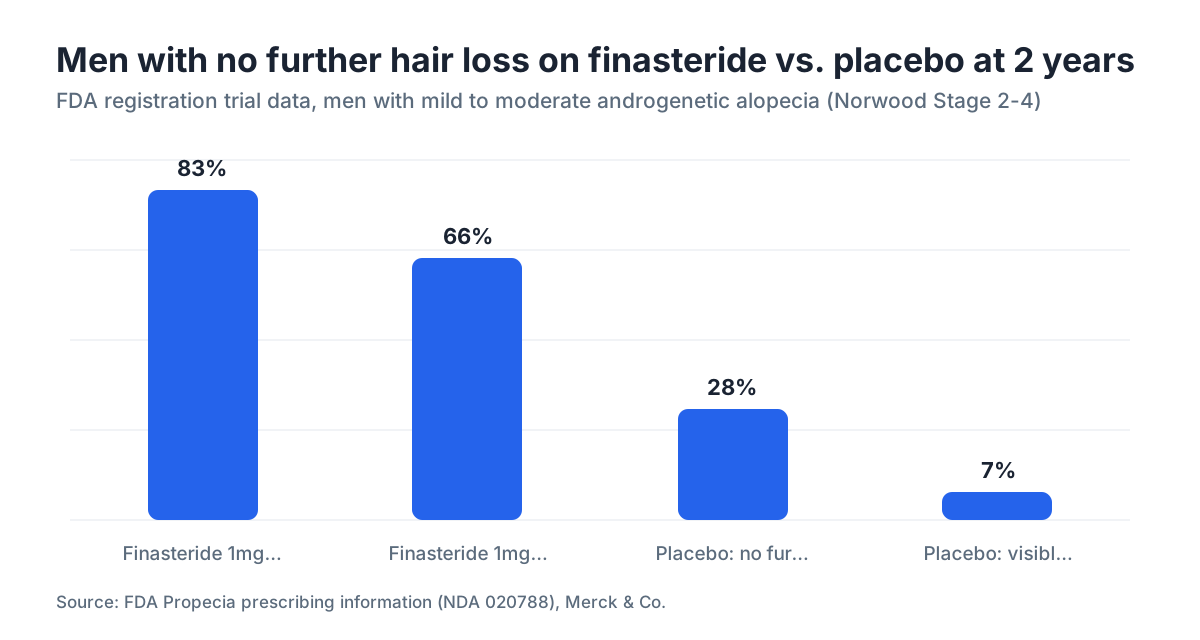
Stage 2 and 3: This is the sweet spot for medical therapy. Finasteride (1 mg daily, oral) has the strongest evidence for slowing and partially reversing miniaturization. The FDA-reviewed registration trials found that 83% of men taking finasteride had no further hair loss at two years, and 66% had visible regrowth [8]. Topical minoxidil for men applied twice daily (2% or 5% solution, or 5% foam) is FDA-approved as well and works through a different mechanism, increasing follicle blood flow and extending the growth phase [6]. Using both together gives better results than either alone, as the guide on finasteride and minoxidil covers in detail.
Stage 3 Vertex and Stage 4: Medical therapy can still slow progression and preserve existing hair, but results are more modest. Some men at Stage 4 start exploring hair transplant consultations while staying on medication to protect non-transplanted hair.
Stage 5 and 6: A hair transplant is often the most visible option, but donor supply is a real constraint. A surgeon needs to extract enough follicles from the permanent zone (sides and back) to cover the bald area. At Stage 6, that math gets tight. Medication should continue after a transplant to protect native hairs.
Stage 7: Transplant feasibility drops sharply. The donor zone is limited and sometimes fine-textured, which makes coverage difficult and results look thin. Some Stage 7 men shave their head and find it suits them. Scalp micropigmentation (a cosmetic tattooing technique) can create the look of a close-shaved head on a bald scalp, and some men prefer that outcome to a modest transplant.
Finasteride has known side effects you should read about before starting it, including sexual side effects that occur in roughly 1-2% of users in clinical trials [8]. The finasteride article and the dht blocker overview both cover the pharmacology and risk profile honestly.
For anyone considering oral minoxidil instead of topical, the dosing, evidence, and minoxidil side effects are meaningfully different from the topical form and worth understanding separately.
Is the Norwood scale used for women too?
No. Women lose hair differently. Female pattern hair loss usually shows up as diffuse thinning across the top of the scalp, not recession from the temples and crown. The Ludwig scale (published 1977) is the standard classification system for women, using three grades based on the width of the central part and density across the crown [2].
A woman with a receding hairline is more likely dealing with traction alopecia from tight hairstyles, frontal fibrosing alopecia (a scarring condition), or hormonal causes than androgenetic alopecia in the classic Norwood pattern. If a woman is given a Norwood stage, that's a red flag that the clinician may not specialize in female hair disorders.
What does a receding hairline at Stage 2 look like vs. a mature hairline?
This is one of the most common questions men in their early 20s ask, and the confusion is legitimate. A mature hairline is a normal, permanent shift that happens to most men between ages 17 and 29. The hairline moves back slightly from its teenage position, losing that straight-across-the-forehead look, but it stabilizes and doesn't keep thinning or receding further.
Stage 2 recession looks similar at first, but it doesn't stop. The temples keep creeping back over months or years, and the density behind the hairline may start to thin. Miniaturization under a dermatoscope is the clearest tell: a mature hairline has full, normal-caliber hairs; early androgenetic alopecia shows a mix of thick terminal hairs and thin, short vellus-like hairs in the recession zone [2].
If your hairline has moved and stayed put for two-plus years with no further change, it's probably mature. If it keeps shifting, get it checked. The receding hairline article goes into more detail on how to tell the difference and when to act.
How fast does hair loss progress through the Norwood stages?
Progression speed varies enormously between individuals, and honestly, predicting it for any one person is hard. Some men go from Stage 2 to Stage 5 in five years. Others spend a decade between Stage 3 and Stage 4.
A few rough patterns from the research:
Men who start losing hair in their early 20s tend to progress faster and reach higher stages than men whose loss begins after 30 [5]. Early onset is linked to a more aggressive genetic predisposition.
Rate of loss in the first two years after you notice it is a reasonable predictor of future rate. If you've lost visible ground quickly, assume it will keep going quickly without intervention.
Finasteride substantially slows progression. The two-year trial data showing 83% of men with no further loss [8] has held up in longer studies, with five-year data showing continued benefit in most users. Stopping the medication typically brings resumed progression within 6-12 months.
There's no way to predict your Norwood endpoint from a snapshot of your current stage. Some Stage 3 men never progress further. Some hit Stage 6 by their mid-30s. The honest answer is that monitoring over 6-12 month intervals, ideally with standardized photos in the same lighting, is the only way to know your personal trajectory.
What is the Norwood Stage 3 Vertex and why is it clinically important?
Stage 3 Vertex is worth calling out on its own because it's the earliest stage where crown (vertex) thinning appears, and crown thinning changes the whole treatment plan.
In standard Stage 3, recession is confined to the temples. In Stage 3 Vertex, a bald or thinning spot shows up on the crown even though the hairline recession itself might be modest. This pattern often means the person will eventually develop the connected crown-and-hairline loss of Stage 5 or 6, even if it doesn't look that dramatic yet.
For transplant surgeons, treating a Stage 3 Vertex patient carries more risk than treating a Stage 3 patient without crown involvement. If you place grafts in the crown at Stage 3 Vertex and the patient progresses to Stage 6 in his 40s, the transplanted island of hair in the crown looks unnatural surrounded by bald scalp. Most experienced surgeons either decline to fill the crown until the pattern stabilizes, or counsel patients to commit to lifetime medication.
If you have crown thinning, tell your surgeon or dermatologist directly. It changes the treatment map.
Can you reverse Norwood stage with treatment?
Partially, in some cases. Not fully, in most.
Finasteride and minoxidil can reverse miniaturization in follicles that haven't fully stopped producing hair. The FDA-approved indication for finasteride covers men with mild to moderate hair loss (roughly Stage 2-4), and that's where the regrowth data comes from [8]. Men with Stage 5-7 loss weren't included in the registration trials, partly because there's little active follicle biology left to work with in the bald zones.
What this means in practice: catch loss early and you can push back. If your scalp has been smooth and bald for years, those follicles are likely gone, and no medication approved today will bring them back. A hair transplant moves permanent donor follicles to bald areas; it doesn't restore the original follicles.
The word "regrowth" in clinical trials means a measurable increase in terminal hair count compared to baseline, not a full return to Stage 1. Finasteride's 66% regrowth rate [8] means two-thirds of men see some improvement in hair density, but most don't recover a full teenage hairline. Managing expectations honestly here matters more than any treatment choice.
How is the Norwood scale used in hair transplant surgery?
Surgeons use Norwood stage in at least three distinct ways.
First, for candidate selection. Stages 2-4 with stable loss and adequate donor density are generally good candidates. Stages 6-7 are harder to treat well because the math of available donor follicles versus bald area to cover rarely works in the patient's favor.
Second, for graft planning. A follicular unit transplant or FUE procedure involves extracting individual follicular units (each holding 1-4 hairs) from the permanent zone and placing them in bald or thinning areas. The number of grafts needed depends on stage: a Stage 3 frontal recession might need 1,500-2,500 grafts, while a Stage 5 with hairline and crown involvement might need 4,000-6,000+ across multiple sessions [9]. Donor supply caps out around 6,000-8,000 lifetime grafts for most people.
Third, for future-proofing. A good surgeon asks where this patient is going to be in 15 years. Placing grafts for a Stage 3 pattern in a man likely to progress to Stage 6 means designing a hairline that will still look natural decades later. This is a real skill difference between average and excellent surgeons.
The full breakdown of procedures, costs, and what to expect is in the hair transplant guide.
Sources
- Norwood OT. Male pattern baldness: classification and incidence. Southern Medical Journal, 1975
- American Academy of Dermatology, Hair loss types: Androgenetic alopecia
- Vary JC Jr. Selected disorders of skin appendages: acne, alopecia, hyperhidrosis. Medical Clinics of North America, 2015
- American Academy of Dermatology, Hair loss: Who gets and causes
- Heilmann-Heimbach S et al. Meta-analysis identifies novel risk loci and yields systematic insights into the biology of male-pattern baldness. Nature Communications, 2017
- FDA, Drugs@FDA database (minoxidil topical solution labeling)
- Kaufman KD. Androgens and alopecia. Molecular and Cellular Endocrinology, 2002
- FDA, Drugs@FDA database (Propecia finasteride prescribing information, NDA 020788)
- International Society of Hair Restoration Surgery, Practice Census Results
- Sinclair R et al. Male androgenetic alopecia. BMJ Clinical Evidence, 2011
- Kanti V et al. German Dermatology Society study on prevalence of male androgenetic alopecia by age. JDDG: Journal der Deutschen Dermatologischen Gesellschaft, 2018