
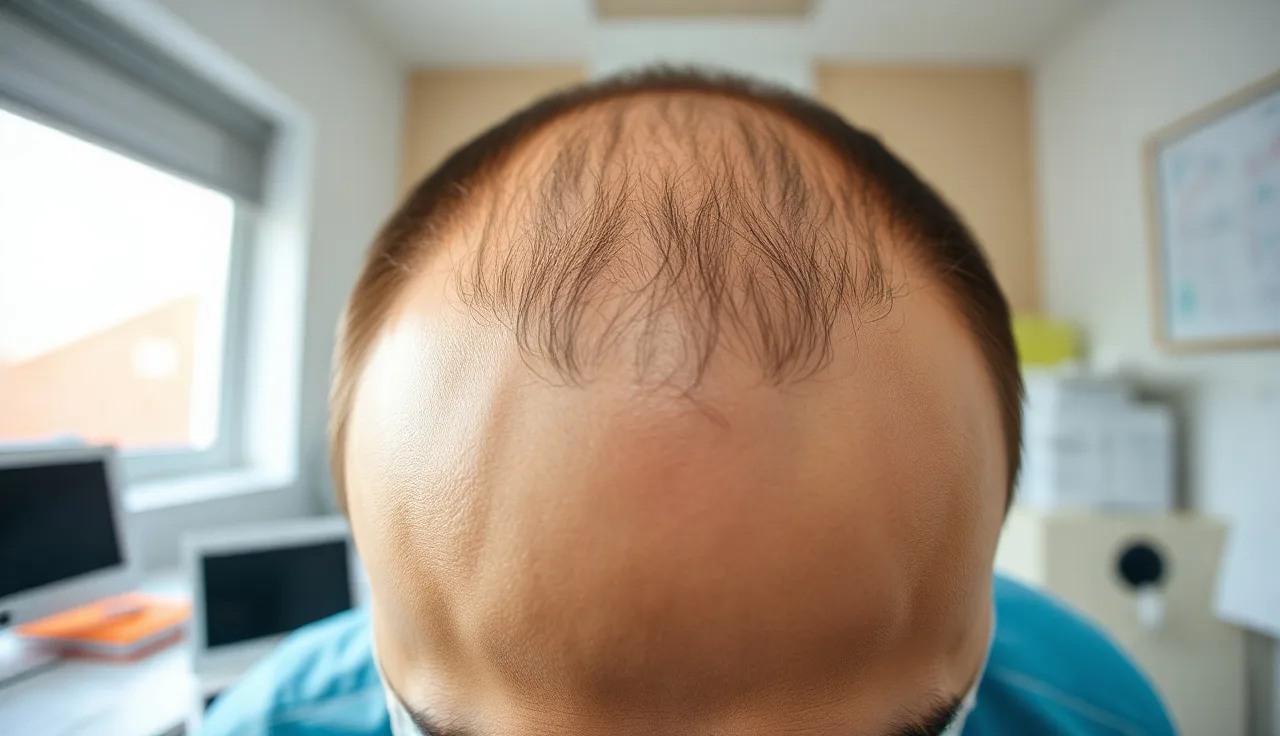
TL;DR: The Norwood scale sorts male pattern baldness into seven stages, from a full hairline (Type I) to near-total loss (Type VII). Doctors and transplant surgeons use it to track progression and pick treatment. Finasteride and minoxidil work best at Norwood II-IV. Transplants get harder at V-VII. The earlier you treat, the more hair you keep.
What is the Norwood scale and who created it?
The Norwood scale is the most widely used system for classifying male pattern baldness. A physician named James Hamilton first sketched out the classification in the 1950s. O'Tar Norwood revised and expanded it in 1975, and that revised version, published in the Southern Medical Journal, is what dermatologists and hair restoration surgeons still reference today [1].
The scale runs from Type I through Type VII, with a separate "A" variant for men whose hairline recedes straight back rather than leaving an island of hair on top. Type I is essentially a full, unaffected hairline. Type VII is the most advanced stage: a band of hair remains only along the sides and back of the scalp, with everything else gone.
It sounds simple, and in broad strokes it is. But a lot of nuance gets compressed into those seven numbers. Two men classified as Norwood IV can look quite different from each other depending on hair density, texture, and how much the crown versus the frontal zone is affected. The scale is a communication tool and a rough treatment guide, not a precise biological measurement.
What does each Norwood stage look like?
Here is a plain description of each stage. A dermatologist can place most men into the right category in about thirty seconds.
Type I: No meaningful recession. The juvenile hairline is intact. Many men in their 20s sit here and stay here forever.
Type II: A slight recession at the temples. The hairline has moved back a centimeter or so on each side, forming shallow triangular areas. Hair on top is still full.
Type III: The first stage considered clinically significant hair loss. The temples have receded deeper, forming more pronounced triangles. In Type IIIa (the "A" variant), recession is across the entire front rather than just the corners. Type III Vertex adds early thinning at the crown.
Type IV: Recession at the front is deeper, and thinning at the crown is more obvious. A band of hair still separates the two zones. This is where many men first feel the loss looks undeniable.
Type V: The band of hair separating the front recession and the crown thinning has thinned significantly. The two zones are starting to merge.
Type VI: The two zones have merged completely. A large area of the top of the scalp is bald or nearly bald. Hair on the sides and back remains.
Type VII: The most advanced stage. Only a horseshoe-shaped fringe of hair remains around the sides and back of the head. The top is entirely bald. Donor hair for a transplant is limited here, which makes surgical restoration complicated [2].
The "A" variants run parallel to the main scale but describe a different pattern of recession. In the A variants, the hairline recedes uniformly from front to back with no island of hair preserved at the front. Type IVa and Va are the most common A-variant presentations.
How common is each Norwood stage?
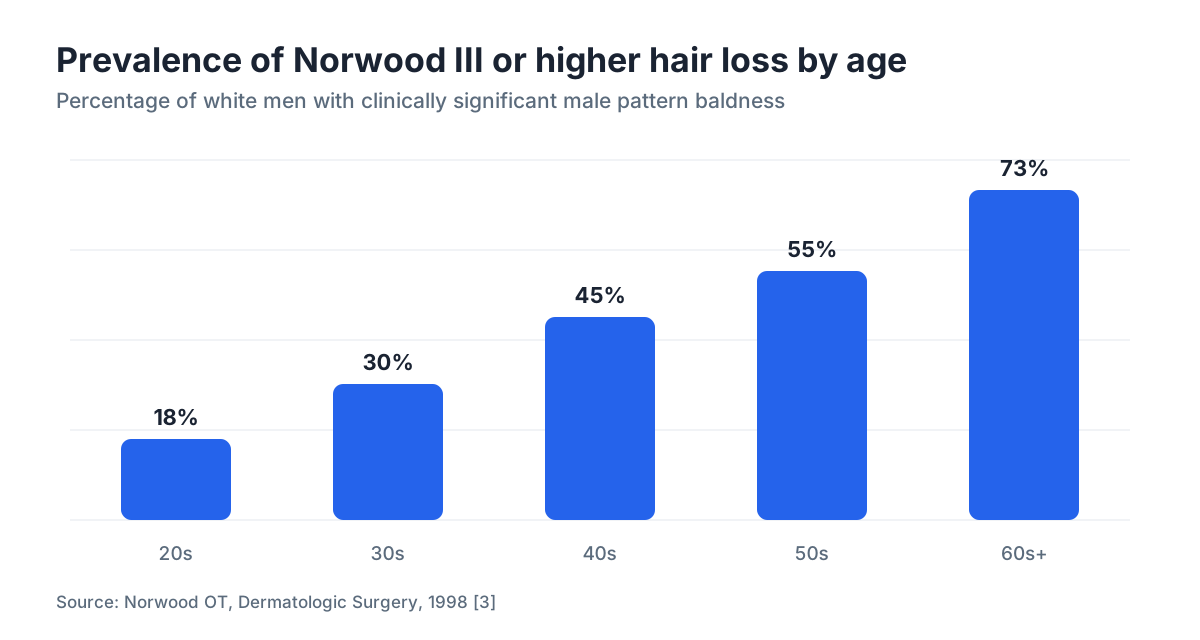
Male pattern baldness is extremely common, far more so than most men realize before they start losing hair. A 1998 study in Dermatologic Surgery looked at prevalence across age groups and found that by age 50, roughly half of white men show Norwood III or higher [3]. By their 70s, about 80 percent of men have some degree of androgenetic alopecia.
Here is a rough breakdown by age, based on the available epidemiological literature [3][4]:
| Age range | Approximate % with Norwood III or higher |
|---|---|
| 20s | 15-20% |
| 30s | 25-35% |
| 40s | 40-50% |
| 50s | 50-60% |
| 60s+ | 65-80% |
These numbers vary by ethnicity. Asian and Black men tend to experience androgenetic alopecia at lower rates and with different patterns than white men [4]. The Norwood scale was developed primarily from observations of white men, which is worth keeping in mind if your hair loss pattern feels like it doesn't quite match the diagrams.
Women have their own classification system, the Ludwig scale, because female pattern hair loss typically causes diffuse thinning at the crown rather than a receding hairline. The Norwood scale does not apply to women.
What causes progression through the Norwood stages?
The engine behind male pattern baldness is dihydrotestosterone, or DHT. DHT is a hormone derived from testosterone by the enzyme 5-alpha reductase. In men who are genetically susceptible, DHT binds to androgen receptors in hair follicles and causes them to miniaturize over time, producing progressively thinner and shorter hairs until the follicle stops producing visible hair entirely [5].
The genetic susceptibility is polygenic, meaning many genes contribute. Despite popular belief, you do not inherit it only from your mother's side. Both parents contribute. If your father is a Norwood VI and your maternal grandfather had a full head of hair, you could still develop significant hair loss. Nobody can predict your endpoint Norwood stage with certainty.
The rate of progression varies widely. Some men move from Norwood II to IV in their 20s. Others stay at III for decades. Stress, illness, crash diets, and some medications can trigger a separate type of shedding called telogen effluvium, which temporarily accelerates the appearance of thinning but is not the same as androgenetic alopecia. If you want to understand what causes hair loss beyond DHT, that article covers the full picture.
Progression is also not linear. Hair loss often happens in waves, with periods of stability followed by steps down the scale.
Which treatments work at which Norwood stage?
This is the question that actually matters. What works depends heavily on where you sit on the scale right now.
Norwood I-II: Most dermatologists would not start pharmacological treatment here unless you have a strong family history and are highly motivated to prevent progression. Watchful waiting is reasonable.
Norwood II-IV: This is the sweet spot for medical treatment. Finasteride (1 mg daily) is the most effective single medication for male pattern baldness. It works by inhibiting 5-alpha reductase and reducing DHT levels by roughly 70 percent [5]. A five-year trial published in the Journal of the American Academy of Dermatology in 1998 found that 48 percent of finasteride users saw improvement versus 25 percent in the placebo group, and most of the rest held onto their hair rather than losing more [6]. Minoxidil, applied topically or taken orally, is the other main option. It works differently from finasteride, stimulating follicles through a mechanism that is not entirely understood, and the FDA approved it for topical use for androgenetic alopecia specifically [7]. Using finasteride and minoxidil together tends to outperform either alone.
Norwood IV-V: Medical treatment can still slow or partially reverse thinning, but the crown and frontal zone may already have extensive miniaturization. Hair transplant surgery becomes a realistic option to discuss. A surgeon needs to look at your donor density before committing. A receding hairline at this stage is often what brings men through a consultation door for the first time.
Norwood VI-VII: Medical treatment is still worth maintaining to protect remaining hair. Transplants are possible but the donor supply from the back and sides of the head is finite, and covering a large bald area demands a lot of grafts. A realistic surgeon will tell you that full coverage is unlikely. Scalp micropigmentation (SMP), which tattoos the look of a shaved head, is an option many men at these stages prefer.
If you are somewhere in the middle and unsure where you stand, myhairline.ai offers a free AI hair scan that maps your hairline and gives you a Norwood estimate, which can be a useful starting point before seeing a dermatologist.
A note on DHT blockers beyond finasteride: dutasteride blocks both isoforms of 5-alpha reductase (finasteride blocks only one) and shows stronger DHT suppression in studies, though it is not FDA-approved for hair loss and carries a longer half-life. Some physicians prescribe it off-label for men who do not respond adequately to finasteride.
Can you predict how far your hair loss will progress?
Honestly, no. Not with real precision. Genetic testing services market polygenic risk scores for hair loss, but these have not been validated well enough in prospective studies to reliably predict your endpoint Norwood stage. The closest thing to a useful predictor is family history on both sides, your current rate of progression, and a scalp examination under magnification (trichoscopy) to assess follicle miniaturization.
A dermatologist looking at trichoscopy can estimate the percentage of miniaturized follicles in a given zone. More than 20 percent miniaturization in a zone is considered a sign of active androgenetic alopecia even before visible thinning occurs. This matters because it means someone who looks like a Norwood II may already have subclinical progression toward Norwood III or IV.
If you are in your early 20s and already at Norwood III, the trajectory is worth taking seriously. Early intervention with finasteride has the best evidence for slowing progression [6]. Waiting until you're at Norwood V to ask what you can do leaves fewer options.
How does a hair transplant surgeon use the Norwood scale?
Surgeons use the Norwood scale as a planning framework, but the scale alone is not enough. What actually determines surgical feasibility is the ratio of the bald area that needs to be covered versus the available donor hair in the permanent zone at the back and sides of the scalp.
A typical follicular unit extraction (FUE) or follicular unit transplantation (FUT) procedure can move anywhere from 1,000 to 4,000 grafts in a single session. The safe donor area in a typical man contains roughly 6,000 to 8,000 extractable grafts over a lifetime, though this varies considerably by scalp laxity, hair density, and hair characteristics [2].
For a Norwood III or IV patient, covering the recession area is usually achievable in one or two sessions. For a Norwood VI or VII, covering the entire top of the scalp would theoretically require more grafts than most donor zones can safely provide. This is why surgeons often plan conservatively at higher Norwood stages: they prioritize the hairline and midscalp because those have the most visual impact, and they preserve donor supply for future sessions.
Learn more about what to expect from the procedure itself in this overview of hair transplant surgery.
Surgeon quality and technique matter enormously. The Norwood stage tells you the terrain. The surgeon's skill determines the outcome.
What does the Norwood scale look like for men with different hair textures?
This is genuinely underrepresented in the research. The original Norwood classification was based overwhelmingly on white men. Men with tightly coiled hair (common in Black men) often experience androgenetic alopecia differently: hair loss can be more diffuse and the hairline recession pattern may not match the standard Norwood diagrams cleanly.
Asian men, on average, have lower rates of androgenetic alopecia and a different distribution of affected zones. Some dermatologists use modified classification systems for Asian patients, though none has achieved the same universal adoption as the Norwood scale [4].
For men with gray or white hair, the visual contrast against the scalp makes Norwood staging easier. For men with dark fine hair against light skin, thinning can appear more dramatic than the follicle count would suggest. For men with dark coarse hair against darker skin, significant thinning can be visually masked.
The bottom line: the Norwood scale is useful for everyone, but interpret it knowing it was not designed with all hair types in mind. A dermatologist who can actually see your scalp will always be more accurate than a diagram.
Is the Norwood scale used differently for women?
The Norwood scale is not the right tool for female hair loss, and using it on women will usually give you a misleading picture.
Female pattern hair loss (androgenetic alopecia in women) typically causes diffuse thinning across the crown while the frontal hairline is preserved. The Ludwig scale, proposed in 1977, is the standard classification for women, running from Type I (mild thinning at the part line) to Type III (extensive thinning with the scalp clearly visible on top) [8].
Women can experience frontal recession, and there is a classification called the Sinclair scale that some clinicians prefer for women because it tracks density changes as well as hairline position. But if you are a woman researching the Norwood scale because you are worried about your own hair, what causes hair loss and the section on female pattern baldness there is a better starting point.
When should you start worrying about your Norwood stage?
If your hairline has moved at all from where it was in your late teens, you are probably at Norwood II. That alone is not a medical emergency. Most men's hairlines mature slightly in their early 20s, and a minor recession does not always mean progressive androgenetic alopecia.
Start paying attention if you notice any of these: the recession is continuing month over month; the crown is thinning; you see hair on your pillow or in the shower drain in larger quantities than before; or family members on both sides of your family experienced significant hair loss before 40.
A dermatologist, not a hair salon or a supplement company, is the right person to assess you. The American Academy of Dermatology recommends seeing a board-certified dermatologist for persistent hair shedding or progressive thinning before self-treating [9].
Medical treatment at Norwood II is dramatically more effective than treatment started at Norwood V. The follicles are still there. They are just miniaturizing. Stop DHT from reaching them and many will recover some thickness. Wait until the follicle is gone and no treatment brings it back.
Some men find it useful to photograph their hairline in consistent lighting every few months. The change between photos is often more obvious than day-to-day observation.
What about minoxidil side effects and other treatment risks?
No treatment for hair loss is without tradeoffs, and you should know them before you start.
Minoxidil is generally well tolerated topically. The main side effects are scalp irritation, dryness, and in some users, unwanted facial hair growth if the product runs down the forehead. A small number of users experience a temporary increase in shedding in the first four to eight weeks, which reflects the follicle cycling rather than worsening loss. Oral minoxidil (a low-dose off-label use) can cause fluid retention and, rarely, changes in heart rate [7]. The full picture is worth reading in the minoxidil side effects guide and the overview of minoxidil for men.
Finasteride carries sexual side effects in a subset of users: decreased libido, erectile dysfunction, and reduced ejaculate volume. The prescribing label puts the incidence at roughly 2-4 percent across these categories in clinical trials [5]. Post-finasteride syndrome, where side effects persist after stopping the drug, is reported by patients but remains contested in the medical literature. The FDA added a label update in 2012 acknowledging reports of persistent sexual dysfunction [10]. Discuss this honestly with a prescribing physician.
For hair loss supplements, the evidence base is thin. Some supplements, such as those containing biotin, are heavily marketed but there is little clinical evidence they reverse androgenetic alopecia in people who are not biotin deficient. A realistic overview of hair loss supplements covers what has actual data behind it.
How accurate is the Norwood scale as a diagnostic tool?
The Norwood scale is useful and widely accepted, but it has real limitations.
Inter-rater reliability, meaning whether two different clinicians agree on the same patient's stage, is moderate at best. A 2014 study found that agreement between clinicians on Norwood staging varied significantly, particularly at intermediate stages like III and IV where the difference can be subtle [11]. This is not a reason to dismiss the scale. It is a reason not to treat your stage number as a hard medical fact.
The scale also does not capture hair density. Two men at Norwood IV can have very different amounts of hair on top depending on how miniaturized their follicles are. Trichoscopy or phototrichogram analysis adds that dimension but is not part of the standard Norwood classification.
For practical purposes, the scale does what it needs to do: it gives you and your doctor a shared vocabulary, it tracks change over time, and it guides treatment decisions at a population level even if it is imperfect at the individual level.
If you want the most accurate assessment of where you are right now, a dermatologist with a dermatoscope is more useful than any online chart or app, including AI tools. That said, a free AI scan like the one at myhairline.ai can give you a reasonable first estimate of your Norwood stage and help you decide whether a dermatology visit is worth making.
Sources
- Norwood OT, Southern Medical Journal, 1975
- International Society of Hair Restoration Surgery, Hair Transplant Overview
- Norwood OT, Dermatologic Surgery, 1998, prevalence of male androgenetic alopecia
- Gan DC, Sinclair RD, Dermatologic Surgery, 2005, prevalence of male and female pattern hair loss across ethnicities
- Kaufman KD et al., Journal of the American Academy of Dermatology, 1998, five-year finasteride trial
- Ludwig E, British Journal of Dermatology, 1977, female pattern hair loss classification
- American Academy of Dermatology, hair loss diagnosis and treatment guidance
- FDA Drug Safety Communication, finasteride label update 2012
- Gupta M et al., Dermatologic Surgery, 2014, inter-rater reliability of Norwood staging
- van der Merwe J et al., Clinical Journal of Sport Medicine, 2009, creatine and DHT