

TL;DR: The Norwood scale sorts male pattern baldness into 7 stages, from a full hairline at Stage 1 to near-total loss on top at Stage 7. Dr. James Hamilton described it in 1951 and Dr. O'Tar Norwood refined it in 1975. Your stage tells you which treatments have a real shot and what a transplant can honestly deliver.
What is the Norwood scale and why does it matter?
The Norwood scale (formally the Hamilton-Norwood scale) is the most widely used classification system for male pattern baldness, also called androgenetic alopecia. It maps hair loss into seven stages based on where thinning starts, how far it goes, and whether the thin patches eventually merge into one bald zone across the top of the scalp [1].
It matters for concrete reasons. Dermatologists use it to describe severity in plain terms. Researchers use it to define who qualifies for trials, which is why nearly every finasteride and minoxidil study reports results by Norwood stage [2]. Transplant surgeons use it to estimate how many grafts you need and whether your donor area can cover your eventual loss. Take away the shared reference point and every conversation about treatment turns vague fast.
The scale has limits. It was built for men and handles diffuse thinning, which is common in women, badly. It also tells you where you are today, not how fast you're moving. For male androgenetic alopecia, though, it's the standard, and reading it correctly is the first practical step toward a plan. See what causes hair loss for the biology behind why these patterns show up in the first place.
Who created the Norwood scale and when?
Dr. James Hamilton first described a classification for male pattern hair loss in 1951, laying out the basic march from frontal recession through crown thinning to full baldness on top [1]. In 1975, Dr. O'Tar Norwood revised and expanded it, adding intermediate stages and tightening the criteria, including the Type A variant. That 1975 version is what clinicians and researchers still use.
Norwood's paper studied more than 1,000 white males and found that about 96% of cases fit one of the scale's patterns, which is how it became the reference standard [1]. The sample was mostly white, and that has raised real questions about whether it applies equally across ethnicities. Some research suggests men of African descent thin at the crown more often than they recede at the front, while Asian men may progress more slowly, though the data on ethnic variation is thin and inconsistent [3].
What does each Norwood stage look like?
Here is what each stage actually involves, in terms you can hold up against your own hairline.
Stage 1: No meaningful recession. This is baseline, the hairline of a young adult with no visible androgenetic alopecia.
Stage 2: Slight recession at the temples, still inside the frontal zone. The corners have crept back a little. Plenty of men in their late teens and early twenties sit at Stage 2 and never move past it. A mature hairline (a natural, small recession that then stabilizes) often looks exactly like Stage 2.
Stage 3: The first stage the American Academy of Dermatology treats as clinically significant hair loss [4]. Temple recession deepens into M-shaped or U-shaped notches. There may be some separate thinning at the crown (vertex).
Stage 3 Vertex: Temple recession like Stage 3, but the crown is the bigger story. The top of the scalp shows a clear bald or thinning patch.
Stage 4: Both the temple recession and the crown patch are obvious, separated by a band of hair running across the top. The front hairline has pulled back a lot.
Stage 5: The bridge of hair between the temples and the crown has thinned and narrowed. The two bald zones are close to joining. This is usually where transplants get harder to plan, because the eventual bald area is still growing.
Stage 6: The bridge is gone. Temple recession and crown thinning have merged into one large bald zone over most of the top. Only a horseshoe of hair remains on the sides and back.
Stage 7: The most advanced stage. The horseshoe has thinned and dropped to its lowest point on the scalp. Very little hair survives on the top, sides, or back above ear level, and what remains tends to be finer [1].
The "Type A" variant runs alongside this main sequence. In Type A, the hairline retreats evenly from front to back instead of leaving an island of hair on the crown. Type A men have no vertex bald spot early on because the whole front-to-top zone recedes as one.
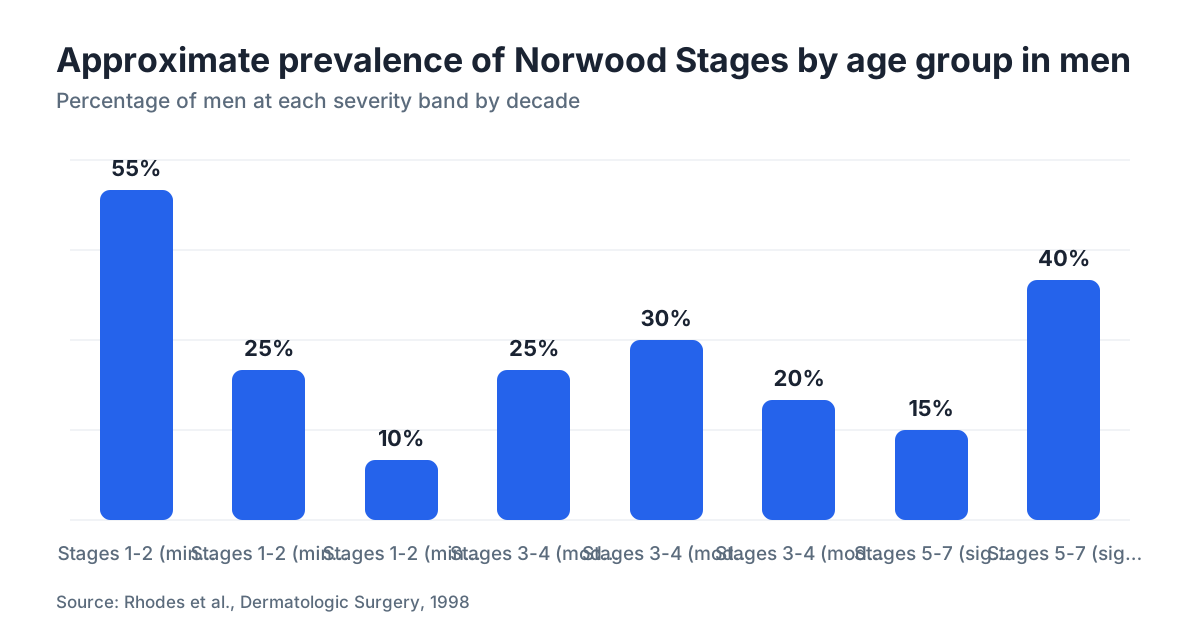
What percentage of men reach each Norwood stage?
Roughly half of white men have Norwood Stage 3 or higher by their mid-40s, and the majority sit at Stage 4 or beyond by 70. Norwood's 1975 work and a later prevalence study by Rhodes and colleagues give useful band estimates, though exact figures shift with age group and population [1][3].
Here is a summary based on those sources for white males across age groups.
| Norwood Stage | ~Age 20s | ~Age 40s | ~Age 70s |
|---|---|---|---|
| 1-2 (minimal loss) | ~55% | ~25% | ~10% |
| 3-4 (moderate loss) | ~25% | ~30% | ~20% |
| 5-7 (significant loss) | ~15% | ~40% | ~65% |
These are rough bands, not exact figures from one dataset. The pattern holds across sources: hair loss shows up at every age but speeds up hard after 40.
Progression speed swings wildly. Some men go from Stage 2 to Stage 5 in five years. Others park at Stage 3 for decades. No clinical test reliably predicts your personal rate, which is one reason dermatologists lean toward starting treatment early if you care about keeping what you have.
How do you figure out your own Norwood stage?
Self-assessment from mirrors and photos is imprecise, especially telling Stage 2 from Stage 3 or Stage 4 from Stage 5. The angles are awkward, lighting rewrites everything, and the Type A variant fools people because there's no crown spot to warn them.
The most reliable route is an in-person exam by a dermatologist or trichologist, ideally with dermoscopy (a lit handheld magnifier that reads follicle density). A trained eye can catch miniaturization, where follicles still exist but push out thinner, shorter hairs, before any recession is obvious [4].
Want a starting point before you book? Take overhead photos in consistent light and compare them against published Hamilton-Norwood diagrams. The free AI scan at MyHairline maps photos to Norwood stages, but treat any digital tool as an estimate, not a diagnosis.
Two markers narrow it down for most people. Look at your temples head-on in a mirror. If the corners are receding into distinct M-shaped notches that push well past ear level, you're likely Stage 3 or higher. Then check the crown under direct overhead light or a phone camera. A thinning patch there that doesn't connect to your temple recession puts you in the Stage 3 Vertex or Stage 4 range.
Which treatments work best at each Norwood stage?
This is where the scale earns its keep. Options shift by stage, partly from how much hair is left to defend and partly from what a surgeon can actually build.
Stages 1-2: No proven treatment is needed unless you're actively shedding. Some men start finasteride or minoxidil here to get ahead of it. Both are FDA-approved for androgenetic alopecia, and starting early gives each drug more hair to work with [2]. Talk it through with a dermatologist first, since both carry side effect profiles worth understanding before you commit. Read up on finasteride and minoxidil for men before you decide.
Stages 3-4: The clinical sweet spot for medication. Finasteride (1mg oral, daily) and topical minoxidil (2% or 5%) both showed statistically significant hair count gains in this range in controlled trials [2]. Running them together beats either alone, as the evidence on finasteride and minoxidil lays out. Transplants are possible at Stage 3-4 but risky: keep losing hair behind the transplanted zone and you may need more procedures.
Stages 5-6: Medication can still slow the loss and, sometimes, hold onto existing hair, but the odds of real regrowth drop a lot. Transplants become the main move here. A Stage 5-6 case runs roughly 2,000 to 3,500 grafts depending on the area, and donor supply turns into a genuine planning limit [5].
Stage 7: The hardest stage to treat. Donor hair on the sides and back is scarce, and any transplant has to live inside that limit. Medications still help protect what remains. Some surgeons pull in body hair as a supplemental donor source, though results vary and this stays a less predictable approach [5].
FDA labeling for finasteride approves it for men with mild to moderate hair loss, which roughly maps to Norwood Stages 2-5 [2]. The label states plainly: "Propecia is not indicated for use in women," and its efficacy evidence comes from men in that moderate-loss range.
If a transplant is on your mind, the hair transplant overview walks through what to expect by stage, graft counts, and how to size up a surgeon.
Does the Norwood scale apply to women?
Not really. Female pattern hair loss looks different. Women rarely develop the sharp frontal recession of Norwood Stages 3-7. They lose density diffusely across the top while the frontal hairline usually holds. The Ludwig scale describes that far better, with three grades running from diffuse thinning to severe loss on top.
Some women do show a more male-type recession, often with conditions involving elevated androgens, but the Hamilton-Norwood scale was never validated in women. Forcing it onto female cases produces misclassification, which then leads to wrong treatment expectations and bad transplant planning.
A dermatologist evaluating a woman for hair loss usually orders a broader workup anyway, including thyroid function, ferritin, and hormone panels, because female hair loss has more varied causes than male pattern baldness [4]. Telogen effluvium is one cause that looks nothing like Norwood staging and needs a completely different plan.
What is the difference between a mature hairline and early Norwood recession?
This distinction causes a lot of pointless anxiety, especially for men in their late teens and early twenties.
A mature hairline is a natural, permanent shift where the frontal line rises a little from its adolescent spot, usually settling about 1 to 1.5 cm above the highest forehead wrinkle. It happens in roughly 95% of adult men by their late teens to late twenties and doesn't go on to baldness [4]. It reads as slight, symmetric, smooth recession at the temples.
Early Norwood recession (Stage 2-3) looks similar at first but carries tells. The recession is often asymmetric, the temples cut deeper notches rather than a smooth curve, you may spot miniaturized hairs (short, fine hairs in the receding zone), and there's often a family history of real baldness. A dermatologist can separate the two with a dermoscopy exam in most cases.
The safe move: unsure, and a strong family history of baldness? Get a clinical eval instead of guessing. See the full breakdown on receding hairlines for more.
Can Norwood stage actually reverse with treatment?
Technically yes, though "reverse" oversells what usually happens. Finasteride trials in men at Norwood Stage 2-5 showed mean hair count gains and better hair weight, with a solid share of participants rated as improved by both doctor and patient [2]. One five-year finasteride study found 48% of men improved, 42% held steady, and 10% kept getting worse [2]. That's not a full hairline coming back, but it's a real, measurable shift.
Minoxidil's regrowth data is thinner. The 5% topical showed statistically significant hair count increases over placebo in controlled trials, but the absolute numbers stay modest and regrowth usually peaks around 16 to 24 weeks before flattening out [6].
Most men on medication hold their current stage or gain back a fraction of one, not a jump from Stage 4 back to Stage 2. A transplant is the only intervention that meaningfully changes hair count in a specific zone, and even that doesn't stop the underlying loss, which is why surgeons keep patients on medication afterward.
Before starting, it's worth knowing which minoxidil side effects to watch for. If you're weighing natural options, the evidence behind hair loss supplements and DHT blockers is covered separately.
How does hair transplant planning use the Norwood scale?
Your Norwood stage sets two numbers in transplant planning: how many grafts you need now, and how many you'll probably need later.
A Norwood Stage 3 patient might need 800 to 1,200 grafts to rebuild a natural frontal hairline. A Stage 6 patient might need 3,000 to 4,500 to cover the whole top [5]. The donor area, that permanent horseshoe on the sides and back, holds a finite number of grafts, often 6,000 to 8,000 in an average patient, though this swings a lot with density and scalp laxity [5].
Here's the trap: most men seeking transplants are still losing hair. A surgeon who restores a Stage 4 hairline without planning for eventual Stage 6 progression can leave transplanted hair up front and native loss opening a gap behind it. It looks wrong and it costs more procedures. Good surgeons design hairlines that still read right if the loss continues, which sometimes means a more conservative front than the patient wants to hear.
That's why many surgeons won't operate on men under 25 to 30 unless family history, current stage, and stabilization on medication make the long-term picture clear enough to plan around. The hair transplant guide covers FUE versus FUT, graft counts by stage, and cost ranges in detail.
Are there other hair loss classification scales besides Norwood?
Yes, though none has pushed Norwood aside for male pattern baldness in clinics or research.
The Ludwig scale (1977) is the standard for female pattern hair loss. It runs three grades: Grade I is a widening part, Grade II is more pronounced diffuse thinning on top, and Grade III is near-complete loss on top with a remaining frontal fringe [7].
The BASP (Basic and Specific) classification arrived in 2007 as a more globally applicable system that scores the frontal hairline shape and vertex density separately. It has four basic types and two specific types and aims to work across ethnicities and both sexes. Some Asian dermatology and hair surgery groups use it, but it hasn't replaced Norwood in most Western clinics [8].
The Sinclair scale is female-specific, close to Ludwig but with a fifth grade. The Savin scale is another female-specific system.
For most men reading this, Norwood is the one that counts, because it's what your dermatologist, the clinical trial data you'll read, and any transplant surgeon all use as the reference point.
What questions should you ask a dermatologist about your Norwood stage?
Walking in with specific questions gets you far more useful information than showing up cold. Here's what actually matters.
Ask your dermatologist to name your current Norwood stage and to say whether they see miniaturization in areas that still look full. Miniaturization is an early warning of future loss in a zone that hasn't visibly thinned yet, and it changes the treatment conversation.
Ask about your progression rate. A doctor can't hand you a precise number, but comparing photos over 6 to 12 months, or taking baseline hair density measurements, gives a directional read.
If you're considering finasteride, ask about your personal side effect risk and whether any labs should run first. PSA is one relevant baseline for men over 40, since finasteride shifts that marker [2].
If you're near the age or stage where transplants come into play, ask when the surgeon would want a consultation and whether stabilizing on medication for 12 months first changes the math.
MyHairline's free AI scan at myhairline.ai/scan can give you a preliminary Norwood estimate before the visit, so you show up with sharper questions instead of starting from zero.
Sources
- Norwood OT, Southern Medical Journal, 'Male Pattern Baldness: Classification and Incidence', 1975
- U.S. FDA, Drug Label for Propecia (finasteride 1mg)
- Rhodes T et al., Dermatologic Surgery, 'Prevalence of male pattern hair loss in 18-49 year old men', 1998
- American Academy of Dermatology, Hair Loss: Diagnosis and Treatment
- International Society of Hair Restoration Surgery (ISHRS), Practice Census and Guidelines
- Olsen EA et al., Journal of the American Academy of Dermatology, 'A randomized clinical trial of 5% topical minoxidil versus 2% topical minoxidil and placebo in the treatment of androgenetic alopecia in men', 2002
- Ludwig E, British Journal of Dermatology, 'Classification of the types of androgenetic alopecia (common baldness) occurring in the female sex', 1977
- Lee WS et al., Journal of the American Academy of Dermatology, 'New classification of pattern hair loss that is universal for men and women', 2007
- U.S. National Library of Medicine, MedlinePlus, Androgenetic Alopecia
- van Zuuren EJ et al., Cochrane Database of Systematic Reviews, 'Interventions for female pattern hair loss', 2016
- Kaufman KD et al., Journal of the American Academy of Dermatology, 'Finasteride in the treatment of men with androgenetic alopecia', 1998