

TL;DR: Norwood scale 4 is mid-stage male-pattern baldness: a defined bald patch on the crown, deep temple recession, and a strip of hair separating the two zones. You still have enough donor hair for an effective transplant. Finasteride and minoxidil can slow or partially reverse further loss. This stage is genuinely treatable.
What does Norwood scale 4 actually look like?
The Norwood-Hamilton scale runs from 1 to 7, and stage 4 sits right in the middle. At stage 4 you have deep recession at both temples, a bald patch developing or established at the crown (vertex), and a bridge of hair running across the top of the scalp that still connects the two areas. That bridge is the defining feature. It separates Norwood 4 from Norwood 5, where the bridge gets thin, and from Norwood 6 and 7, where it disappears entirely.
From the side, the hairline has moved back well behind where a normal hairline sits. From the top, you can clearly see scalp at the crown. Norwood 4A is a variant where the recession runs straight back across the scalp rather than forming a separate crown spot. Some men have both recession and crown thinning (classic 4); others have recession only (4A). The distinction matters for transplant planning because a 4A pattern requires coverage of a longer strip across the front and mid-scalp.
Norwood 4 is one of the most common stages men present with when they first seek professional help. One reason: it is the stage where the loss becomes undeniably visible to other people, more than to yourself in a harsh bathroom light. The hairline is clearly adult-male-receding, and the crown is no longer hidden by styling. That visibility tends to be the psychological trigger.
The original scale was published by Dr. James Hamilton in 1951 and later revised by Dr. O'Tar Norwood in 1975 [1]. Since then it has been the reference classification in nearly every hair transplant study and clinical trial for male androgenetic alopecia (AGA).
How do you know if you're Norwood 4 or Norwood 3 or 5?
The boundary between stages is not a sharp line. Norwood 3 vertex (3V) already has crown thinning but the temples are not as deeply recessed as in 4. The defining shift from 3 to 4 is how far back the hairline has retreated and how distinct the crown patch has become. Norwood 5 is set apart from 4 by how thin the connecting strip of hair has become: in 5 it is clearly narrowing, and in 5A it may already be breaking down.
The honest answer is that dermatologists and experienced hair transplant surgeons sometimes disagree on borderline cases, especially 3V versus 4 and 4 versus 5. Photography in consistent lighting helps. A trichoscopy or scalp examination adds information about miniaturization across the scalp, which tells you where you are headed.
Want a quick self-check? Compare your hairline and crown to reference images from the American Academy of Dermatology [2] or your surgeon's consultation materials. For a more data-informed picture, tools like the free AI scan at MyHairline let you upload a photo and get a Norwood estimate, which gives you a starting point before a clinical visit. That is what it is: a starting point, not a diagnosis.
One thing to gauge carefully at stage 4 is miniaturization in the bridge. If the hairs connecting your front hairline to the back of your scalp are already fine and thin under a dermoscope, you are closer to 5 than the surface appearance suggests, and that affects how a surgeon plans your donor usage.
What causes Norwood 4 hair loss?
The underlying driver is androgenetic alopecia. Dihydrotestosterone (DHT), a potent androgen made from testosterone by the enzyme 5-alpha reductase, binds to receptors in genetically susceptible follicles and gradually shrinks them in a process called miniaturization [3]. Each growth cycle the follicle produces a thinner, shorter hair, until eventually it produces nothing.
Genetics decides which follicles are susceptible. The inheritance is polygenic and messy: the AR gene on the X chromosome is one factor, but genome-wide association studies have flagged more than 200 loci linked to male-pattern hair loss [4]. The short version is that you can inherit the susceptibility from either parent's side. A bald father does not guarantee you go bald, and a full-haired father does not protect you.
Age is the other driver. Most men who reach Norwood 7 by their 60s passed through Norwood 4 somewhere in their late 20s to early 40s. The American Hair Loss Association estimates that roughly 85 percent of men will have significantly thinning hair by age 50, though the spread across Norwood stages at any given age varies widely.
Speed of progression shapes Norwood 4 too. Some men stabilize at 4 for years or decades. Others move through it in 18 months. Predicting your personal trajectory is genuinely hard, and anyone who tells you otherwise with certainty is guessing. A dermatologist can read miniaturization patterns and family history to give you a probability range, but not a guarantee.
To understand the full biological picture, what causes hair loss goes deeper into the hormonal and genetic mechanisms.
Does finasteride or minoxidil work at Norwood 4?
Both can work at this stage. The key word is "can."
Finasteride (1 mg oral, sold as Propecia among other brands) inhibits type II 5-alpha reductase, cutting serum DHT by roughly 60 to 70 percent [5]. The five-year trial published in the Journal of the American Academy of Dermatology found that 48 percent of men taking finasteride maintained or increased hair count versus 7 percent on placebo after five years [5]. Most of those studies enrolled men at Norwood 2 to 4, so that data speaks directly to you. At stage 4, finasteride works best at slowing or halting further loss. Regrowth at the crown happens in some men; regrowth at the temples is less consistent.
Minoxidil works differently: it prolongs the anagen (growth) phase and is thought to widen blood vessels around follicles, though the full mechanism is still not completely understood [6]. For men at Norwood 4, topical minoxidil (2% or 5%) can produce moderate regrowth at the crown in a meaningful share of users. The 5% formula outperforms 2% on vertex regrowth in head-to-head trials [6]. Oral minoxidil at low doses (0.625 mg to 2.5 mg) has become more common and shows similar or slightly better efficacy than topical in some studies, with a different side effect profile. Oral minoxidil covers that option in detail.
Using both together beats either alone. A 2021 randomized trial in the Journal of the American Academy of Dermatology found that combination oral minoxidil plus finasteride produced significantly greater hair count increases than either monotherapy [7]. That is the combination most hair loss physicians would recommend at Norwood 4 if you have no contraindications.
The honest caveat: neither drug cures baldness. Stop taking them and the protection ends, usually within 6 to 12 months. These are long-term commitments, not a course of treatment. For a thorough look at the finasteride and minoxidil combination and what the trial data actually says, that article covers it well.
For men who want the DHT-blocking mechanism spelled out, the dht blocker article explains how different pharmacological approaches compare.
Is a hair transplant a good option at Norwood 4?
Norwood 4 is one of the better stages for a hair transplant. Not because it is early, but because you still have a healthy donor zone at the back and sides of the scalp and a defined, manageable area to cover.
The two dominant techniques are Follicular Unit Excision (FUE) and Follicular Unit Transplantation (FUT, sometimes called strip). FUE removes individual follicular units from the donor area; FUT removes a strip of scalp from the back, which allows slightly higher graft yield per session and leaves a linear scar. Both produce natural-looking results in skilled hands.
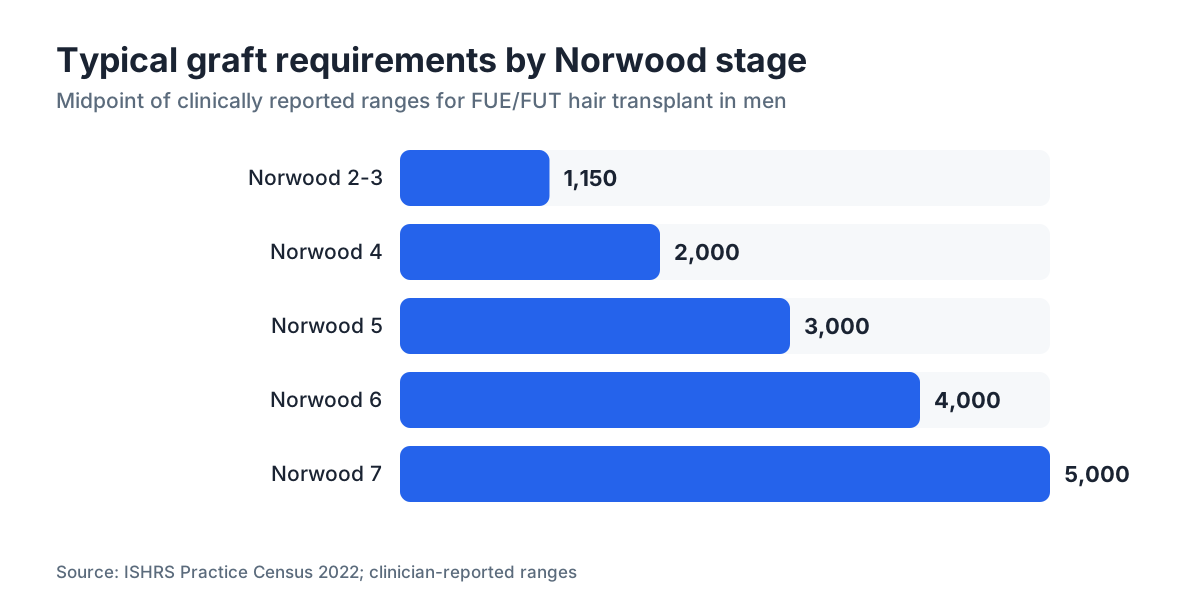
A typical Norwood scale 4 hair transplant needs somewhere between 1,500 and 2,500 grafts, depending on the extent of recession, whether crown coverage is included, and the patient's native hair characteristics (caliber, curl, and density all affect how many grafts you need to achieve coverage). Grafts above that range push you toward the total lifetime donor supply, which matters because you may need future sessions if the loss continues.
That is the biggest planning consideration at Norwood 4: your hair loss may not be finished. A 30-year-old at Norwood 4 who spends most of his donor reserve on a transplant, and then progresses to Norwood 6, can end up with transplanted hair on the front and an uncovered crown behind it. Surgeons call this "island" hair, and it looks worse than a shaved head. Most experienced surgeons will insist on a medication plan (finasteride, minoxidil, or both) alongside a transplant to slow progression, and they will design the transplant conservatively with future loss in mind.
For a full breakdown of the surgery, recovery, and cost, hair transplant is the right next read.
Norwood scale 5, 6, and 7 transplants get progressively harder. At Norwood 5 you are using more grafts to cover a larger area with fewer obvious reference lines; a Norwood scale 5 hair transplant typically needs 2,500 to 3,500 grafts. A Norwood scale 6 hair transplant often requires 3,500 to 4,500 grafts and may need a second session. Norwood 6 and Norwood 7 work is where scalp donor supply becomes genuinely limiting, and beard or body hair grafts may supplement. Acting at stage 4 rather than waiting until 6 or 7 gives you more options and a better cosmetic outcome.
How many grafts does a Norwood 4 transplant need and what does it cost?
The graft estimate depends heavily on the size of your bald zone, your donor hair density (measured in follicular units per cm²), and what cosmetic outcome you are aiming for. An honest range for a Norwood 4 case is 1,500 to 2,500 grafts for combined front hairline and crown coverage, with some cases running slightly over if the crown is large or the donor density is low.
In the United States, transplant pricing is usually quoted per graft. Prices in 2024 range from roughly $3 to $9 per graft depending on the clinic, technique (FUT is generally less expensive per graft than FUE), and geography. At 2,000 grafts the total cost runs from about $6,000 to $18,000. The wide range is real, and it reflects genuine variation in surgeon skill, clinic overhead, and market positioning as much as any difference in quality.
Outside the US, costs drop sharply. Clinics in Turkey commonly quote $1,500 to $3,000 all-in for a Norwood 4 case; clinics in India land in a similar band. The trade-off is that you are traveling, follow-up care is harder to reach, and quality control varies enormously. Medical tourism for hair transplants is common enough to research seriously, but the failure and revision rate at low-cost volume clinics runs higher.
Insurance does not cover hair transplants in the United States because they are classified as cosmetic procedures. FSA and HSA funds generally cannot be used either, since the procedure is not medically necessary.
The table below gives a reference frame for grafts and costs by Norwood stage.
| Norwood Stage | Typical Graft Range | Estimated US Cost (mid-range $6/graft) |
|---|---|---|
| 2-3 | 800-1,500 | $4,800-$9,000 |
| 4 | 1,500-2,500 | $9,000-$15,000 |
| 5 | 2,500-3,500 | $15,000-$21,000 |
| 6 | 3,500-4,500 | $21,000-$27,000 |
| 7 | 4,500+ (often 2 sessions) | $27,000+ |
These are estimates, not quotes. Your surgeon's in-person assessment is the only reliable number.
Will Norwood 4 progress to 5, 6, or 7?
Probably, but the timeline is unpredictable. Population data from the Hamilton-Norwood studies suggests most men with genetic AGA keep progressing over their lifetime if untreated. The rate varies from person to person, and a meaningful number of men do stabilize at moderate stages for long stretches.
The best predictors are family history (paternal and maternal), the age your hair loss started, and the speed of progression you have already seen. Men who reached Norwood 4 in their early 20s tend to progress further than men who reached it at 45. Men with a parent or sibling at Norwood 6 or 7 carry higher risk.
Dermoscopic assessment of miniaturization across the scalp tells you more than visual inspection alone. If the hair shafts in your bridge and mid-scalp show big diameter variation under magnification, the area is already thinning even if it looks fine to the eye. A dermatologist can document this at baseline and recheck in 6 to 12 months to measure your actual progression rate.
Finasteride cuts the rate of progression substantially. The five-year placebo-controlled data showed that 72 percent of men on finasteride had visible hair count maintenance or improvement at the vertex, compared with 7 percent on placebo [5]. That does not mean finasteride stops progression forever for everyone, but it meaningfully slows the clock for most men who tolerate it.
Understanding the receding hairline pattern that precedes and accompanies Norwood 4 progression helps you catch early changes; receding hairline covers that in detail.
Are there any non-surgical treatments worth considering at Norwood 4?
Finasteride and minoxidil are the only treatments with FDA clearance or approval for male-pattern hair loss [8]. Everything else sits somewhere between "decent supporting evidence" and "basically marketing."
Low-level laser therapy (LLLT) devices, including combs and helmets, have FDA clearance as cosmetic devices. Some randomized controlled trials show modest hair count increases, but effect sizes are generally smaller than what you see with finasteride or minoxidil. It is a reasonable add-on for someone who cannot tolerate medications, not a substitute.
Platelet-rich plasma (PRP) injects concentrated growth factors from your own blood into the scalp. The evidence base is growing but inconsistent. A 2019 systematic review in Dermatologic Surgery found that PRP produced statistically significant hair count increases in several trials, but flagged high heterogeneity across studies and a lack of standardized protocols [9]. At Norwood 4, PRP alone is unlikely to be enough, but some clinicians use it as an adjunct after transplant surgery.
Ketoconazole shampoo (prescription 2% or OTC 1%) has weak but real evidence for lowering scalp DHT and maintaining hair, based on a 1998 trial that found it roughly comparable to 2% minoxidil for hair density maintenance [10]. At the price of a shampoo, the risk-to-benefit ratio is fine. It is not going to reverse Norwood 4 on its own.
Hair loss supplements cover the landscape of nutraceuticals like biotin, saw palmetto, and marine proteins. Honest summary: the evidence for supplements is generally weak, biotin only helps if you are deficient, and saw palmetto has mixed trial results. A supplement is unlikely to hurt but also unlikely to make a meaningful difference at Norwood 4.
For men looking specifically at the evidence base for minoxidil for men, that article covers formulations, dosing, and what to actually expect.
What are the side effects of treatments for Norwood 4 hair loss?
This is a fair question to ask before committing to a long-term medication.
Finasteride's side effects get more attention than their frequency warrants, and sometimes less attention than individual cases deserve. The original five-year trial reported sexual side effects (decreased libido, erectile dysfunction, ejaculation disorder) in 3.8 percent of men on finasteride versus 2.1 percent on placebo [5]. The FDA label includes these risks and a warning about post-finasteride syndrome, a contested but documented phenomenon where some men report persistent sexual and cognitive side effects after stopping the drug [8]. The scientific community argues over the incidence and mechanism; the FDA updated labeling in 2022 to add more explicit warnings. Anyone starting finasteride should read the label and talk through their personal history with a prescribing physician.
Minoxidil's most common side effects with topical application are scalp irritation and unwanted facial hair growth (particularly in women, or men who touch their face after applying). The propylene glycol in some topical formulations causes contact dermatitis in some users. Oral minoxidil at low doses can cause fluid retention, low blood pressure, and increased body hair; the minoxidil side effects article goes into the full picture.
Hair transplant surgery carries the standard risks of any surgical procedure: infection, scarring, poor wound healing, and anesthesia reactions. Procedure-specific risks include follicle damage during extraction, poor graft survival if handling technique is off, and an initial telogen shed of transplanted and native hair called shock loss in the weeks after surgery. Shock loss resolves for transplanted hairs; shock loss in native hairs usually resolves but occasionally does not, which is a real risk surgeons should disclose.
A temporary hair shed from stress or a medical event is covered in more detail in the telogen effluvium article, useful context if you notice shedding after starting minoxidil or after a transplant.
How should a Norwood 4 man approach treatment practically?
Start with a dermatologist or hair loss specialist, not a supplement website. A confirmed diagnosis of androgenetic alopecia (versus alopecia areata, scarring alopecia, or diffuse telogen effluvium) matters before you commit to any treatment pathway. The presentation can look similar and the treatments are different.
If the diagnosis is AGA and you want to slow progression, finasteride is the most evidence-backed single intervention. Add minoxidil, topical or oral, for extra benefit. Give medications at least six months before judging response; twelve months is a more honest assessment window.
Want to address the cosmetic result now and are willing to commit to medication for the long term? A transplant at Norwood 4 is very viable. The combination of a well-executed transplant plus ongoing finasteride use is, in most experienced surgeons' view, the best approach for long-term cosmetic results at this stage.
If you are not sure where you fall on the Norwood scale and want a data point before seeing a specialist, the MyHairline AI scan gives you a photo-based Norwood estimate you can bring to that conversation.
Skip the money pits: PRP as a monotherapy, exotic supplements, unproven topical serums. Your money is better spent on a consultation with an ISHRS-member surgeon (the International Society of Hair Restoration Surgery) or a board-certified dermatologist who subspecializes in hair loss.
For anyone with a receding hairline who is not sure they have reached Norwood 4 yet, the article on receding hairlines clarifies earlier-stage decisions.
Sources
- Norwood OT, 'Male Pattern Baldness: Classification and Incidence,' Southern Medical Journal, 1975
- American Academy of Dermatology, Hair Loss Resource Center
- Sinclair R, 'Male pattern androgenetic alopecia,' BMJ, 1998
- Heilmann-Heimbach S et al., 'Meta-analysis identifies novel risk loci and yields systematic insights into the biology of male-pattern baldness,' Nature Communications, 2017
- Kaufman KD et al., 'Finasteride in the treatment of men with androgenetic alopecia,' Journal of the American Academy of Dermatology, 1998 (5-year data published 2002)
- Olsen EA et al., 'A randomized clinical trial of 5% topical minoxidil versus 2% topical minoxidil and placebo in the treatment of androgenetic alopecia in men,' Journal of the American Academy of Dermatology, 2002
- Jha AK et al., 'Oral minoxidil and finasteride combination versus finasteride alone,' Journal of the American Academy of Dermatology, 2021
- FDA, Propecia (finasteride 1 mg) prescribing information and labeling updates
- Gupta AK et al., 'Platelet-rich plasma as a treatment for androgenetic alopecia,' Dermatologic Surgery, 2019
- Piérard-Franchimont C et al., 'Ketoconazole shampoo: effect of long-term use in androgenetic alopecia,' Dermatology, 1998
- International Society of Hair Restoration Surgery (ISHRS), Practice Census 2022
- FDA, Rogaine (minoxidil 5% topical) OTC label