

TL;DR: The Norwood scale is the standard classification for male pattern baldness. It runs from Stage 1 (a full hairline) to Stage 7 (only a horseshoe fringe left around the sides and back). Doctors use it to diagnose androgenetic alopecia, forecast how far you'll likely progress, and decide whether medication, a transplant, or watchful waiting fits your situation.
What is the Norwood scale and why do doctors use it?
The Norwood scale, formally the Hamilton-Norwood scale, is the most widely used classification system for male pattern baldness (androgenetic alopecia). It runs from Stage 1, where the hairline is intact, to Stage 7, where only a thin horseshoe band around the sides and back survives. O'Tar Norwood revised James Hamilton's original 1951 work in 1975, adding intermediate categories to capture the real variety of how hair loss actually spreads [1][10].
Doctors use it because it gives them a shared language. When a dermatologist writes "Norwood 3 vertex" and a transplant surgeon reads the chart, they're looking at the same picture. It also forecasts where someone is headed. Androgenetic alopecia follows predictable genetic and hormonal pathways, so your stage today is a rough map of your stage in five years if you do nothing [2].
It doesn't tell you everything. It says nothing about density, hair caliber, or how fast you're shedding. Two men can both sit at Norwood 4 and have wildly different amounts of hair left, one with fine, sparse strands and the other with thick ones. Treat the scale as a map of the territory, not a census of everyone living there.
What does each Norwood stage look like?
Here's what each stage actually describes, in plain terms.
Stage 1 is baseline. The hairline sits where it did in your late teens. No recession, no thinning. Most men stay here into their twenties, though some start moving by 18 or 19.
Stage 2 is the first thing most men notice: a slight recession at the temples that lifts the hairline into a more mature shape. This is still within normal variation for an adult male. Plenty of men park at Stage 2 for years or decades.
Stage 3 is where most dermatologists say male pattern baldness has genuinely started. The temples have receded deeply enough that the hairline forms an M, U, or V shape. Stage 3 Vertex is a variant where the recession sits mostly at the crown rather than the temples. This is the earliest stage where FDA-cleared treatments are generally recommended.
Stage 4 adds real crown thinning on top of the temple recession. The two areas (front recession and crown patch) are still separated by a bridge of hair across the top, but that bridge is visibly thinning and narrowing.
Stage 5 is when that bridge becomes a thin, wispy strip. The frontal recession and crown patch are close to merging. Many men first seriously weigh a hair transplant here, because the window for good coverage is still open, just not wide.
Stage 6 means the bridge is gone. Frontal and crown areas have merged into one large bald zone. Hair on top is essentially absent. The donor area (sides and back) usually stays dense, which matters a lot for transplant candidacy.
Stage 7 is the most advanced. A thin horseshoe of hair remains around the sides and back, often finer and sitting lower than it did earlier. Even that band can be sparse. Surgical options are limited here because there may not be enough donor hair to fill the bald area.
There are also "A" variants for Stages 2 through 5 (written 2A, 3A, 4A, 5A). In the A pattern, recession moves straight back across the whole front of the scalp rather than leaving an island of hair on top. It reads as an aggressive, even retreat rather than the classic M-shape.
How common is each Norwood stage and who gets there?
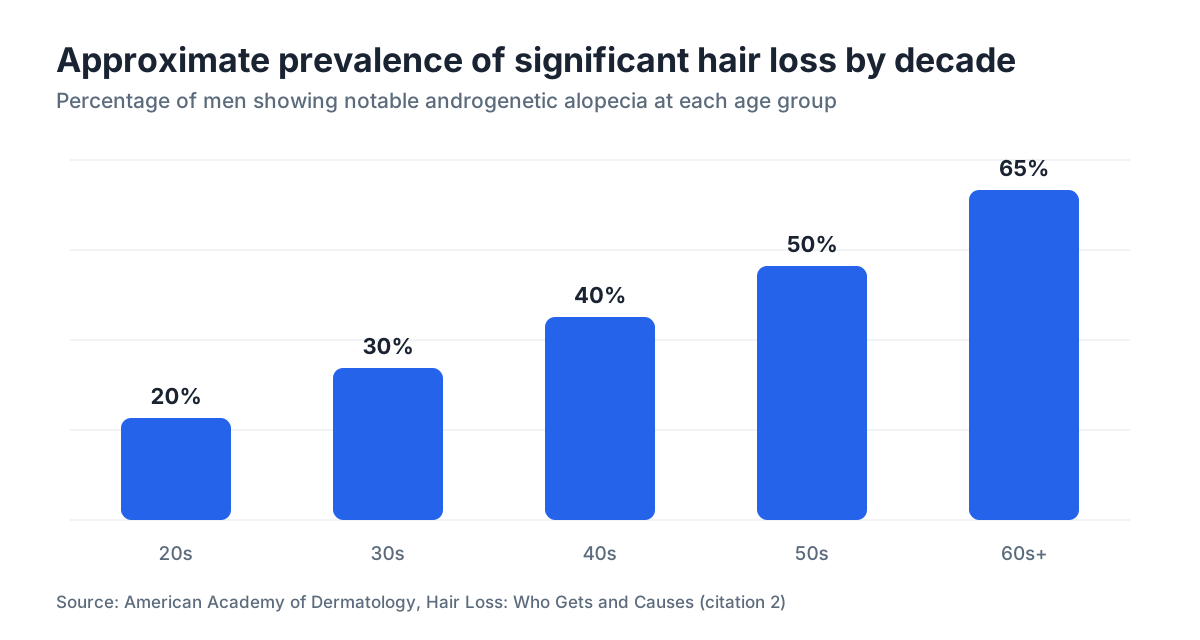
Male pattern baldness is common. Roughly 50% of men show significant androgenetic alopecia by age 50, and prevalence climbs with age in every population studied [2][11]. The stages are not evenly distributed.
Prevalence work published in the Journal of Investigative Dermatology examined a multiethnic sample and found Stage 2 the most common finding, while Stage 7 affected around 8% of men in the cohort by their 70s. White men tend to have higher prevalence than Asian or African men at comparable ages, though all groups show the condition [3].
Age of onset drives how far you'll go. Men who start losing hair before 25 statistically finish at higher Norwood stages than men who begin in their 40s. It's not a guarantee, but it's the pattern the data shows. Family history on both sides predicts risk, more than your maternal grandfather as the old myth claims [2].
| Approximate age | Prevalence of any notable hair loss |
|---|---|
| 20s | ~20% of men |
| 30s | ~30% of men |
| 40s | ~40% of men |
| 50s | ~50% of men |
| 60s+ | ~65-70% of men |
These figures come from review data cited by the American Academy of Dermatology [2]. Individual variation is wide. Some men hit Stage 6 by 30. Others stay at Stage 2 for life.
Is the Norwood scale used for women too?
No. Women lose hair in a different pattern, so doctors use the Ludwig scale (or sometimes the Sinclair scale) instead. Female pattern hair loss usually shows up as diffuse thinning across the crown and top, with the frontal hairline mostly preserved. That makes the Norwood scale a poor fit, because it maps a recession pattern women rarely experience.
There's also a separate condition called telogen effluvium, where hair sheds all over the scalp in response to stress, illness, or hormonal shifts. It looks nothing like the Norwood pattern. Knowing which type of loss you have changes the treatment completely. If you're a woman researching hair loss, the Ludwig scale and a dermatologist visit are better starting points than anything Norwood-related.
What causes the progression from one stage to the next?
The mechanism is androgenetic alopecia, driven by dihydrotestosterone (DHT). DHT is a byproduct of testosterone, created when the enzyme 5-alpha reductase converts testosterone in scalp tissue. In genetically susceptible follicles, DHT binds androgen receptors and progressively miniaturizes the follicle: each hair it produces gets thinner, shorter, and lighter until the follicle stops making a visible hair at all [4].
The susceptibility is polygenic, meaning many genes contribute. Genes on the X chromosome (inherited from your mother) include the androgen receptor gene, which is why the maternal grandfather myth has a grain of truth, but studies show paternal family history matters nearly as much [2][5].
Follicles at the temples and crown are more sensitive to DHT than those on the sides and back. That's why the horseshoe fringe at Stage 7 survives: those follicles are DHT-resistant. It's also the biological basis for hair transplant surgery. Donor follicles from the back and sides carry their DHT resistance to the new location and keep growing there.
If you want the hormonal chain in more detail, the what causes hair loss article covers the full pathway and what the peer-reviewed data says about each factor.
Can you predict which Norwood stage you'll reach?
Honestly, no one can tell you with confidence. The best predictors are family history (both parents' families), your age of onset, and how fast you've moved between stages so far. If you were Stage 2 at 20 and you're Stage 4 at 25, that's a faster trajectory than someone who spent 15 years at Stage 3.
Genetic testing for hair loss exists. Companies sell panels looking at androgen receptor variants and other genes, but the predictive power is modest. Research on polygenic risk scores for androgenetic alopecia found they can stratify risk at a population level while still having limited use for predicting an individual's endpoint stage [5].
The honest answer: document your stages over time with photos. Take one every three to six months, same lighting, same angle. That beats any genetic test on the market right now.
What treatments work at each Norwood stage?
This is where stage matters most in practice. Your options shift as loss advances.
Stages 1 and 2: Watchful waiting is reasonable. Minoxidil and finasteride both work best when there's still hair to save, so some men start early as prevention. That's a real conversation to have with a dermatologist. No FDA-cleared treatment is indicated specifically for Stage 1 because there's no clinical hair loss yet.
Stages 3 and 4: This is the zone where finasteride and minoxidil for men have the strongest evidence. The FDA approved finasteride 1 mg/day for male pattern hair loss in 1997 [6]. Clinical trials showed 83% of men on finasteride had no further loss over two years, and 66% saw some regrowth [6]. Topical minoxidil (2% and 5%) was the first FDA-approved treatment for male pattern hair loss; the 5% foam and solution are backed by multiple randomized controlled trials showing statistically significant regrowth versus placebo [7]. Combining both tends to beat either alone, which is why many dermatologists now recommend finasteride and minoxidil together [9].
Stage 5: Still a candidate for medication, but many men here start seriously evaluating hair transplant surgery. FUE (follicular unit extraction) and FUT (follicular unit transplantation) can both work at Stage 5, though the surgeon needs to plan conservatively to leave enough donor hair for future sessions if loss continues.
Stages 6 and 7: Medication is still worth taking to protect the hair you have. But surgery gets more limited because the bald area is large and donor supply is finite. A realistic transplant at Stage 6 or 7 might fill the hairline and front third while leaving the crown uncovered, or accept visible thinning across a larger area. Some men at Stage 7 find scalp micropigmentation (tattooing that mimics a shaved look) gives a cleaner result than a stretched-thin transplant.
DHT blockers like finasteride cut scalp DHT by roughly 60-70% [6]. That slows or stops miniaturization in most men, but it won't resurrect follicles that have already died. The earlier you start, the more there is to preserve.
If you're wondering whether supplements are worth adding, see hair loss supplements for a straight breakdown of what has data and what doesn't.
What are the limitations of the Norwood scale?
The scale is useful but imperfect, and you should know where it falls short before you lean too hard on a self-diagnosis.
First, it captures pattern, not density. Two men at Norwood 4 can have dramatically different amounts of hair because one has thick, coarse strands and the other has fine, miniaturized ones. Density matters enormously for how the hair looks and for how many grafts a surgeon can extract.
Second, it doesn't capture speed. The scale is a snapshot, not a movie. A man who moved from Stage 2 to Stage 4 in 18 months has a very different prognosis than one who made the same journey over 15 years, and the scale can't show it.
Third, self-staging is unreliable. Studies show significant disagreement even among trained dermatologists looking at the same scalp [1]. When someone on a forum says "I'm Norwood 3," they're often off by at least one stage in either direction. Getting staged by a dermatologist or hair restoration specialist who can part the hair and assess density under a dermatoscope is worth the visit.
Fourth, it doesn't apply cleanly to diffuse loss or patterns that skip the classic recession-then-crown sequence. Diffuse unpatterned alopecia (DUPA) is a type of androgenetic alopecia where even the donor zone thins, which has serious implications for transplant candidacy that the standard Norwood map doesn't flag.
If you want a fast, free first look before booking a dermatologist, the MyHairline AI scan at myhairline.ai/scan can estimate your Norwood stage from a photo and flag whether your pattern looks typical or unusual. It's a starting point, not a diagnosis.
How do I accurately determine my own Norwood stage?
Self-staging works reasonably well at the clear extremes (Stage 1 or Stage 6 are hard to misread) but gets tricky in the middle, where the difference between a 3 and a 4, or a 4 and a 5, is a judgment call about how thin that bridge of hair across the top really is.
For the best read at home: use good overhead lighting (natural light from above wins), take photos from four angles (front, both sides, straight overhead), and compare them against published clinical Norwood diagrams. The American Academy of Dermatology's patient resources have basic illustrated guides [2].
For a real answer, see a board-certified dermatologist or a hair restoration surgeon. They can use a dermatoscope to assess follicular miniaturization, which tells you whether hair you can still see is healthy or already in decline. That's information the naked eye can't get.
The receding hairline article covers how to tell a maturing hairline (normal in almost all men by their mid-20s) from genuine Norwood-scale recession, a common and genuinely confusing distinction.
Is Norwood stage reversible with treatment?
Partially, in some stages. Finasteride and minoxidil don't erase the underlying genetic predisposition, and they won't bring back follicles that have fully miniaturized and stopped producing hair. What they do is halt or slow progression, and in some men they produce enough regrowth to visually step back a stage or fill in areas that had been thinning.
The FDA prescribing information for finasteride (Propecia) reports that in trials run over five years, men on the drug kept significantly more hair than placebo-treated men, and that stopping treatment reverses the benefit within 12 months [6]. That tells you the drug manages the condition, it doesn't cure it.
Minoxidil works differently. It's a potassium channel opener that raises blood flow to follicles and may lengthen the anagen (growth) phase. It doesn't block DHT. So minoxidil used alone, without a DHT-blocking drug, fights one part of the problem while leaving the other running. Most hair specialists now treat topical 5% minoxidil plus finasteride as the baseline combination for men in Stages 3 to 5 who want to slow progression [9].
Transplanted hair is effectively permanent because the donor follicles are DHT-resistant. But the native hair around a transplant keeps following the Norwood trajectory if you stop treating it, which can leave transplanted islands looking odd as the surrounding hair thins.
Some men worry about specific lifestyle or supplement factors. Does creatine cause hair loss is a good example of a concern with a more nuanced answer than the internet suggests.
When should you see a doctor about your Norwood stage?
If you're at Stage 2 and stable, a dermatology visit is useful but not urgent. If you're moving stages visibly within a year, that's faster than average and a reason to go sooner rather than later.
See a doctor promptly if the loss is fast (dramatic shedding in a short span, more consistent with telogen effluvium than pattern baldness), if you're a woman with any Norwood-style recession (unusual enough to warrant investigation), if you have scalp symptoms like itch, burning, or scaling alongside the loss, or if you're under 20 and losing hair rapidly.
A dermatologist can rule out other causes: thyroid disease, iron deficiency, autoimmune conditions like alopecia areata. Each needs very different treatment than androgenetic alopecia. Assuming Norwood-pattern loss when something else is happening wastes time and money.
For men clearly in Stages 3 to 5 with a classic pattern and a matching family history, the conversation will move quickly to treatment. Walk in knowing your approximate stage, your timeline of progression, and your family history on both sides, and the appointment gets much more useful.
Sources
- Norwood OT, 'Male pattern baldness: classification and incidence,' Southern Medical Journal, 1975
- American Academy of Dermatology, Hair Loss: Who Gets and Causes
- Otberg N et al., Journal of Investigative Dermatology, 2007 (Norwood prevalence data)
- Sinclair R, 'Male pattern androgenetic alopecia,' BMJ, 1998
- Hagenaars SP et al., 'Genetic prediction of male pattern baldness,' PLOS Genetics, 2017
- FDA, Propecia (finasteride 1 mg) prescribing information
- FDA, Minoxidil (topical) OTC Monograph and approval history
- Kanti V et al., 'Evidence-based (S3) guideline for the treatment of androgenetic alopecia in women and men,' JEADV, 2018
- Hamilton JB, 'Male hormone stimulation is prerequisite and incitant in common baldness,' American Journal of Anatomy, 1951
- National Institutes of Health, MedlinePlus: Hair Loss