

TL;DR: Norwood scale 3 is the third stage on the 7-stage Hamilton-Norwood classification. It means visible recession at both temples, forming a deep M or U shape, with the hairline pushing back past an imaginary line across the top of the head. Norwood 3 vertex adds thinning at the crown. This is the earliest stage where most dermatologists recommend starting treatment, and the stage with the best odds of meaningful regrowth.
What is the Norwood scale and how does stage 3 fit in?
The Hamilton-Norwood scale is the standard classification system for male pattern baldness. O'Tar Norwood revised James Hamilton's original work in 1975, producing a seven-stage chart that dermatologists and hair transplant surgeons still use as a common language today [1]. Stage 1 is a full hairline with no meaningful recession. Stage 7 is near-total loss across the top of the scalp, with only a horseshoe band of hair remaining at the sides and back.
Norwood 3 sits in the middle of the early stages. It's the point where recession stops being subtle. The temples have receded deeply enough that the empty areas on each side either meet across the forehead or come close to it, forming a pronounced M or U shape. Norwood defined stage 3 as the earliest stage of "cosmetically significant" hair loss [1]. That phrasing matters: stages 1 and 2 are hairline changes that many men don't notice or don't act on. Stage 3 is usually the one that brings someone into a dermatologist's office for the first time.
The scale splits into two branches at stage 3. The "classic" Norwood 3 is about temporal recession. Norwood 3 vertex (sometimes written 3A in older literature, though the vertex designation is more common now) describes men whose temples have receded to a similar degree but who also have significant thinning or a bald spot at the crown. The vertex variant matters clinically because crown thinning can progress on its own timeline and often responds differently to treatment [2].
One thing worth knowing: the scale was built mostly from studying white men. How well it maps onto Black, Asian, and Hispanic men is less validated, and loss patterns can differ across ethnic groups. If your pattern doesn't line up neatly with the diagrams, that's not unusual.
What does Norwood 3 actually look like? Signs and examples
The clearest sign of Norwood 3 is deep temporal recession that passes a specific anatomical point. Norwood's original description uses a line drawn across the scalp, roughly from one ear to the other at the top of the head. In stages 1 and 2, the hairline stays in front of or on that line. In stage 3, the recessed temples push behind it [1].
In practice, this looks like:
- A hairline that has clearly moved back several centimeters from where it was in your late teens or early twenties
- Empty or very thin triangular patches at each temple
- A forelock (the strip of hair in the center front) that looks narrower and may itself be starting to thin
- Scalp that's plainly visible at the temples under good lighting or in a photo taken from above and in front
Norwood 3 vertex adds a second area of concern: the crown. Men with the vertex subtype might have relatively mild temple recession on its own but also notice a round or oval area of thinning at the back-top of the scalp. The crown thinning often starts as a "swirl" where the hair grows outward from a central point, making the scalp visible at that center. Over time the circle widens.
Photos from the top of the head are the most useful for tracking both temple recession and crown thinning. Hold your phone above and slightly in front of your head, or ask someone to shoot down at you from a stepladder. Bathroom mirror selfies in most lighting systematically underestimate how much recession other people actually see.
If you want an objective baseline before seeing a doctor, MyHairline's free AI scan maps your hairline to the Norwood scale from a photo, which helps you track change over time before your first appointment.
How quickly does Norwood 3 progress, and will it get worse?
Male pattern baldness is driven by dihydrotestosterone (DHT), a potent androgen converted from testosterone by the enzyme 5-alpha reductase [3]. Follicles at the temples and crown carry androgen receptors that, in genetically susceptible men, cause those follicles to miniaturize over years. The process is called follicular miniaturization: each successive hair grows thinner, shorter, and lighter until the follicle stops producing a visible hair at all.
Progression rate varies enormously between individuals. Some men move from Norwood 3 to Norwood 5 or 6 within five years. Others sit at stage 3 for a decade or more. The main predictors of faster progression are a strong family history of advanced baldness (particularly on the maternal grandfather's side, though the genetics are polygenic and not simple), age at onset (earlier onset tends to mean faster progression), and active crown thinning alongside temple recession.
Nobody can tell you with certainty how fast you'll progress. The honest answer is that without treatment, the large majority of men with Norwood 3 keep progressing to higher stages [4]. The question is how fast. A 2001 review in the Journal of the American Academy of Dermatology describes the untreated course of pattern loss as steady miniaturization over time, and observational data suggest roughly half of men with early androgenetic alopecia move to a more advanced stage within about five years without treatment [4].
This is why most dermatologists call Norwood 3 the ideal time to start treatment. You have the most follicular mass left to protect, and the treatments that work (more on those below) are better at slowing loss and holding onto what you have than at reversing advanced loss.
What treatments work at Norwood 3?
Three treatments have real clinical evidence behind them for androgenetic alopecia: minoxidil, finasteride, and hair transplantation. Everything else has weak evidence or none.
Minoxidil
Minoxidil is a topical (or increasingly, oral) vasodilator that prolongs the anagen (growth) phase of the hair cycle and may have direct follicular effects too. The FDA approved topical minoxidil for male pattern hair loss in 1988 [5]. Standard doses are 2% or 5% solution, or 5% foam. The 5% formulation beats 2% in most trials.
At Norwood 3, minoxidil is a reasonable first step, especially if you're not ready to take a daily oral drug or you're worried about side effects. It does more to maintain existing hair and coax growth from active follicles than to regrow hair from long-dormant ones. Give it four to six months before judging it. If you stop, any benefit reverses within three to six months. See the full breakdown at minoxidil for men and the minoxidil side effects page before starting.
Finasteride
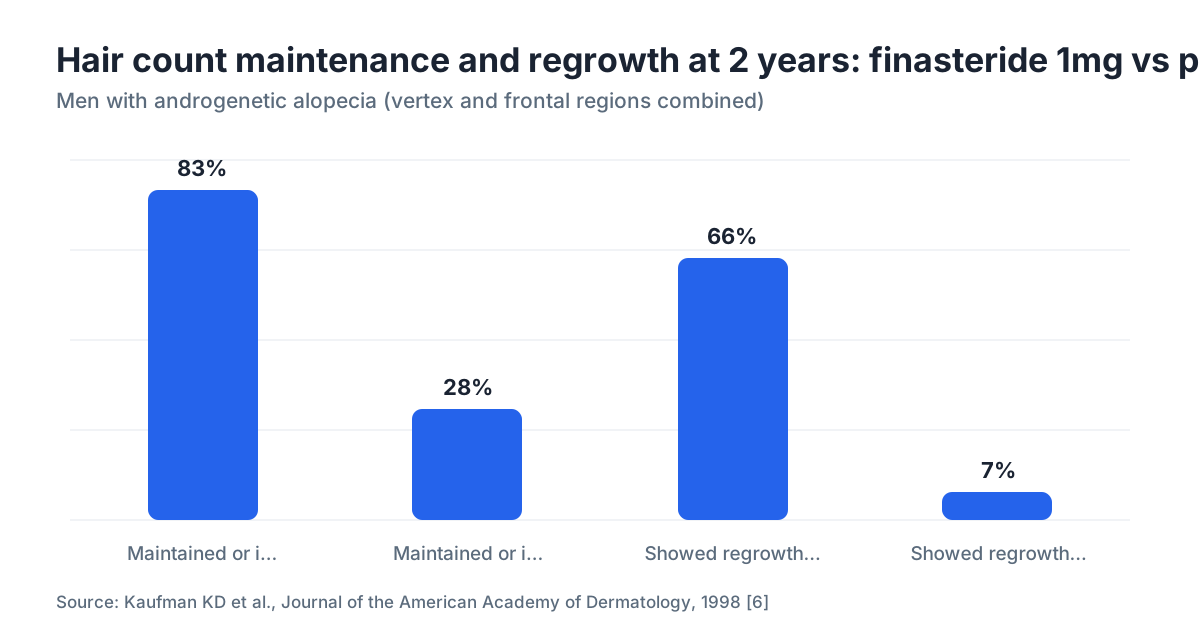
Finasteride 1mg daily (brand name Propecia) is an oral 5-alpha reductase inhibitor that blocks conversion of testosterone to DHT. A well-known randomized controlled trial published in the Journal of the American Academy of Dermatology found that 83% of men taking finasteride 1mg maintained or increased their hair count over two years, compared to 28% on placebo [6]. At Norwood 3, finasteride is arguably the single most evidence-backed step for slowing progression.
Sexual side effects have been reported in roughly 2 to 4% of men in trials, and there's ongoing debate about post-finasteride syndrome, though causality is disputed. The drug is prescription-only in the United States. Read the full picture at finasteride and the DHT blocker overview.
Combination therapy
Finasteride and minoxidil together beat either alone. A randomized trial published in JAMA Dermatology found that oral minoxidil 5mg plus finasteride 1mg outperformed topical minoxidil 5% plus finasteride 1mg on hair count endpoints [7]. The finasteride and minoxidil article covers the combination in detail.
Hair transplantation
At Norwood 3, a transplant is possible and many surgeons will do one. Here's the main caution. If you're in your twenties and at Norwood 3, transplanting now without medical therapy to slow progression can mean a second or third procedure later as the native hair behind the transplant keeps falling out. Most experienced surgeons want you to stabilize loss with medication for at least a year before transplanting if you're young. The hair transplant article covers candidacy, costs, and what FUE versus FUT means for a Norwood 3 pattern.
Is Norwood 3 vertex (crown thinning) treated differently?
The vertex subtype deserves its own answer because the crown responds to treatment a bit differently than the temples.
Finasteride has good evidence specifically for vertex preservation and regrowth. The original Merck trial included a vertex cohort, and men with vertex thinning showed meaningful hair count increases after two years [6]. The crown seems more responsive to DHT suppression than the frontal hairline in many men, possibly because those follicles are in earlier stages of miniaturization when treatment begins.
Minoxidil carries specific FDA labeling for crown (vertex) application [5]. Applying it directly to the crown twice daily is the recommended approach for the vertex subtype.
The trickier issue with Norwood 3 vertex is that crown thinning is hard to see yourself and easy to dismiss early. By the time you notice it clearly in a photo, the process has usually been going on for a year or more. If a family member has advanced vertex loss, check your own crown every few months with a hand mirror or camera. It's worth the two minutes.
How is Norwood 3 different from Norwood 2 and Norwood 4?
This comparison comes up constantly, and it matters because it decides whether a doctor recommends starting treatment now or waiting.
| Stage | Key feature | Temple recession | Crown involvement | Typical treatment approach |
|---|---|---|---|---|
| Norwood 2 | Minor recession at temples | Slight, symmetrical | None | Monitor; some start treatment |
| Norwood 3 | Deep temporal recession past ear-line | Pronounced M or U shape | None (or vertex subtype) | Most dermatologists recommend starting treatment |
| Norwood 3 vertex | Like stage 3 but with crown thinning | Pronounced | Yes, early-to-moderate | Start treatment; vertex often responds well |
| Norwood 4 | Recession joins or nearly joins across top | Severe | Moderate-to-large bald spot | Treatment to slow; transplant candidacy depends on donor area |
The practical difference between Norwood 2 and Norwood 3 comes down to the anatomical line described above: has the recession passed the line across the top of the head? If yes, you're at stage 3.
The difference between Norwood 3 and Norwood 4 is the bridge. At Norwood 4, the recession on both sides connects or nearly connects across the top of the scalp, opening a large bald area that spans the front and top. At stage 3, there's still a clear band of hair joining the forelock to the rest. That band getting thinner is often the first sign you're heading toward stage 4.
If you're trying to self-assess your stage, the receding hairline guide has a more detailed walkthrough of the reference points.
What causes Norwood 3 to happen in the first place?
The root cause of Norwood 3 is androgenetic alopecia (AGA), commonly called male pattern baldness. AGA is polygenic, meaning dozens of genes shape your susceptibility rather than a single inherited trait. The androgen receptor gene on the X chromosome is one of the most studied contributors, which is why the maternal grandfather's hair gets cited as a predictor, but paternal genetics matter too [11].
DHT is the key hormonal driver. Men with AGA have follicles at the temples and crown that are genetically programmed to shrink in response to DHT. Blood DHT levels aren't necessarily higher in men with AGA; the problem is follicular sensitivity, not DHT quantity [3].
Other factors can speed up or muddy the picture. Serious physical or emotional stress can trigger telogen effluvium, a temporary shed that can make underlying AGA look worse or bring on visible thinning earlier than the pattern otherwise would. Nutritional gaps (particularly iron and ferritin in men on low-meat diets) can drag down density. There's ongoing debate about whether creatine supplementation speeds up AGA via DHT precursors; the does creatine cause hair loss article covers what the evidence actually shows. The full picture of contributors is at what causes hair loss.
Can Norwood 3 be reversed, or is the goal just to stop it getting worse?
Honest answer: partial reversal is possible, full reversal is not.
Finasteride and minoxidil can produce measurable increases in hair count at Norwood 3, especially in men who start early and in follicles that are miniaturized but not yet dead. The Merck finasteride trial reported that 66% of men who took the drug for two years showed hair regrowth versus 7% on placebo, with the rest holding steady rather than losing ground [6]. But "regrowth" in these trials means increased hair count in an area, not the return of a teenage hairline.
Follicles that have been fully dormant for years are unlikely to produce meaningful hair no matter what you do. That's the biological ceiling. You can rescue follicles still in the miniaturization process. You can't reliably resurrect follicles that quit years ago.
Hair transplantation physically moves follicles from the DHT-resistant donor zone (back and sides of the scalp) into the affected area, which can restore density in receded temples or a thinning crown. At Norwood 3, the needs are relatively modest, which is a practical advantage in graft count and cost.
So here's the realistic framing. At Norwood 3 with early treatment, the goal is to keep what you have, add back some density in thinning areas, and avoid reaching Norwood 5 or 6. That's a genuinely achievable outcome for many men who start promptly and stick with it.
What does a dermatologist actually do at a Norwood 3 diagnosis?
A board-certified dermatologist or trichologist usually does several things at a first visit for Norwood 3 pattern loss.
First, they confirm the diagnosis is androgenetic alopecia and rule out other causes. A scalp exam, often with a dermatoscope (a magnifying device that shows follicular miniaturization directly), is standard. Blood work may include thyroid function, ferritin, complete blood count, and sometimes DHEA-S or free testosterone to rule out hormonal contributors beyond typical AGA.
Second, they stage the loss. The Norwood scale is one tool; some practitioners also use the SALT (Severity of Alopecia Tool) score for density. Photographs from standardized angles get taken for tracking.
Third, they walk through options. At Norwood 3, the typical menu is finasteride alone, minoxidil alone, or both together. Low-level laser therapy (LLLT) devices have FDA clearance for hair loss, though the evidence is weaker than for the two medications [8]. Platelet-rich plasma (PRP) injections are offered at some practices, but the evidence is inconsistent and the AAD notes more research is needed [9].
The American Academy of Dermatology's own guidance points to topical minoxidil and oral finasteride as the primary evidence-based options for men with AGA [9]. That's the right starting point for most Norwood 3 men before considering more expensive or invasive routes.
If you want a rough sense of your current stage before an appointment, the MyHairline AI scan can give you a baseline from a photo in a few minutes.
How much does treating Norwood 3 cost, and is it worth it?
Cost depends heavily on which treatments you use and whether you go brand-name or generic.
Generic finasteride 1mg runs about $15 to $40 per month in the United States from a legitimate pharmacy or telehealth service. Brand-name Propecia costs much more ($70 to $100 a month or higher) without insurance, and insurance rarely covers it for hair loss. Over a year, generic finasteride costs roughly $180 to $480.
Generic topical minoxidil 5% solution or foam costs $10 to $25 per month at most pharmacies. Oral minoxidil (off-label at 0.5 to 2.5mg for hair loss in men) costs a similar amount as a generic.
Combining both medications runs $25 to $65 per month, or $300 to $780 per year. That's a reasonable price for a condition that otherwise keeps progressing.
A hair transplant at Norwood 3 usually needs fewer grafts than later stages. Most Norwood 3 cases need somewhere between 800 and 2,000 grafts to address temporal recession and, if applicable, the crown. At current US market rates of roughly $3 to $9 per graft depending on surgeon and location, that puts a Norwood 3 transplant in the range of $4,000 to $12,000 [10]. It's a one-time cost, but it doesn't stop ongoing loss in non-transplanted hair, which is why medication usually continues alongside a transplant.
The "is it worth it" question is personal. But the medical math favors acting at Norwood 3 rather than waiting. You spend less on a transplant (fewer grafts), you have more native hair to protect with medication, and you skip the psychological and social cost of drifting to higher stages while you make up your mind.
What lifestyle factors affect Norwood 3 progression?
No lifestyle change stops androgenetic alopecia on its own. The genetics and hormonal sensitivity are the main drivers. But several factors can speed up loss or make the situation harder to manage.
Stress is a real contributor. Serious physical stress (surgery, illness, crash dieting) can trigger telogen effluvium on top of AGA, causing a sudden shed that looks like AGA accelerating when it's actually a separate, usually temporary process. Chronic psychological stress may act more directly on the hair cycle through cortisol, though the evidence here is thinner.
Nutrition matters at the margins. Severe caloric restriction or iron deficiency can worsen density. The evidence for specific supplements (biotin, saw palmetto, and the like) is mixed at best; the hair loss supplements article covers what's actually supported by data and what's marketing.
Sleep, smoking, and scalp health are lower-tier factors. Chronic poor sleep affects several hormonal axes. Smoking is tied to worse AGA progression in some studies, possibly through vascular effects on follicles. Scalp hygiene matters mostly because seborrheic dermatitis (dandruff-related inflammation) can add to follicular stress, and treating it with the right shampoo is simple and sensible.
None of these replace finasteride or minoxidil for a man with true AGA at Norwood 3. They're additive, not substitutes.
Sources
- Norwood OT. Male pattern baldness: classification and incidence. Southern Medical Journal, 1975
- American Academy of Dermatology, Hair Loss Types: Alopecia
- Sinclair RD. Male pattern androgenetic alopecia. BMJ, 1998;317:865
- Whiting DA. Possible mechanisms of miniaturization during androgenetic alopecia or pattern hair loss. Journal of the American Academy of Dermatology, 2001
- U.S. Food and Drug Administration, Drugs
- Kaufman KD et al. Finasteride in the treatment of men with androgenetic alopecia. Journal of the American Academy of Dermatology, 1998;39(4):578-89
- Hu R et al. Oral minoxidil vs topical minoxidil combined with finasteride for androgenetic alopecia. JAMA Dermatology, 2022
- FDA, 510(k) Premarket Notification database, low-level laser devices for hair loss
- American Academy of Dermatology, Clinical guidelines: Androgenetic alopecia in men
- International Society of Hair Restoration Surgery, Practice Census Survey 2022
- Ellis JA et al. Androgenetic alopecia: pathogenesis and potential for therapy. Expert Reviews in Molecular Medicine, 2002