

TL;DR: Norwood scale 5 is an advanced stage of male pattern baldness where the loss bridges the crown and the front, leaving a narrow strip across the top. Medications alone rarely reverse it. Finasteride and minoxidil can slow further loss, and a hair transplant is a realistic option for men with enough donor supply.
What is Norwood scale 5, exactly?
The Norwood-Hamilton scale is the standard classification system for male pattern hair loss, running from Type I (no recession) through Type VII (near-total baldness on top). Norwood 5 sits near the upper end of that spectrum and is defined by a large area of hair loss across the crown and frontal scalp, with only a narrow, often sparse strip of hair separating the two bald zones. That bridge is still technically present, which is what distinguishes Type 5 from Type 6, where the bridge disappears entirely. [1]
There's also a variant called Norwood 5A. In the A variants, loss spreads backward from the front in a single continuous zone rather than developing independently at the crown. Men with 5A sometimes still have some hair at the very back of the top of the scalp, but the overall density and coverage is roughly equivalent to standard Type 5. If you're looking at photos and you're not sure which you are, the distinction matters less for treatment decisions than the total surface area of thinning and the density of what remains.
At this stage, the donor area, meaning the permanent fringe of hair around the sides and back of the head, is still intact for most men. That's the part that matters for transplant planning. The donor fringe in male pattern baldness is genetically programmed to resist DHT (dihydrotestosterone), the hormone responsible for follicle miniaturization, so it stays even when the top goes.
Norwood 5 is an inflection point. Medications can genuinely slow or partly reverse miniaturization in earlier stages. By Type 5, you've probably already lost most of that recoverable ground. That doesn't make medication useless. It means the goal shifts from regrowth to holding the line, and your expectations need to shift with it.
How common is Norwood 5, and who gets there?
Male pattern baldness, or androgenetic alopecia, affects roughly 50% of men by age 50 [2]. The spread across Norwood stages isn't even, and solid population data on the exact share who reach Type 5 specifically is thin. The most-cited source, Hamilton's original 1951 work and Norwood's 1975 revision of it, found that the advanced stages (V through VII) make up a minority of balding men but become more common with age. [1]
Genetics is the dominant driver. If your father and maternal grandfather both had advanced hair loss, your odds go up substantially. But genetics isn't the whole story. DHT sensitivity varies between individuals even with identical genetic backgrounds, and factors like chronic stress, nutritional deficiencies, and some medications can speed up the timeline. To understand more about what pushes loss forward, what causes hair loss covers the full picture.
Most men who reach Norwood 5 get there gradually, over 10 to 20 years starting from the mid-20s through the 40s. Some hit it faster. If you've gone from Type 3 to Type 5 in two or three years, that speed changes the prognosis and should change how aggressively you treat it. Rapid progressors are more likely to reach Type 6 or 7 without intervention.
Age at onset predicts your final stage better than most people realize. A 2011 study in the Journal of Investigative Dermatology found that men who show significant hair loss before age 30 are more likely, statistically, to reach advanced Norwood stages over their lifetime than men whose loss starts later. [3]
How do you know if you're a Norwood 5 or something else?
Self-assessment is harder than it looks. Most men see themselves from the front in a mirror and underestimate crown loss. A photo taken from above, or a second mirror to check the back, beats intuition every time.
The defining features of Norwood 5 are: a large bald zone at the crown, a bald or heavily receded frontal area, and a strip connecting them that is either thin and sparse or noticeably narrowed compared to the original density. If that strip is completely gone and the two zones have fully merged, you're likely at Type 6.
Dermoscopy, a handheld skin microscope used by dermatologists, can measure follicle miniaturization that isn't visible to the naked eye. This matters because some areas that look bald actually have miniaturized follicles that could still respond to treatment. A dermatologist can also rule out other causes of hair loss, like telogen effluvium, which can overlay on top of androgenetic alopecia and make staging more complicated.
If you want an objective starting point without booking a clinic appointment, myhairline.ai's free AI scan at /scan can assess your photo and give you a Norwood stage estimate. It won't replace a clinical exam, but it's a faster way to understand roughly where you stand before committing time or money.
The clinical question that matters isn't just your current stage. It's your trajectory. A dermatologist reading hair pull test results, miniaturization density, and family history together gives a better forecast than any single-point snapshot.
Does finasteride work at Norwood 5?
Finasteride (1 mg daily, brand name Propecia) blocks the conversion of testosterone into DHT, cutting scalp DHT levels by roughly 60-70%. [4] The trials that got it FDA-approved in 1997 focused heavily on men with vertex (crown) loss and milder stages. The results at Type 4 and 5 are real but more modest than in earlier stages.
Here's the honest answer. Finasteride is better at keeping what you have than regrowing what you've lost at this stage. For a Norwood 5, the main benefit is slowing or halting further loss. Some men do see partial regrowth of miniaturized follicles, especially near the existing fringe. Full coverage of the bald zones from medication alone doesn't happen reliably, and nobody should promise it.
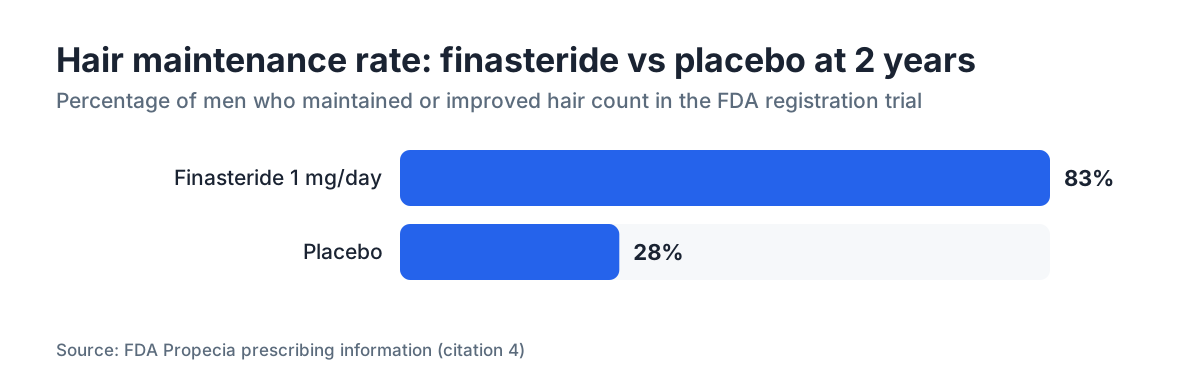
A 2-year placebo-controlled study found that 83% of men on finasteride maintained or improved their hair count, versus 28% on placebo. [4] Those numbers are real and they mean something, but they come from a population that included earlier-stage patients. The effect at Norwood 5 specifically is hard to isolate from published data.
Finasteride carries sexual side effects in a minority of users, including reduced libido, erectile dysfunction, and ejaculatory changes. The FDA label lists these at roughly 3.8% incidence in trials, though post-market data suggests the number may vary depending on how thoroughly patients are asked. [4] A small subset of men report persistent symptoms after stopping the drug, a phenomenon sometimes called post-finasteride syndrome, though the epidemiological evidence on this remains contested. For a full look at the drug's benefits and risks, see finasteride.
So here's what I'd do at Norwood 5. Start finasteride if you're not already on it, mostly to protect what remains and slow the march toward Type 6 or 7. Pair it with minoxidil for better effect. Just don't start it expecting it to fill in the bald zones.
Does minoxidil help at this stage?
Minoxidil, the topical vasodilator originally developed as an oral blood pressure medication, has FDA approval for androgenetic alopecia in a 5% topical solution or foam for men. [5] It works by prolonging the anagen (growth) phase of the hair cycle and increasing follicle size. At Norwood 5, it's useful but limited by the same reality as finasteride: the more follicles have already been lost or permanently miniaturized, the less there is for the drug to work with.
In practice, minoxidil produces the most visible results at the vertex and along the hairline margins, exactly where miniaturized follicles are most likely to still be present at Norwood 5. The bald central scalp, where follicles are gone, won't respond. Consistent twice-daily application (or once daily for the 5% foam per its label) is needed to keep any benefit. Stop minoxidil and you typically lose the regrown hair within months.
Oral minoxidil at low doses (0.625 mg to 2.5 mg daily) has grown in clinical use as an off-label option. Small trials suggest comparable or superior efficacy to topical at much lower doses, with different side effects including fluid retention and fine body hair growth. If you want to compare oral to topical, oral minoxidil breaks that down in detail, and minoxidil for men covers topical dosing.
Combining finasteride and minoxidil is the standard dual-therapy approach. The two mechanisms fit together: finasteride reduces DHT-driven miniaturization, minoxidil stimulates follicle activity. See finasteride and minoxidil for how they're typically combined. Minoxidil side effects are worth reviewing before you start.
Is a hair transplant realistic for Norwood 5?
Yes. For many Norwood 5 men, a hair transplant is the most realistic path to meaningful coverage. The question isn't whether it's possible. It's whether your donor supply is adequate and your expectations are sensible.
Here's the basic math. A typical Norwood 5 bald zone is roughly 80 to 120 square centimeters of scalp. To reach a natural-looking density of around 40 to 50 follicular units per square centimeter, you'd need 3,200 to 6,000 grafts to cover it fully. Most men have a donor supply of 5,000 to 8,000 total extractable grafts in their lifetime (the range is wide because head size, donor density, and hair caliber all vary a lot). [6]
That means a Norwood 5 is often achievable in one large session or two sessions, but only if your donor area is dense enough. A surgeon who tells you they can restore full coverage at high density across the entire Norwood 5 zone in a single 2,000-graft procedure is not being straight with you.
FUE (follicular unit extraction) and FUT (follicular unit transplantation) are the two main techniques. FUT yields a higher graft count per session because a strip of scalp is removed rather than individual follicles extracted, but it leaves a linear scar. FUE leaves small circular scars that are less visible under short hair. Neither is universally better. The right choice depends on how much coverage you need, whether you want to wear your hair short, and your surgeon's skill. See hair transplant for a deeper comparison.
Cost in the US typically runs $6,000 to $18,000 for a session appropriate for Norwood 5, depending on graft count, technique, and clinic. International options (Turkey, Mexico, India) are materially cheaper, often $2,000 to $5,000 for the same graft count, though quality control and post-op support vary enormously. [7]
One thing surgeons worth their salt will tell you: if you're Norwood 5 at age 25, you're almost certainly going to keep progressing. Transplanting now means spending a large chunk of your finite donor supply to fill an area that could be ringed by new bald patches in 10 years. Most good surgeons want you on finasteride for at least a year before operating, both to stabilize loss and to prove you're a committed candidate.
What are DHT blockers and do any OTC options work?
DHT is the androgen mainly responsible for follicle miniaturization in androgenetic alopecia. Finasteride and dutasteride are the prescription-strength DHT blockers with clinical evidence. Dutasteride blocks both type I and type II 5-alpha reductase enzymes (finasteride only blocks type II), cutting scalp DHT by closer to 90%, and it's approved for this use in Japan and South Korea, though it stays off-label in the US for hair loss. Early comparative data suggests it beats finasteride on hair count outcomes. [8]
Over-the-counter supplements marketed as DHT blockers, saw palmetto chief among them, have some small-scale trial data suggesting mild 5-alpha reductase inhibition, but the effect size is much smaller than prescription options and trial quality is generally low. [9] For a Norwood 5, leaning on OTC supplements as your primary treatment is a bad bet. They might be a reasonable add-on if you can't tolerate finasteride, but they're not a substitute. Hair loss supplements covers the evidence on these honestly.
Ketoconazole shampoo has some evidence as a mild DHT blocker at the scalp level and is sometimes used as an adjunct. A 1998 study found it comparable to 2% minoxidil in hair density improvements over 6 months [9], though this was a small trial and hasn't been widely replicated. It's cheap and low-risk, so it's a reasonable add-on, not a cornerstone.
For a full look at how DHT blockade fits into a treatment plan, dht blocker is worth reading.
What does the research actually say about treating advanced hair loss?
The honest state of the evidence at Norwood 5 is that prevention and stabilization are the well-supported goals, and significant cosmetic restoration requires surgery.
The FDA-approved treatments for androgenetic alopecia in men are topical minoxidil (2% and 5%) and oral finasteride (1 mg). [5] Both have randomized controlled trial data. Both work better at earlier stages. Neither has strong RCT evidence specifically in Norwood 5 populations, which means we're extrapolating from broader trials.
Low-level laser therapy (LLLT) devices, including FDA-cleared combs and helmets, have some supporting trial data for mild to moderate hair loss. The evidence at advanced stages is thin. A 2009 meta-analysis in the American Journal of Clinical Dermatology concluded that LLLT showed statistically significant improvements in hair density but noted that most trials were in early-stage patients. [10] Worth trying as a non-drug add-on. Not worth making it a cornerstone.
Platelet-rich plasma (PRP) injections have grown in popularity as a clinic-based treatment. The evidence is genuinely mixed. Some small trials show meaningful improvements in hair density. Others show almost nothing. The lack of standardization in how PRP is prepared and injected makes comparing studies difficult. At Norwood 5, PRP alone is not a reliable path to coverage, but some surgeons use it as an adjunct to transplantation to improve graft survival.
The American Academy of Dermatology's guidelines recommend minoxidil and finasteride as first-line treatments for male androgenetic alopecia, with hair transplantation for appropriate surgical candidates. [11] That's the authoritative framework, and it tracks with what the evidence actually supports.
What is a realistic treatment plan for a Norwood 5 man?
There's no single right answer, but here's how most evidence-based clinicians would think it through.
First, stabilize. If you're not on finasteride and you don't have a contraindication, starting it is the first logical step. It won't fill in what's gone, but it cuts the chance you progress to Type 6 or 7 while you figure out your next move. Minoxidil twice daily alongside it. Expect to wait 12 months to see the full effect of both.
Second, assess your donor supply honestly. Book a consultation with a board-certified hair restoration surgeon, ideally a fellow of the International Society of Hair Restoration Surgery (ISHRS), and get an honest graft count estimate and a realistic drawing of what coverage is achievable. Get two or three opinions. Surgeons vary a lot in their conservatism and in how honestly they present trade-offs.
Third, decide on your goal. Some Norwood 5 men want a dense full head of hair. Others just want to soften the contrast between a bald top and a dark fringe. A well-placed hairline with moderate density across the front can look dramatically better without burning through your entire donor supply, leaving grafts in reserve for future needs.
Fourth, maintain. Any transplant needs protecting. Continuing finasteride after surgery protects native hair. Minoxidil supports scalp health and graft survival. A good surgeon will want to know your maintenance plan before they operate.
| Stage | Finasteride likely to halt progression? | Minoxidil regrowth realistic? | Transplant typically feasible? |
|---|---|---|---|
| Norwood 2-3 | Yes, strong evidence | Yes, often meaningful | Not always needed |
| Norwood 4 | Yes, moderate effect | Partial | Yes, smaller session |
| Norwood 5 | Partially | Minimal to partial | Yes, larger session |
| Norwood 6-7 | Limited effect | Minimal | Possible, donor-limited |
Can Norwood 5 hair loss be reversed without surgery?
Reverse is a strong word, and it's where a lot of marketing overreaches. True reversal, meaning filling in bald zones with terminal-density hair, needs functional follicles. At Norwood 5, the large bald areas usually have no viable follicles left above a certain point in the scalp. No medication reaches zero follicles and makes hair appear.
What medications can do is slow or stop further loss and sometimes thicken miniaturized follicles along the edge of the bald zone, making the border less sharp. For a small minority of men, especially those with significant miniaturization rather than complete follicle absence in some areas, there can be visible regrowth. But planning for that outcome at Norwood 5 sets you up for disappointment.
Hair fibers (keratin-based topical products like Toppik) and scalp micropigmentation (SMP, a tattooing technique that mimics the look of a shaved head) are non-surgical options that change appearance without changing biology. SMP has grown in quality and realism and suits men who are comfortable with the shaved-head look. It's not a hair loss treatment in any medical sense, but it's a legitimate cosmetic solution.
No supplement, shampoo, or topical marketed online as regrowing hair at this stage has adequate clinical evidence behind that claim. Keep your skepticism high. If something worked as advertised, it would be an FDA-approved drug.
How much does treating Norwood 5 actually cost?
Costs vary widely by country, treatment type, and provider. Here's a realistic breakdown for the US market.
Generic finasteride runs about $20 to $50 per month, depending on pharmacy and insurance. Brand Propecia costs much more and has no clinical advantage over generic. Generic minoxidil 5% solution or foam is $10 to $25 per month. So dual medical therapy is around $30 to $75 per month ongoing, which adds up, but it's the cheapest sustained option by far. [7]
Hair transplant for a Norwood 5, where a large session is typically needed, runs $6,000 to $18,000 in the US, with most full Norwood 5 restorations in the $9,000 to $15,000 range depending on graft count and technique. Turkey is the dominant destination for medical tourism, with full sessions averaging $2,000 to $5,000 at reputable clinics. [7] The savings are real, but so are the risks of poor aftercare, lower-quality graft handling, and difficulty resolving complications from a distance.
LLLT devices are a one-time cost of $200 to $900 for FDA-cleared consumer devices, plus ongoing use. PRP sessions run $500 to $1,500 each at most clinics, with a typical protocol of 3 sessions in the first year.
Health insurance in the US does not cover hair loss treatments for androgenetic alopecia, since they're classified as cosmetic. [7] Some FSA and HSA accounts can be used for prescription medications but not OTC products. Check your specific plan documentation.
What should you ask a doctor or surgeon at a Norwood 5 consultation?
Going in with the right questions changes the quality of the advice you get. Here's what actually matters.
Ask how many total grafts they estimate you have available in your donor zone and how they measured it. A responsible surgeon uses dermoscopy or folliscopy, not a glance. Ask what coverage they can realistically achieve with those grafts across your bald zone, and ask them to show you the math. If they promise dense, full coverage with a modest graft count, that's a red flag.
Ask specifically about your progression risk. At Norwood 5, the question is whether you're likely to reach Type 6 or 7, and how they plan the transplant to account for that. A surgeon who doesn't raise this on their own is not thinking long-term.
Ask about their experience with advanced Norwood stages. FUE in a Norwood 5 patient is technically demanding. Ask to see before-and-after photos of patients with similar baseline stages, more than favorable Norwood 2-3 cases.
Ask about the role of medications in your plan. Any reputable surgeon will want you on finasteride before and after surgery. If they're indifferent to your medication status, note it.
If a receding hairline was where your loss started, it's worth understanding how hairline reconstruction fits the overall plan. Receding hairline has context on that part of the surgery discussion.
Sources
- Norwood OT. Male pattern baldness: classification and incidence. Southern Medical Journal, 1975.
- American Academy of Dermatology, Hair Loss Overview
- Heilmann-Heimbach S et al. Journal of Investigative Dermatology, 2011. Meta-analysis of GWAS data on androgenetic alopecia.
- FDA Propecia (finasteride 1 mg) prescribing information
- FDA, Minoxidil topical OTC labeling guidance and approval history
- International Society of Hair Restoration Surgery (ISHRS), Practice Census 2022
- ISHRS 2022 Practice Census, cost and procedure data
- Olsen EA et al. Journal of the American Academy of Dermatology, 2006. Dutasteride vs finasteride in men with androgenetic alopecia.
- Prager N et al. Journal of Alternative and Complementary Medicine, 2002. Saw palmetto extract in androgenetic alopecia.
- Avram MR, Rogers NE. American Journal of Clinical Dermatology, 2009. LLLT for hair loss meta-analysis.
- American Academy of Dermatology, treatment guidance for hair loss