

TL;DR: The Norwood scale runs from Stage 1 (no visible loss) to Stage 7 (only a horseshoe rim of hair remains). Identifying your stage takes about two minutes using hairline shape, crown thinning, and a top-down photo. Your stage matters because finasteride and minoxidil show stronger results at earlier stages, while Stage 5 and above often means a transplant conversation.
What is the Norwood scale and why does it matter?
The Norwood scale, formally called the Hamilton-Norwood scale, is the most widely used system for classifying male pattern baldness. Dr. James Hamilton published the original classification in 1951, and Dr. O'Tar Norwood revised and expanded it in 1975 into the version dermatologists and hair surgeons still use today [1]. It maps hair loss into seven stages, with some stages having type A variants that describe loss moving straight back rather than leaving a central forelock.
Why does it matter? Because hair loss treatments do not work equally across all stages. Finasteride's main clinical trials enrolled men at Norwood Stages 2 through 5 vertex, and the drug's FDA-approved labeling reflects outcomes in that range [2]. A Stage 2 man who starts finasteride has a meaningfully different prognosis than a Stage 6 man starting the same drug. Surgeons use the scale to estimate how many grafts a transplant requires and whether the donor area can realistically cover the loss [3].
The scale also gives you a shared vocabulary with any doctor, telehealth provider, or specialist you consult. Saying "I'm a Norwood 3 vertex" communicates more in three words than a paragraph of description.
What does each Norwood stage look like?
Here is a plain-English description of each stage, including the A variants. The easiest way to use this as a calculator is to match your hairline and crown to the description that fits, then confirm with a top-down photo.
Stage 1 No recession. The hairline sits at or near the adolescent position. Most people in their teens and early twenties are here. No treatment is indicated or studied.
Stage 2 Slight recession at the temples, forming a very shallow M shape. The corners pull back but the midpoint hairline holds. This is where many men first notice something changing. Stage 2A shows a band of recession moving uniformly backward without a strong central forelock.
Stage 3 The temples have receded deeper, creating a more pronounced M or U. By strict definition, this is the earliest stage counted as clinically significant baldness [1]. Stage 3 Vertex adds a thinning or bald spot at the crown while the frontal hairline may still look relatively intact.
Stage 4 The temple recession and crown spot have both grown. They are not yet connected, but a band of hair separates them across the top. The front hairline sits noticeably further back than in earlier stages. Stage 4A shows the recession as a single band moving backward without a distinct crown spot.
Stage 5 The bridge of hair between the frontal recession and crown spot narrows a lot. Some photos at Stage 5 look like Stage 4, but the bridge is thinner. Stage 5A loses that bridge almost entirely.
Stage 6 The frontal and crown bald areas have merged into one large zone. Only the sides and a narrow strip at the very back remain. This is where transplant donor supply starts to become a real constraint.
Stage 7 The most advanced stage. A horseshoe-shaped rim of hair runs above the ears and across the low back of the head. Everything above that rim is bald. Donor hair is limited. Treatments at this stage maintain what remains rather than recover what is gone.
| Stage | Hairline | Crown | Bald Area Estimate |
|---|---|---|---|
| 1 | Juvenile, no recession | None | ~0% |
| 2 | Slight temple recession | None | ~5-10% |
| 3 | Moderate M/U recession | None or early | ~15-25% |
| 3V | Moderate M/U recession | Visible thinning | ~20-30% |
| 4 | Significant recession | Distinct spot | ~30-40% |
| 5 | Deep recession | Large spot, narrow bridge | ~45-55% |
| 6 | Merged frontal + crown loss | Merged | ~60-70% |
| 7 | Horseshoe rim only | Fully merged | ~75-85% |
Bald area estimates are approximations based on surface area mapping in Hamilton's original 1951 paper and later surgical planning references [1][3]. Head size and hair density move the actual numbers around.
How do you calculate your own Norwood stage at home?
You need two things: good lighting and a smartphone camera. Natural light or a bright overhead lamp beats bathroom mirror lighting, because shadows from a single point source can exaggerate thinning.
Step 1: Check your hairline in a mirror. Pull your hair back or wet it so it lies flat. Look at the temples first. Are they straight across, or do the corners pull back? How far back do they go relative to the center of your forehead?
Step 2: Take a top-down photo. Hold your phone above your head and tilt it down, or ask someone to shoot straight down from behind you. This angle reveals crown thinning that mirrors completely hide. The scalp shows through thinning areas as a lighter zone against your hair color.
Step 3: Compare both images against the stage descriptions above. Most people land clearly in one stage. If you are on the line between two stages, call yourself the lower one for treatment planning until you have a second data point six months later.
Step 4: Track over time. A single photo tells you where you are. Two photos taken twelve months apart tell you how fast you are moving. Rate of progression matters more than current stage for deciding how hard to treat.
If you want an AI-assisted reading instead of eyeballing the comparison, MyHairline's free AI scan reads your photos and returns a stage estimate in minutes, a useful cross-check before a dermatology appointment.
One honest caveat: the Norwood scale was designed and validated in men. Women lose hair in different patterns, usually diffuse thinning across the top rather than temple-led recession, which is why the Ludwig scale is the standard tool for female pattern hair loss [4]. If you are a woman noticing overall thinning rather than a receding hairline, the Norwood stages may not map cleanly to your situation.
How common is each Norwood stage among men?
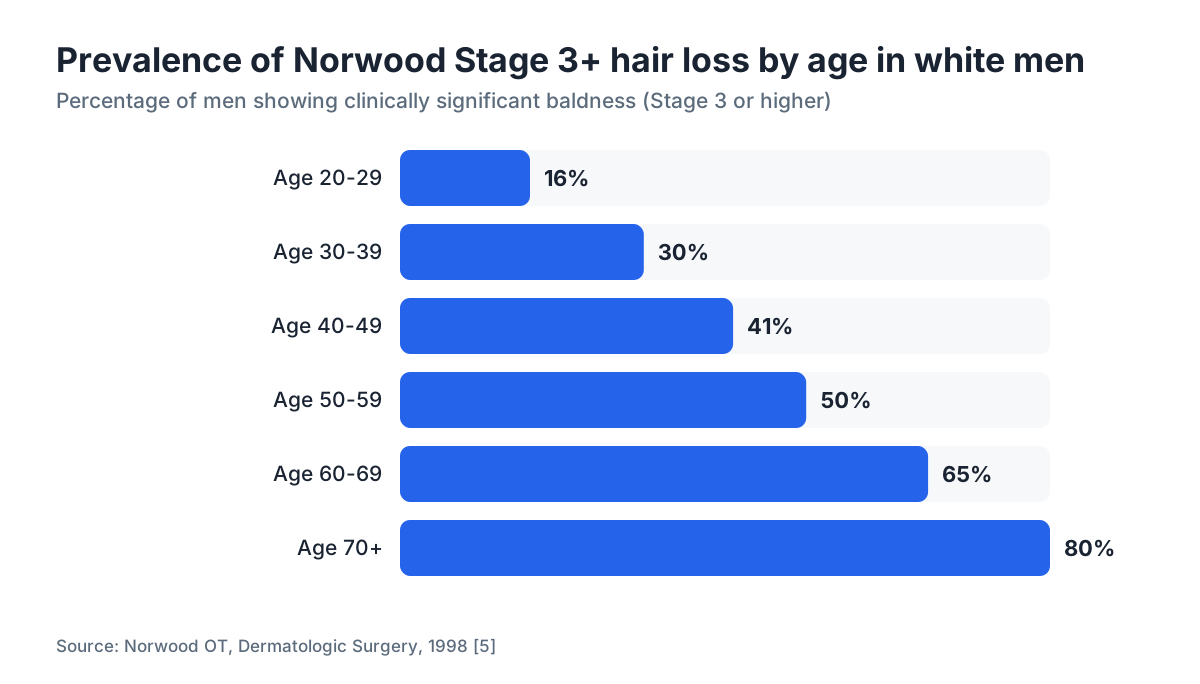
Prevalence data across the Norwood stages comes mainly from a large epidemiological study published in Dermatologic Surgery in 1998 by Norwood himself, which surveyed over 1,000 men across age groups [5].
By age 50, roughly 50% of white men show Norwood Stage 3 or higher loss [5]. By age 70, that figure climbs above 80%. Onset age varies widely. Some men hit Stage 2 in their late teens. Others stay at Stage 1 into their forties.
Ethnicity affects prevalence. Men of East Asian heritage show lower overall rates of androgenetic alopecia and tend to progress more slowly. Men of South Asian and white European heritage show higher rates. Black men fall somewhere in between, though the Norwood scale itself was built primarily on white male populations, a real limitation when applying it broadly [6].
Progression is also non-linear. Many men plateau for years at a given stage, then move fast. Nobody has strong predictive data for individual rate of change. The best proxy is your father's and maternal grandfather's pattern at the same age, though the inheritance is polygenic and imperfect as a forecast.
Stage 2 is the most common stage in men aged 20-35. Stages 3 and 3V dominate the 35-50 range. Stages 5 through 7, dramatic as they look in photos, represent a smaller slice of the total male population simply because not every man progresses that far.
Which treatments work at which Norwood stages?
This is the question that actually matters once you have your stage. Here is an honest breakdown.
Finasteride (oral 1mg) The FDA approved finasteride for male pattern hair loss in 1997. The approval trials covered men aged 18-41 at Norwood Stages 2 through 5 vertex. In those trials, 83% of men taking finasteride maintained or increased hair count over two years versus 28% on placebo [2]. The drug blocks 5-alpha reductase type II, which converts testosterone to DHT, the androgen behind follicle miniaturization. It works best at Stages 2 through 4. At Stage 6 and 7, follicles in the bald zone are gone, and you cannot regrow what no longer exists. Finasteride can hold what remains and may thicken existing hair. See our full breakdown of finasteride for dosing, side effects, and the evidence on 5mg versus 1mg.
Minoxidil (topical 5% and oral) Minoxidil is FDA-approved as a topical solution and foam for men at all Norwood stages where hair is still present but thinning [7]. It works as a vasodilator and a direct stimulant of the hair growth phase, though the exact mechanism is still not fully understood. In the main 12-month trial for 5% topical minoxidil, 84.3% of men reported some degree of hair regrowth versus 39% with placebo. That regrowth is most visible and most meaningful at Stages 2 through 4, where a decent number of follicles are still active but producing finer hair. At Stage 6 and 7, minoxidil can maintain fringe areas but will not rebuild bald zones. Our guide to minoxidil for men covers the 5% versus 2% comparison and how long you actually need to use it.
Combined finasteride and minoxidil A 2021 randomized controlled trial in JAMA Dermatology found that combination therapy produced significantly greater hair count improvements than either drug alone at 24 weeks [8]. Many dermatologists now recommend the combination as a first-line approach for men at Stages 2 through 4 who have no contraindications. The finasteride and minoxidil guide is worth reading if you are considering starting both.
Hair transplant Surgery becomes a real conversation at Stages 4 through 6, once loss has stabilized enough that a surgeon can predict where to place grafts without chasing a moving target. At Stage 7, the donor zone is limited and outcomes are more constrained. The hair transplant guide covers FUE versus FUT, graft estimates by stage, and realistic cost ranges.
DHT blockers (topical finasteride, saw palmetto, etc.) Topical finasteride 0.25% applied to the scalp reduces serum DHT less than oral finasteride and may lower systemic side-effect risk, though the evidence base is thinner. Saw palmetto and other supplements have weak evidence; a 2020 systematic review found some modest benefit but noted that none of the studies were adequately powered [9]. See dht blocker for the full picture.
Stages 1 and 2 specifically At Stage 1 with no family history, most dermatologists would not treat. At Stage 2 with a strong family history of progression, finasteride is reasonable if you understand the risks. Starting early is the single most effective strategy, because you are preserving follicles instead of trying to recover them.
| Stage | Finasteride | Topical Minoxidil | Transplant | Notes |
|---|---|---|---|---|
| 1 | Not indicated | Not indicated | Not indicated | Monitor only |
| 2 | Strong evidence | Useful | Not needed | Best prevention window |
| 3/3V | Strong evidence | Strong evidence | Rare cases | Most common treatment stage |
| 4 | Good evidence | Good evidence | Consider | Combination preferred |
| 5 | Maintenance | Maintenance | Often appropriate | Stabilize first |
| 6 | Maintenance | Maintenance | Limited by donor | Realistic expectations needed |
| 7 | Minimal benefit | Minimal benefit | Very limited | Manage expectations honestly |
Is the Norwood scale accurate and what are its limitations?
The Norwood scale is a useful clinical shorthand, not a precision instrument. A few real limitations:
Inter-rater variability is significant. When multiple dermatologists independently classify the same patient, they disagree more than you would hope, especially at the boundary between Stages 3 and 4 and between Stages 5 and 6 [6]. The scale was built for clinical use, not fine-grained measurement.
It does not capture hair density. Two men can both be Stage 3 with very different futures: one with coarse, dense remaining hair, one with miniaturized, fine hair throughout. The clinical picture differs even though the stage is the same. Trichoscopy (scalp magnification) fills this gap in a specialist setting.
It was developed on white men. Applying it to other ethnicities carries some uncertainty. Hair loss in men of Asian descent sometimes does not follow the classic Norwood progression, showing more diffuse thinning before localized recession.
It has no time dimension. The scale tells you where you are, not how fast you are moving. A man at Stage 2 at age 22 has a very different prognosis from a man at Stage 2 at age 52, even though they land in the same box on the chart.
None of these limitations make it useless. They make it a starting point, not a verdict. Pair the visual classification with a dermatologist's assessment, trichoscopy if available, and your own progression photos over time.
What is the difference between Norwood A variants and standard stages?
The A variants (2A, 3A, 4A, 5A) describe a pattern where recession advances as a fairly uniform band from front to back, without leaving the island of hair in the center that produces the classic widow's peak or forelock shape.
In the standard progression, recession starts at the temples and works inward, often leaving a central forelock intact for years. The A variants skip that phase: the entire front hairline moves backward together. Crown loss can still happen in A variants, but the defining feature is that uniform forward recession.
The A pattern is less common than the standard pattern, roughly 3% of men with androgenetic alopecia in Norwood's own observations [1]. It does not necessarily mean faster progression or a worse prognosis. Treatment approach is the same; the staging just reflects a different geometric pattern of loss.
Can the Norwood scale be used for women?
Short answer: not well. Female pattern hair loss follows a different androgenetic pathway and a different visual pattern. Most women with genetic hair loss get diffuse thinning across the top and crown, with the frontal hairline relatively preserved. That is the opposite of the classic male temple-and-crown progression.
The Ludwig scale, published in 1977, sorts female pattern loss into three grades based on the width of the part and the density of hair across the mid-scalp [4]. The Sinclair scale is a more recent alternative. Neither is a calculator in the same sense as Norwood, but they do the same job of staging severity.
If you are a woman with hair loss that looks more like thinning throughout than a receding hairline, the Norwood descriptions in this piece will not map accurately to your situation. Telogen effluvium is worth reading too, since diffuse shedding in women is often a temporary condition distinct from genetic pattern loss, not a Norwood-scale phenomenon at all. For a broader look at causes, what causes hair loss covers both sexes.
How does your Norwood stage affect hair transplant planning?
Hair transplant surgeons use the Norwood stage as the primary input for estimating how many follicular unit grafts a procedure needs and whether the donor area can supply them.
A rough graft estimate by stage, drawn from surgical planning literature and the International Society of Hair Restoration Surgery's practice guidelines [3]:
- Stage 3: approximately 800-1,500 grafts to restore frontal density
- Stage 4: approximately 1,500-2,500 grafts
- Stage 5: approximately 2,500-3,500 grafts
- Stage 6: approximately 3,000-4,500 grafts
- Stage 7: extremely variable, donor supply often the binding constraint
The average person has roughly 6,000 to 8,000 donor follicular unit grafts available to harvest without leaving the donor zone visibly sparse [3]. At Stage 6 and 7, a surgeon may need almost all of those grafts to cover the loss, leaving little reserve for future procedures if loss continues.
This is why most hair surgeons prefer to operate on patients who have stabilized their loss with medication first. A man at Stage 4 who is actively progressing may be a Stage 5 or 6 by the time transplanted grafts have grown in, making the result look incomplete. Stabilizing with finasteride or minoxidil for men before surgery is standard practice in most clinics.
Cost also scales with stage. FUE transplants in the US typically run $4,000 to $15,000 or more depending on graft count, with higher stages requiring more sessions and higher total cost [3].
Can hair loss reverse, and does your Norwood stage ever go down?
Once a follicle fully miniaturizes and the follicular unit is truly gone, no currently approved treatment reverses that. Your stage does not go backward in a permanently bald area.
Apparent stage can still improve with treatment in two real scenarios.
First, thinning that has not yet become complete baldness. A Stage 3 or 4 man with miniaturized but still-present follicles in the recession zones can regrow visibly thicker hair with finasteride and minoxidil. Trichoscopy studies show that miniaturized hairs can return to terminal size with effective DHT suppression over 12 to 24 months [8]. That can look like a jump backward in stage, even though the underlying genetic predisposition has not changed.
Second, conditions that are not androgenetic alopecia can resolve. Telogen effluvium (diffuse shedding from stress, illness, or nutritional deficiency) can mimic early Norwood advancement and then fully reverse once the trigger clears. If your loss happened fast over weeks or months rather than gradually over years, it may not be pattern baldness at all. See telogen effluvium for the distinction.
The honest framing: the goal of treatment for true androgenetic alopecia is maintenance and modest regrowth of miniaturized hairs, not wholesale reversal of the Norwood stage. Anyone promising you will move from a Stage 5 to a Stage 2 without surgery is overpromising.
What should you do next once you know your stage?
Stage 1 with no family history: nothing required. Take a reference photo now so you have a baseline in five years.
Stage 1 with strong family history: consider a dermatology consult. Early finasteride is genuinely the most powerful prevention tool, though the side-effect risk-benefit discussion is personal and worth having with a doctor rather than deciding alone.
Stage 2 or 3: this is the best treatment window. Finasteride, minoxidil, or both. The evidence at these stages is the strongest, and the chance to preserve most of your hair is real. Do not wait. Every month of delay is follicles that could have been maintained.
Stage 4 or 5: medications are still worth starting for maintenance, especially if you have not tried them. Add a hair transplant consultation to your list, but choose a surgeon who wants you on medication first before cutting a date.
Stage 6 or 7: have an honest conversation about what is realistic. Medications can maintain fringe density. A transplant may be possible but needs a surgeon experienced in high-stage work who will tell you how many grafts are available and what coverage is actually achievable.
If you want a second set of eyes on your photos before booking a dermatologist, MyHairline's free AI scan at myhairline.ai/scan gives you a stage estimate and a treatment overview based on your specific photos. It is a starting point, not a substitute for a clinical exam.
For anything involving prescription medication, a licensed physician or dermatologist should be in the loop. Online telehealth services that prescribe finasteride have made this more accessible in the US, but they vary widely in how thoroughly they screen for contraindications.
Sources
- Norwood OT, 'Male pattern baldness: classification and incidence', Southern Medical Journal, 1975
- FDA, Propecia (finasteride 1mg) prescribing information
- International Society of Hair Restoration Surgery (ISHRS), practice guidelines and graft estimation
- Ludwig E, 'Classification of the types of androgenetic alopecia (common baldness) occurring in the female sex', British Journal of Dermatology, 1977
- Norwood OT, 'Incidence of male androgenetic alopecia', Dermatologic Surgery, 1998
- Yazdabadi A, Sinclair R, 'Treatment of female pattern hair loss', Australasian Journal of Dermatology, 2011
- FDA, Rogaine (minoxidil 5%) OTC labeling and approval history
- Hu R et al., 'Combined treatment with oral finasteride and topical minoxidil in male androgenetic alopecia', JAMA Dermatology, 2021
- Evron E et al., 'Natural hair supplement: Friend or foe? Saw palmetto, a systematic review', Skin Appendage Disorders, 2020
- American Academy of Dermatology (AAD), 'Hair loss: Diagnosis and treatment'
- van der Donk J et al., 'Psychological characteristics of men with alopecia androgenetica and their modification', International Journal of Dermatology, 1994
- Trueb RM, 'Molecular mechanisms of androgenetic alopecia', Experimental Gerontology, 2002