
TL;DR: The Norwood scale classifies male pattern baldness into seven stages, from no visible loss (Stage 1) to nearly complete baldness (Stage 7). James Hamilton introduced it in 1951 and O'Tar Norwood revised it in 1975. Knowing your stage helps you pick treatments that match where your hair loss actually stands right now.
What is the Norwood scale and why does it matter?
The Norwood scale (formally the Hamilton-Norwood scale) is the most widely used classification system for male pattern baldness, also called androgenetic alopecia. It divides hair loss into seven stages based on where hair is receding and how much crown coverage remains. Dermatologists, hair transplant surgeons, and researchers all use it as a shared language.
James Hamilton published the original classification in 1951 [1]. O'Tar Norwood revised and expanded it in 1975, adding more stages and the "Type A" variant, which describes a different recession pattern [2]. That 1975 paper is still the one most clinicians cite today.
Why does your stage matter? Because treatments have different evidence bases and cost profiles at different stages. A man at Norwood 2 has options a man at Norwood 6 does not, and the reverse holds too. Stage also predicts progression risk. If your father or maternal grandfather reached Norwood 6, your own trajectory is more likely to follow a similar path, though genetics are genuinely complicated here and no single gene determines outcome [3].
The scale only applies to male pattern hair loss. Women with androgenetic alopecia are typically classified using the Ludwig or Sinclair scale, which map the diffuse thinning pattern more common in women. Understanding what causes hair loss is a good place to start if you are not sure whether androgenetic alopecia is even what you are dealing with.
What does each Norwood stage actually look like?
Here is what you will see at each stage. These descriptions follow Norwood's 1975 paper and the clinical illustrations used in dermatology training since [2].
Stage 1: No visible recession. The hairline sits at or just above the upper forehead creases. This is the baseline. Most men in their late teens are here.
Stage 2: Slight, symmetric recession at the temples. The hairline has moved back a bit at the corners but the frontal band of hair stays mostly intact. Many men live here for years. This is often the first stage where someone notices something and starts worrying.
Stage 3: The first stage the scale treats as clinically significant. The temporal regions have receded deeply, forming visible M- or U-shaped notches. Stage 3 Vertex is a sub-type where the crown also begins to thin noticeably while the front stays closer to Stage 2.
Stage 4: Both the frontal hairline and the crown show obvious loss. A strip of hair still bridges the top of the scalp, separating the two thinning zones. That bridge matters to surgeons as a reference point.
Stage 5: The bridge of hair between front and crown has narrowed a lot. Hair in both zones is sparse. This is where many men start looking into transplants seriously, though the math on donor density gets harder here.
Stage 6: The bridge is gone. The frontal and crown zones have merged into one large bald area. Side and back hair remain but do not extend over the top.
Stage 7: The most advanced stage. Only a narrow horseshoe of hair circles the sides and back of the head. That horseshoe is the permanent zone surgeons rely on for donor grafts.
Type A variant: Norwood described a separate progression where the hairline recedes evenly from front to back, with no persistent forelock and no isolated crown loss. It is less common but it changes how loss looks and how transplants get planned [2].
One honest limitation: placing yourself precisely between, say, Stage 4 and Stage 5 from a mirror is harder than the diagrams suggest. Even trained dermatologists sometimes disagree by one stage. If the exact stage matters for treatment planning, a clinician assessment or a tool like the free AI scan at MyHairline beats self-assessment alone.
How common is each Norwood stage in the general population?
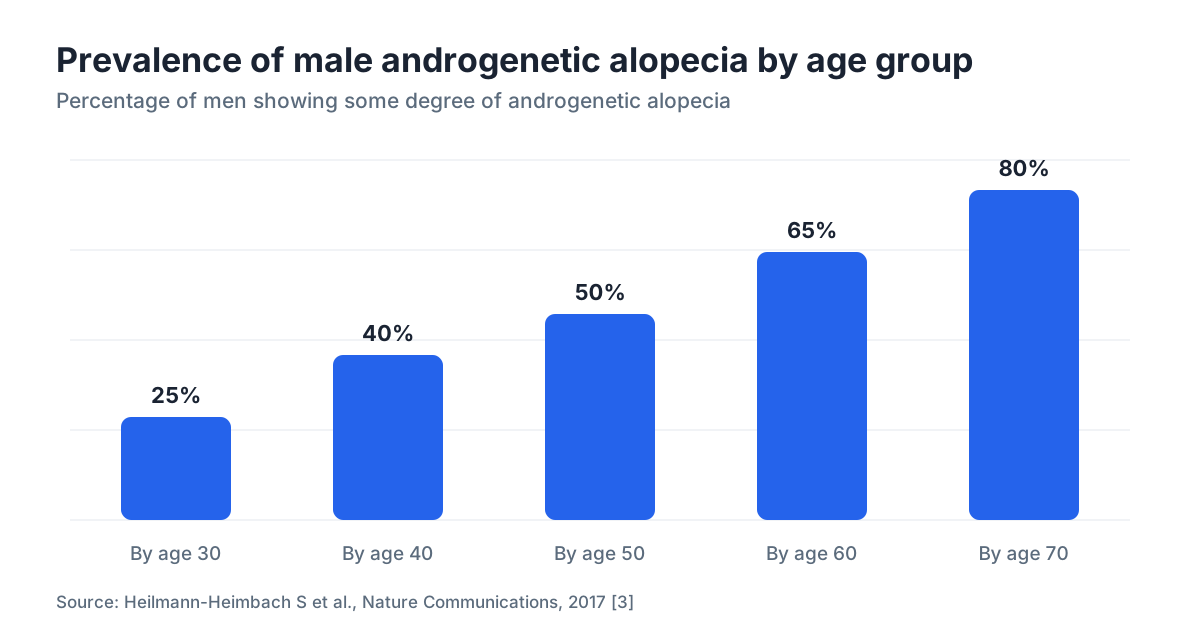
A large cross-sectional study published in the Journal of Investigative Dermatology examined over 1,000 Caucasian men and found that by age 50, roughly 50% showed some degree of androgenetic alopecia, and by age 70 that figure climbed past 80% [3].
Breaking it down by stage is harder, because prevalence studies use different methods and most combine adjacent stages. The broadest population data comes from the Norwood 1975 paper itself and from Kang et al. 2010, which studied Korean men and found lower overall prevalence but a similar stage distribution proportionally [4]. Asian men tend to progress more slowly and reach advanced stages (6 and 7) at lower rates than Caucasian men, though the reasons are not fully understood.
What seems consistent across studies: Stages 2 and 3 are by far the most common in men under 40. Stage 7 affects roughly 8 to 10% of men over 60 in Caucasian populations. Most men who lose hair never reach complete baldness.
Progression follows no fixed rate. Some men move from Stage 2 to Stage 4 in two years. Others stay at Stage 3 for a decade. The DHT-sensitivity of your follicles and the density of androgen receptors in your scalp skin are the main drivers, and those are partly genetic [3].
What treatments work at each Norwood stage?
Treatment choice depends heavily on stage, and I think it helps to be direct about what actually has FDA approval or strong clinical evidence versus what is mostly marketing.
Stages 1-3: These are the stages where medication does the most relative to the amount of loss. Minoxidil (topical or oral) and finasteride both deliver the largest absolute benefit when follicles are still partially active. The American Academy of Dermatology recommends minoxidil and finasteride as first-line treatments for androgenetic alopecia in men [5]. A 5-year randomized controlled trial found that finasteride 1mg/day led to visible improvement or no further loss in roughly 90% of men who completed the trial [6]. Starting early gives you more to preserve.
Stage 4: Medication is still worth using, but many men at this stage are also talking to transplant surgeons. A transplant at Stage 4 is feasible if donor density is adequate, but surgeons usually want stable loss (not actively progressing) before operating. Finasteride alongside a procedure protects the non-transplanted hair. Finasteride and minoxidil for men are both worth understanding thoroughly before any decisions here.
Stage 5: Transplants remain an option but need careful planning, because the area to cover is large and donor supply from the back and sides is finite. A typical transplant session moves 2,000 to 4,000 grafts. Covering a large Stage 5 bald area to a natural density often takes more than one session. Medication still matters post-transplant to slow ongoing loss in the zones that were not treated.
Stages 6 and 7: Transplants at these stages are complex. The donor zone (that horseshoe of permanent hair) has to supply enough grafts to make a real cosmetic difference. Some surgeons use beard hair as supplementary donor via body hair transplant. Medication does less here because most susceptible follicles are already gone, but it can still protect what remains. DHT blockers as a category are worth reading about if you have not already.
A note on supplements and other products: the evidence base for most hair loss supplements is thin. Saw palmetto has the most data, and it is still well below what we see with finasteride. Be skeptical of anything that promises regrowth at Stage 6.
| Norwood Stage | Minoxidil | Finasteride | Transplant | Notes |
|---|---|---|---|---|
| 1 to 2 | Preventive use reasonable | Yes, strongest evidence here | Not typically indicated | Early intervention offers best ROI |
| 3 | Yes | Yes | Sometimes | Stable loss required before surgery |
| 3 Vertex | Yes | Yes | Yes, crown focus | Crown responds well to medication |
| 4 | Yes | Yes | Yes | Need adequate donor supply |
| 5 | Yes | Yes | Yes, plan carefully | May need 2+ sessions |
| 6 | Protective | Protective | Complex, possible | Body hair donor sometimes used |
| 7 | Protective | Protective | Limited, high planning | Realistic expectations essential |
How do doctors use the Norwood scale to plan a hair transplant?
The Norwood stage is one of the first things a transplant surgeon assesses, because it sets two numbers: how large the recipient area is and how much donor hair exists to fill it.
The permanent donor zone at the sides and back of the scalp holds roughly 6,000 to 8,000 grafts in a typical patient, though this varies a lot by individual density, scalp laxity, and age [7]. A surgeon planning for a Norwood 5 patient has to decide how many grafts to allocate now versus hold in reserve for future sessions if loss continues.
Stage also sets expectations. A Stage 7 patient cannot get the hairline density of a Stage 3 restoration from donor hair alone. Surgeons who are honest about this will tell you what coverage is achievable versus what is a fantasy. If a surgeon promises a full, thick hairline on a Norwood 7 scalp, walk away.
The Type A variant matters here too. Because the front recedes uniformly rather than leaving a central forelock, the transplant design for Type A patients differs from the classic M-shaped recession pattern [2].
For anyone considering a hair transplant, knowing your Norwood stage before the consultation means a much better-informed conversation about what is realistic.
Can you predict which Norwood stage you will eventually reach?
Honestly, no, not with precision. But you can estimate your likely path using a few signals.
Family history is the strongest predictor, and it draws from both sides. The maternal grandfather association (the gene for androgen receptors sits on the X chromosome, which you inherit from your mother) is real, but it is not the whole picture. Your father's pattern is a meaningful predictor too. Research consistently shows that men with first-degree relatives who reached Stage 5 or higher have elevated risk of reaching similar stages [3].
Age of onset is another signal. Men who notice recession before age 25 tend to progress further than men who first notice loss at 40. Early onset suggests higher androgen sensitivity in scalp follicles [3].
Rate of change matters. If you move from Stage 2 to Stage 4 over two years, that velocity predicts more total loss than someone who has held Stage 3 for six years.
None of this is deterministic. Medication can meaningfully slow or halt progression for many men. The finasteride trial that followed men for five years found the treated group maintained or improved their hair while the placebo group kept losing [6]. That is not a cure claim, but it is real, measurable slowing.
If you want a clearer sense of where you currently fall, MyHairline's free AI scan maps your hairline against the Norwood stages and gives you a baseline to track from.
What is the Norwood Type A variant and how does it differ?
Norwood described two main recession patterns in his 1975 classification [2]. The standard pattern has the hairline receding at the temples while a central forelock persists for a while, and a separate bald spot forming at the crown. The Type A variant skips that step.
In Type A, the entire hairline recedes from front to back uniformly, with no persistent forelock and no significant crown involvement until the front has moved far back. There is no separate crown bald spot developing on its own.
Type A is less common, affecting roughly 3% of men with androgenetic alopecia in Norwood's original dataset [2]. It has its own sub-stages (2A through 5A) that track how far back the hairline has moved.
For treatment, the distinction matters most in transplant planning. A Type A recession needs a different hairline design than a classic M-shape. For medication, the evidence is the same regardless of pattern, since both are androgen-driven [5].
If your hairline is receding uniformly without any crown thinning, you may be looking at Type A. A dermatologist can confirm. Worth knowing before you start discussing restoration options.
How is the Norwood scale different from the Ludwig scale?
The Ludwig scale is used for female pattern hair loss. It has three stages and focuses on the width of the central part and diffuse thinning across the crown, which is the dominant pattern in women with androgenetic alopecia.
Women rarely show the temporal recession and hairline movement that define the Norwood scale. Their loss concentrates at the top and crown while the frontal hairline usually holds. That is why the two scales exist separately.
Some women do experience recession closer to the Norwood pattern, particularly women with polycystic ovary syndrome or elevated androgens. In those cases, clinicians may describe the loss using both scales or the newer Sinclair scale, which maps female pattern loss in five stages [8].
If you are a woman and someone is describing your hair loss using the Norwood scale, ask whether that is actually the right classification. Telogen effluvium is another condition that can look like diffuse thinning and gets misclassified sometimes.
For men, the Ludwig scale is essentially irrelevant. Stick with Norwood.
What does the research say about Norwood stage and treatment outcomes?
The clinical trial evidence for hair loss treatments is mostly reported in hair count, global photography ratings, and patient-reported outcomes rather than Norwood stage change. But a few things are worth knowing from the actual literature.
The major finasteride trial by Kaufman et al. followed 1,553 men with mild to moderate male pattern hair loss (largely Norwood 3 Vertex through 4) over five years. The study concluded: "Men treated with finasteride for 5 years had significantly improved scalp hair, as rated by both investigators and patients" compared to placebo [6]. Hair count in a defined scalp area rose on average in the treatment group and fell in the placebo group.
Minoxidil 5% topical solution has FDA approval for men with androgenetic alopecia [9]. The label notes that clinical trials showed hair regrowth in the vertex area, with 48% of men in one trial showing moderate to dense regrowth after one year. That is a real number from the FDA label, not a claim I am making.
For transplants, outcome research is less standardized because techniques vary so much between clinics, but a review in Dermatologic Surgery found that follicular unit transplantation (FUT) and follicular unit extraction (FUE) both produce high graft survival rates of 85 to 95% when done by experienced surgeons [7].
Combining finasteride and minoxidil is common practice. The evidence that both together outperform either alone comes from a randomized trial published in Dermatology and Therapy [10]. If you want the combination approach in detail, finasteride and minoxidil together is worth reading.
One honest gap: very few trials specifically stratify results by Norwood stage, so the idea that Stage 4 responds differently from Stage 2 to medication is mostly extrapolated from physiology, not directly proven in large trials. That is a real limitation worth knowing.
How do you accurately self-assess your Norwood stage?
Self-assessment is imperfect, but you can get close if you are systematic about it.
You need two mirrors, good overhead lighting (natural light is best), and photos from multiple angles: straight front, left and right three-quarter views, and a top-down shot. The top-down photo is the most revealing for the crown and the hardest to take alone without a camera on a stand or a second person.
Look at three areas. First, the temples: how far back have they receded, and is the recession symmetric? Second, the top of the head from above: is there a visible bald spot at the crown, how large is it, and is there a connecting strip of hair between front and crown? Third, the front central hairline: has it moved back from where it sat in your early 20s?
Compare what you see against the descriptions above. If you land between stages, that is fine and normal. Report the higher stage to stay conservative about treatment urgency.
Photographing yourself at the same time of day, under the same light, every three to six months is more useful than any single snapshot. Change is what matters, more than your current position.
For a more structured look, the receding hairline guide has more detail on spotting early changes.
Does the Norwood scale apply to women or people of other ethnicities?
The Norwood scale was developed mostly on Caucasian men, and it shows. Several studies have looked at how well it maps onto other populations.
For Black men, androgenetic alopecia follows similar Norwood patterns, but overall prevalence is lower and progression tends to be slower on average. Work published in the Journal of the American Academy of Dermatology found that vertex hair loss (the crown pattern) may be more common relative to frontal loss in Black men than in white men, though Norwood staging still gets used [11].
For Asian men, a 2010 study found lower overall prevalence and later onset, but the Norwood classification still applied reasonably well. The same study noted Stages 6 and 7 were substantially rarer in Asian populations than in Caucasian populations [4].
For women, as covered above, the Ludwig scale fits better.
The practical takeaway: the Norwood scale is a useful clinical tool across ethnicities for men, but the population norms and prevalence figures cited most often come from Caucasian cohorts. If your doctor is estimating your progression risk from population data, that context matters.
Sources
- Hamilton JB. Patterned loss of hair in man: types and incidence. Annals of the New York Academy of Sciences, 1951
- Norwood OT. Male pattern baldness: classification and incidence. Southern Medical Journal, 1975
- Heilmann-Heimbach S et al. Meta-analysis identifies novel risk loci and yields systematic insights into the biology of male-pattern baldness. Nature Communications, 2017
- Kang H et al. A study of the association between the Norwood classification of androgenetic alopecia and the prevalence of androgenetic alopecia in Korean men. Annals of Dermatology, 2010
- American Academy of Dermatology Association. Hair loss: diagnosis and treatment
- Kaufman KD et al. Finasteride in the treatment of men with androgenetic alopecia. Journal of the American Academy of Dermatology, 1998
- Shapiro J, Kaufman KD. Use of finasteride in the treatment of men with androgenetic alopecia. Dermatologic Surgery, 2003 (and transplant graft survival review)
- Sinclair R et al. Female pattern hair loss: a pilot study investigating combination therapy with low-dose oral minoxidil and spironolactone. International Journal of Dermatology, 2018
- U.S. Food and Drug Administration. Minoxidil Topical Solution 5% label
- Hu R et al. Combined treatment with oral finasteride and topical minoxidil in male androgenetic alopecia. Dermatology and Therapy, 2015
- Sperling LC, Heimer WL. Androgen biology as a basis for the diagnosis and treatment of androgenic disorders in women. Journal of the American Academy of Dermatology, 1993; also AAD data on androgenetic alopecia across ethnicities