
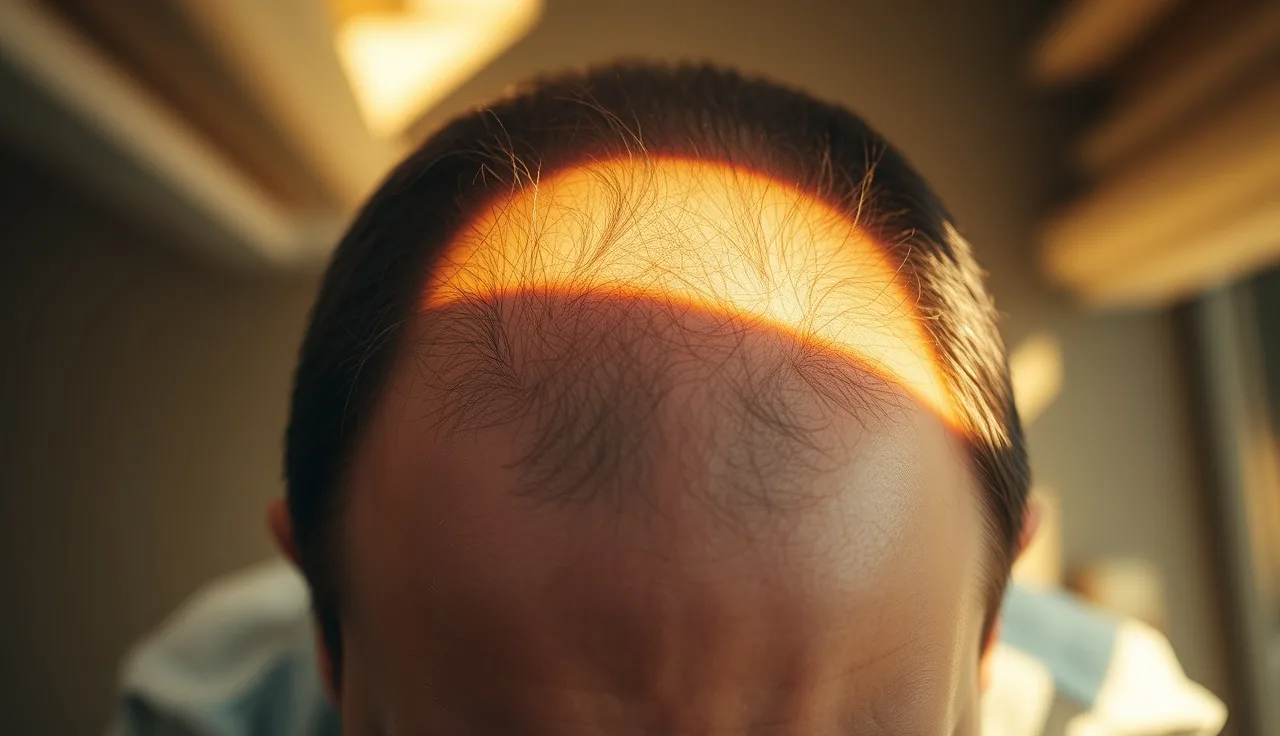
TL;DR: The Norwood scale runs from stage 1 (no loss) to stage 7 (only a horseshoe fringe remains). Crown thinning first appears at stage 3 Vertex (3V) and becomes the dominant feature by stages 5 through 7. Treatment works best before stage 5. Finasteride and minoxidil can slow or partially reverse crown loss; transplants get harder at later stages.
What is the Norwood scale and why does the crown matter?
The Norwood-Hamilton scale is the standard classification system for male pattern baldness. James B. Hamilton published the original version in 1951, and O'Tar Norwood revised and expanded it in 1975 into the seven-stage system doctors still use today [1]. Dermatologists, transplant surgeons, and clinical trial researchers all describe hair loss with it.
The crown, or vertex, is where the staging gets messy. The hairline and the crown thin at different rates in different men, and the Norwood scale captures that split. Some men lose mostly at the temples and hairline (the "Type" progression). Others thin mainly on the crown early on (the "Vertex" or "V" variants). Many eventually lose both zones, and the two merge into one large bald area.
Why does this matter in practice? The crown responds differently to treatment than the hairline. It is harder to cover with a transplant. And its progression tells you something real about where you are headed. Getting the stage right changes the advice a doctor gives you.
What does each Norwood stage look like from the crown?
Here is the crown, stage by stage. Find the one that matches your mirror.
Stage 1: No visible loss anywhere, crown fully covered. This is a baseline, not a stage anyone gets diagnosed with.
Stage 2: Slight recession at the temples only. The crown is completely intact. If you are here, you may be seeing early change that stalls for years, or it may move fast. Nobody can tell you which without tracking it over time.
Stage 3: Temple recession deepens to the point that meets the cosmetic definition of hair loss. The crown is still full.
Stage 3 Vertex (3V): The crown enters the picture. A small, isolated area of thinning appears on top of the scalp. Temple recession may be mild or moderate. The 3V designation exists because the crown loss pattern splits off from the standard Type 3 at this point [1].
Stage 4: The temple recession from stage 3 deepens further, and the crown patch from 3V expands. A band of hair still separates the two zones.
Stage 4A: A variant where recession sweeps across the front-to-mid scalp without a strong crown spot. The "A" variants are a separate subtype within the scale.
Stage 5: The band of hair between the temples and crown thins hard. The two zones start to connect. This is where the overall bald area begins to feel large.
Stage 6: The bridge of hair is gone. Frontal and crown zones have merged into one continuous bald area. Only the sides and the very back remain.
Stage 7: The last stage. A horseshoe fringe around the sides and back is all that is left. The donor area for any transplant is at its narrowest here.
A 2011 study of 1,006 men in the Journal of Investigative Dermatology found that roughly 16% of men aged 18-29 show some hair loss, rising to over 50% by age 50 and over 80% by age 80, with crown and vertex thinning becoming more dominant in the higher stages [2].
| Norwood Stage | Crown Status | Hairline Status |
|---|---|---|
| 1 | Intact | Intact |
| 2 | Intact | Slight temple recession |
| 3 | Intact | Moderate temple recession |
| 3V | Small isolated thinning patch | Mild to moderate recession |
| 4 | Expanding patch, separated from temples | Deep recession |
| 5 | Band between zones thinning | Severe recession |
| 6 | Zones fully merged | Very severe recession |
| 7 | Horseshoe fringe only | No frontal hairline remains |
How does crown hair loss actually progress over time?
Male pattern hair loss is driven by dihydrotestosterone (DHT) binding to androgen receptors in genetically sensitive follicles. The follicles miniaturize. Each growth cycle produces a slightly thinner, shorter hair until the follicle makes nothing visible. This process can take years or decades per follicle [3].
The crown is packed with androgen-sensitive follicles. That is why the vertex thins as a distinct zone at stage 3V before hairline recession catches up. Follicles on the top and crown react more strongly to DHT than the sides and back, which is exactly why the sides and back survive even at stage 7, and why those donor hairs are the ones used in transplants.
Progression is not linear. Some men move through two or three stages in their twenties and then plateau for a decade. Others see slow, steady change their whole life. There is no reliable clinical test that predicts your speed. Family history gives a rough signal: if your maternal grandfather or father reached stage 6 or 7, your risk is higher, but it is not destiny. Learn more about what causes hair loss.
One thing that matters: the crown thinning you see is almost always further along at the follicle level than it looks. By the time you notice a patch, many of those follicles have been miniaturizing for years. That is why doctors push to treat early.
Is crown thinning always male pattern baldness, or could something else cause it?
Crown thinning at stage 3V or beyond is almost always androgenetic alopecia (male pattern baldness) in men. But not always.
Telogen effluvium, where large numbers of follicles shift into the resting phase at once because of stress, illness, or nutritional deficiency, can cause diffuse thinning that reads as early vertex loss [4]. The tell: telogen effluvium sheds hair across the whole scalp, not mainly the crown, and it often reverses within six to nine months once the trigger goes away. Learn how telogen effluvium differs from pattern hair loss.
Alopecia areata can also produce a discrete patch on the crown, but it usually shows up as a smooth, circular area with exclamation-point hairs at the margins, and it can hit the beard and eyebrows too. A dermatologist can tell these apart with a dermoscopy exam or, if needed, a scalp biopsy.
If your crown thinning came on suddenly over weeks, or if you have been under heavy physical or nutritional stress, see a dermatologist before you assume it is pattern loss. If it has been slow and gradual over years, with the temples also receding, androgenetic alopecia is the overwhelmingly likely answer.
What does finasteride actually do for crown loss?
Finasteride 1 mg (brand name Propecia, now widely available as generic) is an oral 5-alpha reductase inhibitor. It blocks the conversion of testosterone to DHT, cutting scalp DHT levels by roughly 60-70% [5]. Less DHT means the androgen-sensitive follicles on the crown get less of the signal that triggers miniaturization.
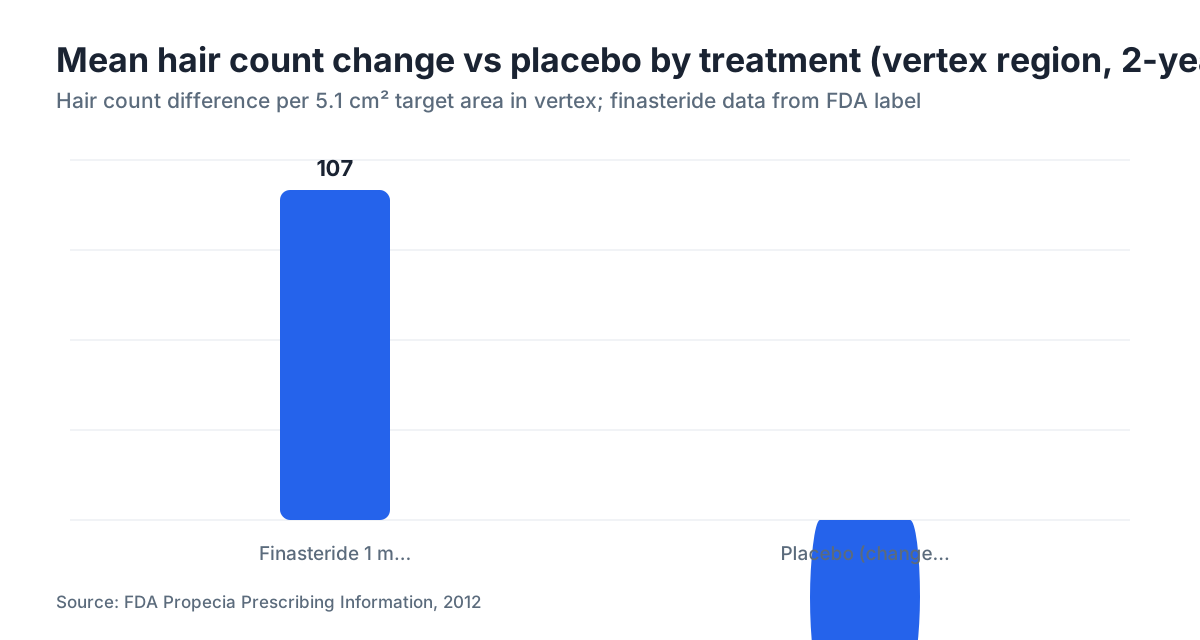
The original FDA-approval trials for finasteride 1 mg included a vertex (crown) efficacy endpoint on purpose. After two years, men on finasteride showed a mean increase of 107 hairs per 5.1 cm² target area on the crown, against a decrease of 50 hairs in the placebo group, a net swing of 157 hairs [5]. The FDA label states that finasteride "improved the progression of hair loss" in men with mild to moderate hair loss.
The crown responds better to finasteride than the hairline in most studies. Good news if your main worry is vertex loss at stages 3V through 5. Less good news if you are already at stage 6 or 7, where many follicles may have miniaturized past the point of response.
Side effects are real and worth knowing. Sexual side effects (decreased libido, erectile dysfunction, ejaculatory disorders) were reported in 3.8% of men on finasteride versus 2.1% on placebo in the original trials [5]. Post-finasteride syndrome, a reported persistence of side effects after stopping, is disputed in both mechanism and prevalence, but it is not something to wave off without reading about it. Read more about finasteride.
Finasteride is not approved for women of childbearing potential and is teratogenic.
Does minoxidil help with crown thinning specifically?
Yes. Minoxidil was the first drug FDA-approved for hair loss, and that original approval was specifically for vertex (crown) loss in men [6]. The topical 5% solution and 5% foam are approved for men; the 2% solution is approved for women.
Minoxidil's mechanism is not fully worked out, but it extends the anagen (growth) phase of the hair cycle and may increase blood flow and nutrient delivery to the follicle. It does not lower DHT. Because it works on a different pathway than finasteride, the two drugs together tend to beat either one alone.
A 48-week randomized controlled trial in the Journal of the American Academy of Dermatology found that 5% topical minoxidil produced significantly greater hair counts and satisfaction scores than 2% minoxidil in men with androgenetic alopecia, with the largest absolute differences in the vertex [7].
The honest limit: minoxidil slows loss and can produce some regrowth, but it does not stop the underlying DHT-driven miniaturization. Stop using it and any benefit usually reverses within three to six months. It is a long-term commitment, not a cure.
If you are considering topical minoxidil, check the full side effect profile before you start, and read about minoxidil for men to set realistic expectations. Oral minoxidil (low-dose, off-label) is another option; oral minoxidil has different absorption and systemic side effect considerations.
Running both drugs together? Finasteride and minoxidil combined is the most evidence-backed two-drug approach.
At what Norwood stage should you start treatment?
The earlier the better. This is one of the clearer answers in hair loss medicine.
Finasteride and minoxidil both work by keeping what you have, not by rebuilding what is gone. Once a follicle fully miniaturizes and the follicular unit becomes essentially scar tissue, no drug on the market regenerates it. The treatment window is while follicles are shrinking but still alive.
For crown loss, stages 3V through 5 are where drug treatment has the most evidence and the most impact. The vertex response data for finasteride came largely from men in this range. Stage 6 and 7 crown loss can still show partial response in some men, but the absolute benefit is lower and expectations should be modest.
A practical rule: if you can still see scalp through thinning hair on the crown but the area is not entirely bare, treatment has a real chance. If the crown is completely smooth over a large area, drugs alone are unlikely to restore meaningful density.
Unsure of your stage? A professional assessment matters. The free AI scan at MyHairline can give you a starting read on where you are before you book a dermatology appointment, which helps you show up with sharper questions.
One nuance: some men at stage 2 or 3 (no crown loss yet) start treatment to keep the crown stage from ever arriving. The evidence supports this. Finasteride was shown to halt progression in men who had not yet reached significant vertex loss.
Can a hair transplant fix crown loss at stages 5, 6, or 7?
Transplants can improve crown appearance at higher stages, but the crown is the hardest area to transplant well. Understanding why should change how you read a surgeon's promises.
Start with geometry. The crown has a circular or spiral whorl. Recreating a natural swirl with transplanted follicles means placing grafts at precise, varying angles radiating out from the center. It is technically demanding, and results that photograph fine can look off in person when the surgeon ignores the natural pattern.
Next, the donor supply problem. At stages 6 and 7 you have a large bald area and a narrow horseshoe of donor hair. Over-transplanting the crown risks draining the donor zone, leaving you with a poor crown and a thin, unnatural fringe. Experienced surgeons usually treat the frontal hairline and midscalp first, because those frame the face, and leave the crown as a secondary target.
Third, progression. Transplant a crown at stage 4 or 5 and let pattern loss continue (because you skipped medication), and the native hairs around the grafts keep falling out. You end up with islands of transplanted hair surrounded by bald scalp, which looks worse than before. The standard recommendation is to be on finasteride (if medically appropriate) for at least a year before a major crown transplant and to stay on it afterward.
Fourth, density. The crown needs high perceived density to look natural because light hits it straight from above. Many patients at stage 6 or beyond do not have enough donor hair to reach satisfying density across the whole crown. Read the full picture on hair transplants before committing.
The right surgeon tells you all of this. Be wary of anyone who looks at a stage 6 crown and quotes you a single session that will fully restore it.
What does the Norwood scale look like for women, and is it used?
The Norwood-Hamilton scale was built for men. It maps male pattern baldness, which usually moves from the temples and vertex outward.
Women with androgenetic alopecia lose hair differently. Female pattern hair loss (FPHL) produces diffuse thinning across the top of the scalp, often widening the part line, while the frontal hairline mostly holds. So the Ludwig scale (three stages, based on frontal and mid-scalp density) is the tool used for women, not the Norwood scale [8].
That said, some women do get vertex-predominant thinning that overlaps with Norwood patterns, especially after menopause. And some dermatologists use modified Norwood staging for women in clinical notes. If you are a woman who has been told you are at a Norwood stage, it likely means the clinician is noting the distribution, not that you have male pattern baldness.
Treatment for female pattern hair loss runs on different tracks. Minoxidil 2% is FDA-approved for women. Finasteride is not approved for premenopausal women because of teratogenicity risk. Spironolactone is sometimes used off-label. What causes hair loss in women involves hormonal factors beyond DHT.
What about DHT blockers beyond finasteride?
Dutasteride is a 5-alpha reductase inhibitor that blocks both type 1 and type 2 isoforms of the enzyme, where finasteride mainly blocks type 2. That gives dutasteride stronger DHT reduction: roughly 90% versus finasteride's 60-70% [9]. It is approved for androgenetic alopecia in some countries (South Korea, Japan) but stays off-label in the United States for this use, approved here only for benign prostatic hyperplasia.
Several head-to-head trials show dutasteride producing greater hair count gains than finasteride, with the sharpest differences in the vertex. The trade-off is a much longer half-life (roughly 5 weeks versus finasteride's 6-8 hours), so side effects, if they show up, linger longer after you stop.
Topical finasteride (not FDA-approved for hair loss as of 2025, though in development) aims to deliver DHT reduction locally with less systemic absorption. Early trials look promising. Learn about DHT blockers in general to see where dutasteride fits in the treatment hierarchy.
Ketoconazole shampoo has weak evidence for mild DHT-blocking activity at the scalp, but using it as a primary treatment is not well supported. It works better as an adjunct.
Are there any supplements that actually help with crown thinning?
The honest answer: most are not proven for crown thinning, and many are overpriced. But a few have real evidence worth knowing.
Nutritional deficiency can worsen shedding and make pattern loss look worse. Low ferritin (iron stores), vitamin D deficiency, and zinc deficiency have all been linked to increased hair shedding in studies, though none of them cause androgenetic alopecia [10]. If a blood panel shows you are deficient in any of these, correcting it is basic care.
Saw palmetto gets marketed as a natural DHT blocker. The evidence is thin. A 2002 small trial showed some effect, but the study quality was low, and the American Academy of Dermatology does not list it as a recommended treatment.
Biotin is sold everywhere for hair loss. If you are not biotin-deficient (rare in healthy adults eating normally), biotin supplements have no good evidence for improving hair loss. They can, however, interfere with certain lab tests, including thyroid function tests and troponin assays used in cardiac workups [11].
Nutrafol and similar branded supplements pack in a mix of ingredients including ashwagandha, marine collagen, and saw palmetto. One randomized controlled trial funded by Nutrafol showed improvement versus placebo, but industry-funded trials need cautious reading. Read the full breakdown of hair loss supplements before you spend money.
How do you accurately self-assess your own Norwood stage?
Most people guess wrong. They stare at the front and miss the crown, or they read the crown backward in a mirror.
The better approach: take photos under bright, direct light (overhead bathroom light is fine) from three angles: front-facing, directly above the crown (use a second camera or ask someone), and from the back. Compare them to the standard Norwood chart diagrams from dermatology sources. Look at whether your crown is fully covered, showing a small isolated patch, or connected to the front recession.
Things that throw off self-assessment: wet hair looks far sparser than dry hair; styling products and hair direction can mask real thinning; overhead light exaggerates visible scalp; reading glasses or a magnified mirror can make mild thinning look severe.
Dermatologists use dermoscopy, a magnified view of the scalp with polarized light, to catch follicle miniaturization before it is visible to the naked eye. It is the most accurate assessment tool available and runs roughly $100-200 as a standalone visit at most clinics.
If you want a faster starting point without a clinic visit, the free AI scan at MyHairline (myhairline.ai/scan) reads your photos and gives you a Norwood estimate you can bring to a doctor's appointment.
Sources
- Norwood OT, "Male pattern baldness: classification and incidence," Southern Medical Journal, 1975 (original revised Norwood-Hamilton classification paper)
- Gan DC, Sinclair RD, "Prevalence of male and female pattern hair loss," Journal of Investigative Dermatology, 2011
- American Academy of Dermatology Association, Hair Loss: Causes
- American Academy of Dermatology Association, Hair Loss Types (telogen effluvium)
- FDA, Propecia (finasteride 1 mg) Prescribing Information
- U.S. National Library of Medicine, MedlinePlus: Minoxidil Topical
- Lucky AW et al., Journal of the American Academy of Dermatology, 2004 (5% vs 2% minoxidil in men)
- American Academy of Dermatology Association, Hair Loss in Women
- Olsen EA et al., Journal of the American Academy of Dermatology, 2006 (dutasteride vs finasteride trial)
- Almohanna HM et al., "The role of vitamins and minerals in hair loss," Dermatology and Therapy, 2019
- U.S. Food and Drug Administration, Safety Communication on Biotin Interference with Lab Tests