TL;DR: Oral minoxidil for women uses very low doses, usually 0.25 mg to 1 mg daily, far below the old blood-pressure doses. Most women see less shedding by month 3 and real regrowth by month 6. It's prescribed off-label, so you need a dermatologist. Side effects like facial hair and mild fluid retention are real but manageable at low doses.
What is oral minoxidil and why are dermatologists prescribing it to women now?
Minoxidil started as a blood-pressure pill in the 1970s. Doctors kept noticing that patients grew hair in places they didn't expect, and that side effect became a product: topical minoxidil, sold as Rogaine. For decades nobody used the pill for hair loss because the hypertension doses, 10 mg to 40 mg a day, carried real cardiovascular risk.
Then a run of small trials starting around 2017 tested tiny doses, 0.25 mg to 5 mg, aimed at hair loss instead of blood pressure. The results were good enough that dermatologists started writing for it off-label. By 2022, prescribing-trend data put oral minoxidil among the fastest-growing hair-loss prescriptions in the U.S. and Australia [1].
The appeal for women is simple. Topical minoxidil works, but plenty of women find twice-daily application messy, drying, or impossible to keep up under styling. A once-daily pill removes that friction. The catch is that a systemic drug produces systemic effects, which is exactly why the dose you land on matters so much.
Oral minoxidil is not FDA-approved for hair loss. The FDA has approved oral minoxidil only for hypertension [2]. That shapes your conversation with your doctor: they're making a clinical call based on the published trials, not following a label.
What dose do women typically take for hair loss?
Most dermatologists start women at 0.25 mg or 0.5 mg once daily. The most studied and most prescribed range for women is 0.25 mg to 1 mg per day [3].
That sounds almost homeopathic next to the 10 to 40 mg hypertension doses. But the follicle effect shows up at very low plasma levels. A 2020 retrospective study of 100 women on low-dose oral minoxidil (mean dose 0.9 mg/day) found 80% reported better hair density, and side effects stayed mild [3].
Here's how the dosing landscape generally looks:
| Dose | Who it's typically used for | Notes |
|---|---|---|
| 0.25 mg/day | Women sensitive to side effects, starting point | Lowest commonly compounded dose |
| 0.5 mg/day | Most common starting dose for women | Balances effect and tolerability |
| 1 mg/day | Women who tolerated 0.5 mg with good response | Upper end of the typical female range |
| 2.5 mg/day | Some postmenopausal women, physician judgment | More side effects expected |
| 5 mg/day | Rarely used in women; more common in men | Much higher hypertrichosis and fluid-retention risk |
Doses above 1 mg get used in women, but less often, and the odds of unwanted facial hair climb noticeably. Postmenopausal women sometimes tolerate higher doses because the follicular response to androgens shifts after estrogen drops.
You can't buy a 0.25 mg or 0.5 mg pharmaceutical tablet off the shelf in the U.S. The FDA-approved oral tablets come in 2.5 mg and 10 mg, both for hypertension. So women on low doses usually get compounded capsules from a compounding pharmacy, or their dermatologist has them split the 2.5 mg tablet, which trades precision for cost. Ask your prescriber which route they use and why.
See also: oral minoxidil for how the pill stacks up against the topical forms.
How long does it take for oral minoxidil to work in women?
Slower than you want, but the timeline is predictable. That's the honest answer.
Month 1 to 2: Nothing good yet. Some women actually shed more during this window. That's not failure. It's minoxidil pushing hairs that were already on their way out of the telogen (resting) phase, clearing space for new anagen (growth-phase) hairs. This shedding shows up with topical minoxidil too and is well documented [4]. It settles on its own.
Month 3: Most women notice shedding drop off. No new hairs yet, but fewer going down the drain. This is the first real signal the drug is doing something.
Month 4 to 6: New hairs appear, fine and short at first. Same-angle, same-light photos are the only reliable way to catch this. Your eye adjusts to the mirror too fast to trust it.
Month 6 to 12: The clearest visible change. Randolph and Tosti's 2020 retrospective found density gains showed up on phototrichogram at six months in most women who responded [3]. A separate 2020 randomized trial comparing 1 mg oral minoxidil to 5% topical in women found comparable results by six months, with slightly better tolerability in the oral group [5].
Month 12 and beyond: The response keeps deepening. Many dermatologists say the full effect of any minoxidil, oral or topical, isn't clear until 12 to 18 months of steady use.
Steady is the word that matters. Oral minoxidil isn't a course you finish. It's maintenance. Stop, and the new hair sheds within three to six months as follicles slide back to their pre-treatment pattern [4].
If you're not sure how much hair you've lost or what your pattern looks like, MyHairline's free AI scan can give you a baseline before you start, so you have something concrete to measure against later.
Does oral minoxidil actually work for female pattern hair loss?
Yes, with real caveats.
Female pattern hair loss (androgenetic alopecia, or FPHL) is the most studied use. It causes diffuse thinning at the crown and a widening part while the frontal hairline usually holds. That's different from male pattern baldness, and it responds differently to treatment.
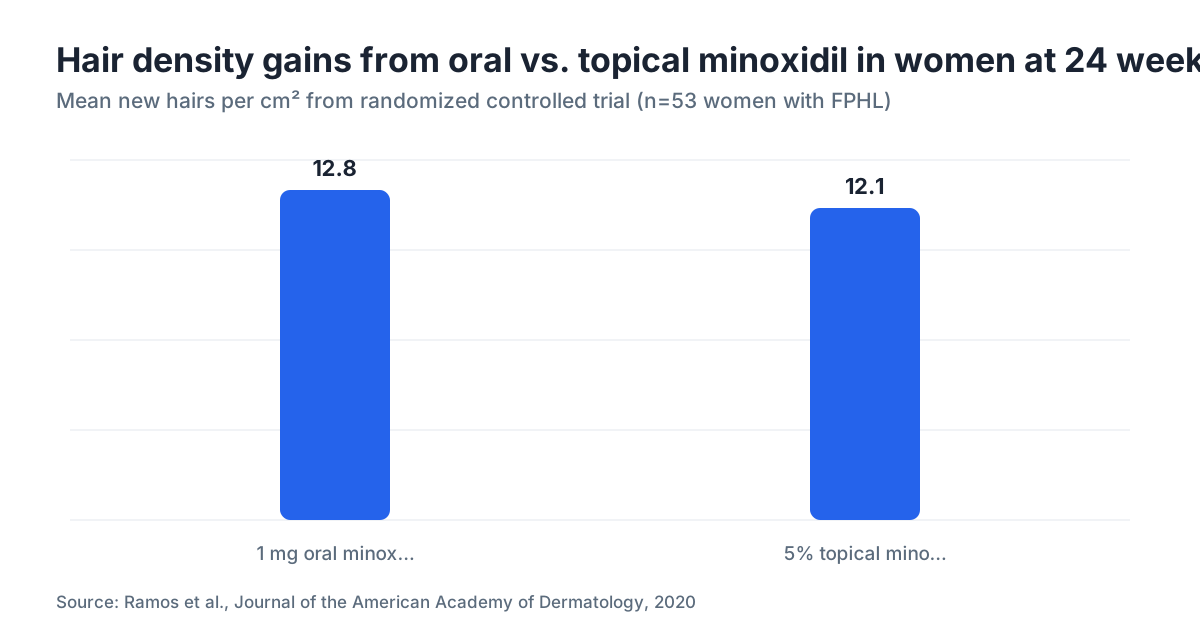
The trial data on low-dose oral minoxidil in women looks good. The 2020 randomized controlled trial by Ramos and colleagues enrolled 53 women with FPHL and compared 1 mg oral minoxidil daily against 5% topical twice daily over 24 weeks. Density rose in both groups. The oral group gained a mean of 12.8 hairs per cm², the topical group 12.1 hairs per cm², a gap that wasn't statistically significant [5]. Put plainly: at 1 mg, oral minoxidil worked about as well as standard topical therapy.
With thinner evidence, oral minoxidil also gets used for:
- Alopecia areata (patchy hair loss)
- Telogen effluvium (diffuse shedding from stress, illness, or nutrition). Our explainer on telogen effluvium covers how to tell it apart from pattern loss.
- Traction alopecia
- Chemotherapy-related alopecia (very limited data)
The evidence is strongest for FPHL. For the rest, your dermatologist is working from small case series and their own experience, not big trials.
One thing worth stating flat out: oral minoxidil does not block DHT, the androgen behind most follicle miniaturization in pattern loss [6]. It works another way, widening the blood vessels around follicles and stretching out the anagen phase. So it can slow loss and grow hair, but it doesn't touch the hormonal cause the way a DHT blocker like spironolactone or finasteride does. Plenty of dermatologists combine them for that reason.
What are the side effects of oral minoxidil in women?
Low dose is the whole story here. At hypertension doses (10 mg and up), oral minoxidil causes serious cardiovascular trouble: fluid retention, tachycardia, pericardial effusion. At 0.25 mg to 1 mg the picture is much milder. But side effects are still real.
Hypertrichosis (unwanted hair growth): The most common complaint in women, and the one that drives dose changes. It usually shows up as fine hair on the temples, sideburns, and upper lip, sometimes the arms and legs. In the 2020 retrospective of 100 women, hypertrichosis hit 16% at a mean dose of 0.9 mg/day [3]. It's dose-dependent, so higher doses mean more of it. Some women shrug it off. Others won't.
Fluid retention and leg swelling: Minoxidil is a vasodilator, so mild fluid retention happens. At low doses it usually means slight ankle puffiness. Women with heart conditions should talk this through with their physician first.
Headache and dizziness: From mild blood-pressure lowering. Usually short-lived and gone within the first few weeks.
Fast heartbeat (tachycardia): Uncommon at low doses but worth watching. Some doctors check a baseline blood pressure and resting heart rate before you start.
Fatigue: Reported now and then. The mechanism isn't clear.
What mostly doesn't happen at low doses: the severe cardiovascular effects in the FDA label, which are tied to hypertension-range dosing [2]. Even so, women with existing cardiovascular disease, significant low blood pressure, or kidney disease need a physician review before starting.
For the full spectrum across both oral and topical forms, see our guide to minoxidil side effects.
Who should not take oral minoxidil?
Contraindications matter here, and your prescriber should screen for them.
Strong cautions or hard stops:
- Pregnancy and breastfeeding. Minoxidil carried the old FDA Pregnancy Category C label; animal studies showed fetal harm at high doses [2]. Low-dose human pregnancy data is essentially nonexistent. Most dermatologists say no during pregnancy, full stop.
- Pheochromocytoma (adrenal tumor). Can trigger dangerous blood-pressure swings.
- Severe cardiovascular disease, including heart failure or a recent heart attack.
- Symptomatic hypotension. Adding a vasodilator to already-low blood pressure can make it worse.
- Known allergy to minoxidil.
Age counts too. There's little trial data on oral minoxidil in women under 18, and most dermatologists won't prescribe it to teenagers without a specialist involved.
If you take other blood-pressure medications, guanethidine in particular carries an interaction risk serious enough that the FDA label names it directly [2].
Women trying to conceive need a frank talk about timing. The drug's half-life is roughly 4 hours, but its follicle effects hang around longer. Most physicians recommend stopping at least a month before trying to get pregnant, though there's no firm consensus.
How does oral minoxidil compare to topical minoxidil for women?
Both work. The choice comes down to lifestyle, which side effects you'd rather risk, and whether you'll actually stick with it.
The head-to-head trial by Ramos et al. (2020) found statistically similar density gains at 24 weeks between 1 mg oral and 5% topical twice daily [5]. On efficacy at these doses, it's roughly a tie.
Where oral wins:
- One pill, once a day. Far easier to keep up.
- No scalp irritation, dryness, or flaking.
- No greasy residue in your hair.
- Reaches follicles evenly, even in spots where topical goes on unevenly.
Where topical wins:
- Systemic side effects (hypertrichosis, fluid retention, blood-pressure changes) are minimal to absent.
- Over the counter. No prescription.
- FDA-approved specifically for hair loss in women (2% solution) [11].
- Considered a safer option during breastfeeding in most clinical guidance, though some absorption still happens and you should ask your doctor.
Many dermatologists now treat oral minoxidil as first-line for women who failed topical, couldn't tolerate it, or just want the convenience. Others reach for it first, often at 0.5 mg, because adherence with a pill beats a bottle every time.
See also: minoxidil for men for how dosing and expectations shift between the sexes.
Can women take oral minoxidil with other hair loss treatments?
Yes, and combination therapy is routine in dermatology.
The most studied pairing is oral minoxidil plus spironolactone. Spironolactone is an anti-androgen that blocks DHT's effect on follicles, hitting the hormonal driver of female pattern hair loss. Minoxidil stimulates follicle activity by a separate path. They complement each other, and several retrospective series show added benefit from the combination [7].
Oral minoxidil also gets paired with:
- Finasteride. Used less in premenopausal women because of teratogenicity risk, but prescribed to some postmenopausal women. See our breakdowns: finasteride and finasteride and minoxidil combined.
- Topical minoxidil. Some doctors stack oral and topical for severe cases, though the added benefit over oral alone isn't well established and the systemic exposure may not rise much.
- Platelet-rich plasma (PRP). Used in clinic, often alongside maintenance oral minoxidil.
- Nutritional supplements. The evidence for most hair loss supplements is weak, but correcting a documented iron or vitamin D deficiency makes biological sense next to drug therapy.
What to avoid: adding other strong blood-pressure drugs without your physician coordinating it. Blood pressure can fall further than expected when minoxidil layers onto existing antihypertensives.
Your dermatologist should have your full medication and supplement list before adding oral minoxidil.
What do real clinical trial results look like for women using oral minoxidil?
The evidence is still growing, but a handful of studies drive what dermatologists actually do.
Randolph and Tosti (2020): A retrospective study of 100 women with FPHL on low-dose oral minoxidil (mean 0.9 mg/day) for at least six months. Eighty percent reported improvement; 16% got hypertrichosis; no serious cardiovascular events [3]. It's cited constantly because it was one of the first to document low-dose use in a female group systematically.
Ramos et al. (2020): Randomized controlled trial, 53 women with FPHL, 1 mg oral versus 5% topical, 24 weeks. Mean density gain: 12.8 hairs/cm² oral versus 12.1 hairs/cm² topical, no significant difference. Patient satisfaction edged slightly higher in the oral group [5].
Sobhy et al. (2023): A prospective study of 0.5 mg oral minoxidil in women with FPHL, finding significant density improvement at six months with a lower hypertrichosis rate than the 1 mg studies [8].
The pattern across the literature holds: at 0.25 mg to 1 mg, oral minoxidil delivers density gains roughly on par with standard topical therapy, with a different but generally acceptable side-effect profile. The weakness is that most studies are small, retrospective, and short (six to twelve months). Long-term data at three to five years barely exists.
The American Academy of Dermatology lists oral minoxidil as a clinical option for hair loss but not as a first-line approved treatment, which reflects its off-label status [9].
How is oral minoxidil prescribed and what does it cost?
You need a prescription from a physician or nurse practitioner, usually a dermatologist, or your primary care doctor if they know the off-label hair-loss space.
The pathway usually runs one of two ways:
-
Compounded low-dose minoxidil (0.25 mg, 0.5 mg, or 1 mg capsules or tablets) from a compounding pharmacy. Most insurance won't cover it. Compounded oral minoxidil typically runs $20 to $60 a month depending on dose and pharmacy.
-
The commercial 2.5 mg tablet, split at home. A 30-day supply of generic 2.5 mg oral minoxidil runs roughly $10 to $25 at most pharmacies with a GoodRx-type discount card. Splitting adds some dose variability but is common practice.
Telehealth has made prescriptions easier to get. Several direct-to-consumer platforms now run oral minoxidil consults for women at subscription prices that bundle the visit and the medication.
Insurance for off-label prescriptions is a coin flip. Because the hair-loss use isn't on the FDA label, many insurers decline. Your pharmacy benefits manager can tell you before you fill.
If you're weighing whether oral minoxidil is the right starting point or whether something else fits your pattern better, a baseline photo analysis can clarify what you're dealing with. MyHairline's AI scan is free and takes about two minutes.
For where oral minoxidil sits in the wider set of options, including surgery: a hair transplant is something some women consider after medical therapy plateaus.
What should women expect at the 3-month, 6-month, and 12-month marks?
A concrete timeline manages expectations, and expectations are the single biggest reason women quit treatments that are actually working.
3 months: Shedding should be slowing or stopped. Some women see early vellus (fine, unpigmented) hairs starting. This is the checkpoint to confirm you tolerate the drug. Side effects, if they're coming, usually show by now. If hypertrichosis is developing and you can't live with it, this is the time to talk dose reduction with your doctor rather than quit outright.
6 months: The clearest read on whether it's working. Density on phototrichogram or consistent photos should show visible improvement if you're a responder. The Ramos 2020 trial used 24 weeks (about six months) as its primary endpoint [5]. If you see no change at all at six months, raise it with your dermatologist, though some slow responders need longer.
12 months: Close to full benefit. Hair is thicker and more terminal (darker, coarser) instead of vellus. Your part line should look clearly better if that was your main worry. Quality-of-life scores in trials tend to peak around here.
Beyond 12 months: Maintenance. Many women report slow gains into year two. The plateau lands in a different spot for everyone.
Photograph yourself every four weeks. Same spot (crown and part), same lighting, same camera distance. The human eye is terrible at catching gradual change. A photo isn't.
Sources
- Journal of the American Academy of Dermatology, Gupta et al. 2022, Oral minoxidil prescribing trends
- FDA Drug Label, Loniten (minoxidil) tablets, DailyMed/NLM
- Randolph M, Tosti A. Journal of the American Academy of Dermatology, 2021, Oral minoxidil treatment for hair loss: A review of efficacy and safety
- American Academy of Dermatology, Hair loss types and minoxidil mechanism
- Ramos PM et al. Journal of the American Academy of Dermatology, 2020, A randomized clinical trial of low-dose oral minoxidil in female pattern hair loss
- National Library of Medicine, StatPearls, Androgenetic Alopecia
- Sinclair R et al. International Journal of Dermatology, Spironolactone and minoxidil combination for female pattern hair loss
- Sobhy N et al. Journal of Cosmetic Dermatology, 2023, Low-dose (0.5 mg) oral minoxidil in female pattern hair loss
- American Academy of Dermatology, Clinical guidelines for hair loss management
- FDA, Pregnancy and Lactation Labeling (Drugs) Final Rule (2015)
- MedlinePlus, U.S. National Library of Medicine, Minoxidil topical