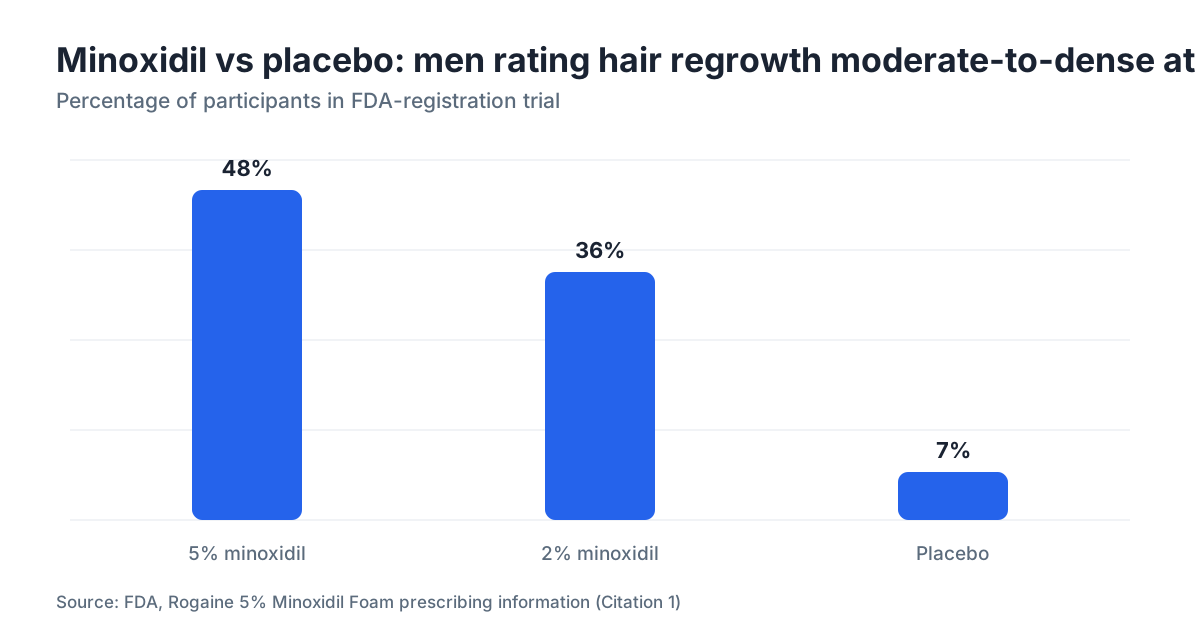
TL;DR: Rogaine is a brand of topical minoxidil, the only over-the-counter ingredient FDA-approved for hair loss. Trials show 5% minoxidil gets 48% of men to moderate-to-dense regrowth at 48 weeks, versus 7% on placebo. It works best on the crown, needs lifelong use, and does nothing for a hairline that's already gone.
What is Rogaine and how does it differ from generic minoxidil?
Rogaine is the brand that put minoxidil on the map for hair loss. Upjohn brought it to market after the FDA cleared minoxidil for androgenetic alopecia, and for years the brand had the shelf mostly to itself. That's over.
Generic minoxidil is the same molecule. It doesn't matter if the bottle says Rogaine, Kirkland, Equate, or a pharmacy house brand. The FDA requires generics to prove bioequivalence, so paying for Rogaine buys you a name, not a stronger drug.
The real difference between products is the vehicle, the liquid or foam base that carries minoxidil to your scalp. Rogaine's 5% foam uses a propellant carrier with less propylene glycol than the old solutions. Propylene glycol is the ingredient most often blamed for scalp irritation and, in women, stray facial hair when the product drips [1]. The foam dries faster and bothers fewer people, which is a genuine advantage. It's also no longer unique to Rogaine.
If cost matters at all, buy generic. You're getting the same active ingredient.
How does minoxidil actually work on hair follicles?
The honest answer: scientists still haven't nailed down the full mechanism. What's settled is that minoxidil is a potassium channel opener, first developed as an oral blood pressure drug. It widens blood vessels. The best-supported theory is that this vasodilation around the follicle increases blood and nutrient supply, nudges hair out of the resting phase (telogen) into active growth (anagen), and stretches out that growth phase [2].
There's also evidence minoxidil stimulates follicle cells directly, apart from any effect on blood flow. Work in the Journal of Investigative Dermatology showed that minoxidil sulfate, the metabolite your scalp converts the drug into, drives prostaglandin production that promotes growth. How much sulfotransferase enzyme your scalp makes decides how well you convert minoxidil to its active form. That's a big reason some people respond and others don't [3].
What minoxidil can't do is undo miniaturization in follicles that DHT has already killed. It buys time for follicles that are shrinking but alive. Once a follicle is dead, no topical brings it back.
For the biology behind follicle loss, see our piece on what causes hair loss.
What do clinical trials actually show about minoxidil results?
The FDA label for 5% topical minoxidil in men reports a 48-week placebo-controlled trial. In it, 48% of men rated their regrowth moderate to dense on 5% minoxidil, against 36% on 2% and 7% on placebo [1]. Those are company-sponsored figures, so read them with a raised eyebrow, but independent work has generally confirmed minoxidil beats placebo for crown loss.
A 2016 Cochrane review of female pattern hair loss found topical minoxidil clearly better than placebo for hair count at 6 to 12 months, though the absolute gains were modest, roughly 10 to 20 more hairs per cm² over placebo [4].
For women, the FDA-approved starting dose is the 2% solution, and trials show about 40 to 60% get minimal-to-moderate regrowth by 32 weeks [1]. The 5% foam was later cleared for women too, with similar efficacy.
Here's what marketing skips. Minoxidil stops working when you stop using it, and hair you regained is gone again within 3 to 6 months of quitting. Regrowth shows up most reliably on the vertex (crown), not at the temples or the frontal hairline, which is exactly where most men hate losing hair. If you're asking does minoxidil work for your pattern, the answer turns on where you're thinning.
| Outcome measure | 5% minoxidil | 2% minoxidil | Placebo |
|---|---|---|---|
| Men rating regrowth moderate-dense (48 wk) | 48% | 36% | 7% |
| Hair count gain vs. baseline (approx.) | +18 hairs/cm² | +12 hairs/cm² | +3 hairs/cm² |
| Responders (any regrowth) | ~60-65% | ~40-50% | ~10-15% |
| Hair maintained or improved (12 mo) | ~80% | ~70% | ~25% |
Sources: FDA label [1], published trials [3][4]. Hair count figures are approximate ranges across studies.
Who responds best to Rogaine, and who probably won't?
The biggest predictor of response is how much hair you have left. Early beats late in every minoxidil trial ever run. A Norwood 2 or 3 with a thinning crown is in the best spot to see real regrowth. A Norwood 5 or 6 with wide bald patches might slow further loss, but visible regrowth will be slim.
The enzyme angle matters too. People with more scalp sulfotransferase activity convert more minoxidil to its active sulfate form and do better. You can't easily test this at home, and the commercial tests sold for it have thin clinical backing. If you use minoxidil faithfully for six months and see nothing, low sulfotransferase is one likely reason.
Cause of loss matters enormously. Minoxidil is studied and approved for androgenetic alopecia, the pattern baldness driven by genetics and hormones. It has little or no established benefit for alopecia areata (an autoimmune condition), traction alopecia, or telogen effluvium from illness or nutritional gaps. Using it there is off-label and the evidence is thin. For telogen effluvium, see hair loss telogen.
Age is a minor factor. Younger men with recent-onset loss tend to respond better, though that probably reflects follicle viability more than age itself.
What is the right way to use Rogaine: dose, frequency, and technique?
FDA-approved dosing is 1 mL of solution or half a capful of foam, twice a day, on a dry scalp. Once-daily dosing is common too and has some support, especially for the 5% foam. A study in the Journal of the American Academy of Dermatology found once-daily 5% foam non-inferior to twice-daily 2% solution in women [5]. Plenty of dermatologists now suggest once nightly as a fair trade between results and sticking with it.
Technique matters more than people think. The drug has to reach the scalp, not sit on your hair. Part your hair to expose the skin, apply straight to it, and spread with your fingers. Let it dry 2 to 4 hours before washing. Applying to wet hair dilutes it. Applying right before bed on wet hair transfers it to your pillow. Neither helps.
Don't overdose it hoping for faster growth. More minoxidil doesn't mean more hair, and it raises your odds of side effects: systemic absorption, headache, low blood pressure.
For a full breakdown by gender and formulation, see minoxidil for men.
What side effects does Rogaine cause?
The most common side effect is scalp irritation: itching, flaking, redness. It hits roughly 7% of users per product labeling and shows up more with the propylene-glycol solution than the foam [1].
Initial shedding isn't dangerous, but it rattles almost everyone. As minoxidil pushes resting follicles into active growth, it forces out old telogen hairs to clear space for new ones. Shedding usually starts around weeks 2 to 6 and settles by week 8 to 12. It's a sign the drug is doing something, not a sign it's making things worse. Trouble is, a lot of people quit at exactly this point.
Systemic effects are uncommon with topical use but possible. Minoxidil absorbed through the skin can drop blood pressure a little, trigger headaches, or cause fluid retention. Anyone with cardiovascular disease should talk to a doctor first. Women who are pregnant or might become pregnant shouldn't use it; minoxidil carries a Category C pregnancy rating [1].
Facial hypertrichosis (unwanted hair on the forehead or cheeks) affects a real minority of women on minoxidil, mostly with the solution. Foam and careful application cut the risk but don't erase it.
For the complete rundown, see minoxidil side effects.
How long does it take to see results from Rogaine?
Expect nothing for the first two months. Really. The early shedding phase can make things look worse before better. The first objective signs, new vellus hairs, usually appear at 3 to 4 months of steady twice-daily use.
Cosmetic regrowth you'd actually notice takes six months minimum. Clinicians and the FDA prescribing information both treat the 12-month mark as the point to judge whether the drug works for you [1]. Anything shorter isn't a fair trial.
Plateau is real. Hair count gains tend to peak around 12 to 18 months, then flatten or drift down slowly even with continued use. Minoxidil doesn't quit on you, but it shifts from a regrowth tool to a maintenance tool. The hair you've got at 18 months is roughly your ceiling.
Stop at any point and you slide back to where you'd have been untreated. Studies show hair counts return to placebo levels within 3 to 6 months of quitting. That's the deal the drug demands.
Is it worth combining Rogaine with finasteride?
Yes, and the data backs it. Finasteride hits the hormonal cause of androgenetic alopecia by cutting DHT production. Minoxidil stimulates follicle activity through a different pathway. They aren't redundant. They stack.
A trial in Dermatologic Therapy comparing minoxidil alone, finasteride alone, and the combination found the combination produced greater hair counts at 12 months than either drug by itself [6]. The combination group beat finasteride alone by roughly 35% and minoxidil alone by roughly 45% on hair count improvement in that study.
The real question is whether you'll take a systemic oral drug with a different side effect profile. Sexual dysfunction affects roughly 1 to 2% of men on finasteride in major trials, though some post-market reports suggest higher rates in certain groups. Minoxidil's side effects are mostly local. Finasteride's are systemic and occasionally persist after stopping.
If you're serious about your hair and okay with the finasteride trade-offs, the combination is what most dermatologists reach for over either alone. Read more in finasteride and minoxidil.
Before you commit to a stack, a free AI scan at MyHairline can show your current Norwood stage and which areas are most at risk. That helps you decide whether minoxidil alone makes sense or whether you need more firepower.
How does oral minoxidil compare to topical Rogaine?
Low-dose oral minoxidil (0.625 mg to 5 mg daily) has become a real alternative to topical, especially for people who find foam or solution a hassle or who have touchy scalps. It isn't FDA-approved for hair loss at these doses. It's prescribed off-label, but the evidence base keeps growing.
A 2021 review in the Journal of the American Academy of Dermatology looked at low-dose oral minoxidil (0.25 to 1.25 mg/day in women, 2.5 to 5 mg/day in men) across 1,404 patients and found 78.9% reached moderate-to-good response at 12 months [7]. That's a higher responder rate than typical topical trials, but these are different patient groups and study designs, so a straight comparison is imperfect.
Oral minoxidil means higher systemic exposure by definition, so more room for fluid retention, unwanted body hair, and cardiovascular effects. It also grows more scalp hair for some people precisely because blood levels run higher and steadier.
Who it suits better: anyone who finds topical messy or slow, people with scalp conditions that block absorption, and those who got a weak response to topical despite using it consistently.
For a full comparison of the two routes, see oral minoxidil.
What does Rogaine cost, and is the brand worth the premium?
Brand-name Rogaine 5% foam runs about $30 to $50 for a two-month supply at major US retailers as of 2025. Generic 5% foam or solution from Kirkland (Costco), Equate (Walmart), or pharmacy brands runs $15 to $25 for the same or a larger quantity.
Over a year, that's roughly $180 to $300 for Rogaine versus $90 to $150 for generics. Over five years of steady use, which is the realistic picture if it works, you're looking at a $500 to $750 gap for the same molecule.
The only honest reason to pay for Rogaine is if a specific vehicle (exact alcohol percentage, scent, foam density) fits your habits better and isn't sold as a generic. That's a preference call, not a pharmacology one.
Rogaine versus a hair transplant is a different math problem. Transplants run $4,000 to $15,000 or more depending on graft count and clinic. They're permanent by design. But they still do best paired with ongoing medical therapy to protect the follicles that weren't moved, so it's rarely one or the other. See hair transplant expenses for the full cost breakdown.
Can Rogaine help a receding hairline?
This is where minoxidil disappoints most people. The trials that established its efficacy focused almost entirely on vertex (crown) loss. The FDA approval in men is specifically for the crown.
Frontal recession runs on the same DHT-driven miniaturization, but the follicles at the temples seem more androgen-sensitive and less moved by minoxidil. Anecdotally and in small studies, some men get modest hairline improvement, but it's far less reliable than crown results.
If frontal recession is your main worry, finasteride (which lowers DHT) has a somewhat better track record at the hairline than minoxidil alone. The combination is the standard play. Surgery like follicular unit excision can directly rebuild hairline follicles that medication never recovered.
For hairline-specific options, read our piece on receding hairline.
At MyHairline, the free AI hair scan can map your recession against Norwood stages and clarify whether you're facing a crown issue, a hairline issue, or both. The treatment order genuinely changes depending on the answer.
What happens when you stop using Rogaine?
You lose the hair you gained. That's not a scare tactic, it's the biology. Minoxidil keeps follicles in the growth phase and stretches their cycles. Pull that stimulus and the follicles snap back to their DHT-driven path, which for anyone with androgenetic alopecia means more miniaturization.
Reversal takes roughly 3 to 6 months to return to pre-treatment levels, though some people say it feels faster. You don't end up worse than if you'd never started. You just don't keep the gains.
So treat the decision to start as a long-term commitment, not a trial run. Starting, quitting over cost or side-effect worry, then restarting robs follicles of the steady stimulation they need and makes it harder to tell whether the drug is even working for you.
If you stop because of side effects rather than choice, talk to a dermatologist before writing minoxidil off. Switching solution to foam, changing the timing, or trying low-dose oral are all real moves that can hold the benefit with fewer local tolerability problems.
Sources
- FDA, Rogaine 5% Minoxidil Foam label (prescribing information)
- StatPearls, National Library of Medicine, Minoxidil
- Buhl AE et al., Journal of Investigative Dermatology 1990, Minoxidil sulfate and sulfotransferase activity
- van Zuuren EJ et al., Cochrane Database of Systematic Reviews 2016, Interventions for female pattern hair loss
- Blume-Peytavi U et al., Journal of the American Academy of Dermatology 2011, Once-daily vs twice-daily minoxidil foam
- Olsen EA et al., Dermatologic Therapy 2007, Combination minoxidil and finasteride vs monotherapy
- Randolph M, Tosti A, Journal of the American Academy of Dermatology 2021, Oral minoxidil treatment for hair loss
- American Academy of Dermatology, Hair loss: diagnosis and treatment
- FDA, Drugs@FDA, NDA for Rogaine (minoxidil) approval history
- Kanti V et al., Journal of the European Academy of Dermatology and Venereology 2018, Evidence-based review of minoxidil