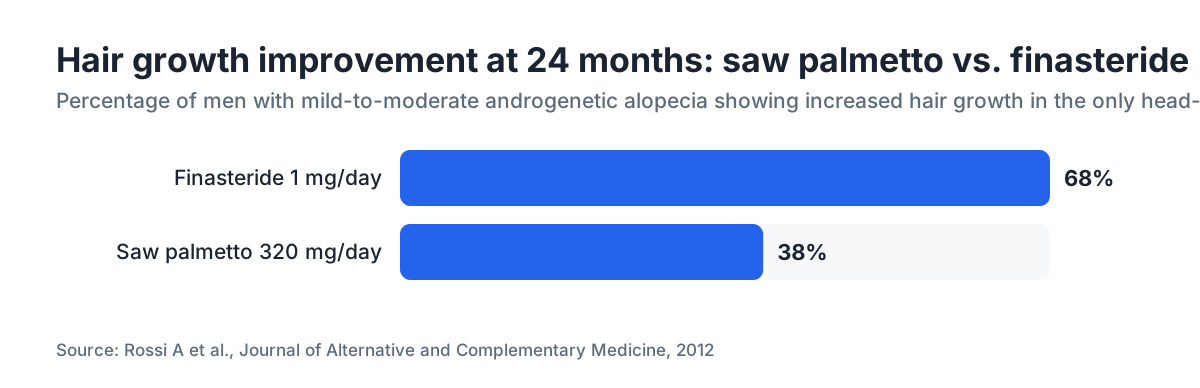
TL;DR: Saw palmetto extracts inhibit 5-alpha reductase, the enzyme that turns testosterone into DHT, the hormone that shrinks hair follicles in androgenetic alopecia. Trials show modest hair-retention benefits, far smaller than finasteride. In the one head-to-head study, 38% of saw palmetto users improved versus 68% on finasteride. It's a low-risk option if you want to skip prescription drugs. Don't expect dramatic regrowth.
What is DHT and why does it cause hair loss?
DHT stands for dihydrotestosterone. It's a strong androgen your body makes when an enzyme called 5-alpha reductase (5-AR) converts free testosterone. DHT binds to androgen receptors in scalp follicles and shrinks them cycle by cycle until they stop making visible hair. This process is androgenetic alopecia, the most common cause of hair loss in both men and women [1].
The follicles most sensitive to DHT sit along the hairline and crown, which is why a receding hairline follows a set pattern instead of thinning evenly. DHT doesn't kill a follicle overnight. It shortens the anagen (growth) phase a little more each cycle until hairs get finer and shorter, then disappear.
There are two main forms of 5-AR. Type 1 concentrates in sebaceous glands and the liver. Type 2 is the dominant form in scalp follicles. Finasteride mostly blocks type 2. Saw palmetto appears to hit both, at least in the lab, which is one reason researchers took an interest in it [2].
Still piecing the picture together? What causes hair loss covers everything beyond DHT, including autoimmune triggers and nutritional gaps.
Does saw palmetto actually block DHT?
Yes, with a caveat. It blocks DHT in a measurable way in the lab and in some clinical hair-count data, but the effect is much smaller than a prescription 5-AR inhibitor delivers.
Saw palmetto (Serenoa repens) is a small palm native to the southeastern United States. Its berry extract holds fatty acids and plant sterols, mainly beta-sitosterol and free fatty acids like lauric acid, that interfere with 5-AR activity [2]. In cell-culture and animal studies, those compounds cut DHT synthesis reliably. The harder question is whether any of that carries over to a living human scalp.
A 2012 randomized controlled trial in the Journal of Alternative and Complementary Medicine assigned 100 men with mild-to-moderate androgenetic alopecia to either 320 mg/day of saw palmetto extract or 1 mg/day of finasteride for 24 months. By the end, 38% of the saw palmetto group showed increased hair growth versus 68% in the finasteride group [3]. Gains in both groups clustered at the vertex (crown). Saw palmetto worked. It just worked less well.
A 2020 systematic review in the Journal of Dermatological Treatment pulled together the available trials and observational studies on Serenoa repens and hair loss. The authors wrote that "there is emerging evidence suggesting saw palmetto can improve hair quality, density, and satisfaction," while noting the evidence stays limited by small samples and inconsistent formulations [4].
So is saw palmetto a DHT blocker? Technically, yes. Clinically, it's a mild one.
How does saw palmetto compare to finasteride for blocking DHT?
This is the comparison most supplement sellers would rather you skip.
Finasteride 1 mg/day cuts serum DHT by about 70% in clinical studies [5]. That number is large, consistent, and replicated many times over. Saw palmetto has never shown anything close in blood measurements, and most trials don't even measure serum DHT directly. They lean on hair counts as a stand-in.
The 2012 head-to-head trial is the best direct comparison we have. Finasteride beat saw palmetto nearly 2-to-1 on the main endpoint of increased hair growth, 68% versus 38% [3]. Both beat doing nothing. The gap is real.
The side-effect profiles split in the other direction. Finasteride carries documented risks of sexual dysfunction, depression, and (rarely) persistent symptoms after stopping. Saw palmetto's adverse effects in trials have been mild, mostly stomach related: nausea and loose stools at higher doses. The FDA has not approved saw palmetto for hair loss. It sells as a dietary supplement, not a drug, so it skips the drug approval process entirely [6].
Here's the practical side-by-side:
| Metric | Saw palmetto | Finasteride 1 mg |
|---|---|---|
| Serum DHT reduction | Not well established | ~70% [5] |
| Hair growth responders (RCT) | 38% at 24 months [3] | 68% at 24 months [3] |
| FDA approval for hair loss | No [6] | Yes (men only) [5] |
| Prescription required | No | Yes |
| Common side effects | Mild GI upset | Sexual dysfunction, mood changes |
| Typical monthly cost | $15-40 | $20-80 (generic) |
For more on what finasteride actually does and whether the side-effect risk is worth it, see our finasteride explainer.
What form and dose of saw palmetto works best for hair loss?
Most hair-loss trials used lipophilic (fat-soluble) extracts of saw palmetto berry standardized to 85-95% fatty acids and sterols, at 200-320 mg per day [3][4]. Whole berry powder, tea, and non-standardized capsules have never been studied for hair loss, and there's no good reason to expect them to behave the same way. The active compounds are fat-soluble, so the extract form matters.
Topical saw palmetto has been tested too. A 2002 randomized study found that a 1% saw palmetto solution on the scalp over 16 weeks raised hair counts, though it was compared against a 3% minoxidil solution rather than a placebo, which muddies the reading [7]. The topical route makes pharmacological sense, since you're aiming at follicles directly without much systemic absorption.
The honest answer on dose: nobody has done the dose-ranging work in hair loss that drug companies do for prescription products. 320 mg/day of a standardized lipophilic extract is the dose with the most trial data behind it. Going higher has no evidence and may add GI side effects.
Timing barely matters, but taking it with food cuts stomach upset. Some people split the dose morning and night. The trials mostly used once daily.
Can women use saw palmetto for hair loss?
Women get androgenetic alopecia too, and DHT contributes to female-pattern hair loss, though the picture is messier. Hormonal shifts, estrogen decline at menopause, and other androgens all interact in ways that aren't fully worked out [1].
Doctors generally don't prescribe finasteride to premenopausal women because it can feminize a male fetus if the woman becomes pregnant [5]. That's one reason some clinicians and patients look at saw palmetto as a lower-risk alternative.
Trial data in women is thin. Most saw palmetto hair-loss studies enrolled only men. Anecdotal reports are common, but anecdotes tell you nothing about rare harms. Here's what we can say: saw palmetto does show anti-androgenic effects in women in other settings (it's been studied for hirsutism and polycystic ovary syndrome), which points to a real mechanism [4].
Pregnant women should avoid saw palmetto. Its anti-androgenic action could in theory affect fetal development, and there are no safety trials in pregnancy. This is not a small caution.
If you're a woman with real thinning and want to sort out your options, rule out telogen effluvium first. That condition gets mistaken for androgenetic alopecia constantly and responds to completely different treatments.
How long does saw palmetto take to show results for hair loss?
Hair cycles are slow. Even the strongest DHT blockers take months to show anything measurable, because you're waiting on new anagen cycles to start, not on existing hairs to thicken overnight.
The 2012 RCT ran 24 months and produced meaningful results [3]. Shorter trials of 3-6 months tend to show modest or statistically borderline gains. Plan on seeing nothing obvious before 6 months, and treat 12 months of steady use as a fair trial.
Seeing some shedding in the first 2-3 months? Don't panic. DHT-blocking treatments can trigger a brief telogen shed as follicles reset into a new growth cycle. This is better documented with minoxidil than saw palmetto, but it happens.
Patience is the whole game here. Most people quit supplements after 8 weeks because nothing seems to be happening, which is far too early to judge. The other side of that: if you've been consistent for 12-18 months and see zero change, saw palmetto probably isn't enough for your degree of loss.
What else does saw palmetto do, and are there side effects?
Saw palmetto's biggest research base is benign prostatic hyperplasia (BPH), an enlarged prostate where DHT-driven cell growth is a key mechanism. A 2006 New England Journal of Medicine trial found no significant benefit over placebo for BPH symptoms in a tight double-blind design, which dented the supplement's reputation there [8]. Hair loss has never been tested anywhere near that rigor.
Side effects in trials have been mild. GI complaints (nausea, diarrhea, stomach discomfort) show up most, and they're more common above 320 mg/day. A handful of case reports link saw palmetto to liver injury, though causality is hard to pin down with supplements because people often take several products at once [9].
Bleeding risk is a real concern. Saw palmetto may slow platelet aggregation, which can raise bleeding risk if you also take warfarin, aspirin, or other blood thinners. On any anticoagulant, talk to your doctor before adding it [9].
There are no long-term (10-plus year) safety studies. People have used it widely for decades with no obvious population-level red flags, but that's not the same as a safety record proven to the standard drugs meet.
Should you combine saw palmetto with other hair loss treatments?
Some people stack saw palmetto with minoxidil, the topical that's FDA-approved for hair loss in men and women. The logic holds up: minoxidil works through a separate pathway (it lengthens the anagen phase and boosts blood flow to follicles), so pairing a mild DHT blocker with a growth stimulator isn't redundant [10]. No trial has tested saw palmetto plus minoxidil specifically, so the combined benefit is inferred, not proven.
Stacking saw palmetto on top of finasteride makes little sense, since both target 5-AR. Adding an unproven supplement to a proven drug is a poor trade. If you're already on finasteride, saw palmetto's extra DHT suppression rounds to zero.
Nutritional support is a fair add-on. Low ferritin, zinc deficiency, and vitamin D deficiency all track with hair shedding, and fixing a real deficiency helps. Our hair loss supplements article covers which ones have actual evidence.
Wondering whether creatine is feeding your hair loss through a DHT pathway? That's a separate question, covered in does creatine cause hair loss.
Before committing to any regimen, it helps to know where your thinning sits. MyHairline's free AI scan at myhairline.ai/scan estimates your Norwood stage from photos and flags which treatments usually matter at that stage. It's no substitute for a dermatologist, but it's a solid starting point.
Is saw palmetto approved by the FDA for hair loss?
No. The FDA has not approved saw palmetto for hair loss or androgenetic alopecia in men or women [6]. It's regulated as a dietary supplement under DSHEA, the Dietary Supplement Health and Education Act of 1994, which means the manufacturer doesn't have to prove it works before selling it. The FDA only steps in if a product turns out to be unsafe after it's already on shelves.
That matters for two reasons. First, product quality swings wildly. With no pre-market approval, some products carry less standardized extract than the label claims. A market analysis cited in the 2020 review found many saw palmetto products didn't match their stated fatty acid content [4]. Second, no manufacturer can legally claim their saw palmetto treats or prevents hair loss. A label making that specific claim is, technically, an unapproved drug claim.
Look for products that are third-party tested (USP, NSF, or ConsumerLab verified) and clearly state a lipophilic extract standardized to 85-95% fatty acids and sterols. That's the form with the most trial data.
When is saw palmetto not enough and you need to consider other options?
Saw palmetto is a fair first step if your hair loss is mild (roughly Norwood 1-3), you want to skip prescription side effects, and you're patient. It's a reasonable add-on to minoxidil. It won't rescue significantly advanced loss.
At Norwood 4 and beyond, miniaturization is extensive and many follicles may have quit permanently. No DHT blocker, saw palmetto or finasteride, regrows hair from a truly dead follicle. At that point the real question shifts to whether you want to hold onto the hair you have or look at surgery.
A hair transplant moves DHT-resistant follicles from the back of the scalp to thinning zones. It's a structural fix rather than a pharmacological one, and it doesn't hinge on how well you respond to DHT blockers. The two approaches can run together.
If you decide a prescription DHT blocker is the right move, understanding how finasteride and minoxidil work together is useful. That pairing has the strongest evidence base for androgenetic alopecia in men.
The wider point: saw palmetto is no substitute for a dermatologist or trichologist if your loss is significant, moving fast, or came on suddenly. Sudden loss can signal something other than androgenetic alopecia entirely.
What does the research still not know about saw palmetto and DHT?
Quite a lot, honestly.
We don't have good data on how much saw palmetto actually lowers scalp DHT in humans. Most trials count hairs or shoot photos, not hormone levels. We don't know the ideal dose for hair retention specifically. We don't know whether food timing matters beyond tolerability. We have no long-term (5-plus year) hair-loss trials. We have almost no data in women. And we have essentially none in people of color, whose follicle structure and androgenetic alopecia patterns differ.
The mechanism is plausible. The lab and animal data line up. The human trial data are suggestive but limited. The 2020 systematic review concluded that "larger, well-designed randomized controlled trials are needed" before firm conclusions are possible [4]. That's not a polite way of saying it fails. It's an honest read on where the evidence sits.
For anyone tracking the science: the National Institutes of Health's National Center for Complementary and Integrative Health keeps a current summary of the Serenoa repens evidence at nccih.nih.gov, updated more often than any single review [9].
If you're using MyHairline's tools to track progress, consistent photo comparison gives you your own n=1 read on whether a treatment is working for you. That matters when the population-level evidence is this thin.
Sources
- American Academy of Dermatology, Hair Loss Overview
- Moser RL et al., Phytotherapy Research 2022, Serenoa repens mechanism of action
- Rossi A et al., Journal of Alternative and Complementary Medicine 2012
- Evron E et al., Journal of Dermatological Treatment 2020, systematic review of Serenoa repens and hair loss
- U.S. National Library of Medicine, MedlinePlus Drug Information: Finasteride
- U.S. FDA, Dietary Supplements
- Prager N et al., Journal of Alternative and Complementary Medicine 2002, topical saw palmetto vs. minoxidil
- Bent S et al., New England Journal of Medicine 2006, saw palmetto for BPH
- NIH National Center for Complementary and Integrative Health, Saw Palmetto
- U.S. National Library of Medicine, MedlinePlus Drug Information: Minoxidil Topical