

TL;DR: A white or pale club-shaped bulb at the root of a shed hair is the signature of telogen effluvium. It means the follicle finished its resting phase and released the hair. The follicle is not dead. Most people regrow their hair fully within 3 to 6 months once the trigger is gone, though complete recovery can take up to 12 months.
What is the telogen effluvium hair bulb?
Pull a shed hair off your brush or pillow, hold it to the light, and look at the root. See a small solid white or pale yellow knob shaped like a tiny club? That is a telogen club hair. The bulb is the keratinized end of a hair that finished its resting (telogen) phase and got released from the follicle on schedule. [1]
This is not a follicle dying. The follicle stays put, anchored in your scalp. What you are holding is the finished product of a normal cycle that, in telogen effluvium, is happening to way too many follicles at the same time.
Here is the part most articles skip. The white bulb is not a living cell. By the time telogen begins, the lower third of the hair shaft has already gone through apoptosis (programmed cell death), the dermal papilla has pulled back, and what is left is a hardened, inert structure. [1] The pigment that colors the hair root is gone in telogen hairs, which is why the bulb looks white even on jet-black hair.
Anagen hairs, the ones still actively growing, shed differently. They come out with a translucent, sometimes gelatinous sheath and a pigmented, tapered root. If you are pulling hairs with that look, that is a different and more serious pattern, and it is worth a dermatologist's eyes.
How does telogen effluvium cause so many hairs to shed at once?
Normally about 85 to 90 percent of your scalp hairs sit in anagen (active growth, lasting 2 to 6 years), roughly 1 to 2 percent are in catagen (a short transition), and 10 to 15 percent are in telogen (rest, lasting about 3 months). [1] On a normal day you lose 50 to 100 telogen hairs. That is baseline noise.
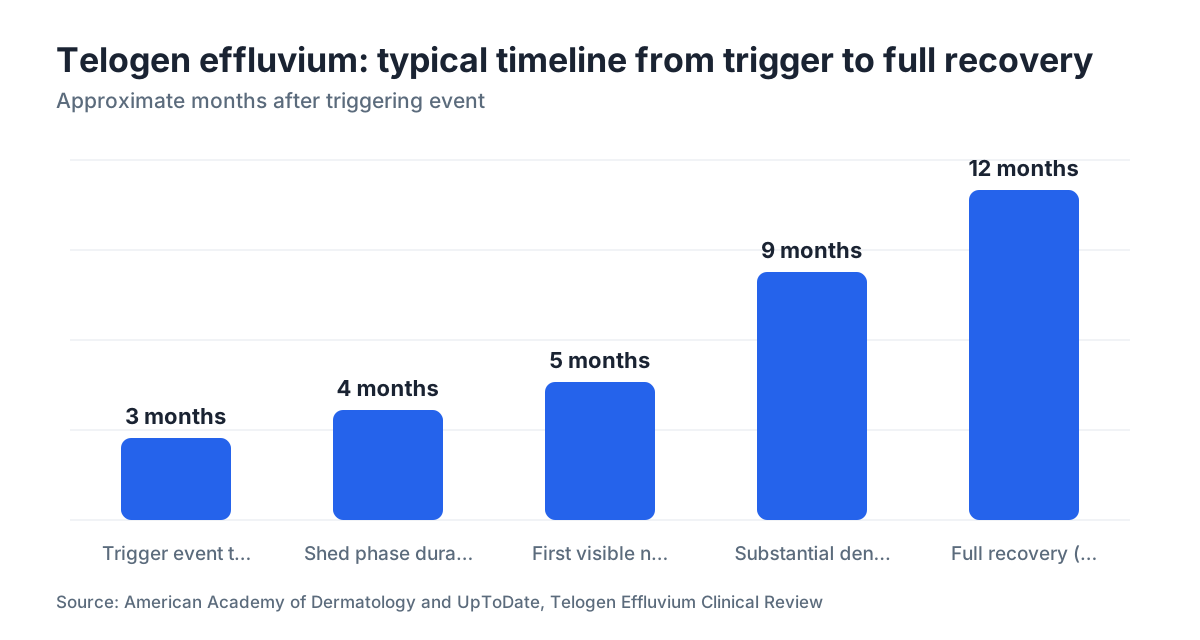
Telogen effluvium happens when a shock forces a big group of anagen follicles to flip into telogen early, all together. Think of it as a hard reset. The trigger signals that the body is in crisis, the follicle saves energy by halting growth, and roughly 2 to 3 months later that whole cohort of resting hairs reaches the end of telogen and drops at once. [2] That delay is exactly why the shedding feels unconnected to whatever set it off.
Common triggers: high fever, major surgery, childbirth (postpartum telogen effluvium is one of the most common forms), rapid weight loss, severe psychological stress, thyroid problems, iron deficiency, and crash diets. [2][3] The American Academy of Dermatology puts the lag between trigger and peak shedding at 2 to 3 months. [3]
Chronic telogen effluvium, defined as shedding that lasts more than 6 months, is less common. It usually points to an ongoing trigger, a nutritional gap, or a medical condition nobody has found yet. [9] The distinction changes the treatment path, so it matters. You can read our full telogen effluvium overview for the wider picture.
Is a white bulb on shed hairs actually a sign of recovery?
Strangely enough, yes. White bulbs mean your follicles went through a proper telogen phase and ejected the club hair cleanly. That step has to happen before the follicle can re-enter anagen and grow something new. A hair with no bulb broke mid-strand, which tells you nothing useful about follicle health.
So if your shed hairs have obvious white bulbs and you are 8 to 12 weeks past a known stressor, your follicles are almost certainly intact and lined up to regrow. That is the expected pattern, not a warning sign.
What is not normal: a fleshy or dark bulb, or a hair with a long gelatinous sheath. That can mean anagen effluvium (a different problem, often from chemotherapy or an autoimmune attack on the follicle) or traction injury. And if the shedding comes with a part that keeps widening, temples pulling back, or clearly miniaturized hairs, androgenetic alopecia may be sitting underneath it. The two coexist all the time, and telling them apart changes what you should do. Our guide on what causes hair loss walks through the full breakdown.
How long does hair regrowth after telogen effluvium actually take?
The honest answer: 3 to 6 months before you see new growth, and 12 to 18 months before the density feels fully back. [3] That timeline frustrates people because the shed itself lasts 2 to 4 months, so you can be 6 to 8 months into the whole episode before recovery is obvious.
Here is why it drags. After the club hair falls, the follicle does not fire back up immediately. There is a short latency period first. Once anagen restarts, hair grows about 1 cm per month, roughly half an inch. [11] So even if every follicle restarted in perfect sync the day your trigger resolved, coverage would not return for about 3 months, and those new hairs would be maybe 3 cm long at that point.
A few things speed it up or slow it down.
- Removing the trigger fast makes the biggest difference. A one-off event like surgery means the trigger is already gone. Chronic stress or ongoing iron deficiency keeps sending the follicle the same distress signal.
- Nutrition matters. Iron, ferritin, zinc, and protein all feed the anagen phase. Serum ferritin below 30 ng/mL has been tied to hair shedding in multiple studies, though the exact causal threshold is still debated. [4]
- Age nudges it a little. Anagen shortens slightly as you get older, but telogen effluvium at any age is still expected to resolve.
People ask whether they will get back to exactly where they were. For acute telogen effluvium, usually yes. For chronic cases, some permanent thinning is possible if the episode unmasked androgenetic alopecia.
What does the telogen-to-anagen transition look like on your scalp?
The first thing most people notice is a fringe of tiny, fine, short hairs along the hairline and part. People call them "baby hairs." Technically they are new anagen hairs moving from vellus toward terminal thickness. They stand straight up and feel soft. Under a dermoscope (the magnifier dermatologists use on the scalp), they show up as thin upright hairs of different lengths, a pattern that tells a trained eye regrowth is underway. [1]
The new hairs often come back a bit finer at first, which spooks people, but they thicken as anagen matures. If they stay permanently thin and keep miniaturizing (shorter, progressively narrower shafts), that points at androgenetic alopecia in those follicles, not telogen effluvium.
Postpartum cases follow a clear rhythm. The shed usually peaks around 3 to 4 months after delivery, then regrowth follows the same 3 to 6 month curve. Most women see solid recovery by 12 months postpartum. [3]
Can you speed up telogen effluvium hair regrowth?
Fix the underlying cause first. Obvious, yes, and also the intervention with the strongest evidence behind it. Correcting iron deficiency, normalizing thyroid levels, closing a protein gap, or cutting the stressor are the moves most likely to shorten recovery. Skip the root cause and everything else is marginal.
Minoxidil is the only topical with peer-reviewed evidence in telogen effluvium. It works by extending the anagen phase and may shorten the dormant gap between telogen and the next anagen cycle. [5] The FDA has cleared topical minoxidil 2% for women and 5% for men over the counter, but the approved use is androgenetic alopecia, not telogen effluvium. [5] Dermatologists still reach for it off-label in effluvium, especially chronic cases or where androgenetic alopecia looks like it is riding along. Dosing and side effects are covered in our minoxidil for men guide and our minoxidil side effects page.
Finasteride is not for telogen effluvium. It blocks testosterone converting to DHT, which matters for androgenetic alopecia but has no known job in effluvium driven by non-hormonal triggers. [6] If your shedding is partly androgenetic, that is a separate conversation. See our finasteride article.
Biotin gets endless marketing. In people who are not deficient, the evidence for it is basically zero. [7] Iron supplementation in genuinely deficient patients holds up. Zinc, vitamin D, and protein are reasonable to correct when a deficiency is documented, but topping up nutrients you already have plenty of will not speed regrowth. Our hair loss supplements page lays out what the trial data actually shows.
Scalp massage has one small randomized trial behind it (Tsuboi et al., 2016, found increased hair thickness with 4 minutes of standardized daily massage), but that was in androgenetic alopecia, not effluvium. Nobody has good data on massage for effluvium specifically. It is unlikely to hurt and costs nothing to try.
Want a quick read on where your own case falls before spending money? MyHairline's free AI hair analysis at /scan can characterize your pattern from phone photos.
How do you tell a telogen bulb hair apart from androgenetic alopecia shedding?
This is the question that matters most in practice, because the two paths split hard.
Telogen effluvium tends to thin the whole scalp evenly, usually with a clear trigger 2 to 3 months before the shed began, and the shed slows as the trigger clears. The hairs that fall have full-diameter shafts topped with clean white club bulbs. Regrowth shows up within months.
Androgenetic alopecia causes patterned loss (temples, vertex, and crown in men along the Norwood scale; diffuse crown and part widening in women), sheds miniaturized hairs (thin, short shafts with small bulbs), and worsens gradually with no single trigger. [8]
In real life the two overlap more than either textbook admits. A meaningful share of people who develop apparent effluvium after a stressor have an underlying androgenetic tendency that the effluvium exposed. They still recover from the effluvium, but baseline density can end up lower than before because the androgenetic process was already running. A trichogram (plucking 50 to 100 hairs from two scalp zones and counting the anagen/telogen ratio under a microscope) or dermoscopy by a dermatologist can separate them. [1]
What blood tests actually help diagnose the cause of telogen effluvium?
A dermatologist or internist usually orders a panel aimed at the most treatable causes. The tests with the most evidence behind a hair-shedding workup: [3][4]
| Test | What it checks | Threshold often flagged |
|---|---|---|
| Serum ferritin | Iron stores | Below 30 ng/mL commonly cited; some sources use 70 ng/mL |
| Complete blood count | Anemia, infection | Low hemoglobin or MCV |
| TSH (thyroid stimulating hormone) | Thyroid function | Outside roughly 0.4 to 4.0 mIU/L |
| Free T4 | Active thyroid hormone | Below lab normal range |
| Serum zinc | Zinc deficiency | Below 70 mcg/dL |
| 25-OH Vitamin D | Vitamin D stores | Below 20 ng/mL often flagged |
| ANA (antinuclear antibody) | Autoimmune causes | If clinical picture suggests lupus |
| Testosterone / DHEA-S / free androgen index | Hormonal androgenetic pattern | Elevated in PCOS or adrenal causes |
Ferritin and thyroid are the two highest-yield tests in most effluvium workups. [3] Low ferritin turns up in a large share of women with chronic diffuse hair loss, and correcting it does seem to help, though the evidence is observational rather than randomized. [4][10]
One note on timing. Labs during the acute shed are reasonable, but repeat testing after recovery is often informative too. Some deficiencies only become obvious once the body has had time to show the effect of a long shortfall.
When should you see a dermatologist instead of waiting it out?
Most acute telogen effluvium resolves on its own, so watchful waiting is legitimate for a few months. Some situations call for earlier eyes.
See a dermatologist if the shedding is still heavy after 6 months with no improving trend, if you are consistently losing more than 150 to 200 hairs a day, if you notice patches of complete hair loss (that suggests alopecia areata, a separate condition), if the part is visibly widening or the temples are receding, or if you have systemic symptoms like fatigue, weight change, or cold intolerance that could flag an endocrine cause.
A dermatologist can run a pull test (gently tugging about 60 hairs across three scalp zones and counting how many release; more than 10 percent is positive for active effluvium) [9], do dermoscopy, and order targeted labs. They can also run a trichogram to measure your anagen/telogen ratio directly.
For context: a normal scalp runs roughly 80 to 90 percent anagen hairs on trichogram. In active telogen effluvium that ratio can drop to 70 percent or below. [9][12] Knowing your actual number gives you a real benchmark to track recovery against.
Does telogen effluvium cause permanent hair loss?
Acute telogen effluvium, the kind with one clear trigger, is reversible in the vast majority of cases. [2][3] The follicles are structurally intact. They rested, they shed, they regrow. That is the whole story.
Chronic telogen effluvium is trickier. If the trigger drags on for years, some follicle miniaturization can happen. More often, though, what looks like permanent thinning after a long effluvium is really androgenetic alopecia that was progressing quietly all along, now more visible because the effluvium stripped away the coverage hairs that hid the pattern. That distinction changes everything about treatment.
True permanent follicle destruction from telogen effluvium alone is not the expected outcome and is not well documented in the literature. The follicle bulge, where the stem cells live, sits high enough in the hair canal that the effluvium process does not touch it. [1] That is one real difference between effluvium and scarring alopecias like lichen planopilaris, where inflammation destroys the stem cell niche for good.
So: if a one-time event triggered your episode and you have removed or resolved that trigger, your outlook is good. If you are not recovering on schedule, checking for a coexisting androgenetic component or an unresolved systemic cause is the right next step.
What can you do right now if you are in the middle of active shedding?
Confirm the trigger first if you have not. Cast back 2 to 4 months. Major illness, surgery, a dramatic weight change, childbirth, an extreme diet, or a long stretch of high stress are the usual suspects. Find a clear candidate and you already have your most useful piece of information.
Get basic labs. Ferritin and TSH are cheap, everywhere, and cover the two most correctable systemic causes. If ferritin is low, supplementing iron under a doctor's guidance (to avoid toxicity) has evidence behind it. [4][10]
Eat enough protein. Hair is roughly 95 percent keratin. Severe protein restriction is a documented effluvium trigger, and even mild deficiency can slow regrowth. Nutrition guidance puts baseline adult protein at 0.8 to 1.2 grams per kilogram of body weight, and people recovering from hair loss often do better near the top of that range.
Handle your hair gently. Tight styles, heat, and rough brushing do not cause effluvium, but they add mechanical breakage that makes density look worse during a stretch that already feels bad enough.
Track the shed. Count hairs lost per day for a week, or photograph the same scalp zone weekly under the same light. Tedious, yes, but it turns "I think it is getting worse" into real data.
If you want to speed recovery and are weighing minoxidil, the finasteride and minoxidil combination is worth understanding when androgenetic alopecia is part of the picture, though finasteride alone does nothing for the effluvium mechanism itself.
Sources
- Springer: Blume-Peytavi U et al. Hair Growth and Disorders, Chapter on Hair Cycle
- UpToDate: Telogen effluvium clinical overview
- American Academy of Dermatology, Hair Loss types and treatment guidance
- Rushton DH. Nutritional factors and hair loss. Clinical and Experimental Dermatology, 2002
- FDA drug approval database, topical minoxidil (Rogaine) OTC labeling
- FDA drug approval database, Propecia (finasteride 1mg) prescribing information
- Patel DP et al. A Review of the Use of Biotin for Hair Loss. Skin Appendage Disorders, 2017
- American Academy of Dermatology, Androgenetic Alopecia: Diagnosis and Treatment
- Whiting DA. Chronic telogen effluvium. Dermatologic Clinics, 1996
- Trost LB et al. The diagnosis and treatment of iron deficiency and its potential relationship to hair loss. Journal of the American Academy of Dermatology, 2006
- National Institutes of Health, MedlinePlus: Hair loss
- Headington JT. Transverse microscopic anatomy of the human scalp. Archives of Dermatology, 1984