

TL;DR: A white or pale club-shaped bulb at the root of a shed hair is a telogen root, meaning that follicle finished its normal resting cycle. In telogen effluvium, a trigger (illness, crash diet, major stress) forces too many follicles into telogen at once, causing diffuse shedding of 200 to 500 hairs per day. Most cases resolve within 3 to 6 months once the trigger is gone.
What does a telogen effluvium hair root actually look like?
A telogen root is a small, dry, white or cream-colored bulb shaped loosely like a club or the tip of a cotton swab. Pull a shed hair from your shower drain and look at the base. If that bulb has no gel-like sheath, no pigment, and no follicular cells clinging to it, you are holding a hair that finished its natural cycle.
Contrast that with an anagen (growth-phase) root, which looks nothing alike. Anagen roots are dark or pigmented, wrapped in a glistening inner root sheath, and slightly sticky to the touch. Yank one out by force and you may pull a full follicular unit with inner and outer sheaths attached.
The white club root is the signature of a hair that ran its full arc. The follicle let it go on its own. That single detail matters enormously, because it tells you the follicle itself is probably fine. It just cycled early.
In telogen effluvium (TE), a physiological shock pushes an abnormally large share of follicles into the resting (telogen) phase at the same time [1]. When those hairs shed 2 to 4 months later, they all carry that same white club bulb. That lag is why so many people can't name their trigger. The illness or the crash diet happened months before the shedding ever started.
What is the normal hair growth cycle and where does telogen fit?
Every follicle runs through three main phases. Anagen is the active growth phase, lasting 2 to 7 years on the scalp. Katagen is a short 2 to 3 week transition. Telogen is the resting phase, lasting roughly 3 months, during which the hair sits in the follicle as a club hair before it sheds [2].
At any moment, about 85 to 90% of scalp follicles are in anagen and 10 to 15% are in telogen. Losing 50 to 100 hairs a day is the normal output of healthy cycling [2]. Do the math and it holds up: with roughly 100,000 scalp hairs, 15% in telogen cycling through over 90 days, you shed around 150 to 170 hairs daily, though 50 to 100 is the range clinicians usually quote.
A fourth phase called exogen describes the actual shedding event, when the club hair releases from the follicle. Some researchers treat it as separate from telogen. Others fold it in. For your purposes, the white-bulb hair on your pillow is exiting during exogen.
After shedding, the follicle re-enters anagen. That is the reassurance in most acute TE cases. The cycling machinery is intact, just running on a shifted schedule. The follicle has not miniaturized the way it does in androgenetic alopecia (AGA), so the outlook is very different.
For a wider look at the causes of shedding, see what causes hair loss.
What triggers so many follicles to enter telogen at once?
Telogen effluvium happens when a stressor interrupts anagen across a large number of follicles at once, sending them into telogen early. The stressor doesn't have to feel dramatic. The follicle is sensitive to nutritional and hormonal signals in ways that surprise most people.
Common documented triggers include [1][3]:
- High fever or severe systemic illness
- Major surgery or physical trauma
- Childbirth (postpartum TE is one of the most common forms)
- Crash dieting or caloric restriction below roughly 1,200 kcal per day
- Iron deficiency (even without clinical anemia)
- Thyroid dysfunction, both hypo- and hyperthyroid
- Chronic psychological stress
- Abrupt discontinuation of combined oral contraceptives
- Certain medications including anticoagulants, retinoids, beta-blockers, and some antidepressants [4]
The 2 to 4 month gap between trigger and shedding is a firm clinical feature, not a loose guess. Follicles pushed into telogen take about 100 days to finish resting and release the club hair. A fever in January produces handfuls of white-bulb hairs in April.
Chronic TE is a different animal. The trigger either persists or never gets identified, shedding runs past 6 months, often fluctuates, and can be harder to treat. Iron and thyroid status are the two most frequently missed causes of chronic TE, per Whiting's work on the condition, and both are correctable with straightforward blood tests [9].
How much shedding is too much, and how is telogen effluvium diagnosed?
No blood test says "you have TE." Diagnosis is clinical, built from history, pattern, and ruling out other causes. That is the whole game.
The trichogram (or a looser tug test) is the classic bedside check. A dermatologist grasps a bundle of about 60 hairs and pulls firmly. Fewer than 6 hairs releasing is generally normal. More than 6, especially if those hairs carry white club roots, points to active TE [1]. Some clinicians use a ratio instead: if more than 20% of shed hairs in a sample are club-shaped telogen hairs, that sits above the expected baseline.
A more quantitative approach is the 60-second hair count. Collect every hair shed into a white towel after shampooing and count them. More than 100 hairs in that session, across several consecutive wash days, suggests elevated shedding worth investigating.
Blood work your doctor should order: complete blood count (CBC), serum ferritin (the most sensitive iron marker for hair loss), thyroid-stimulating hormone (TSH), and, in women with menstrual irregularities, a hormonal panel [3]. Ferritin below 30 ng/mL is tied to impaired hair cycling in several studies, though the exact threshold is still argued in the literature.
Dermoscopy (a magnified scalp exam) separates TE from AGA. In TE, follicle caliber is normal and consistent. In AGA, you see miniaturized follicles mixed with normal ones, and the loss concentrates at the crown or temples. If you want an early read before your dermatology appointment, the free AI scan at MyHairline can flag visible pattern changes that warrant faster follow-up.
For a deeper look at the condition beyond the root, the full telogen effluvium guide covers clinical staging and recovery timelines.
Can you tell the difference between telogen effluvium and androgenetic alopecia by the root?
Partly, yes. Root shape gives you a clue. It is not the whole picture.
In active TE, the shed hairs overwhelmingly carry white club roots and a normal shaft diameter along their length. Part the scalp and it looks thinner than before, but the hairs that remain are roughly the same thickness as your hairs always were.
In androgenetic alopecia, miniaturization produces progressively thinner shafts over successive cycles. Shed hairs may have smaller, less developed roots because the follicle has shrunk. The pattern differs too. AGA concentrates at the crown, temples, and hairline in predictable Norwood or Ludwig shapes, while TE spreads diffusely across the whole scalp [1][3].
The overlap is real and clinically frustrating. AGA can drive a chronic, low-grade shedding that mimics TE. A TE episode can speed up the visible expression of AGA that was quiet before. Some people have both at once. That is exactly why ferritin and thyroid labs matter even when the pattern looks like AGA. A treatable TE layered on top of AGA can be partly reversed, while the AGA portion needs its own plan (finasteride, minoxidil, or both).
See the receding hairline article if your shedding concentrates at the temples rather than diffusing across the scalp.
What does the timeline from trigger to regrowth actually look like?
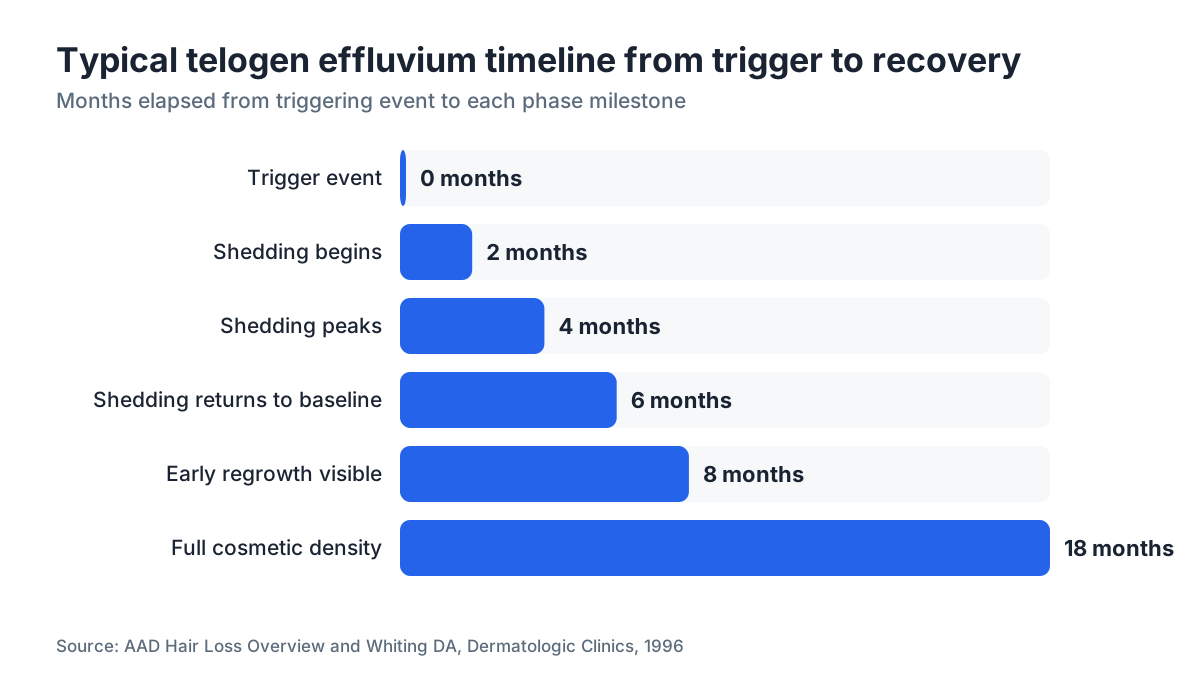
This is what most people staring at a pile of white-bulb hairs really want to know. Acute TE follows a recognizable arc. The trigger lands at month 0. Shedding begins around months 2 to 4, peaks around months 3 to 5, then gradually slows. By months 6 to 9 most patients are back to baseline shedding, with regrowth showing up as short, fine hairs across the scalp [1][3].
Those regrowth hairs feel like baby hair because they are. First-cycle anagen hairs in a fresh growth phase. They thicken over 12 to 18 months as they complete later anagen cycles. Full cosmetic density can take 12 to 24 months in more severe cases.
Chronic TE (lasting longer than 6 months) does not follow this clean arc. It fluctuates or plateaus at higher-than-baseline shedding. Finding and correcting the underlying driver, most often iron deficiency, thyroid dysfunction, or a persistent medication side effect, is what shifts the trajectory [9].
Nothing speeds TE recovery like treating the cause. Minoxidil can shorten the apparent shedding window by nudging follicles back into anagen sooner, but the evidence is stronger for its role in AGA than in TE. If you and your doctor decide minoxidil makes sense, read minoxidil for men and minoxidil side effects before you start.
| Phase | Typical timing | What you see |
|---|---|---|
| Trigger | Month 0 | Illness, crash diet, birth, surgery, stress |
| Lag (telogen resting) | Months 1-3 | No visible change yet |
| Shedding onset | Months 2-4 | Diffuse white-bulb hairs on drain, pillow |
| Shedding peak | Months 3-5 | Highest daily counts, parting looks thinner |
| Shedding decline | Months 5-7 | Daily count drops back toward normal |
| Early regrowth | Months 6-9 | Short fine hairs visible at part |
| Full density recovery | Months 12-24 | Shafts thicken through multiple anagen cycles |
Does telogen effluvium cause permanent hair loss?
Acute TE almost never causes permanent loss. The follicle miniaturization that defines permanent androgenetic alopecia does not happen in TE. The follicles stay structurally intact. They just cycled at the wrong time.
The American Academy of Dermatology states that TE-related shedding typically resolves once the underlying cause is addressed [3]. Most patients recover to their pre-trigger density.
A few exceptions are worth knowing. Prolonged severe nutritional deficiency, especially extended protein malnutrition, can damage follicles enough to delay recovery for a long time. And if AGA was already present silently, a TE episode can speed up its visible arrival. In that case the TE resolves but the underlying AGA stays and needs its own treatment.
There is also a rare, poorly understood group of conditions worth naming: frontal fibrosing alopecia and other cicatricial (scarring) alopecias that can mimic TE early but do cause permanent loss. These produce scarring around the follicle opening, visible on dermoscopy as absent follicular ostia. That is one more reason to see a board-certified dermatologist for shedding that persists or looks unusual.
How does nutrition affect telogen effluvium and what blood levels matter most?
The follicle is metabolically expensive tissue. It cycles fast and demands iron, protein, zinc, and certain vitamins. When systemic supply drops, the body deprioritizes hair growth first.
Iron is the most studied and most commonly deficient nutrient in TE. Serum ferritin reflects iron stores, and levels below 30 ng/mL have been tied to shedding in multiple studies, though a review in the Journal of the American Academy of Dermatology found the evidence linking ferritin to TE is strongest when other causes have been excluded [5]. Some dermatologists target ferritin above 70 ng/mL before ruling iron out as a factor [11].
Protein restriction matters too. Hair is roughly 95% keratin, and severe caloric or protein restriction (crash diets, eating disorders, the period after bariatric surgery) triggers TE within weeks to months. Restoring adequate protein, around 0.8 to 1.2g per kg of body weight, is the base of recovery.
Vitamin D deficiency has been linked to TE in several small studies, though causality is not settled. Zinc deficiency is well documented in alopecia areata and has some evidence in TE. Biotin deficiency does cause hair loss, but genuine biotin deficiency in an adult eating a normal diet is extremely rare, which is why biotin supplements rarely help despite the heavy marketing.
For people researching supplements more broadly, hair loss supplements covers what actually has peer-reviewed support.
What hairstyles and grooming habits make telogen effluvium look worse or better?
TE does not care about your hairstyle, but some choices make the thinning more visible and some hide it while your follicles recover. Diffuse thinning shows most dramatically at the part and under direct overhead light. A center part exposes the widest strip of scalp and looks noticeably thinner during peak shedding. A side part, a deeper part, or a slightly off-center placement narrows the exposed scalp.
Loose, layered cuts add the illusion of density. Very long hair, oddly enough, can make TE look worse, because the weight pulls fine strands flat and kills volume. A moderate trim can improve how full the hair looks even though the follicle count hasn't changed.
Skip tight styles like high ponytails, tight braids, and buns during active shedding. They do not cause TE, but they do cause traction, and traction on already-cycling hairs can accelerate the exogen phase, pulling out hairs that might have hung on a little longer. The tension also irritates a scalp that may already feel sensitive.
Heat styling is fine in moderation. Excessive heat causes mechanical breakage. Broken hairs have no white bulb. They have frayed or snapped ends instead. If you see both types on your pillow, you have two separate problems (TE plus damage), and styling changes will only fix one of them.
Scalp massage has small trial evidence for pushing follicles toward anagen. A 2016 study in ePlasty reported that standardized scalp massage (4 minutes daily for 24 weeks) increased hair thickness in nine healthy Japanese men [6]. The sample was tiny and the subjects did not have TE, so read the result with caution. It costs nothing and causes no harm, which is more than you can say for most of what gets sold to shedding patients.
What treatments actually help telogen effluvium, and which ones are a waste of money?
The single most effective treatment for TE is finding and removing the trigger. No topical or oral drug fixes TE faster than correcting a ferritin of 12 ng/mL or stopping the medication that caused it. That is the honest hierarchy, and everything below it is secondary.
Treating iron deficiency has good support for improving hair cycling when ferritin is genuinely low. Oral iron under medical supervision can raise ferritin meaningfully within 3 to 6 months.
Topical minoxidil is FDA-approved for androgenetic alopecia, not for TE [7]. Dermatologists sometimes use it off-label in TE to shorten the shedding phase, and the mechanism (pushing follicles toward anagen) is at least relevant. The catch: minoxidil triggers its own initial shed as it synchronizes follicle cycling, which can rattle a TE patient who is already losing hair fast. That minoxidil shed settles within 4 to 8 weeks. Read about oral minoxidil, which some dermatologists prefer for diffuse shedding.
Finasteride is not a standard TE treatment. It reduces DHT and belongs to androgenetic alopecia. If a patient has concurrent AGA that the TE episode unmasked, finasteride may fit as a separate intervention. See finasteride for that use case.
Biotin supplements, collagen powders, and most hair vitamins have negligible evidence for TE. They rarely cause harm, though high-dose biotin can distort lab tests, which the FDA has warned about [8]. They are almost never the answer.
PRP (platelet-rich plasma) injections have small trials showing benefit for AGA. Evidence for TE is thin. Sessions run $500 to $2,500 each with multiple sessions needed, so the cost-benefit case is weak without stronger data.
For people whose shedding turns out to be AGA rather than TE, combination therapy has the most evidence. Finasteride and minoxidil together beat either alone in AGA trials. And if you are weighing more aggressive options later, hair transplant is worth understanding, though any honest surgeon will tell you transplanting during active TE is a mistake.
Want a read on where you stand before booking anything? The free AI hair analysis at MyHairline can flag whether your visible pattern matches TE, AGA, or something else worth raising with a dermatologist.
When should you see a dermatologist about white-bulb hair shedding?
See a dermatologist if shedding is heavy (more than 150 to 200 hairs a day) and has lasted more than 8 weeks, if you can't name a plausible trigger from 2 to 4 months prior, if you notice a specific pattern (hairline recession, crown thinning) rather than diffuse loss, or if you have scalp symptoms like redness, scaling, pain, or itching.
Go sooner if you are postpartum and the shedding is severe enough to cause visible thinning, or if you have a personal or family history of autoimmune disease. Alopecia areata can look like TE early on and should be excluded in those cases [10].
The standard workup: CBC, serum ferritin, TSH, and a scalp dermoscopy exam. Those four rule the most common correctable causes in or out. If they come back normal and shedding runs past 6 months, a punch biopsy can confirm TE on histology (a higher-than-normal ratio of telogen follicles in the specimen) [1].
Don't wait two years to be seen because "it will probably resolve." Most acute TE does resolve. But undiagnosed chronic TE, iron deficiency anemia, and undetected AGA each carry real costs from delayed treatment.
Sources
- Mubki T et al., Journal of the American Academy of Dermatology, 2014, Evaluation and diagnosis of the hair loss patient
- American Academy of Dermatology, Hair loss types: Overview
- American Academy of Dermatology, Telogen effluvium: Diagnosis and treatment
- LiverTox/NIH National Library of Medicine, Drug-induced hair loss
- Rasheed H et al., Journal of the American Academy of Dermatology, 2013, Serum ferritin and vitamin D in female hair loss
- Koyama T et al., ePlasty, 2016, Standardized scalp massage results in increased hair thickness
- FDA, Drugs (minoxidil topical prescribing information and OTC monograph)
- FDA, Biotin can interfere with lab tests: safety communication
- Whiting DA, Dermatologic Clinics, 1996, Chronic telogen effluvium: increased scalp hair shedding in middle-aged women
- NIH National Institute of Arthritis and Musculoskeletal and Skin Diseases, Alopecia areata
- Riedel-Baima B, Riedel A, Dermatologic Surgery, 2008, Female pattern hair loss and iron deficiency