
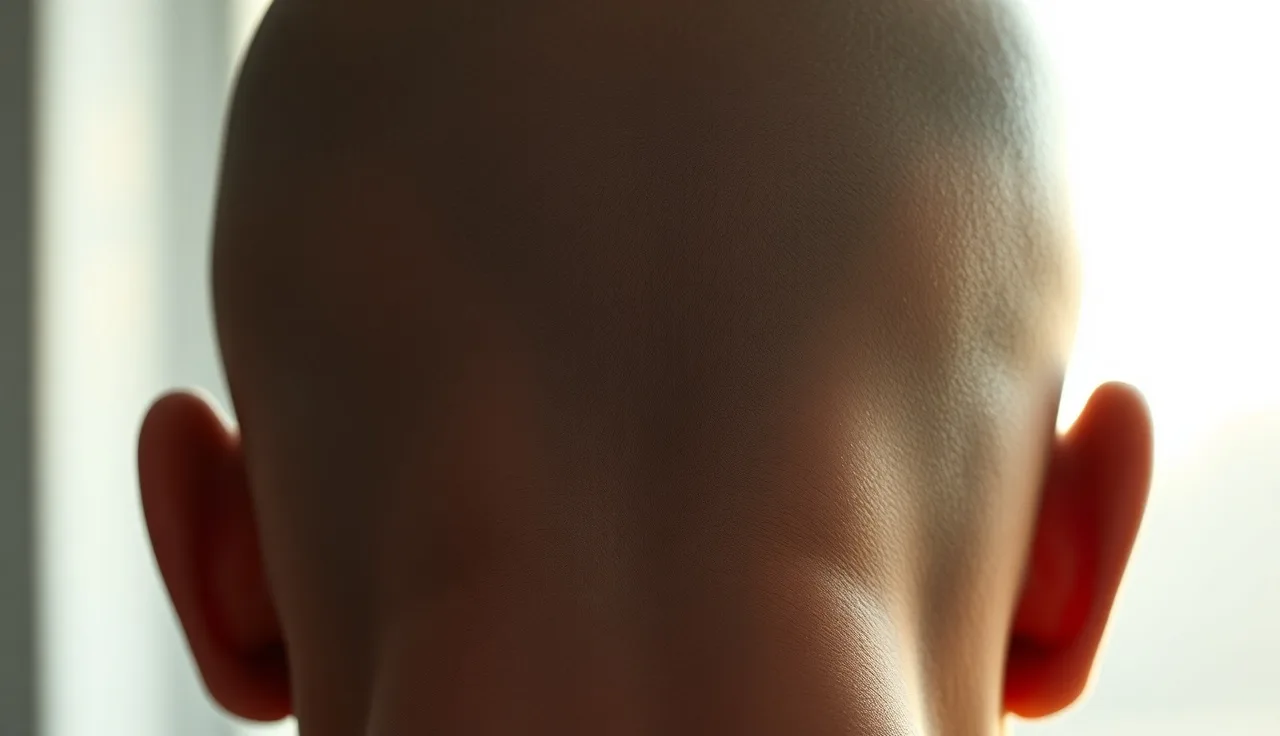
TL;DR: A healed FUE scar is a cluster of pale, flat, circular dots roughly 0.8 to 1.2 mm wide scattered across the donor zone. Good scars are nearly invisible at a grade 2 to 3 buzz cut. Bad scars show white pitting, wide irregular circles, raised keloid tissue, or moth-eaten bald patches. The difference comes down to surgeon technique, punch size, and your skin's healing biology.
What exactly is an FUE scar and where does it form?
FUE stands for follicular unit extraction. A surgeon uses a circular punch tool, usually 0.8 to 1.0 mm in diameter (some go up to 1.2 mm for coarser grafts), to core out individual follicular units from the donor area, typically the back and sides of the scalp [1]. Each punch leaves a small open wound that heals by secondary intention, meaning the skin closes on its own without sutures.
The result is a field of tiny round scars spread across the donor zone. How visible they are depends on four things: punch diameter, punch depth, harvesting density, and your individual skin biology. A skilled surgeon working at safe density leaves scars that are genuinely hard to see even with short hair. A careless one leaves something that looks like a bird hit a window.
This is a different animal from the linear scar left by FUT (strip) surgery. FUT produces one continuous scar that hides under grown-out hair but shows plainly if you shave down. FUE scars are many but small. FUT scars are single but long. Neither technique is scar-free [2].
What does a good healed FUE scar look like?
A well-healed FUE scar looks like a small pale dot, roughly the size of a period on this page. Under a dermatoscope those dots show a circular or slightly oval depigmented ring sitting flush with or just barely below the surrounding skin. Up close under magnification you can count them. From normal viewing distance, at a standard haircut length, you see nothing.
The visible benchmarks for a good outcome:
- Color: ivory-white to light pink, matching surrounding non-tan skin, not stark white against a tanned scalp
- Size: each scar stays close to the original punch diameter, 0.8 to 1.0 mm, with minimal spread
- Texture: flat or very slightly indented, smooth, no raised edges
- Distribution: evenly spaced, no clusters where multiple punches landed too close together
- Hair density around scars: neighboring follicles untouched, so hair grows normally between scars and covers them
At a grade 1 clipper guard (roughly 3 mm), good FUE scars show up as faint dots. At grade 2 (6 mm) they're nearly impossible for a non-expert to detect. Most patients can wear their hair at grade 3 or above with zero noticeable donor scarring [3].
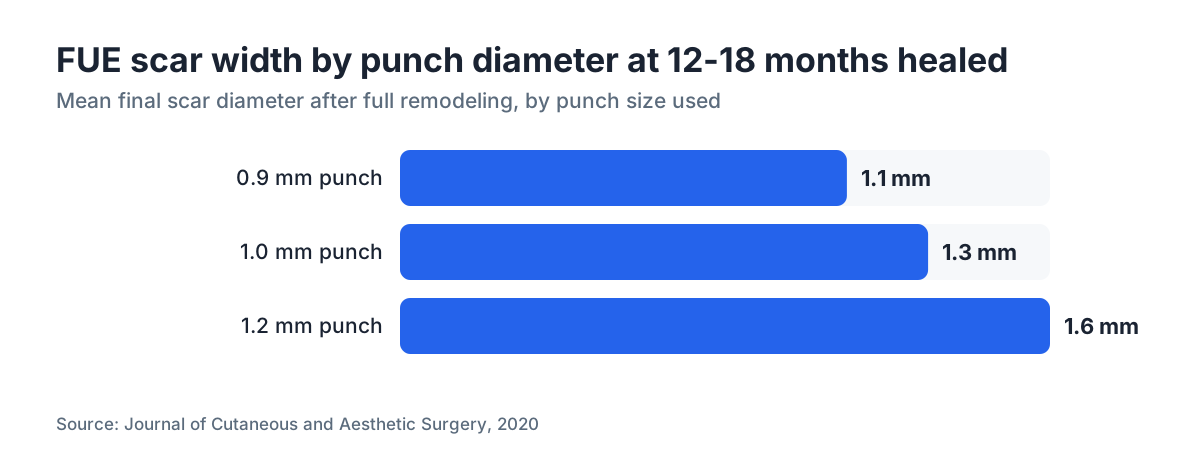
A 2020 study in the Journal of Cutaneous and Aesthetic Surgery examined FUE donor sites and found that scars harvested with a 0.9 mm punch had a mean final diameter of 1.1 mm after full remodeling, compared to 1.6 mm for 1.2 mm punches. Punch size directly predicts final scar width [4].
What does a bad healed FUE scar look like?
Bad FUE scarring shows up in several distinct patterns, and it helps to know which one you're dealing with because the causes differ.
White pitting (hypopigmented pitting): the most common poor outcome. Scars are stark white, obviously depigmented against surrounding skin, and sit noticeably sunken below the scalp surface. This usually comes from punches that went too deep, damaging the dermal-epidermal junction and destroying melanocytes. The scar can't make pigment. It looks like someone took a hole punch to pale paper and scattered the results across your head.
Oversized scars: each scar is wider than 1.5 mm, sometimes approaching 2 to 3 mm. This happens with large-diameter punches (1.2 mm or above), blunt or low-quality instruments, or aggressive rotational technique that tears tissue instead of cleanly coring it. The scars look more like divots than dots.
Clustered bald patches: the donor area has visible zones of thinning or near-baldness where the surgeon harvested too densely. Guidelines from the International Society of Hair Restoration Surgery recommend leaving at least 1 to 2 mm of unaffected skin between each extraction site to keep the native density illusion [5]. Break that rule and you get moth-eaten patches.
Hypertrophic scarring or keloids: raised, thickened scar tissue. This is less common on the scalp than on the chest or shoulders because scalp skin has high tension only at the vertex, but it happens, particularly in patients with a personal or family history of keloid formation. These scars can be itchy, tender, and visually obvious even through longer hair.
Hyperpigmented scarring: dark, discolored dots that stand out against lighter scalp skin. More common in patients with Fitzpatrick skin types IV to VI [6]. Often a post-inflammatory response rather than permanent damage, but in some cases it sticks around.
Moth-eaten donor zones are arguably the worst outcome. Hair doesn't regrow from harvested follicles, so the thinning is permanent unless the donor area gets pigment camouflage or a corrective procedure.
How long does FUE scar healing actually take?
Wound closure happens fast. Most small punch wounds heal over within 7 to 10 days. Redness and minor scabbing clear in 2 to 3 weeks for most patients. The full scar maturation story is much longer.
Collagen remodeling in a punch wound continues for 12 to 18 months. The scar shifts color and texture the whole time, typically going from pink-red at 1 to 2 months, to lighter pink at 3 to 6 months, to its final pale color by 12 to 18 months. Judging a bad outcome before 12 months is premature for most texture and color concerns.
Here's the realistic timeline:
| Phase | Timeframe | What you see |
|---|---|---|
| Acute healing | Days 1 to 14 | Small scabs, pinpoint redness, mild tenderness |
| Early remodeling | Weeks 2 to 8 | Pink-red dots, some temporary hyperpigmentation possible |
| Active remodeling | Months 2 to 6 | Color fading, texture softening |
| Scar maturation | Months 6 to 18 | Final color and size stabilize |
| Full assessment | 12 to 18 months | Accurate judgment of final outcome |
Surrounding hair recovers on its own timetable too. Shock loss (temporary shedding of miniaturized hairs near extraction sites) can make the donor area look worse at 1 to 3 months before it bounces back. This is normal and usually resolves by month 6 [7].
If you're also managing ongoing genetic hair loss, keeping that in check with treatments like finasteride or minoxidil for men matters for how the donor area looks over time, since progressive thinning eats into the hair that's camouflaging your scars.
What causes poor FUE scar outcomes?
Surgeon technique is the biggest variable. It's not the only one.
Punch angle errors: each follicle exits the scalp at a specific angle. If the punch doesn't follow that angle, it transects (cuts through) the follicle and leaves a larger, irregular wound. Transection rates above 5% are considered poor by most experts. Skilled surgeons target under 2% [5]. High transection also correlates with worse scarring because the wound geometry is ragged rather than clean.
Punch diameter too large: some surgeons default to 1.2 mm punches to speed up graft yield. That's a real tradeoff. Larger punches leave larger scars. For coarse or curly hair, some size increase is unavoidable, but choosing the smallest effective punch for your hair type matters.
Overharvesting: pulling too high a percentage of available donor follicles in one session depletes the zone. A general safe upper limit cited in the literature is around 50% of donor follicles in any one area [5]. Push past that chasing graft count and you compromise both density and the spacing between scars.
Patient biology: some people scar poorly regardless of technique. A history of keloids, darker Fitzpatrick skin types, and certain connective tissue conditions all raise risk. A good surgeon reviews healing photos or does a test patch before committing to a full session [6].
Post-op care failures: picking scabs, sun exposure on fresh wounds, and scalp infections all worsen scar quality. UV exposure on healing wounds is a reliable way to end up with hyperpigmented scarring.
Inexperienced or low-volume clinics: here's the uncomfortable practical truth. High-volume "hair mills" in some countries run procedures at prices well below market (sometimes under $2,000 for 2,000+ grafts) using less experienced technicians rather than surgeons for the extraction step. The ISHRS has warned patients about unlicensed technician-performed FUE and its link to higher complication rates [5].
If you're worried about existing hair loss that might affect your candidacy, understanding what causes hair loss in your specific case is a reasonable first step before a surgical consultation.
Can you tell good from bad FUE scars from photos?
Sometimes, but photos are tricky. Good before/after donor photos for FUE should show hair buzzed to grade 1 (3 mm) or shorter, under consistent lighting, from the same angle before and after. At that length, good scars are faint or invisible and bad scars are obvious.
What to look for in a surgeon's portfolio:
- Donor zone photos at 12+ months post-op (not 6 weeks)
- Hair shaved short in the photo, not grown out to hide scars
- Multiple extraction zones shown, more than a cherry-picked clean patch
- Natural lighting, or at least consistent lighting between before and after shots
If a clinic only shows recipient hairline results and never shows donor zones, that's a meaningful omission. The recipient result is where the money is aesthetically, but the donor tells you about scar quality.
Dermatoscopy images are the most honest assessment tool. A 10x or 20x dermatoscope view of the donor area shows scar dimensions clearly. Some clinics publish these. Most don't. If you're checking your own donor area, a $30 to $60 smartphone dermatoscope attachment gives you a reasonable view, though interpretation still benefits from a professional eye.
For ongoing hair loss beyond transplant scarring, the free AI hair analysis at MyHairline can help you understand your current loss pattern and whether you have enough donor density left for a future procedure.
How is dense donor harvesting different from a bad scar pattern?
Dense harvesting and bad individual scars are related but separate problems. You can have technically perfect individual scars (small, pale, well-spaced) and still have a visually poor donor area if the total number of grafts pulled depletes the zone.
Think of it like removing tiles from a floor. Each removed tile might have a clean edge, but pull 60% of the tiles and the floor still looks wrecked.
The visible effect of overharvesting is called donor depletion or donor area diffuse thinning. Hair between extraction sites thins because the follicular units that remain can't optically fill in for so many missing neighbors. From a distance the donor area looks generally thin rather than showing discrete scars.
This hits patients who push for maximum graft counts in one session, or who return for repeat sessions with the same surgeon pulling from the same zone without adequate tracking.
Donor density before surgery is the limiting factor. People with naturally dense donor hair (more than 80 follicular units per cm2) have more reserve [8]. People with lower baseline density, or diffuse genetic thinning creeping into the donor zone (a pattern tied to more aggressive androgenetic alopecia), face higher risk of visible depletion. Understanding where your hair loss is heading with a receding hairline assessment helps set realistic expectations.
What treatments actually improve bad FUE scars?
The honest answer is that nothing fully reverses poor FUE scarring, but several treatments improve appearance meaningfully.
Scalp micropigmentation (SMP): the most effective cosmetic fix for white pitting and donor depletion. A trained practitioner tattoos tiny dots that mimic shaved follicles, blending visible scars into the surrounding scalp. Results can be very convincing at short hair lengths. The pigment fades over 3 to 5 years and needs touch-ups [9]. It's cosmetic, not medical, but it's the most consistently useful option for visible scarring.
PRP (platelet-rich plasma): some evidence suggests PRP injected into scars improves texture and pigmentation by stimulating growth factor activity. The data is modest. A 2019 review in Dermatologic Surgery found PRP improved scar appearance in some patients but flagged high variability in protocols and outcomes [10]. If a clinic offers it post-FUE, it's reasonable to consider, but it's no slam dunk.
Fractional laser resurfacing: carbon dioxide or erbium fractional lasers can improve scar texture and pigmentation. More evidence exists for facial acne scars than scalp FUE scars specifically, but the wound-healing mechanism is the same. The risk in the scalp is that aggressive laser can damage surviving follicles nearby.
Corticosteroid injections: for hypertrophic or keloidal scars specifically. Intralesional triamcinolone can flatten raised scar tissue, though it may lighten pigmentation further.
Surgical scar revision: for truly poor scarring from wide punches or grouped bad scars, a dermatologic or plastic surgeon can excise and close individual scars or small patches. This is uncommon and carries its own healing risk.
Minoxidil applied to the donor area has been studied for post-surgical shock loss, not scar remodeling. It may help adjacent hairs regrow faster after shock loss, which improves camouflage, but it doesn't touch the scars themselves [7]. See more on minoxidil side effects if you're thinking about adding it post-op.
How do you assess your own donor area after FUE?
Wait a full year before drawing conclusions. Seriously. Patients who panic at the 3-month mark are usually looking at temporary pigmentation changes and shock-loss thinning that resolves on its own.
At 12 months, shave or cut your hair to a grade 1 guard (3 mm) and look at the donor zone in good natural light. What you want to see:
- Dot scars that are faint, flat, pale, and evenly distributed
- Overall donor density that looks similar to before surgery
- No obviously bald patches, clusters of white pitting, or raised tissue
If you see concerning patterns, the right next step is a consultation with a dermatologist or hair restoration surgeon, not another immediate procedure. Document with photos.
A few objective questions to ask yourself:
- Can you see individual scars as distinct dots at 6 inches in normal indoor light? (If yes, individual scars may be oversized.)
- Do you see any zones of overall thinning rather than discrete scars? (If yes, consider donor depletion.)
- Are any scars raised, itchy, or tender? (If yes, hypertrophic scarring is possible.)
- Are scars stark white against tanned surrounding skin? (If yes, hypopigmentation from deep punch injury.)
Document your concerns with a smartphone camera in consistent lighting so you can track changes at 3-month intervals.
Does FUE scar visibility change if you lose more hair later?
Yes, and this is one of the most underappreciated risks of hair transplant surgery. FUE grafts come from the permanent zone, the band of hair at the back and sides that's genetically resistant to DHT-driven miniaturization. In most patients this zone stays stable for life. But some patients have diffuse thinning patterns, retrograde alopecia (thinning creeping upward from the neckline), or very aggressive androgenetic alopecia that eventually thins the donor zone [11].
If the donor zone thins over time, two problems compound. The hair covering your scars disappears, so the scars show more. And the zone looks depleted even if the original surgery was technically perfect.
This is why surgeons should assess donor zone stability, more than current density, before operating. Patients with a family history of very widespread baldness (Norwood VI or VII) run higher risk of donor thinning.
Managing the underlying hair loss medically, with options like finasteride and minoxidil or DHT blockers, helps preserve the donor zone long-term. A hair transplant with no plan to manage ongoing loss is a setup for progressive visibility of whatever scarring exists.
What questions should you ask a surgeon about FUE scarring before committing?
Before you pay a deposit, these questions are worth asking directly:
What punch size do you use, and why? A surgeon reaching for 1.0 mm or smaller for fine hair is a better sign than one defaulting to 1.2 mm for everyone.
What is your average transection rate? An honest answer is under 5%, ideally under 2%. An inability to answer this question is itself informative.
Can I see donor area photos at 12+ months in patients buzzed to grade 1? If they only show hairline photos, ask why.
Who performs the extractions? In some clinics, especially overseas, technicians perform extractions under loose supervision. That's tied to higher complication rates per the ISHRS [5].
What is the maximum number of grafts you'll take in one session, and how will you track donor density? Safe planning means mapping before and after.
Do you have experience with my hair type and skin tone? This matters more for patients with very curly hair (higher transection risk) or darker Fitzpatrick types (higher hyperpigmentation risk) [6].
The AAD recommends choosing board-certified dermatologists or plastic surgeons with specific hair restoration training for any surgical hair procedure [12]. Membership in the ISHRS is a reasonable additional credential marker, though it's no guarantee of quality.
If you haven't assessed your current hair loss pattern systematically, the free AI scan at MyHairline gives you a baseline picture of what you're working with before any surgical consultation.
Sources
- International Society of Hair Restoration Surgery (ISHRS), FUE Technique Overview
- American Academy of Dermatology (AAD), Hair Transplant Information
- Journal of Cutaneous and Aesthetic Surgery, FUE Donor Area Assessment
- Journal of Cutaneous and Aesthetic Surgery, 2020, Punch Size and Final Scar Diameter
- ISHRS, Practice Census and Patient Safety Report
- Journal of the American Academy of Dermatology (JAAD), Skin of Color in Surgical Hair Restoration
- National Library of Medicine (PubMed), Shock Loss and Minoxidil in Hair Transplant Surgery
- Hair Transplant Forum International (ISHRS), Donor Density Norms
- Journal of Cosmetic Dermatology, Scalp Micropigmentation for Donor Scar Camouflage
- Journal of the European Academy of Dermatology and Venereology (JEADV), Retrograde Alopecia and Donor Stability
- American Academy of Dermatology (AAD), Choosing a Hair Transplant Surgeon