

TL;DR: A receding hairline starts at the temples. The corners pull back, the hairline takes an M-shape, and the loss slowly moves toward the crown. It hits roughly half of men by age 50 and follows the Norwood stages. The earliest sign is usually temple retreat, not shedding in the drain. Catch it at Norwood 2 and you have the most treatment options.
What does a receding hairline actually look like?
The first thing most people notice is that their hairline no longer runs in a straight or gently curved line across the forehead. The corners pull back. The temples thin and retreat, and what's left starts to look like the letter M when you face yourself in the mirror. The center front often holds its position longer, which leaves a triangular point of hair in the middle, sometimes called a widow's peak.
As recession continues, that M deepens. The two temples move further back toward the ears, and eventually the center peak retreats too. At advanced stages the hairline moves so far back that it meets thinning at the crown, leaving an island of hair in the middle of the scalp that keeps shrinking.
Color and texture matter too. Receding hair usually gets finer before it disappears. The hairs at your temples may look shorter, thinner, or almost see-through next to the rest of your hair. That miniaturization, where follicles produce progressively thinner and shorter strands, is the signature of androgenetic alopecia, the most common cause of hairline recession [1].
The honest answer is that a receding hairline looks different on different people. Face shape, your original hairline position, and how fast the process moves all change the picture. But M-shaped temple recession is the thread running through almost every case.
What are the very first signs of a receding hairline?
The earliest sign is almost always temple recession, not shedding. Most people who worry about losing hair go looking for it in the drain or on the pillow, but androgenetic recession happens quietly. Follicles miniaturize gradually instead of falling out in clumps.
Watch for these early signals:
- The corners of your hairline sit noticeably higher than they did a few years ago in photos.
- Hair at the temples looks thinner and lighter than hair at the top or back of your scalp.
- Your forehead looks measurably taller in photos, especially with your hair pulled back or wet.
- A defined point or widow's peak is forming at the center of your hairline where it used to be more even.
- Styling takes more work to cover the temples.
One self-check beats the rest: compare a current photo, same lighting and angle, to a photo from three to five years ago. Changes over months are invisible day to day but obvious across years. The American Academy of Dermatology notes that androgenetic alopecia comes on gradually, which is exactly why so many people miss the early stages [2].
Want a faster read? MyHairline's free AI scan compares your hairline against Norwood reference images and gives you a stage estimate in under a minute. A board-certified dermatologist or hair restoration specialist is still the gold standard for a real diagnosis.
What is the Norwood scale and how does it map what a receding hairline looks like?
The Norwood-Hamilton scale is the classification system doctors use to describe male pattern hair loss, published in its updated form by O'Tar Norwood in 1975 [3]. It runs from Type I to Type VII. Each type has a visual description that matches a specific hairline shape.
| Norwood Stage | What the hairline looks like |
|---|---|
| I | No recession. Juvenile or adult baseline hairline. |
| II | Slight recession at the temples. Small triangular areas of thinning, minimal overall. |
| IIA | Recession extends past the temples, more of a band across the front. |
| III | Deep temple recession forming a clear M. Forehead looks noticeably larger. |
| III Vertex | Temple recession like Type III, plus thinning starting at the crown. |
| IV | Hairline has retreated significantly. Crown thinning is obvious. A solid band of hair still connects the sides. |
| V | The band between front and crown narrows. The two areas of loss start to merge. |
| VI | Front and crown loss have merged. Only a horseshoe of hair remains on the sides and back. |
| VII | Minimal hair remains. The horseshoe is narrow and sits low on the sides. |
Most men who start worrying about their hairline land at Norwood II or III when they first pay attention. That's the window where treatment has the most evidence behind it [4].
For a closer look at the full progression and what each stage means for your options, see our guide to receding hairline stages.
How is a receding hairline different from a mature hairline?
This one trips people up constantly, and the confusion makes sense, because both involve the hairline moving back from where it sat in childhood. The difference is pattern, hair quality, and whether it keeps moving.
A mature hairline is a normal transition that happens to most men between roughly 17 and 29. The juvenile hairline, which sits very close to the eyebrows, lifts by about a centimeter as testosterone rises in late adolescence. You get a slight arc across the forehead without real temple recession and without any thinning of the hairs. A mature hairline then stays put for decades.
A receding hairline keeps going. The temples show the most obvious retreat. The hairs in the affected areas get finer. And a photo from three years ago looks meaningfully different from one taken today.
A few practical ways to tell them apart:
- Pattern: A mature hairline recedes fairly evenly across the front. A receding hairline hits the temples first and hardest.
- Hair quality: Mature hairlines don't miniaturize the hair. Receding hairlines do. Run a fingertip across your temple hair. If it feels noticeably softer and finer than the hair on top, pay attention.
- Rate of change: If your hairline looked the same at 22 and 26, you probably have a mature hairline. If it shifted in that same span, that's a different story.
If you're genuinely unsure, a trichoscopy exam (a dermatoscope evaluation of follicle diameter and miniaturization) gives you a definitive answer without guesswork [5].
Does a receding hairline look different in women?
Yes, noticeably. Female pattern hair loss follows the Ludwig scale, not Norwood, and it rarely produces the M-shaped temple recession that defines male hairline retreat. Women tend to lose density diffusely across the top and crown while the hairline itself stays mostly intact. That's why the parting line is often the first clue for women: it widens as more scalp shows through.
Some women do get true hairline recession. Traction alopecia from tight ponytails, braids, or extensions pulls the follicles and causes visible recession at the front and sides [6]. Frontal fibrosing alopecia, an inflammatory condition seen more often in postmenopausal women, scars and destroys the hairline over time, sometimes leaving a pale, slightly shiny band where hair used to grow.
Women with diffuse thinning across the scalp should read about telogen effluvium, a separate mechanism from pattern loss that's often reversible once you find the trigger.
Here's the takeaway. If you're a woman and your temples are visibly receding, that pattern is less likely to be plain androgenetic alopecia and more likely something that needs a dermatologist's eye rather than an off-the-shelf treatment.
What causes a hairline to recede in the first place?
The main driver is dihydrotestosterone, or DHT, a hormone made from testosterone by the enzyme 5-alpha reductase. Follicles at the temples and crown carry androgen receptors that are genetically more sensitive to DHT. When DHT binds those receptors, it shortens the anagen (growth) phase of the hair cycle and pushes follicles to make thinner, shorter hair with each pass until they quit growing hair at all [4].
Genetics sets how sensitive your follicles are. The AR gene on the X chromosome is the strongest single genetic contributor, but many genes across many chromosomes are involved, which is why hair loss can skip generations and look different in siblings [7].
Other causes that look similar but work differently:
- Traction alopecia: mechanical stress from tight hairstyles that pulls follicles at the margins.
- Frontal fibrosing alopecia: a scarring alopecia that destroys follicles at the edge of the hairline.
- Alopecia areata: an autoimmune condition that can hit any part of the scalp, including the hairline, though it usually causes patchy loss.
- Telogen effluvium: diffuse shedding triggered by stress, illness, or nutritional gaps. This causes overall thinning rather than a classic receding pattern.
For a full breakdown of what triggers each mechanism, our article on what causes hair loss covers the evidence.
How fast does a receding hairline progress?
There's no single answer, and anyone who hands you a precise timeline without knowing your family history and your current rate of loss is guessing. Research does give us some boundaries.
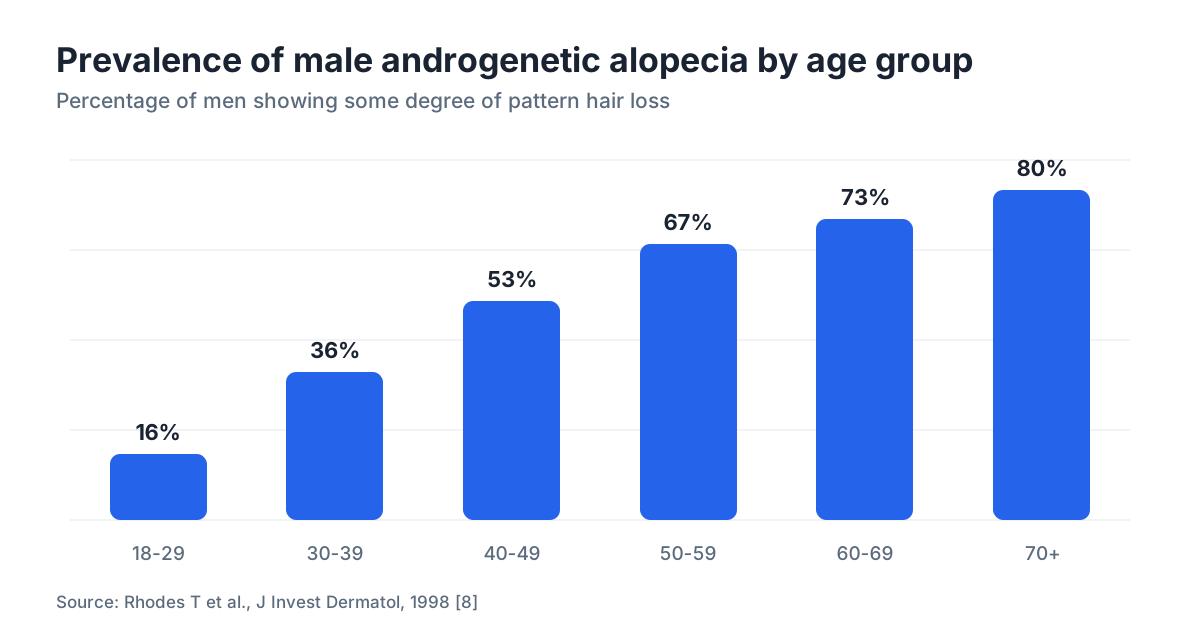
Work published in the Journal of Investigative Dermatology found that roughly half of men have some degree of androgenetic alopecia by age 50, rising to about 80% by age 70 [8]. The rate of progression varies enormously. Some men go from Norwood II to Norwood V in their 20s. Others sit at Norwood III for decades.
What speeds it up:
- A father or maternal grandfather who went bald young is a meaningful signal, though not destiny.
- Earlier onset generally predicts faster and more complete eventual loss.
- High androgen sensitivity, which is genetic and not something lifestyle changes.
What slows it down:
- FDA-approved medications like finasteride and minoxidil have good evidence for slowing or stopping progression and, in some cases, modest regrowth [9][10]. Starting earlier, before follicles scar and die, gets you better outcomes.
The uncomfortable truth: once you notice recession, it rarely stops on its own. Waiting to see how bad it gets is a legitimate choice, but the follicles you lose while waiting are gone. Early intervention is where the evidence is strongest.
What treatments work for a receding hairline?
The FDA has approved two medications specifically for androgenetic alopecia, and they work through different mechanisms.
Finasteride (Propecia, 1 mg oral daily) blocks 5-alpha reductase, the enzyme that turns testosterone into DHT. A 5-year placebo-controlled trial found 48% of men on finasteride showed regrowth and 42% showed no further loss, while most placebo subjects kept losing hair [9]. It preserves and regrows hair at the vertex (crown) better than at the frontal hairline, but it still slows frontal recession a lot. For the full picture, see our guide to finasteride.
Minoxidil (2% and 5% topical solution or foam, FDA-approved for men at 5%) extends the anagen phase and may improve follicle blood supply. It works best at the crown but plenty of men use it for hairline recession. A 48-week trial found 5% topical minoxidil produced significantly greater regrowth than 2% [10]. Learn more in our minoxidil for men article, or read minoxidil side effects before you start.
Used together, finasteride and minoxidil have additive effects, and many dermatologists prescribe the pair, especially for men in their 20s and 30s with active recession. See our article on finasteride and minoxidil.
Hair transplant surgery is the only way to physically move hair back into receded areas. Modern follicular unit extraction (FUE) takes individual follicles from the back and sides of the scalp, which aren't genetically sensitive to DHT, and places them along the receded hairline. Results are permanent as long as the donor area stays healthy. There's more in our hair transplant guide.
Low-level laser therapy (LLLT) has some trial data supporting modest gains in density, though the effect sizes are smaller than finasteride or minoxidil, and FDA clearance came through the device pathway rather than the drug pathway, which sets a lower evidence bar.
What has little to no good evidence: biotin supplements for people without a biotin deficiency, caffeine shampoos on their own, derma rolling as a solo fix. For a fair look at the supplement aisle, see hair loss supplements.
Can a receding hairline grow back?
Partial regrowth is real. Full restoration to a teenage hairline without a transplant is not.
Finasteride and minoxidil both have clinical data showing regrowth in a meaningful share of users, especially when started early. The variable that matters is whether the follicle is still alive. A follicle that has only miniaturized can often be revived. A follicle replaced by scar tissue cannot. That's why dermatologists talk about a treatment window: the sooner you act, the more follicles are still salvageable.
At the temples specifically, regrowth with medication tends to be more modest than at the crown. The frontal hairline is often the last area to respond and the first area people want fixed, which sets up a mismatch between what you want and what you get.
A hair transplant can rebuild a hairline aesthetically, but it needs enough donor hair at the back and sides, and it doesn't stop ongoing loss elsewhere unless you're also on medication. Experienced surgeons flag transplant-without-medication as a risk: you can end up with a transplanted hairline and continued thinning behind it.
The honest bottom line: if your follicles are alive, medication can help. If large areas are gone, a transplant can restore them. No product guarantees regrowth, and any marketing that promises it is overstating the evidence.
How do I check if my hairline is receding at home?
A few reliable self-checks that need no equipment:
Photo comparison: Find a photo from two to four years ago where you're facing the camera with your hair in its normal state. Take a matching photo now. Look at where your hairline sits relative to your eyebrows, and look at the shape at the temples. If the corners have moved back noticeably, that's recession.
The pencil test: Lay a pencil across your forehead touching your eyebrows, then look at where your hairline sits above it. Rough rule of thumb: a hairline more than about 1.5 inches (4 cm) above the brows, plus visible temple recession, leans toward male pattern loss over a mature hairline. This isn't a clinical standard, just a rough orientation.
Feel the temple hair: Miniaturized hairs feel noticeably finer and softer than healthy ones. If the hair at your temples is dramatically finer than the hair at your crown, that's worth investigating.
The wet hair check: Wet hair clings to the scalp and stops covering sparse areas. Styling products and volume mask early recession. A look in the mirror after a shower, no product, is often revealing.
Want a more structured read? The free MyHairline AI scan maps your hairline against Norwood reference images from a photo you upload. It's not a medical diagnosis, but it gives you a concrete starting point before you book a dermatology appointment.
Does a receding hairline mean you will go completely bald?
Not necessarily. But a Norwood II or III in your 20s does raise the odds of significant eventual loss compared to someone still at Norwood I at 35.
The strongest predictors of how far loss goes are age of onset, family history on both sides, and current rate of progression. None of these is a lock. There are men with Norwood V fathers who plateau at Norwood III. There are men with no family history who lose most of their hair by 30. Genetics is probability, not a guarantee.
What the data does show: earlier onset is generally a bad prognostic sign. A man who starts losing hair at 20 is statistically more likely to end up with heavy loss than one who starts at 40, even after controlling for family history [8].
The practical answer is simple. If your hairline is receding and you care about keeping hair, act sooner rather than later. Medication works best while follicles are still active. Waiting to see how bald you get costs you the window where treatment has the highest odds of working.
Sources
- American Academy of Dermatology, Hair Loss Overview
- American Academy of Dermatology, Hair Loss: Causes
- Norwood OT. Male pattern baldness: classification and incidence. South Med J. 1975;68(11):1359-1365.
- Starace M et al. Diffuse variants of scalp alopecia. Dermatol Ther. 2019.
- Rudnicka L et al. Trichoscopy update 2011. J Dermatol Case Rep. 2011.
- American Academy of Dermatology, Hairstyles That Pull Can Cause Hair Loss
- Heilmann-Heimbach S et al. Meta-analysis identifies novel risk loci and yields systematic insights into the biology of male-pattern baldness. Nature Communications. 2017.
- Rhodes T et al. Prevalence of male pattern hair loss in 18-49 year old men. J Invest Dermatol. 1998.
- Kaufman KD et al. Finasteride 1 mg in the treatment of men with androgenetic alopecia. J Am Acad Dermatol. 1998.
- Olsen EA et al. A randomized clinical trial of 5% topical minoxidil vs 2% topical minoxidil vs placebo. J Am Acad Dermatol. 2002.
- FDA, Drugs@FDA: Approved Drug Products (Propecia finasteride label)
- Craiglow BG, King BA. Tofacitinib citrate for treatment of alopecia areata. J Am Acad Dermatol. 2014.