
TL;DR: Every hair follicle runs a cycle: anagen (growth, 2-7 years), catagen (transition, 2-3 weeks), and telogen (rest/shedding, 3 months). DHT binds to follicle receptors, shortening the anagen phase a little more with each cycle until the follicle miniaturizes and stops producing visible hair. That's the mechanism behind male and female pattern hair loss.
What is the hair growth cycle?
Every hair on your head is doing something different right now. Some are growing. Some are transitioning. Some are resting before they shed. This is the hair cycle, and it runs on its own clock in each follicle, which is why healthy hair doesn't all fall out at once.
The cycle has three main phases. Anagen is the growth phase. Cells in the hair bulb divide fast, pushing a new strand up and out of the scalp. Anagen lasts anywhere from two to seven years depending on genetics, health, and where the hair sits on your body. Scalp hair has a much longer anagen than eyebrow or body hair, which is why your scalp hair grows several feet long and your arm hair can't [1].
Catagen comes next. It's a short transition, about two to three weeks, where the hair stops growing and the follicle starts to shrink. The hair detaches from its blood supply and becomes a club hair, anchored in place.
Telogen is the resting phase. It lasts roughly three months. The old hair sits quiet while a new anagen hair starts forming beneath it. When the new hair grows far enough, it pushes the old one out. That's the shed you see in the shower or on your brush.
A fourth phase, exogen, gets listed separately sometimes. That's just the active shedding event itself. Some researchers fold it into telogen. Others keep it separate. For anything practical, the distinction doesn't matter.
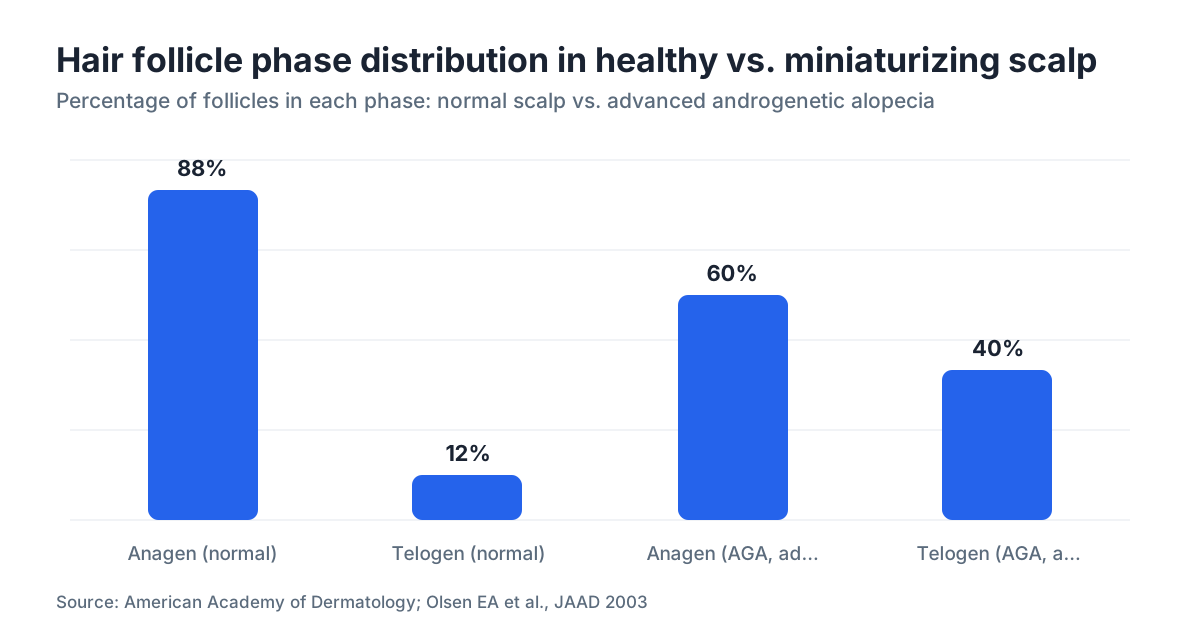
At any moment, roughly 85-90% of scalp follicles are in anagen, about 1-2% are in catagen, and 10-15% are in telogen [1]. Losing 50 to 100 hairs a day is normal, and it's the telogen shed doing its job.
How long does each phase of the hair cycle last?
The numbers move a little person to person, but the ranges are well set in the dermatology literature.
| Phase | Duration | % of follicles at any time |
|---|---|---|
| Anagen (growth) | 2-7 years | 85-90% |
| Catagen (transition) | 2-3 weeks | 1-2% |
| Telogen (rest/shedding) | ~3 months (100 days) | 10-15% |
Anagen duration is the number that matters most for hair length, and it's the exact number DHT attacks. A follicle in anagen for six years produces a hair roughly three feet long (assuming average growth of about half an inch per month). Shorten anagen to six months and that same follicle produces a hair a few inches long before it cycles out. Do that over and over across years, and the hair gets shorter and finer with every round [2].
Age alone shortens anagen a bit. DHT speeds that shortening up hard in genetically susceptible follicles.
What is DHT and where does it come from?
DHT stands for dihydrotestosterone. It's an androgen, a hormone made from testosterone. The enzyme 5-alpha reductase (5AR) converts testosterone into DHT in tissues all over the body, including skin, liver, and prostate. Two forms of the enzyme matter here. Type I sits mostly in skin and sebaceous glands. Type II sits in the scalp, hair follicles, and prostate [3].
DHT is more potent than testosterone at the androgen receptor, binding with roughly three to five times the affinity [3]. That strength is useful in some tissues during development. In scalp follicles with a genetic weakness, the same strength turns destructive.
Men carry higher circulating DHT than women, which is why androgenetic alopecia (pattern hair loss) hits men more often and more severely. But women make DHT too, and female pattern loss runs on the same mechanism. It just shows up differently, usually as diffuse thinning at the crown instead of a receding hairline [4].
Here's the part people miss. Total DHT in your blood doesn't reliably predict how much hair you'll lose. What matters more is how sensitive the androgen receptor is inside the follicle, and that's genetic. Some men with high DHT keep thick hair. Others with average levels lose it fast. This is why hair loss has a strong hereditary component.
How does DHT actually disrupt the hair cycle?
The damage is slow and it stacks. DHT binds to androgen receptors in the dermal papilla cells at the base of the follicle. That shifts the signaling proteins those cells release, cutting IGF-1 (insulin-like growth factor 1, which drives anagen) and raising TGF-beta (which drives catagen and shuts down growth) [2].
So the follicle leaves anagen early. The growth phase shortens. Not by months on the first pass, but bit by bit. Each cycle runs a little shorter than the one before. The hair comes out a little thinner each time because the follicle itself is shrinking, its diameter dropping with every round.
This is follicular miniaturization. A terminal hair (thick, pigmented, fully formed) slowly regresses toward a vellus hair (the fine, near-invisible fuzz on a baby's forehead). Eventually the follicle makes nothing you can see. If it goes on long enough with no treatment, the follicle can scar closed, and at that point nothing brings it back [5].
Miniaturization doesn't spread evenly across the scalp. It tracks androgen receptor density, which runs higher at the frontal hairline, temples, and crown in people with the genetic setup. The sides and back have follicles with lower receptor density, which is exactly why hair there survives pattern baldness and why surgeons use it as donor tissue in hair transplants.
There's no single catastrophic moment. It's slow erosion across hundreds of cycles, often starting in the mid-to-late twenties and taking decades to read as baldness. By the time someone notices thinning, the process has usually been running for years.
What's the difference between miniaturization and normal shedding?
Normal shedding is part of a healthy cycle. A telogen hair falling out is fine because a new anagen hair is already lined up to replace it. The follicle is intact. The cycle keeps going.
Miniaturization is different. The follicle still cycles, but each cycle gives a weaker result. Look at a miniaturizing scalp under a dermoscope and you see hairs of different shaft diameters coming from nearby follicles, the sign that some have started shrinking while others haven't [5]. Dermatologists call this diameter variation, and it's one of the earliest signs of androgenetic alopecia.
The difference changes when you should treat. Miniaturizing follicles can still be rescued if you cut the DHT signal. Follicles that have fully involuted and scarred over cannot. That's the whole case for treating early. You're saving follicles that still cycle, not regrowing ones that are already gone [6].
Telogen effluvium is a separate thing, where a large batch of follicles gets pushed into telogen at once, usually by a shock (illness, surgery, extreme stress, crash dieting). That triggers heavy shedding over months, but the follicles themselves stay intact and regrowth usually comes back once the trigger clears. The two can overlap, which muddies diagnosis.
Which part of the scalp is most vulnerable to DHT?
The frontal scalp, temples, and vertex (crown) carry much higher concentrations of androgen receptors and 5-alpha reductase activity than the occipital and parietal areas (the back and sides). A 1987 study by Imperato-McGinley and colleagues, backed by later work from Messenger and others, documented this distribution and explained why pattern baldness follows predictable maps instead of scattering at random [2].
This is why the Norwood scale for men and the Ludwig scale for women describe set patterns rather than diffuse loss. The receding hairline and crown thinning of early androgenetic alopecia trace exactly where DHT sensitivity runs highest.
The occipital fringe is DHT-resistant. Those follicles hold their receptor insensitivity even after being transplanted to the top of the scalp, which is the basic principle behind hair transplant surgery. Donor follicles keep their DHT resistance in the new spot and keep cycling normally.
What treatments work by targeting DHT or the hair cycle?
Two treatments have FDA approval specifically for androgenetic alopecia, and both work through the DHT and cycle mechanism.
Finasteride blocks 5-alpha reductase Type II, dropping scalp DHT by roughly 60-70% [7]. With less DHT hitting the follicle receptors, the anagen-shortening signal weakens, and follicles that were miniaturizing can steady or partly recover. The original trials showed 83% of men taking 1 mg daily had no further loss after two years, and 66% saw measurable regrowth [7]. Good result. Not a cure. Stop taking it and DHT returns to baseline within weeks, and the miniaturization picks back up. There's more on how it works and its side effects in the finasteride article.
Minoxidil doesn't touch DHT at all. It works another way, by stretching the anagen phase and improving blood flow to the follicle. It pushes follicles into anagen sooner than they'd go on their own, and holds them there longer. That's why you see shedding in the first few weeks: telogen hairs get displaced by new anagen hairs coming in [8]. That shed is temporary and clears. Minoxidil for men is over the counter in 2% and 5% topical solutions, and oral minoxidil at low doses (0.625-2.5 mg) is prescribed off-label more and more. What to expect side-effect wise is in the minoxidil side effects article.
Running both together makes sense mechanically. Finasteride cuts the DHT disruption to the cycle, and minoxidil actively stretches the growth phase. The combination of finasteride and minoxidil has shown stronger results in trials than either drug alone.
DHT blockers like saw palmetto also sell as supplements, though the evidence is much thinner than for finasteride. For a fair read on what the supplement data actually shows, the hair loss supplements article runs the numbers.
Once miniaturization has gone far enough that follicles stop making visible hair, medication won't bring them back. That's the point where hair transplant surgery becomes the real option, moving DHT-resistant donor follicles into the affected areas.
If you want to figure out where you are before spending money on treatment, the free AI hair analysis at MyHairline gives an early read on your pattern and density from photos.
Can the hair cycle recover if DHT is reduced?
Partly, yes. How much recovery you get depends heavily on how far miniaturization has already gone.
When 5AR inhibitors like finasteride cut DHT, the dermal papilla cells get less androgen signaling. IGF-1 can climb back. TGF-beta signaling drops. Follicles that were cutting their anagen short can start stretching it again. In the clinic this shows up as less shedding first (usually within three to six months), then visible regrowth in some follicles (typically judged at twelve months) [7].
Recovery is better in follicles early in miniaturization than in ones nearly involuted. This is not a fully reversible condition. Think of it as slowing and partly reversing a process that, left alone, only moves one way.
One question comes up a lot. Does stopping and restarting treatment reset the process badly? There's no strong evidence that stopping causes a catastrophic "catch-up" shed beyond what would have happened anyway. But the protection you built while on treatment goes away as DHT returns to baseline, so the miniaturization you paused resumes. Starting early and staying consistent matter more than anything else.
Does the hair cycle differ in women with pattern hair loss?
The core mechanism is the same. DHT shortens anagen in susceptible follicles. A few things differ in women.
Women carry lower circulating androgens, so the process tends to run slower and less complete. Full baldness is uncommon in women with androgenetic alopecia. Diffuse thinning over the crown with a kept frontal hairline (described by the Ludwig scale) is the typical picture [4]. The follicles miniaturize, but many hold some function longer.
Women also have more variety in cause. Polycystic ovary syndrome (PCOS) raises androgen levels and can speed up pattern loss. Thyroid trouble can disrupt the hair cycle on its own, with no DHT involved. Postpartum shedding is classic telogen effluvium, not androgenetic alopecia, even when it looks alarming. This is why a dermatologist workup with bloodwork (ferritin, thyroid, androgens) matters more in women than in men before starting treatment.
Finasteride and dutasteride are not approved for premenopausal women (both are teratogenic) [7]. Minoxidil is the main FDA-approved option for women with pattern hair loss, and spironolactone gets prescribed off-label as an anti-androgen.
What can disrupt the hair cycle beyond DHT?
DHT gets the attention because it's the main driver of permanent pattern loss, but the hair cycle is sensitive to plenty else.
Nutrition gaps matter. Iron (ferritin below roughly 30-40 ng/mL is tied to more shedding in women, though the exact threshold is still argued in the literature), zinc, vitamin D, and low protein can all push follicles into telogen early or stall anagen from starting [9].
Physical and emotional stress triggers cortisol, which can interrupt normal cycling. Big stressors often produce a telogen effluvium shed two to four months after the event, that lag being the time between the insult and when those follicles finish their shortened anagen and reach shedding.
Some medications disrupt cycling too, including certain antidepressants, blood thinners (heparin especially), retinoids, and beta-blockers. The mechanism changes by drug.
Creatine is an open question. A 2009 study found creatine supplementation raised DHT by about 56% over three weeks in rugby players [10]. Whether that turns into measurable hair loss is still debated. The creatine and hair loss evidence is genuinely unclear, and nobody has good trial data measuring hair outcomes directly.
Autoimmune conditions like alopecia areata work on a completely different mechanism. The immune system attacks anagen follicles directly, skipping DHT entirely. Treatments that work for androgenetic alopecia do nothing for alopecia areata.
Here's the question worth asking at the end of any hair loss investigation. Which phase of the cycle is being disrupted, by what mechanism, and is it reversible? That framing beats any single supplement or product. Getting a real diagnosis before spending money is the most useful thing anyone can do. MyHairline's free AI scan can flag early pattern changes worth bringing to a dermatologist.
How do dermatologists diagnose disruption to the hair cycle?
A pull test is the simplest tool. The examiner grabs 40 to 60 hairs and pulls with gentle traction. More than 10% releasing (more than 4 to 6 hairs) suggests high telogen or dystrophic activity [5]. It's a rough screen, not a verdict.
Dermoscopy (trichoscopy) tells you more. Under magnification, a trained clinician sees shaft diameter variation (the signature of miniaturization), perifollicular redness, yellow or brown dots (empty or sebum-filled follicular openings), and the ratio of terminal to vellus hairs. These findings separate androgenetic alopecia from other causes without a biopsy.
Scalp biopsy with horizontal sectioning is the gold standard for the ambiguous cases. It shows the ratio of terminal to vellus follicles directly and any fibrosis around them. A terminal to vellus ratio below 7:1 is abnormal. Below 4:1 means significant miniaturization [5].
Bloodwork matters too. A basic hair loss panel covers complete blood count, ferritin, thyroid-stimulating hormone, free and total testosterone, DHEAS, and sometimes prolactin in women. The American Academy of Dermatology's clinical guidelines recommend this workup, particularly before prescribing antiandrogens [4].
Sources
- American Academy of Dermatology, Hair loss types: Alopecia areata overview
- Lolli F et al., Androgen-independent mechanisms of female pattern hair loss, Journal of Investigative Dermatology, 2017
- Rittmaster RS, 5alpha-reductase inhibitors, Journal of Andrology, 1997
- American Academy of Dermatology, Clinical guideline: Female pattern hair loss
- Olsen EA et al., Trichoscopy in the diagnosis of hair disorders, Journal of the American Academy of Dermatology, 2003
- Kaufman KD et al., Finasteride in the treatment of men with androgenetic alopecia, Journal of the American Academy of Dermatology, 1998
- FDA, Propecia (finasteride 1 mg) prescribing information
- FDA, Rogaine (minoxidil 5%) over-the-counter label
- Almohanna HM et al., The role of vitamins and minerals in hair loss: a review, Dermatology and Therapy, 2019
- van der Merwe J et al., Three weeks of creatine monohydrate supplementation affects dihydrotestosterone to testosterone ratio, Clinical Journal of Sport Medicine, 2009
- Prager N et al., A randomized, double-blind, placebo-controlled trial to determine the effectiveness of botanically derived inhibitors of 5-alpha-reductase, Journal of Alternative and Complementary Medicine, 2002
- National Library of Medicine, StatPearls: Androgenetic Alopecia