
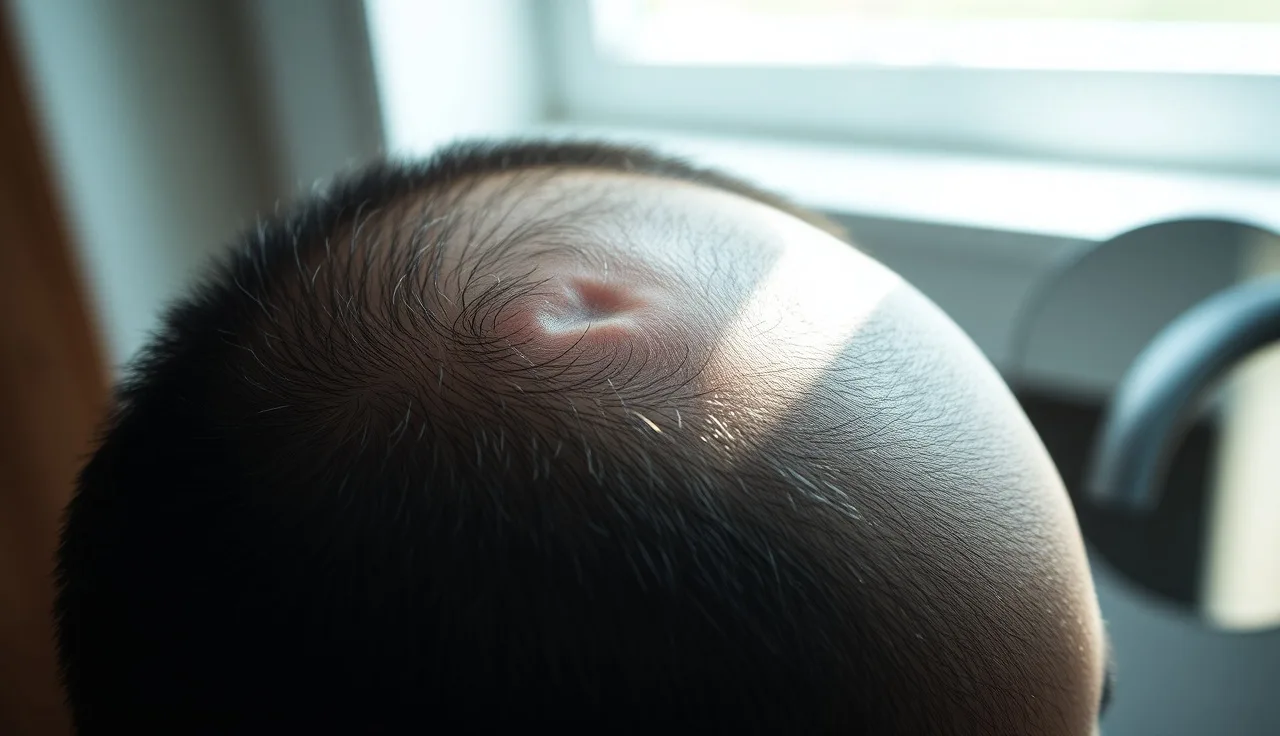
TL;DR: Alopecia areata causes smooth, round bald patches that can appear anywhere on the scalp within days, often with an 'exclamation mark' hair sign at the edges. Male pattern baldness follows a predictable temple-and-crown recession tied to DHT. The two conditions look different, feel different, and need completely different treatments. A dermatologist can confirm with a pull test or scalp biopsy.
What does early stage alopecia areata actually look like?
The first thing most people notice is a coin. Literally, a smooth, roughly circular patch of bare skin, usually somewhere between the size of a quarter and a golf ball, appearing almost overnight with no itch, no pain, and no obvious cause. The surrounding scalp looks completely normal. No redness, no scaling, no broken skin.
The patch itself is the giveaway. Healthy scalp in the middle, a clean border, and at the very edge of the patch you may see what dermatologists call 'exclamation mark hairs', short broken strands that are thicker at the tip than at the root, pointing inward toward the center of the patch. The American Academy of Dermatology (AAD) describes these as a hallmark early sign of alopecia areata [1].
The scalp underneath the patch is usually smooth to the touch and slightly shiny. This is because the follicles are still alive and technically intact, just switched off by an immune attack. That's a clinically meaningful point: the follicles are not dead. They are dormant.
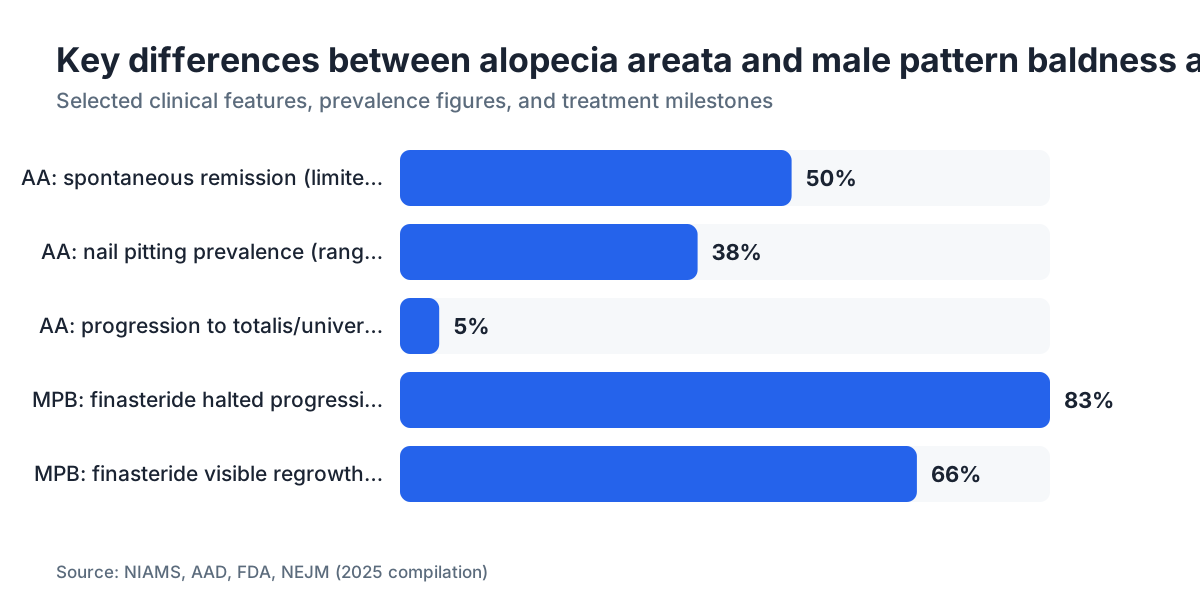
Early alopecia areata rarely causes just one patch and stays there. In many people it spreads to two, three, or more patches within weeks. The patches can merge. In around 5% of cases it progresses to alopecia totalis (full scalp loss) or alopecia universalis (full body hair loss), though predicting which patients will progress is still difficult [2].
Nail changes are a lesser-known early clue. Fine pitting across the fingernails, like someone pressed a tiny pin into each nail in a grid, shows up in roughly 10-66% of alopecia areata patients depending on the study [3]. If you have round scalp patches and pit-marked nails at the same time, that combination points strongly toward alopecia areata and away from pattern hair loss.
What does early stage male pattern baldness look like?
Male pattern baldness does not produce round bald spots. That's the single fastest visual rule. Instead, it follows a slow, symmetric, and entirely predictable map, the Norwood-Hamilton scale, which starts at the temples [4].
The first change most men notice is a slight recession at the corners of the hairline, often described as the hairline going from a flat or slightly curved line to an M-shape. The temples push back symmetrically. Hair at the front becomes finer and shorter before it disappears entirely, a process called miniaturization, where DHT progressively shrinks each follicle over years, not weeks.
At the same time or shortly after, the crown (vertex) may start thinning. The hair there gets sparse, diffuse, and the scalp becomes visible under bright light. At Norwood stage 3-4, both the temporal recession and the crown thinning are detectable. By stage 5-7, the two areas merge and a broad bald region covers most of the top of the scalp, while the sides and back stay dense because those follicles lack DHT receptors [4].
Nothing about male pattern baldness is sudden. The timeline from first recession to obvious thinning is measured in years. The scalp under thinning areas does not look different from the rest of the scalp. No patches, no smooth circular borders, no exclamation mark hairs.
For a deeper look at what's driving the follicle miniaturization, the what causes hair loss article covers the DHT pathway in detail. And if you're trying to categorize where you are on the Norwood scale, the receding hairline guide walks through each stage with photographs.
What are the key visual differences between the two conditions?
| Feature | Alopecia Areata | Male Pattern Baldness |
|---|---|---|
| Patch shape | Round or oval, sharp border | Diffuse, follows hairline/crown pattern |
| Location | Anywhere on scalp (or beard, brows, lashes) | Temples first, then crown |
| Onset speed | Days to weeks | Years |
| Scalp appearance | Smooth, slightly shiny in patch | Normal throughout |
| Exclamation mark hairs | Present at patch edge (early sign) | Never |
| Nail changes | Pitting in ~10-66% of cases | Not associated |
| Hair elsewhere | Can affect beard, brows, lashes | Rarely affects body hair |
| Age of onset | Any age, including children | Almost never before puberty |
| Underlying cause | Autoimmune | Genetic + androgenic |
| Spontaneous regrowth | Yes, possible (sometimes fine/white first) | No |
The table above summarizes the clinical picture. A single feature in isolation isn't conclusive, but the combination of location, onset speed, and patch shape together is usually enough for an experienced clinician to make a working diagnosis on visual inspection alone.
The most common source of confusion is when male pattern baldness produces a thinning crown that, in a certain light, looks like a 'spot'. It's not a spot. It has a diffuse edge, not a clean circular border, and it's surrounded by thinning hair rather than normal hair. Run a finger around the edge of what you're seeing: if the border is crisp and the transition from bare to normal scalp is sharp, that's alopecia areata territory.
What causes alopecia areata compared to male pattern hair loss?
The causes are mechanistically unrelated.
Alopecia areata is an autoimmune condition. The immune system mistakes hair follicles for a threat and sends T-cells to attack them. The follicles don't die, they just stop producing hair. The exact trigger is unknown, but genetic predisposition matters: first-degree relatives of people with alopecia areata have roughly a 6% lifetime risk, compared to about 2% in the general population [2]. Stress, illness, and certain other autoimmune diseases (thyroid disease, vitiligo, type 1 diabetes) are associated with flares, but stress alone doesn't cause the condition from scratch.
Male pattern baldness is androgenetic alopecia, driven by sensitivity of hair follicles to dihydrotestosterone (DHT). DHT, a derivative of testosterone converted by the enzyme 5-alpha reductase, progressively miniaturizes follicles in genetically susceptible men. The genetic risk is polygenic, inherited from both parents, more than the mother's father as the old myth says. The dht blocker article goes through how finasteride and dutasteride interrupt this process.
One important overlap: both conditions have a genetic component, and both can appear in the same person at the same time. Having alopecia areata doesn't protect you from also developing pattern hair loss. If you notice round patches on a scalp that's also receding symmetrically at the temples, you may have both, which is not rare and makes treatment planning more complex.
How do doctors diagnose early alopecia areata vs pattern baldness?
Dermatologists use several tools, and for most cases the diagnosis is primarily clinical, meaning they look and pull.
The hair pull test is simple: the doctor grasps about 40-60 hairs between thumb and forefinger, applies gentle traction, and counts what comes out. More than 6 hairs is considered a positive result and suggests active shedding from alopecia areata or telogen effluvium [5]. In stable male pattern baldness, the pull test is usually negative because the hairs aren't actively shedding en masse, they're just miniaturizing.
Dermoscopy (a lighted magnifying tool placed against the scalp) lets the clinician see exclamation mark hairs, yellow dots (empty follicular openings), and black dots (broken hairs at the scalp surface). These dermoscopic features are specific to alopecia areata and not seen in pattern hair loss.
A scalp biopsy is the definitive tool if the diagnosis is unclear. In alopecia areata, pathology shows a 'swarm of bees' pattern, a dense infiltrate of lymphocytes around the hair bulb [6]. In androgenetic alopecia, biopsy shows a shift in the terminal-to-vellus hair ratio with no inflammatory infiltrate.
Blood tests are not used to diagnose either condition directly, but they help rule out thyroid disease, iron deficiency, or lupus, conditions that can cause hair loss patterns superficially similar to alopecia areata.
If you're trying to get a faster initial read before booking a dermatologist, the free AI scan at MyHairline (/scan) can analyze a scalp photo and flag patterns consistent with alopecia areata or androgenetic alopecia, though it doesn't replace clinical examination.
Can alopecia areata patches appear on the beard or eyebrows instead of the scalp?
Yes, and this trips people up. Alopecia areata is a systemic autoimmune condition targeting follicles wherever they exist. The beard is the second most common site after the scalp, and isolated beard alopecia areata (sometimes called 'alopecia areata barbae') can occur without any scalp involvement at all.
Brow and lash involvement is a marker of more severe disease. The AAD notes that when alopecia areata affects brows or lashes, it's more likely to be associated with widespread or persistent loss [1].
Male pattern baldness does not affect the beard, brows, or lashes in any meaningful way. If you have a smooth circular patch missing from your beard with no explanation, alopecia areata is the first thing to investigate, not pattern hair loss.
What treatment options exist for each condition?
The treatments are completely different, which is why getting the diagnosis right matters before spending money.
For alopecia areata, the treatment landscape shifted meaningfully in 2022 when the FDA approved baricitinib (Olumiant) for severe alopecia areata, the first FDA-approved systemic treatment for this condition [7]. In June 2023, ritlecitinib (Litfulo) followed, approved for patients 12 and older [8]. Both are JAK inhibitors that reduce the immune attack on follicles. Before these approvals, the standard approach was intralesional corticosteroid injections (triamcinolone acetonide, usually 2.5-10 mg/mL injected every 4-8 weeks) into individual patches, which works for limited scalp alopecia areata but is impractical for extensive disease. Topical minoxidil is sometimes added to encourage regrowth but doesn't address the underlying immune process.
For male pattern baldness, the two evidence-based first-line treatments are topical minoxidil and finasteride. Minoxidil (2% or 5% for men) extends the anagen growth phase and increases follicle size. The FDA approved it specifically for androgenetic alopecia [9]. Finasteride 1 mg/day inhibits 5-alpha reductase, reducing DHT by roughly 70% at the scalp level, and the registration trials showed it halted progression in about 83% of men and produced visible regrowth in about 66% at 2 years [10]. You can read the full breakdown of side effects and who should be cautious in the minoxidil side effects and finasteride articles. The finasteride and minoxidil piece covers combining the two.
Hair transplant surgery is an option for male pattern baldness where donor hair is stable, but it is not a treatment for alopecia areata because the transplanted follicles remain vulnerable to the same immune attack and can be lost again [11]. The hair transplant article goes through candidacy criteria in detail.
One thing I'd say plainly: if you're self-treating with minoxidil because you saw a round patch and assumed it was just thinning, stop and see a dermatologist first. Treating alopecia areata with minoxidil alone isn't harmful but it delays getting the right therapy, and the new JAK inhibitors for severe disease are genuinely effective in a way that minoxidil is not for this condition.
Will alopecia areata grow back on its own?
Sometimes, yes. This is one of the genuinely confusing things about the condition. Spontaneous regrowth happens in a meaningful share of patients, particularly those with a single small patch of less than a year's duration. The British Association of Dermatologists estimates that around 50% of patients with limited alopecia areata recover within one year without treatment [6].
When hair does grow back naturally, it often comes in fine and white or gray at first before pigmenting. That's normal and not a sign of permanent damage.
The problem is that nobody can reliably predict which patients will regrow spontaneously and which will progress. Factors linked to a worse prognosis include extensive loss at onset, loss before puberty, nail involvement, other autoimmune conditions, and a family history of the disease.
Male pattern baldness, by contrast, never spontaneously reverses. Without treatment it progresses at a genetically determined rate. There is no 'phase' where it pauses and reverses without intervention.
This asymmetry has real implications. If you have what looks like alopecia areata and you wait to see if it regrows, you might be doing the right thing for a mild case. If you have male pattern baldness and you wait, you are losing follicle mass that becomes progressively harder to recover.
What about women: does early alopecia areata look different in women than in men?
The alopecia areata pattern looks essentially the same in women as in men: smooth, round patches with exclamation mark hairs at the border. The condition affects women at roughly the same rate as men, and the immune mechanism is identical.
Where things differ is that women's hair loss is more likely to be dismissed or misdiagnosed. Female pattern hair loss (androgenetic alopecia in women) presents as diffuse thinning over the crown and top of the scalp, with preservation of the frontal hairline, which is different from both alopecia areata and the male pattern. The Ludwig classification describes this pattern in women [4].
A woman who presents with diffuse thinning across the top but without distinct patches most likely has female pattern hair loss or possibly telogen effluvium rather than alopecia areata. A woman with one or more sharply bordered round patches has alopecia areata until proven otherwise, same as a man.
Oral minoxidil has become an option some dermatologists use for both female pattern hair loss and as adjunct therapy in alopecia areata. The oral minoxidil article covers the doses and evidence for that route.
When should you see a dermatologist and how urgent is it?
See a board-certified dermatologist if you notice any of the following: a smooth, round or oval bald patch appearing over days to weeks; more than one such patch; hair loss on the eyebrows, lashes, or beard without a clear reason; or rapid diffuse shedding across the whole scalp.
None of these require an emergency room visit, but they also shouldn't wait six months. Alopecia areata is more treatable when caught early, especially if you're a candidate for JAK inhibitor therapy for severe disease, and the diagnostic workup is straightforward and fast.
Male pattern baldness is less time-urgent in the sense that a few extra weeks won't make a material difference, but the sooner treatment starts, the more follicle mass there is to preserve. Finasteride preserves what you have far better than it recovers what's already gone.
If an in-person appointment isn't immediately accessible, a validated AI-assisted scalp assessment can be a useful first screen. The MyHairline AI scan (/scan) uses uploaded scalp photos to flag patterns and can help you have a more productive conversation with your doctor, though it doesn't replace the pull test, dermoscopy, or biopsy that a dermatologist performs.
Are there early signs or risk factors that predict who gets each condition?
For alopecia areata, the clearest risk factor is a personal or family history of autoimmune disease. A 2010 genome-wide association study published in Nature identified multiple susceptibility loci, several of which overlap with rheumatoid arthritis, type 1 diabetes, and celiac disease, confirming the autoimmune architecture of the condition [12]. If you have one autoimmune condition, your risk for others, including alopecia areata, is elevated.
Stress is repeatedly cited as a trigger but the evidence is associative rather than causal. Nobody has shown in a controlled trial that stress alone induces alopecia areata in otherwise unexposed individuals. What stress may do is precipitate a flare in someone already genetically predisposed.
For male pattern baldness, the risk factors are genetic susceptibility and androgen levels. The AR gene (androgen receptor) on the X chromosome has a well-established association, but the trait is polygenic with contributions from both parents. Early onset of recession before 25 and a strong family history on both sides predict more extensive eventual loss. External factors like diet, supplements, and DHT-influencing substances come up often, and the does creatine cause hair loss article addresses one commonly worried-about example. The hair loss supplements article covers what the evidence actually says about vitamins and minerals.
One overlap worth knowing: emotional stress can trigger telogen effluvium, a temporary diffuse shedding that produces neither the round patches of alopecia areata nor the patterned recession of MPB. Telogen effluvium is its own condition and is covered in the telogen effluvium guide.
Sources
- American Academy of Dermatology, Alopecia Areata overview
- National Institute of Arthritis and Musculoskeletal and Skin Diseases (NIAMS), Alopecia Areata
- Journal of the American Academy of Dermatology, Tosti et al., Nail changes in alopecia areata
- StatPearls (NCBI Bookshelf), Androgenetic Alopecia and pattern hair loss classification
- StatPearls (NCBI Bookshelf), Hair pull test evaluation
- British Association of Dermatologists, Alopecia Areata patient information
- U.S. Food and Drug Administration, FDA approves first systemic treatment for alopecia areata
- U.S. Food and Drug Administration, Litfulo (ritlecitinib) approval 2023
- U.S. Food and Drug Administration, Minoxidil labeling and approval history
- New England Journal of Medicine, Finasteride Male Pattern Hair Loss Study Group, 1998
- International Society of Hair Restoration Surgery, Alopecia Areata and Hair Transplant Candidacy
- Nature, Petukhova et al., Genome-wide association study in alopecia areata implicates both innate and adaptive immunity, 2010