
TL;DR: Diffuse unpatterned alopecia (DUPA) is androgenetic hair loss that thins the entire scalp, including the back and sides normally harvested for transplants. Because the donor zone is not stable, transplanted hairs miniaturize and fall out over a few years. Most surgeons decline to operate on a confirmed DUPA patient. Medical therapy, finasteride and minoxidil, is the real treatment.
What exactly is DUPA?
DUPA stands for diffuse unpatterned alopecia. It is a subtype of androgenetic alopecia (AGA), the same hormone-driven hair loss behind classic male pattern baldness and female pattern hair loss. What sets it apart is where the thinning lands.
Standard AGA follows a predictable map. The top and front thin and eventually bald, while the back and sides (the occipital and parietal zones) stay dense and DHT-resistant. That predictability is what makes hair transplants work at all: surgeons pull follicles from those stable zones and move them up front, where they keep growing for life.
DUPA breaks the map. Thinning spreads across the whole scalp, including the zones that are supposed to be safe. The back and sides look thinner than they should for the patient's age, often uniformly rather than in the horseshoe pattern of typical AGA. The donor follicles are not DHT-resistant. They miniaturize just like the ones on top.
That leaves a scalp with no reliable bank of healthy follicles to borrow from. That single fact is the whole problem of DUPA, and it drives every treatment decision that follows.
How is DUPA different from standard male or female pattern baldness?
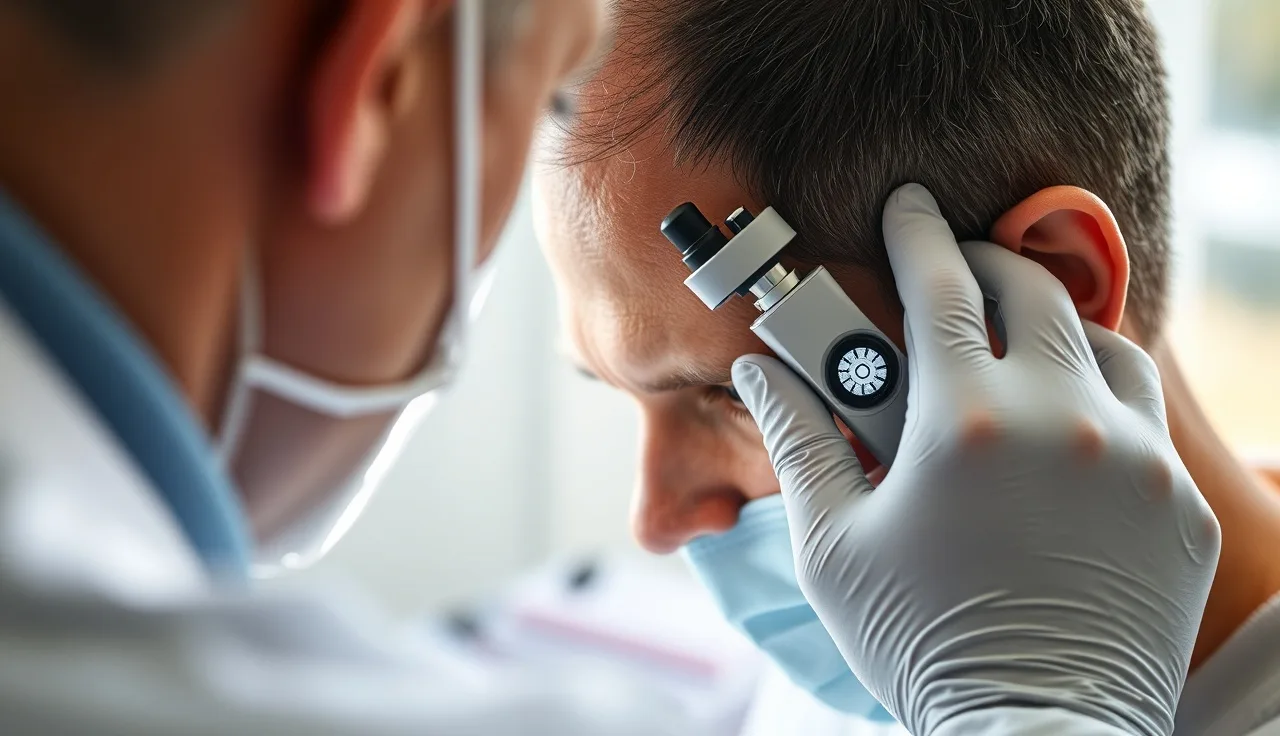
The fastest way to see the difference is to look at the donor zone under magnification. In classic AGA it stays dense. In DUPA it is already thinning.
In Norwood-scale AGA, the occipital donor strip holds roughly normal follicle density and caliber. A trichoscopy or densitometer reading there usually shows hair shaft diameter variation below 20%, the rough threshold dermatologists use to define significant miniaturization [1].
In DUPA, trichoscopy of the same donor zone shows widespread miniaturization, often past 30 to 40% of follicles in the occipital area. The shafts are thin, short, and fine instead of the thick terminal hairs you want for a graft.
Female pattern hair loss (FPHL) muddies this further. Women with FPHL often show diffuse crown thinning that can look like DUPA at a glance. The Ludwig scale grades FPHL by crown severity, but a meaningful share of women also have donor zone involvement, which puts them functionally in DUPA territory even without the label [2]. Some researchers reserve "diffuse patterned alopecia" (DPA) for a diffuse pattern with a spared donor zone, and DUPA strictly for cases where the donor is compromised. The terminology is not fully standardized across the literature.
So here is the practical part. If your dermatologist checks only the thinning top and declares you a transplant candidate without a careful look at the back and sides, get a second opinion.
| Feature | Classic AGA | DUPA |
|---|---|---|
| Donor zone status | Stable, DHT-resistant | Miniaturized, unstable |
| Thinning pattern | Predictable (Norwood/Ludwig) | Diffuse, no clear boundary |
| Trichoscopy in donor area | <20% miniaturization | >30-40% miniaturization |
| Transplant candidacy | Usually yes | Usually no |
| Responds to finasteride/minoxidil | Often yes | Possibly, less predictably |
What causes DUPA?
Honestly, the exact mechanism is not fully worked out. The best current explanation is that DUPA is androgenetic alopecia in which DHT sensitivity is not confined to the frontal and vertex zones. That sensitivity has either spread to, or was always present in, the occipital and temporal follicles that normally sit protected.
DHT (dihydrotestosterone) binds androgen receptors in follicle cells, shortens the anagen (growth) phase, and drives miniaturization. In typical AGA, follicles at the back of the scalp carry fewer androgen receptors and shrug off DHT. In DUPA, those occipital follicles seem to share the sensitivity of the frontal ones. Why that happens in some people and not others is still unclear. Genetics almost certainly matter, but no single gene variant has been pinned down as the cause.
There is a separate question hiding underneath: whether some cases labeled DUPA are actually something else. Chronic telogen effluvium, iron-deficiency shedding, and thyroid-related loss all produce diffuse thinning. Telogen effluvium in particular can mimic DUPA closely on a visual exam while carrying a completely different prognosis and treatment path. That is why blood work (ferritin, TSH, complete blood count, hormones) belongs in the workup before anyone accepts a DUPA diagnosis.
A scalp biopsy helps settle it. In androgenetic DUPA, horizontal sections typically show an increased ratio of vellus to terminal hairs across both the thinning zones and the donor zone. That histology separates DUPA from telogen effluvium, where miniaturization is not the main finding [3].
How do doctors diagnose DUPA?
No single test hands you a DUPA diagnosis. It is a clinical judgment built from several pieces, and the donor zone exam is the piece people skip.
Start with history: onset, rate of progression, family history, medications, diet, stress events, and any systemic symptoms pointing to a secondary cause.
Next, scalp examination with trichoscopy (dermoscopy of the scalp). A good trichoscopy reads follicle density, shaft diameter, and the proportion of miniaturized hairs across the frontal, vertex, occipital, and temporal zones. Miniaturization past roughly 20% in the donor zone raises serious concern [1]. Some clinicians use a handheld densitometer for a real number instead of eyeballing it.
Then labs. Most dermatologists check ferritin (low iron is a common shedding driver), TSH (thyroid), and a full blood count at minimum. Some add free and total testosterone, DHEAS, and prolactin, especially in women.
Biopsy comes in when the picture is ambiguous. Two 4mm punch biopsies from the affected vertex, read in horizontal section, show the terminal-to-vellus ratio and rule out lichen planopilaris or alopecia areata incognita, both of which can also produce diffuse thinning [3].
Here is the line that matters. Any surgeon who recommends a transplant without performing or ordering trichoscopy of the donor zone is skipping the one step that could cost you tens of thousands of dollars and a wrecked scalp.
Why do hair transplants fail in DUPA?
A hair transplant rests on a single assumption: the harvested follicles carry their growth programming with them. In DUPA, that programming is broken, so the transplant is broken too.
The assumption has a name. Donor dominance. Take a DHT-resistant follicle from the occipital zone, move it to a balding area, and it keeps its resistance and grows for life. Decades of data from hair transplant surgery back this up when the donor zone is genuinely stable [4].
DUPA violates the assumption at its root. The donor follicles are not resistant. They are already miniaturizing in place. Harvest and transplant them and they bring their sensitivity along for the ride. The grafts may grow at first, sometimes for one to three years, which feels like a win. Then they follow the same shrinking path they were always on. The patient ends up with fewer follicles overall (some are sacrificed in harvesting), patchy transplanted areas that thin out, and a depleted donor zone.
This is not a minor setback. It can leave the scalp looking worse than if nobody had operated.
For FUE (follicular unit excision), DUPA is more dangerous than for FUT (strip) surgery. FUE pulls follicles across a wide donor area, and if that whole area is diffusely miniaturized, the surgeon may not catch it until the damage is done. FUT at least lets a pathologist examine the harvested strip and flag abnormal miniaturization rates before the procedure goes further.
Most experienced surgeons decline to operate on a clearly diagnosed DUPA patient. If a clinic is eager to cut without a thorough donor zone assessment, treat it as a warning.
Are there any cases where a transplant might still make sense with DUPA?
Rarely, and only with heavy caveats. The honest default answer is no.
Some patients have what you could call borderline DUPA: donor zone miniaturization that is elevated but not severe, with a clinical picture that has stabilized on medical therapy. If finasteride and/or minoxidil have run consistently for 12 to 18 months and serial trichoscopy shows the donor zone holding steady, a conservative surgeon might consider a small transplant, with realistic expectations spelled out to the patient.
Those three words carry the weight: conservative, small, realistic. This is not a full restoration. It might mean a few hundred grafts placed in one focal area. The patient has to accept that even those grafts may not last.
Body hair transplant (BHT) using beard or chest hair comes up when the scalp donor is compromised. Beard follicles can grow reasonably thick shafts. But they have their own quirks (shorter anagen phase, different curl) and results are inconsistent. BHT is not a mainstream fix for DUPA. It is an experimental workaround used by a handful of specialized surgeons.
For the large majority of DUPA patients, transplantation is the wrong tool. Medical therapy is where the effort belongs.
What treatments actually help people with DUPA?
Medicine, not surgery, is the primary approach for DUPA. Two drugs carry the most evidence: finasteride and minoxidil.
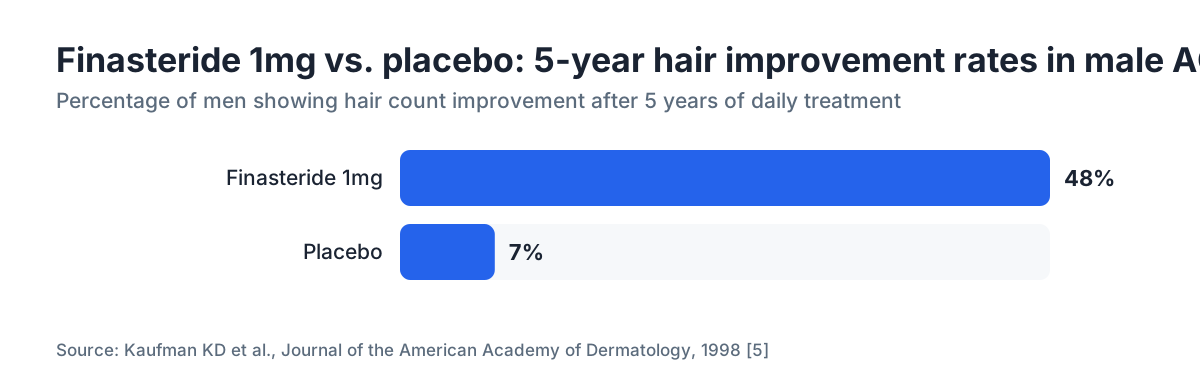
Finasteride is a 5-alpha reductase inhibitor. It blocks the conversion of testosterone to DHT, cutting scalp DHT by roughly 60 to 70% at the standard 1mg daily oral dose [5]. The FDA approved oral finasteride 1mg (Propecia) for male androgenetic alopecia in 1997. Since DUPA is androgen-driven, finasteride is the logical first move. Whether it works as well in DUPA as in classic AGA is genuinely unknown; there are no dedicated randomized trials in DUPA that I am aware of. The closest data comes from AGA generally. A 5-year trial in the Journal of the American Academy of Dermatology found 48% of men on finasteride 1mg improved versus 7% on placebo [5]. DUPA patients should not assume those numbers transfer cleanly.
For women, finasteride is not FDA-approved for hair loss, though it is used off-label in postmenopausal women. Dutasteride blocks both type 1 and type 2 5-alpha reductase and suppresses DHT further; it is approved for male hair loss in some countries (Japan, South Korea) but not in the US [6]. Some dermatologists reach for it off-label in stubborn cases. There is more on how finasteride works and its side effects.
Minoxidil is the other half. Topical minoxidil (2% for women, 5% for men) is FDA-approved for AGA [7]. It prolongs the anagen phase and may improve miniaturization through mechanisms still being studied. Low-dose oral minoxidil (0.625mg to 2.5mg in women, 2.5mg to 5mg in men) has grown into a common off-label option, especially for people who cannot tolerate the topical. A systematic review in the Journal of the American Academy of Dermatology found low-dose oral minoxidil produced meaningful density gains across multiple alopecia subtypes [8]. Oral minoxidil is worth reading up on if this is your situation.
Running finasteride and minoxidil together makes pharmacological sense because they work by different mechanisms. The evidence for the combination in AGA beats either drug alone, though DUPA-specific data is thin here too. There is a full breakdown of finasteride and minoxidil used together.
PRP (platelet-rich plasma) and low-level laser therapy (LLLT) have some AGA evidence, but the data quality is mixed and effects are modest at best. Neither replaces the two established options. Hair loss supplements like biotin get marketed hard and lack strong evidence for androgenetic hair loss.
If you are unsure what you are dealing with, mapping your current miniaturization is step one. The free AI hair analysis at MyHairline can help you document and track scalp changes before a dermatology visit, though it does not replace a clinical exam.
How does DHT drive DUPA and what does blocking it do?
DHT (dihydrotestosterone) forms from testosterone through the enzyme 5-alpha reductase, which comes in two forms (type 1 and type 2) in the scalp. Type 2 dominates in the follicle's dermal papilla. When DHT binds androgen receptors there, it kicks off a cascade that shortens the anagen growth phase and shrinks the follicle over successive cycles. Over years, terminal hairs turn vellus-like, then stop cycling entirely [6].
In classic AGA, this runs mostly in the frontal and vertex scalp, where androgen receptor density is higher. In DUPA, the same process runs in the occipital follicles too.
A DHT blocker like finasteride or dutasteride cuts the fuel for that damage. Less DHT means slower miniaturization and, sometimes, partial recovery as follicles caught mid-shrinkage bounce back. Recovery takes time. Most clinicians expect 12 months of consistent use before a clear response shows, with the full effect out around 24 months.
What DHT blockade cannot do is revive follicles that have already gone fully vellus or scarred over. That is why early treatment matters more in DUPA than in classic AGA. The window to preserve the donor zone is narrower, because in DUPA the donor zone is on the clock too.
How do doctors tell DUPA apart from other causes of diffuse hair loss?
This distinction changes the whole treatment plan, because several conditions produce diffuse scalp-wide thinning and they do not share a fix.
Telogen effluvium (TE) is the most common mimic. TE is reactive shedding, where a large fraction of follicles drop into the telogen resting phase at once, triggered by illness, surgery, major blood loss, crash dieting, or stress. The shed can be alarming. Unlike DUPA, TE does not produce the vellus miniaturization seen on trichoscopy; the shed hairs have intact club roots and normal caliber. TE also tends to recover once the trigger clears. Chronic TE (past six months) looks more DUPA-like but still lacks the donor zone miniaturization pattern. Knowing telogen effluvium cold matters, because calling DUPA a TE gives false reassurance, and the reverse steers people into anti-androgens they do not need.
Alopecia areata incognita is a variant of alopecia areata that produces diffuse, non-patchy loss instead of the classic coin-shaped bald spots. It usually shows yellow dot signs on trichoscopy and a jump in dystrophic hairs on a pull test. Treatment is immunosuppressive, not anti-androgen.
Nutritional gaps, iron deficiency above all, can worsen or mimic androgenetic diffuse loss. Ferritin below 30 ng/mL is linked to shedding even without frank anemia [3]. Thyroid dysfunction, both hypo and hyperthyroid, does the same.
A scalp biopsy in horizontal section stays the most reliable tool when exam and labs do not settle it. In DUPA, the key finding is a vellus-to-terminal ratio worse than roughly 1:4 throughout the sampled areas, donor regions included.
What should someone with DUPA realistically expect long-term?
Honesty beats optimism here, so here it is straight.
DUPA tends to progress without treatment. Because the donor zone is not protected, patients can end up with diffuse thinning across the whole scalp rather than the defined bald area with a dense fringe most people picture when they think of hair loss. It reads differently to the eye, and in some cases more noticeably than classic pattern baldness.
Start medical treatment early and some patients stabilize. A portion see modest regrowth. But DUPA generally does not respond as dramatically to finasteride and minoxidil as classic AGA does, in the clinical experience of specialists who see both, though head-to-head trial data is limited. Setting expectations is the honest job of a good dermatologist.
Cosmetically, DUPA patients often do better with approaches that work with lower density: shorter cuts that make thin hair less obvious, volumizing grooming products that skip the buildup, and sometimes scalp micropigmentation (SMP) for the look of density. SMP is not a hair treatment. It is tattooing built to mimic closely cropped hair or follicle shadows, and it does nothing to slow progression.
If you are worried about causes beyond androgenetics, the overview at what causes hair loss is worth reading to make sure nothing systemic slips past.
MyHairline's free AI scalp scan gives you a baseline for tracking changes over time, which is genuinely useful to bring to a dermatology appointment, particularly for serial comparison of donor zone density.
What questions should you ask a hair transplant surgeon if you think you might have DUPA?
Before you pay a consultation fee or book a date, these five questions protect you.
First: Will you perform trichoscopy or densitometry of my donor zone before recommending a transplant? A no or a dodge means leave.
Second: What is the miniaturization percentage in my occipital and temporal donor zones? A surgeon who cannot give you a number from examination should not be doing your transplant.
Third: Have you operated on DUPA patients before, and what were the long-term outcomes? Ask specifically about graft survival at three-plus years. Vague answers or visible discomfort tell you what you need to know.
Fourth: If my donor zone shows significant miniaturization, will you recommend against surgery? A surgeon willing to say no is worth more than one who always finds a way to say yes.
Fifth: What medical therapy should I try first, or instead, and for how long before you reassess my candidacy?
The transplant industry has a commercial reason to operate. The best surgeons talk openly about when not to. Patients with possible DUPA need that candor more than almost anyone.
One more thing worth knowing: a receding hairline that is your main complaint might look like DUPA but might just be standard pattern loss. Telling them apart takes an examination, not a guess.
Sources
- Olsen EA, Journal of the American Academy of Dermatology, 2005: trichoscopy miniaturization thresholds in AGA
- Ludwig E, British Journal of Dermatology, 1977: Classification of female pattern hair loss (Ludwig scale)
- Sperling LC & Sinclair RD, in Dermatology (Bolognia textbook): scalp biopsy interpretation and ferritin thresholds in hair loss
- Bernstein RM & Rassman WR, Dermatologic Clinics, 1995: donor dominance principle in hair transplantation
- Kaufman KD et al., Journal of the American Academy of Dermatology, 1998: 5-year finasteride 1mg trial in male AGA
- FDA Drug Label: Proscar (finasteride 5mg) and Propecia (finasteride 1mg), FDA prescribing information
- FDA: Minoxidil topical OTC labeling and approval history
- Randolph M & Tosti A, Journal of the American Academy of Dermatology, 2021: systematic review of oral minoxidil for hair loss
- American Academy of Dermatology Association: Hair loss types and treatments overview
- Norwood OT, Journal of Cutaneous and Aesthetic Surgery: Norwood scale classification and donor zone stability