
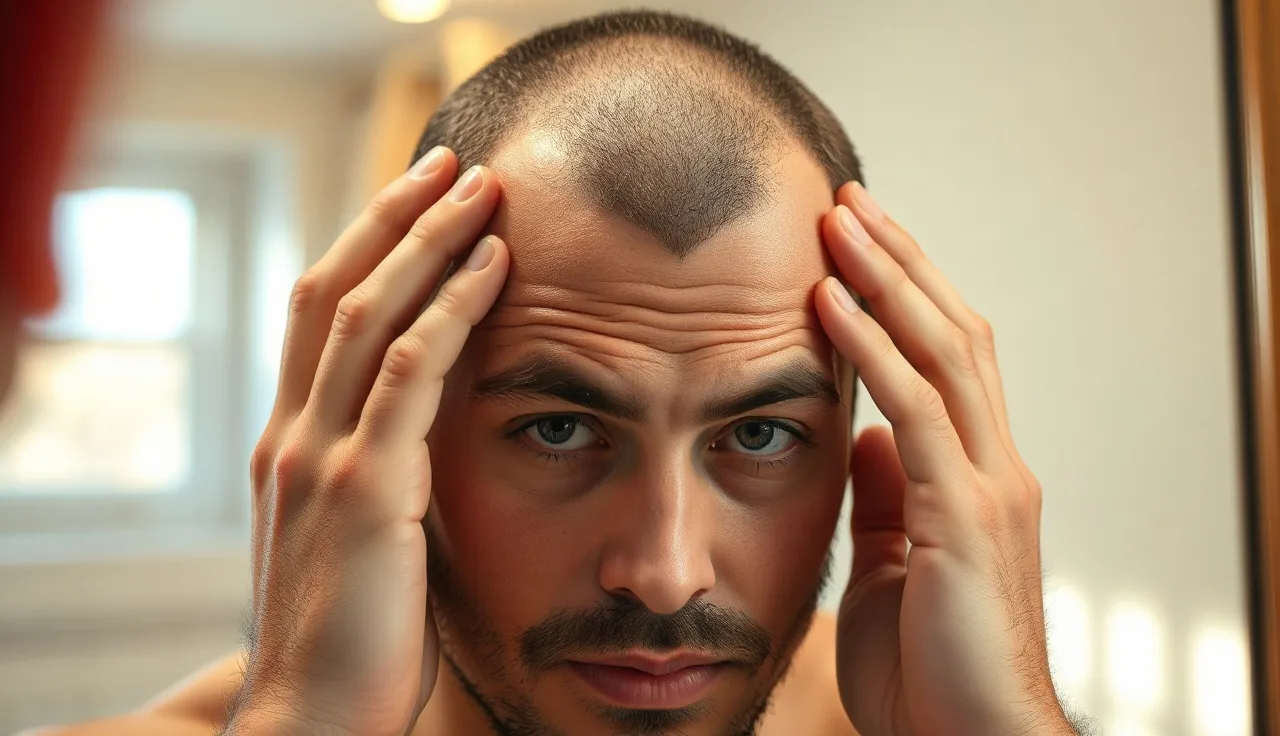
TL;DR: A receding hairline is almost always androgenetic alopecia, where the hormone DHT shrinks hair follicles in genetically vulnerable zones at the temples and front. Age speeds it up. Secondary causes include tight hairstyles, certain drugs, thyroid disorders, and low iron. Roughly half of men show visible pattern loss by age 50.
What actually causes a receding hairline?
Short version: DHT hitting follicles that are genetically primed to react badly to it.
Dihydrotestosterone (DHT) is a potent androgen your body makes when the enzyme 5-alpha reductase converts testosterone. Follicles on the frontal scalp and temples carry androgen receptors. In people with the genetic variant that makes those receptors oversensitive, DHT tells the follicle to miniaturize. Each growth cycle gets shorter, the hair shaft gets thinner and finer, and eventually the follicle produces nothing you can see. That process is androgenetic alopecia (AGA), and it accounts for roughly 95 percent of male pattern hair loss [1].
DHT is not always the whole story though. Tight hairstyles physically stress the root. Some medications trigger sudden shedding. Thyroid disease throws off the entire growth cycle. Low iron and certain B-vitamin gaps can speed up loss that would otherwise stay mild. Figuring out which cause, or which combination, applies to you matters a lot, because the fix for AGA looks nothing like the fix for a tight ponytail or low ferritin.
This article goes cause by cause, with what the evidence actually shows.
How does DHT shrink hair follicles?
DHT shrinks follicles by binding the androgen receptor in the dermal papilla, which suppresses the signals that drive the active growth phase. The follicle spends less time growing and more time resting, and over many cycles it shrinks. That is miniaturization.
Here is the mechanism in more detail. When DHT binds the androgen receptor in a follicle's dermal papilla cells, it cuts the time follicles spend in anagen (the active growth phase) before they cycle back into telogen (the resting and shedding phase). Repeat that over years and the follicle gets smaller with each pass [2].
Under the microscope, biopsy samples from the frontotemporal scalp of men with AGA show more miniaturized follicles and more perifollicular fibrosis than the occipital scalp of those same men [3]. That difference explains why donor hair from the back of the scalp survives a transplant: those follicles just don't carry the same receptor sensitivity.
The enzyme 5-alpha reductase comes in two main forms. Type II is concentrated in scalp follicles, and it's the target of finasteride. Blocking it lowers scalp DHT by roughly 60 to 70 percent, which is why finasteride slows or halts AGA in most men who take it [1].
One detail worth knowing. Serum testosterone is not reliably high in men with AGA. You can have a textbook-normal total testosterone and still lose hair, because the problem is follicular sensitivity to whatever DHT you're making locally, not an excess of testosterone. So checking your testosterone, seeing a normal number, and deciding "that's not it" will steer you wrong.
Is a receding hairline genetic, and which parent passes it on?
Genetics is the biggest risk factor by far, and you can inherit the tendency from either side. Androgenetic alopecia is polygenic, meaning many genes shape it, not one dominant switch.
The old "look at your mother's father" rule oversimplifies things. The androgen receptor gene sits on the X chromosome, so yes, maternal inheritance counts. But a 2017 meta-analysis in Nature Communications identified at least 63 other genomic loci tied to male pattern baldness beyond that X-linked gene [4]. Both parents feed into your odds.
If your father had real hair loss by his 40s, your risk is up. If both parents show pattern loss, higher still. Genetics isn't destiny, though. Some men carry high-risk genotypes and keep most of their hair into their 60s, probably because modifier genes and lifestyle shift the timeline.
Women follow the same basic biology, but the receptor sensitivity expresses differently. That's why most women with AGA see diffuse thinning across the top of the scalp instead of a sharp frontal recession. For the wider view, see what causes hair loss.
At what age does a hairline start to recede?
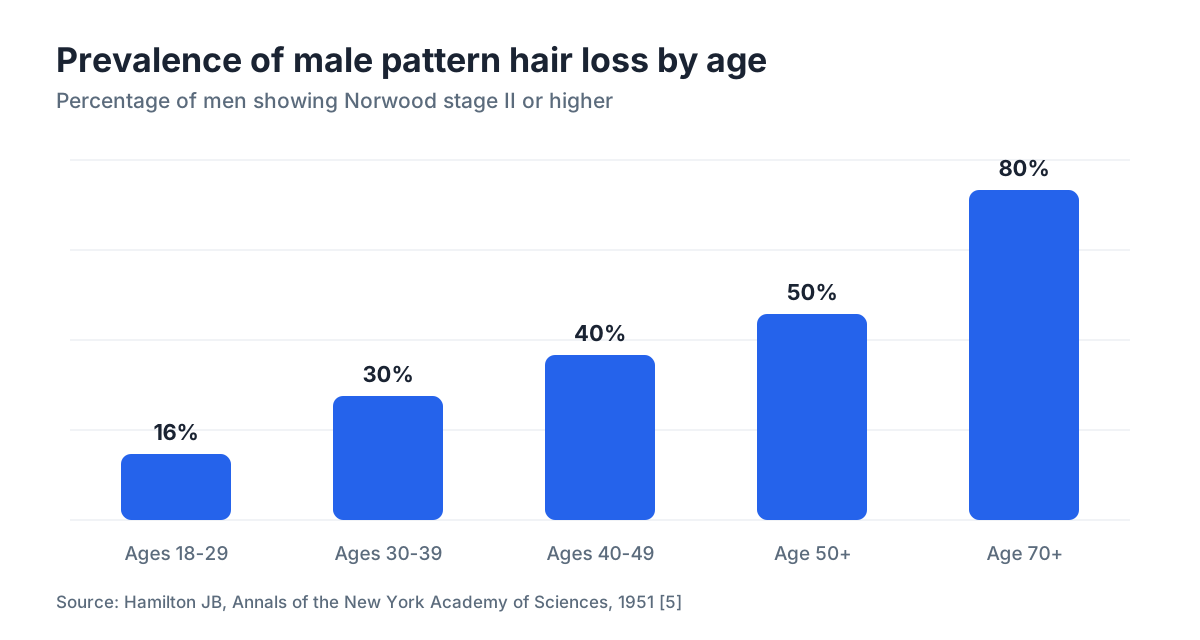
Earlier than most people expect. Studies using the Norwood-Hamilton scale find that about 16 percent of men aged 18 to 29 already show Norwood stage II or higher, meaning visible recession at the temples [5]. By 50, around half of men have visible pattern loss. By 70, it's roughly 80 percent [5].
Women run on a later, slower clock. The Ludwig scale describes their pattern: diffuse crown thinning rather than a receding line. Prevalence climbs sharply after menopause, when estrogen drops and the relative androgenic pull rises.
Here's the practical part. If your temples start pulling back in your early 20s, that is not "too early to worry." Early onset tends to track with more aggressive progression down the road, going back to the longitudinal Hamilton data [5].
Start treatment while follicles are miniaturized but still alive and you keep better odds of holding onto them. Wait until they're gone and there's nothing left to save.
Can stress cause your hairline to recede?
Stress can cause heavy shedding, but the mechanism differs from AGA and the pattern usually looks different from a receding hairline. Stress-driven shedding is diffuse across the whole scalp. A receding hairline concentrates at the temples and front.
The stress condition is called telogen effluvium. Under physical or psychological stress, a big batch of follicles shifts from anagen into telogen all at once. The shed shows up two to three months after the stressor, which is exactly why people can't connect the two.
Chronically high cortisol also disrupts dermal papilla signaling, and some animal work suggests it may speed miniaturization in follicles already primed for DHT. So severe, prolonged stress probably does worsen AGA in predisposed people, even though stress alone in someone without AGA genetics won't carve out a classic receding hairline.
Honest caveat: nobody has clean controlled human data on how much chronic stress accelerates AGA independent of genetics. The closest evidence is correlational, from clinic studies where AGA patients report higher perceived stress. But you can't easily separate that from the stress of watching your own hair fall out.
What role does traction and hairstyling play?
Traction alopecia is real, common, and underdiagnosed, especially in Black women and in men who wear tight buns or braids day after day. Repetitive tension on the follicle, at the infundibulum and bulge region, causes inflammation and eventually fibrosis.
Early on it reverses. Catch it late and the fibrosis is permanent. Recession from traction follows the line of pull, usually the temples and frontal fringe in women wearing tight styles, and it looks different from AGA under dermoscopy.
The American Academy of Dermatology calls traction alopecia one of the most preventable forms of hair loss [6]. The fix is mechanical: drop the tension. Switching hairstyles entirely for a few months can let early-stage follicles recover. No drug reverses fibrotic damage once it sets in.
Relaxers, chemical treatments, and high heat also damage the shaft and follicle, but those usually cause breakage at the shaft rather than true follicular loss. That distinction matters. Broken hair regrows from an intact follicle. A destroyed follicle doesn't come back.
Which medications cause a receding or thinning hairline?
Drug-induced hair loss is more common than most people realize, and the shedding often gets blamed on AGA instead. If your hair started thinning within a few months of a new prescription, that timing is worth flagging to your doctor before you write it off as genetic.
The best-documented offenders:
| Drug category | Hair loss type | Typical onset after starting |
|---|---|---|
| Retinoids (isotretinoin, acitretin) | Diffuse telogen effluvium | 2-4 months |
| Anticoagulants (heparin, warfarin) | Diffuse telogen effluvium | 2-4 months |
| Beta-blockers (propranolol, metoprolol) | Diffuse telogen effluvium | Variable |
| Lithium | Diffuse or patterned | Variable |
| Valproate / other anticonvulsants | Diffuse | 2-4 months |
| Chemotherapy agents | Anagen effluvium (rapid) | Days to weeks |
| Hormonal contraceptives (high-androgen progestins) | Accelerated AGA in susceptible women | Months |
FDA drug labels for many of these list alopecia as an adverse effect [7]. Stopping or switching the drug often brings back partial or full regrowth, so this is worth chasing down.
One thing that trips people up: minoxidil, a hair loss treatment, can trigger a shedding phase in the first 4 to 8 weeks because it resets follicles into a new cycle. That's not the drug failing. It's a temporary effect and it passes. More on that at minoxidil side effects.
Can thyroid problems or nutritional deficiencies cause a receding hairline?
Yes to both, though usually as diffuse thinning rather than a sharp frontal recession. Thyroid hormone sets the length of the growth phase, so hypothyroidism and hyperthyroidism both disrupt the cycle and thin hair across the scalp, front included. Low iron works on a similar diffuse pattern.
With thyroid disease, the outer third of the eyebrows thinning is a classic tell of hypothyroidism. Correct the thyroid with appropriate hormone replacement and this type of loss usually reverses, though full regrowth can take six to twelve months.
Iron deficiency is the most studied nutritional cause. Ferritin below roughly 30 mcg/L (some dermatologists use 70 mcg/L as a stricter cutoff) has been linked to worse shedding in some studies, not all [8]. The signal is stronger for diffuse shedding than for frontal recession, but in someone already set up for AGA, low iron may pull the timeline forward.
Zinc deficiency stalls follicle cell division. Biotin deficiency does cause hair loss, but true deficiency is rare outside people eating raw egg whites long-term, on parenteral nutrition, or with certain metabolic disorders. The biotin supplement industry sells hard, yet the evidence only supports supplementing when deficiency is confirmed. For what actually holds up, hair loss supplements breaks it down.
Vitamin D is still an open question. Low serum vitamin D shows up in several AGA studies, but whether supplementing reverses loss in people who are already replete is unproven.
Does scalp health, sebum, or dandruff make hair recede faster?
Probably not a primary driver, but there may be a secondary role. A greasy or flaky scalp on its own won't cause a receding hairline. Chronic inflammation might nudge things along in follicles that are already vulnerable.
Malassezia yeast, the fungus behind seborrheic dermatitis and dandruff, inflames the scalp. Follicular inflammation from any source could theoretically speed miniaturization in susceptible follicles, and some researchers propose an "inflammation theory" of AGA alongside DHT. Biopsies from balding scalps do show perifollicular lymphocytic infiltrates in a meaningful share of cases [3].
But treating dandruff hard does not reverse AGA. Ketoconazole shampoo has a small evidence base suggesting it may mildly slow loss, possibly through anti-androgenic activity at the follicle more than antifungal effects. One study comparing ketoconazole 2% shampoo to minoxidil found comparable density improvements, though it had methodological limits and the result hasn't been reliably repeated [9].
Keep your scalp reasonably healthy. That's sensible. Just know you can't dandruff-shampoo your way out of AGA.
Does creatine or exercise cause a receding hairline?
No good evidence says creatine causes hair loss, but the concern isn't fully baseless either. The whole panic traces to a single 2009 study in rugby players, where creatine supplementation raised the DHT-to-testosterone ratio, with DHT up about 56 percent from baseline over three weeks [10]. That number went everywhere.
The study is real. Its reach is not. It had 20 subjects, measured DHT at one time point, and never tracked a hair loss endpoint. DHT rising doesn't automatically mean hair falls out, especially if your follicles aren't genetically sensitive to it. No published randomized controlled trial has tested whether creatine causes or accelerates hair loss in humans.
Still, the mechanism is plausible enough that if you're already at high genetic risk for AGA and taking creatine daily, you can reasonably weigh it as a possible accelerant. Does creatine cause hair loss digs into the full picture.
Exercise itself does not cause hair loss. Extreme calorie restriction paired with heavy training can trigger telogen effluvium, which is a separate and usually reversible problem.
Anabolic steroids are another matter entirely. Exogenous androgens can sharply accelerate AGA in susceptible men, and that's well documented in the bodybuilding world.
How do doctors figure out what's causing a receding hairline?
A dermatologist or trichologist usually starts with a visual exam and dermoscopy (trichoscopy), which shows follicle miniaturization, perifollicular signs, and shaft irregularities that separate AGA from traction, seborrheic dermatitis, or scarring alopecias. Blood work comes second, and only when the clinical picture isn't clear.
That blood panel typically covers a full thyroid workup (TSH, free T3, free T4), CBC, serum ferritin, iron and TIBC, zinc, vitamin D, and in women a hormonal set (DHEA-S, free and total testosterone, plus prolactin if there are menstrual irregularities). These tests don't diagnose AGA, which is a clinical call, but they catch the treatable causes that might be driving or worsening the loss.
Scalp biopsy is reserved for the ambiguous cases where traction versus scarring alopecia versus severe AGA is genuinely unclear. It's not routine.
Want a starting point before any appointment? The free AI analysis at MyHairline (myhairline.ai/scan) gives you a Norwood staging estimate from photos, so you walk in with something concrete to discuss. It's a screening tool, not a diagnosis.
Knowing your likely Norwood stage matters because treatment decisions ride on it: whether to run finasteride and minoxidil together, or whether a hair transplant is even worth considering given how far the loss has gone and how much donor hair you have.
What are the proven ways to slow or stop a receding hairline?
Two treatments have the strongest evidence and FDA approval for androgenetic alopecia in men: minoxidil and finasteride. Everything else is either supporting cast or unproven.
Minoxidil, topical or oral, lengthens the growth phase and improves blood supply to the follicle. It does nothing about DHT. The FDA approved topical minoxidil for men in 1988 [7]. Trials show it slows progression and regrows some hair in most users, but it only works while you use it. Stop, and follicles drift back to their pre-treatment path within three to six months. Minoxidil for men covers dosing and daily use.
Finasteride at 1 mg daily cuts scalp DHT by roughly 60 percent. In a two-year randomized controlled trial, 83 percent of men on finasteride had no further loss versus 28 percent on placebo [1]. It shines at preserving and slightly thickening miniaturized follicles, not at regrowing follicles that are already gone.
For women, minoxidil 2% topical is FDA-approved. Finasteride is not approved for premenopausal women because of teratogenicity risk. Anti-androgens like spironolactone and DHT blockers like saw palmetto carry some evidence but no FDA approval for AGA.
Hair transplantation moves DHT-resistant follicles from the back of the scalp to the recession zones. It does not stop ongoing AGA, which is why surgeons pair it with continued medical treatment. Hair transplant covers what's realistic to expect.
The American Academy of Dermatology's 2022 guidelines state that combination therapy with minoxidil and finasteride produces better outcomes than either agent alone in men with AGA [6].
MyHairline's free scan at myhairline.ai/scan maps your current Norwood stage, a useful anchor before any of these conversations.
Sources
- Merck & Co. / FDA drug label for Propecia (finasteride 1mg), NDA 020788
- Sinclair R. 'Male pattern androgenetic alopecia.' BMJ 1998;317:865
- Whiting DA. 'Possible mechanisms of miniaturization during androgenetic alopecia or pattern hair loss.' Journal of the American Academy of Dermatology 2001;45(3):S81-86
- Heilmann-Heimbach S et al. 'Meta-analysis identifies novel risk loci and yields systematic insights into the biology of male-pattern baldness.' Nature Communications 2017;8:14694
- Hamilton JB. 'Patterned loss of hair in man: types and incidence.' Annals of the New York Academy of Sciences 1951;53(3):708-728
- American Academy of Dermatology, Hair Loss Guidelines 2022
- FDA Drug Approvals Database, Rogaine/minoxidil topical
- Rushton DH. 'Nutritional factors and hair loss.' Clinical and Experimental Dermatology 2002;27(5):396-404
- Piérard-Franchimont C et al. 'Ketoconazole shampoo: effect of long-term use in androgenic alopecia.' Dermatology 1998;196(4):474-477
- van der Merwe J et al. 'Three weeks of creatine monohydrate supplementation affects dihydrotestosterone to testosterone ratio in college-aged rugby players.' Clinical Journal of Sport Medicine 2009;19(5):399-404
- Koyama T et al. 'Standardized Scalp Massage Results in Increased Hair Thickness by Inducing Stretching Forces to Dermal Papilla Cells in the Subcutaneous Tissue.' ePlasty 2016;16:e8