

TL;DR: Hair grows in three phases: anagen (active growth, 2-7 years), catagen (brief transition, ~2-3 weeks), and telogen (resting/shedding, ~3 months). At any moment, about 85-90% of your scalp hairs are in anagen and 10-15% are in telogen. Disrupting this cycle is how most hair loss happens, and targeting specific phases is how most treatments work.
What are the anagen, catagen, and telogen phases?
Every hair on your head runs its own private schedule. It grows, rests, falls out, and regrows, cycling over and over for your entire life. That cycle has three named phases: anagen, catagen, and telogen. A fourth phase, exogen (the actual shedding of the old shaft), gets listed separately in some texts, but most clinical literature folds it into telogen.
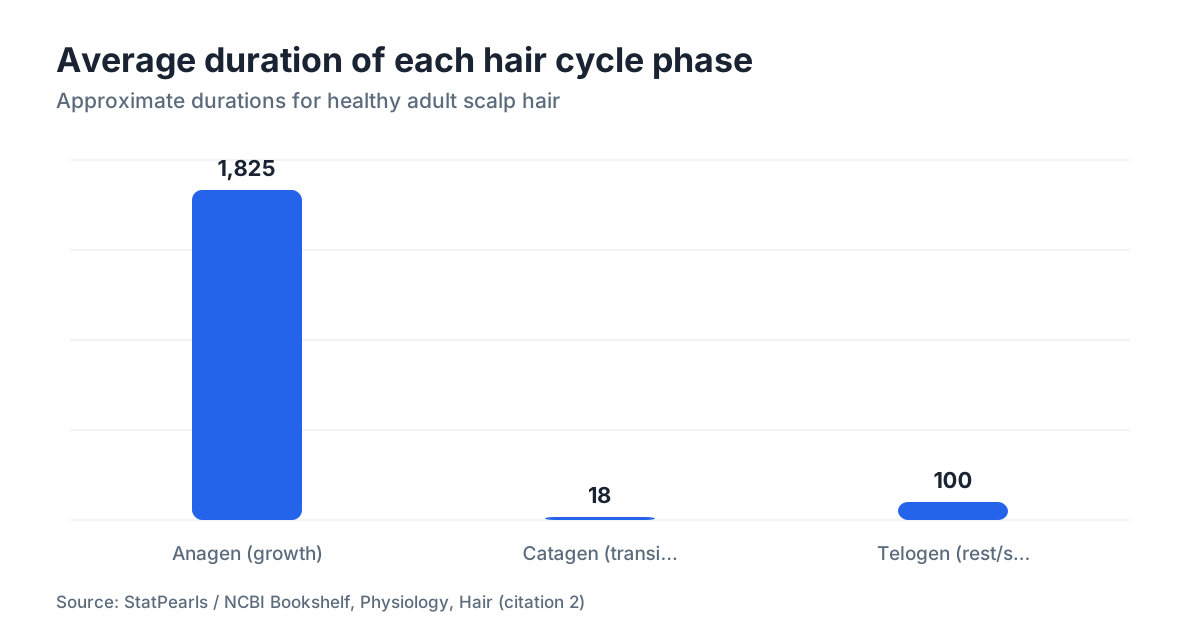
Anagen is the growth phase. The follicle is fully active, producing a new hair shaft at roughly 1 centimeter per month [1]. This phase lasts anywhere from 2 to 7 years depending on your genetics, the region of your scalp, your age, and your hormonal environment. The longer your anagen runs, the longer your hair can grow. People with ankle-length hair simply have a very long anagen.
Catagen is the transition phase. The follicle shrinks and detaches from its blood supply. It lasts only 2 to 3 weeks. The lower portion of the follicle essentially self-destructs in a controlled way, and the hair stops receiving nutrients. No new hair is made during catagen, but the shaft is still physically attached.
Telogen is the resting and shedding phase, lasting roughly 3 months (around 100 days) on average [2]. The old hair sits in place, anchored by what's called a club hair, while the follicle quietly builds the next anagen cycle below it. At some point the old shaft releases and drops, often pushed out by the new hair growing underneath. Losing 50 to 100 hairs a day is normal, because that many follicles are in telogen at any given time.
What percentage of hairs are in each phase at any moment?
On a healthy adult scalp, roughly 85 to 90 percent of follicles are in anagen at any given moment, about 1 to 3 percent are in catagen, and the remaining 10 to 15 percent are in telogen [2]. The phases aren't synchronized, so you shed continuously instead of all at once. That's a design feature. Rabbits and some other mammals molt in synchronized waves; humans largely don't.
These numbers shift with age, health, and hormones. In people with androgenetic alopecia (male or female pattern hair loss), the anagen phase gets shorter over years of DHT exposure, so a higher fraction of follicles sit in telogen at any moment, and the follicles that do enter anagen produce finer, shorter hairs. That's miniaturization. It creeps up slowly enough that most people don't notice until they've lost 50 percent or more of follicle density in an area [3].
How does hair loss actually happen within the cycle?
Most hair loss is a disorder of the cycle, not sudden follicle death. Once you understand the mechanism behind each type, the treatment logic falls into place.
In androgenetic alopecia, DHT (dihydrotestosterone) binds to androgen receptors in genetically susceptible follicles and shortens the anagen phase with each cycle. What was once a 5-year anagen becomes 3 years, then 1 year, then 3 months. The telogen phase stays roughly the same length, so the anagen-to-telogen ratio inverts, and the hairs come in shorter and thinner every round. Eventually anagen is so short the hair barely clears the scalp. The follicle is still alive at that point, which is why early treatment works. Learn how DHT drives this process.
In telogen effluvium, a shock to the system (surgery, childbirth, a crash diet, severe illness, extreme stress) throws a large share of anagen follicles into telogen at once. Two to four months later, when those follicles shed, you get diffuse heavy shedding across the whole scalp. The follicles aren't damaged. They're just running a compressed cycle. Most cases clear on their own in 6 to 9 months once the trigger is gone.
Alopecia areata is an autoimmune attack aimed at anagen follicles specifically. T-cells target the follicle and shorten or abort the anagen phase. Chemotherapy-induced alopecia hits the same target a different way: cytotoxic drugs kill rapidly dividing cells, and the hair matrix cells at the base of an anagen follicle are among the fastest-dividing cells in the body, so chemo often arrests anagen mid-cycle and causes hair to shed within weeks.
Why does minoxidil cause shedding at first?
This one trips people up constantly. You start minoxidil, and somewhere between week 2 and week 8 you shed more hair than usual. Plenty of people quit right there, sure the drug is making things worse. It isn't.
Minoxidil is thought to work partly by shortening the telogen phase and pushing follicles into anagen earlier than they'd otherwise go [4]. When a follicle moves from telogen into a fresh anagen cycle, the incoming new hair physically shoves out the old club hair sitting above it. So you lose the old hair sooner than you would have without the drug. The shed hair was already dead. The new hair is growing underneath.
That early shedding is a sign something's happening. It usually peaks around 6 to 8 weeks and then fades. Quit during this window because you're spooked, and you skip the regrowth that would have followed. The standard advice is to give it at least 4 to 6 months before you judge results, and clinical trials for topical minoxidil typically run 16 to 48 weeks [4]. Read more about minoxidil for men including how to use it, or check minoxidil side effects for what else to expect.
How does finasteride target the hair cycle?
Finasteride never touches the follicle directly. It blocks the type II 5-alpha reductase enzyme, which converts testosterone into DHT. By cutting scalp DHT by roughly 60 to 70 percent [5], finasteride removes the signal that was shortening anagen. Follicles that had been pumping out thin, short hairs slowly recover longer anagen cycles and produce thicker, longer hairs.
Recovery is slow because hair grows about 1 centimeter per month and full follicle recovery takes several complete cycles. That's why the FDA-approved studies for finasteride ran 2 years for vertex results, and the most meaningful visual outcomes landed at 12 to 24 months [5]. Stop finasteride and the DHT reduction reverses, the shortened anagen cycles come back, and noticeable loss usually returns within 6 to 12 months.
For the full picture of how finasteride works and what the evidence says, see our finasteride guide.
What does the hair cycle mean for hair transplant results?
A hair transplant moves follicular units from a DHT-resistant donor area (usually the back and sides of the scalp) to a thinning recipient area. The follicles keep their original genetic programming, so they hold onto longer anagen phases and resist miniaturization at the new site.
Here's the part most people don't expect: transplanted hairs almost always shed within 2 to 6 weeks of the procedure [6]. This is called transplant shock loss or effluvium, and it happens because the trauma of harvesting and grafting throws the follicles into telogen. The follicles survive. They just cycle through a rest before starting a new anagen. New hairs usually begin showing at 3 to 4 months post-surgery, with most of the final result visible at 9 to 12 months and some continued thickening through 18 months.
Patients who know this expect the wait and don't panic at the early shed. Those who don't often think the transplant failed. It almost certainly hasn't. The follicle is resting, not dead. Read more about the hair transplant timeline and what to expect.
Can the anagen phase length be measured or tested?
Yes, though the tests rarely leave research settings. A trichogram (or trichogram pull test) samples 50 to 100 hairs by pulling them from the scalp and examining the root bulbs under a microscope. Anagen hairs have a moist, pigmented root sheath; telogen hairs have a dry, club-shaped root. The ratio gives you an anagen-to-telogen count, called the anagen/telogen ratio [2].
A sharper version is the phototrichogram or digital trichoscopy, which photographs the same marked patch of scalp at two time points a few days apart. Hairs that grew during that window were in anagen; hairs that stayed the same length were in telogen. This method also measures hair shaft diameter, which tracks miniaturization directly.
At-home tools can't match this. Apps and consumer scalp cameras give you rough density and shaft thickness estimates at best. If you want to know whether a treatment is working at the cycle level, a baseline and follow-up trichoscopy with a dermatologist, spaced 6 to 12 months apart, is the most reliable way.
Why does hair loss treatment take so long to show results?
The cycle explains everything about timing. Anagen lasts years. Catagen lasts weeks. Telogen lasts roughly 3 months. When you start a treatment, follicles that are mid-anagen won't show any visible change until they finish that anagen and start a new one. Follicles in telogen have to finish resting, shed, then run a full new anagen before the hair they make is long enough to see. It all stacks up.
For minoxidil, most clinical guidelines and the product's own FDA label put 4 months as the minimum before you assess, with meaningful density changes usually visible at 6 to 12 months [4]. For finasteride, the registration trials showed continued improvement through 24 months, with vertex gains detected at 12 months and frontal gains lagging slightly behind [5]. For hair transplants, the full result takes 12 to 18 months.
Anyone promising a meaningful result in 30 days is leaving out the biology. Regrowth requires completed anagen cycles. Completed anagen cycles take months.
This is also why tracking matters. To decide whether a treatment is working, you need photos taken in the same lighting at the same angle at 0, 6, and 12 months. Before-and-after shots in different lighting are close to useless.
Does nutrition or stress actually change the cycle?
It does, and there's real data on both. Severe iron deficiency has been tied to telogen effluvium and reduced anagen duration in multiple observational studies, though the causality question isn't fully settled [7]. Serum ferritin below 30 mcg/L is the threshold where many dermatologists start investigating iron as a contributor. The ideal ferritin level for hair is unclear, and some researchers argue it should be higher, around 70 mcg/L, though the evidence gets weaker up there.
Zinc deficiency also disrupts follicle cycling. The hair matrix cells that drive anagen growth are among the most metabolically active in the body; they need enough micronutrients to divide fast [7]. A crash diet that drops calories below roughly 1,200 a day can trigger telogen effluvium within 2 to 4 months, which is why post-bariatric surgery patients see significant hair loss and why appetite-suppressing weight loss drugs carry similar risk.
Acute psychological stress seems to have a real but more modest direct effect on cycling, though it's hard to pull apart from the physiological stress responses (cortisol elevation, disrupted sleep, dietary changes) that ride along with it. Chronic stress is more convincingly linked to follicle cycling disruption in animal models [8]; the human data is messier. Hair loss supplements marketed for cycle support are covered separately here.
Do different parts of the scalp have different cycle lengths?
Yes. Anagen duration varies by body site, which is why your eyebrows grow to a fixed short length and your scalp hair can grow indefinitely. Eyebrow anagen lasts roughly 4 to 6 months [2]; eyelash anagen is similarly short. Scalp hair anagen is the longest anagen anywhere on the body, averaging 2 to 7 years.
Even across the scalp there are regional differences. The occipital and parietal areas (back and sides) tend to hold more consistent, longer anagen phases, which is exactly why they get used as donor sites in transplants. These follicles are genetically wired to resist DHT-driven anagen shortening. The frontal scalp, vertex, and hairline carry follicles with greater androgen sensitivity, which is why those zones recede and thin first in androgenetic alopecia. A receding hairline is the visible result of differential anagen shortening across scalp regions.
This geography isn't random. It's the basis of the Norwood scale for men and the Ludwig scale for women, both of which map loss by region because the cycle fails in different zones at predictable rates.
How do I know if my shedding is normal or a sign of something wrong?
Normal daily shedding is 50 to 100 hairs. That figure comes from simple math: roughly 10 to 15 percent of follicles are in telogen at any moment on a scalp with about 100,000 total hairs, and telogen lasts around 100 days, so division gives you that daily shed rate [2]. On wash days you might collect more, because washing frees hairs that were already loose.
Shedding that stays consistently above 150 to 200 hairs a day for more than a month is worth investigating. Sudden diffuse shedding after a stressful event (illness, surgery, childbirth, dramatic weight loss) is almost always telogen effluvium and usually clears on its own. Gradual, progressive thinning at the temples and crown over years points more to androgenetic alopecia.
A few things genuinely warrant a doctor's visit: shedding with scalp inflammation, itching, or scaling; patches of complete loss rather than diffuse thinning; shedding that speeds up instead of leveling off after 6 months; and shedding in women of childbearing age, which calls for thyroid and ferritin testing at minimum.
For a faster first look, MyHairline's free AI scan at myhairline.ai/scan analyzes your scalp and hairline from photos and can flag patterns worth raising with a dermatologist. It's a starting point, not a diagnosis.
Does combining treatments work better because they target different phases?
This is the real rationale behind combination therapy, and the evidence backs it. Finasteride addresses the cause of shortened anagen in androgenetic alopecia by lowering DHT. Minoxidil addresses the cycle mechanics by pushing follicles from telogen into anagen and possibly stretching anagen out. Two different mechanisms on the same problem, which is why the combination consistently beats either drug alone in head-to-head trials [9].
A 2021 randomized controlled trial published in the Journal of the American Academy of Dermatology found that oral minoxidil 5 mg plus finasteride 1 mg produced greater hair count improvements than either drug alone after 24 weeks [9]. The combination group saw a mean increase of around 12 hairs per cm2 versus roughly 7 for minoxidil alone and 6 for finasteride alone, though the specific numbers varied across subgroups. The finasteride and minoxidil combination article walks through the full protocol and evidence.
Adding a DHT blocker like finasteride also hits the root cause of the cycle disruption. Minoxidil alone, without removing the DHT signal, will carry hair through the cycle mechanics, but the anagen shortening keeps grinding away in the background. That's why some people plateau on minoxidil alone after 2 to 3 years.
Oral minoxidil at lower doses (0.625 mg to 2.5 mg for women, 2.5 mg to 5 mg for men) has gained clinical favor because it delivers systemic exposure without the scalp application step and may have a steadier effect on cycling. The oral minoxidil overview covers the evidence and trade-offs.
If you want to know where your own hairline sits before starting anything, MyHairline's free AI hair scan gives you a baseline you can compare against in 6 or 12 months.
Sources
- American Academy of Dermatology, Hair Loss Overview
- StatPearls (NCBI Bookshelf), Physiology, Hair
- Journal of Investigative Dermatology, Androgenetic Alopecia and Follicle Miniaturization
- FDA Drug Label, Rogaine (minoxidil) topical solution
- FDA Drug Label, Propecia (finasteride) 1 mg
- International Society of Hair Restoration Surgery (ISHRS), Patient Education
- Journal of the American Academy of Dermatology, The Role of Vitamins and Minerals in Hair Loss
- Nature, Stress and hair follicle stem cell arrest (mouse model study)
- Journal of the American Academy of Dermatology, Oral minoxidil and finasteride combination RCT, 2021