
TL;DR: Scalp psoriasis causes temporary hair loss through inflammation, scratching, and rough scale removal, not by killing follicles. Treat the psoriasis with topical corticosteroids, coal tar, or biologics for severe cases, and hair usually regrows once the scalp heals. Most people see early fuzz in 6 to 12 weeks. Permanent loss is rare and happens only when prolonged, untreated disease scars the follicle.
What does scalp psoriasis actually do to your hair?
Scalp psoriasis is an autoimmune condition where the immune system drives skin cells to turn over far too fast, producing thick, silvery-white plaques on the scalp. Those plaques, and the inflammation behind them, are what put your hair at risk. The follicle itself is usually fine.
Here's the mechanism. Psoriasis inflames the skin around the follicle opening, and that perifollicular inflammation throws off the normal hair growth cycle. It pushes hairs early into the telogen (shedding) phase, a process sometimes called telogen effluvium. You shed more than you grow for a stretch, and the hairline or part looks thinner [1].
Two mechanical culprits make it worse. The intense itch leads to scratching, which snaps hair shafts and traumatizes follicles. And many people scrub or pick at the thick scale, yanking out hairs that are already loosely anchored in the shedding phase. The American Academy of Dermatology names rough scale removal as a common cause of psoriasis-related hair loss [2].
The reassuring part: as long as the follicle isn't scarred, the hair grows back. Most dermatologists treat psoriasis-related hair loss as reversible.
Is the hair loss from scalp psoriasis permanent?
For most people, no. The loss is temporary. Follicles stay alive and keep making hair once the inflammation is under control, and studies and clinical experience show regrowth within weeks to several months after effective treatment [3].
Permanent loss is uncommon but real. It happens when chronic, severe, untreated psoriasis produces enough sustained inflammation or repeated physical trauma that follicles get replaced by scar tissue. That's scarring (cicatricial) alopecia, a separate diagnosis. If you've had thick, untreated plaques for years and the affected skin now looks smooth and shiny with no visible follicle openings, see a dermatologist fast. A scalp biopsy can tell whether the follicles are still there.
The practical takeaway is simple. Treat active psoriasis early and your risk of crossing from reversible loss into permanent loss stays low.
Does treating scalp psoriasis actually help hair regrow?
Yes, and it's well-documented. Controlling the inflammation removes the main driver of the disrupted hair cycle, so follicles go back to normal growth. Regrowth isn't a lucky side effect of treatment. It's the predictable result of a scalp returning to health [3].
A 2021 review in the Journal of the American Academy of Dermatology on biologic therapies for psoriasis reported that scalp clearance in trials tracked consistently with patient-reported improvement in hair appearance, though direct hair-count data varied study to study [4]. The stronger the effect on the plaques, the more complete the scalp recovery tended to be.
Timing matters. Hair doesn't reappear the moment your plaques clear. Follicles need time to re-enter anagen (the growth phase), and then new growth needs months to show. Most people see early regrowth fuzz within 6 to 12 weeks of scalp clearance, with fuller density over 3 to 6 months. If the psoriasis was severe, plan on being patient.
One thing treatment won't do: regrow hair you lost for other reasons. If you also have androgenetic alopecia (male or female pattern loss), clearing psoriasis won't touch it. Those are separate conditions with separate mechanisms, so it helps to understand what causes hair loss in your specific case before you expect one treatment to fix everything.
Which scalp psoriasis treatments work best for hair regrowth?
It depends on how severe your psoriasis is. There's no single ladder that fits everyone, but the evidence sorts cleanly by disease severity.
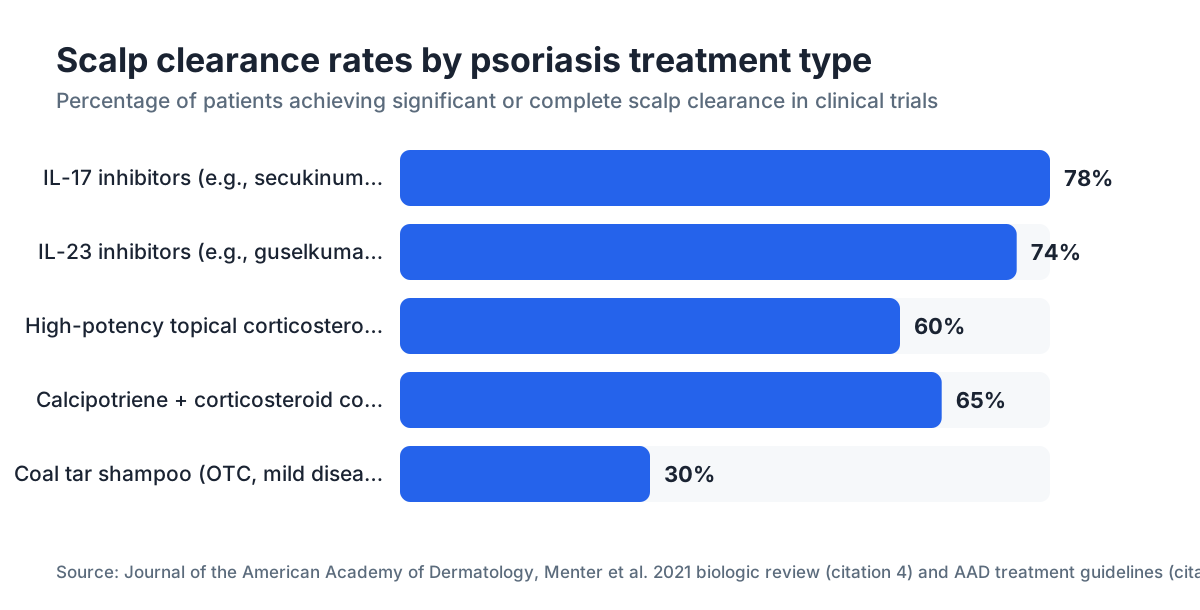
Topical corticosteroids (mild to moderate disease) High-potency topical steroids, like clobetasol propionate 0.05% shampoo or solution, are first-line for scalp psoriasis in the AAD's guidelines [2]. They cut inflammation fast, and most patients see plaque reduction within 2 to 4 weeks. Faster clearance means follicles return to normal growth sooner. The catch: long-term use can thin the skin, so dermatologists cycle them on and off.
Topical vitamin D analogs (calcipotriene) Calcipotriene (brand name Dovonex) slows the abnormal skin-cell turnover that builds plaques. It's often paired with a corticosteroid, and that fixed combination (sold as Taclonex) clears plaques faster and more completely than either ingredient alone [5]. The FDA also approved a foam version (Enstilar), whose label notes improvement as early as 2 weeks in trials [6].
Coal tar shampoos and salicylic acid Coal tar has been in use for over a century, and the AAD still lists it as effective for mild scalp psoriasis [2]. It reduces scaling and itch, which means less scratching and less mechanical damage. Salicylic acid softens and lifts scale. Neither has strong standalone hair-regrowth data, but cutting scale-picking trauma matters more than people think.
Intralesional corticosteroid injections For stubborn, localized plaques, dermatologists sometimes inject triamcinolone acetonide straight into the plaque. That delivers a high local anti-inflammatory dose and often clears a patch more completely than topicals can.
Biologics and systemic treatments (moderate to severe) When psoriasis covers a large part of the scalp, or topicals have failed, systemic options come in. IL-17 inhibitors like secukinumab (Cosentyx) and ixekizumab (Taltz), and IL-23 inhibitors like guselkumab (Tremfya) and risankizumab (Skyrizi), show high scalp clearance in trials, some over 70 to 80% complete response at 16 weeks [4]. When the whole scalp clears, regrowth can be dramatic. These are prescription drugs with their own risk profiles, sorted out with a dermatologist or rheumatologist.
None of this is a hair loss drug. The logic is the same throughout: clear the disease, restore the scalp, and follicles handle the rest.
How long does it take for hair to grow back after treating scalp psoriasis?
Timelines vary, but the biology gives a reliable framework. Once inflammation is controlled and plaques are clearing, follicles in telogen need to re-enter anagen. That transition runs roughly 3 to 6 weeks after the active inflammation is gone. Once a follicle is in anagen, hair grows about half an inch per month. So visible coverage lags well behind the moment the follicle wakes up.
Most dermatologists describe a timeline like this:
| Milestone | Approximate timeframe from scalp clearance |
|---|---|
| Inflammation visibly reduced | 2 to 4 weeks (topical steroids) |
| Follicles re-enter anagen | 3 to 6 weeks |
| Early fuzz visible | 6 to 12 weeks |
| Noticeable density improvement | 3 to 6 months |
| Maximum regrowth (if follicles intact) | 6 to 12 months |
If you've held sustained scalp clearance for 6 months and still see no regrowth, flag it to a dermatologist. That's the point to biopsy for scarring or check for a concurrent diagnosis like androgenetic alopecia.
Should you add minoxidil if you have scalp psoriasis?
Get the psoriasis reasonably controlled first, then decide on minoxidil. Minoxidil is the only topical drug FDA-approved to treat hair loss directly [7]. It extends the anagen phase and thickens miniaturized hairs. The real question for psoriasis patients is whether it helps, hurts, or just doesn't matter yet.
Applying minoxidil solution or foam to an actively inflamed, scaling scalp can irritate it and worsen itch or redness. The propylene glycol in some liquid formulations is a known irritant on damaged skin. Minoxidil foam usually contains less propylene glycol and is better tolerated [8].
The smarter sequence is to calm the psoriasis, then see how much loss actually remains. Much of what looks like psoriasis-related shedding grows back with no minoxidil at all. Once the scalp is quiet, if you're still losing hair in a way that seems separate from the psoriasis, minoxidil becomes a reasonable add-on. Men with concurrent pattern loss should read up on minoxidil for men and the common minoxidil side effects before starting.
Nobody has a clean randomized trial of minoxidil in people with active scalp psoriasis. The closest evidence is on tolerability of foam versus solution. This is a spot where dermatologists use judgment rather than a protocol.
Can scalp psoriasis be confused with other conditions that cause hair loss?
Yes, and the confusion costs people time and money. Several scalp conditions produce inflammation, scaling, and hair loss, and to an untrained eye they look alike.
Seborrheic dermatitis (dandruff) makes greasy yellow-white flakes and itch, but its plaques are thinner and less defined than psoriasis. Tinea capitis (scalp ringworm) is a fungal infection common in children that causes patchy loss with scaling, and it needs antifungals, which is a completely different treatment from psoriasis care. Discoid lupus and lichen planopilaris are scarring conditions that can mimic psoriasis early but are far more dangerous to follicles.
Alopecia areata, the autoimmune condition that causes smooth, round bald patches, can coexist with psoriasis since both involve immune dysregulation. That matters because alopecia areata needs its own treatment (corticosteroid injections, topical immunotherapy, or newer JAK inhibitors) separate from psoriasis management.
Don't self-treat without a formal diagnosis. A biopsy or potassium hydroxide (KOH) prep can separate psoriasis from a fungal infection or scarring alopecia in minutes. Getting the diagnosis right is the single biggest factor in getting the treatment right.
For the wider picture on why hair falls out, what causes hair loss covers the full landscape, including the stress-related shedding that often rides along with a chronic skin condition.
What lifestyle and care habits help protect hair during a psoriasis flare?
Treatment does the heavy lifting, but how you handle your scalp day to day during a flare changes how much hair you lose.
Don't pick or scrub plaques. Dermatologists repeat this for a reason: mechanical trauma during a flare drives a large share of psoriasis-related hair loss. Soften scale with a salicylic acid or coal tar shampoo, let it sit, and rinse gently.
Use lukewarm water. Hot water inflames already sensitive skin, so keep showers short and cool.
Skip tight hairstyles. Ponytails, braids, and tight buns pull on hair that's already loosely anchored in telogen. That's the same mechanism behind traction alopecia.
Go easy on heat styling and chemicals. Bleach and relaxers on an inflamed, scaling scalp deepen the damage. Most dermatologists say hold off on chemical processing until a flare settles.
Take stress seriously. Psoriasis has a well-documented link to psychological stress: stress triggers flares, and flares create stress. That loop has a direct hair component, because the same cortisol spike that worsens psoriasis can independently push hairs into telogen. It's the same mechanism behind classic telogen effluvium.
Sleep and diet won't cure psoriasis. But sleep deprivation and nutrient shortfalls (particularly vitamin D and zinc) can worsen immune dysregulation, so they're worth attention as supportive measures even though they aren't treatments.
When should you see a dermatologist instead of trying over-the-counter treatments?
OTC coal tar shampoos and salicylic acid products are a fine starting point for mild scalp psoriasis. But some signals mean you need a prescription and a dermatologist's eyes on it.
See a dermatologist if your plaques cover more than a small area, the itch is wrecking your sleep, OTC products haven't helped after 4 to 6 weeks, you're losing hair in visible patches, the skin looks raw or cracked or infected, or you're shedding in areas beyond the plaque edges.
Scalp psoriasis can be part of a bigger pattern. About 30% of people with psoriasis develop psoriatic arthritis [9], and some systemic treatments that quiet joint inflammation also clear the scalp. A dermatologist can coordinate those calls.
Want an early read before your appointment? The free AI hair analysis at MyHairline can help you map where thinning concentrates and whether it looks more like a scalp-condition pattern or androgenetic loss. It's not a diagnosis, but it structures the conversation with your doctor.
Cost shouldn't stop you. Many teledermatology visits run $50 to $100, and generic prescription topicals like clobetasol can cost under $20 at major pharmacy chains.
What if you have both scalp psoriasis and pattern hair loss?
This combination is more common than people expect. Androgenetic alopecia (the genetic, DHT-driven pattern loss) affects roughly 50% of men by age 50 [10] and many women too, so the odds of it sitting alongside psoriasis are real.
The hard part is attribution. When your hair thins and your scalp has psoriasis, it's tempting to blame the psoriasis for everything. But if there's a family history of thinning, if the loss follows a pattern (temple recession, crown thinning) rather than tracking the plaques, or if regrowth stalls even after the scalp clears, androgenetic alopecia is probably a second factor.
Treat the psoriasis first, because active inflammation makes any hair loss worse. Once the scalp is stable, pattern loss needs its own plan: finasteride or another DHT blocker for men to address the hormonal driver, minoxidil to extend the growth phase, or both. The finasteride and minoxidil pairing is the most evidence-backed combination for pattern loss.
If you're at an earlier stage and trying to place yourself, the receding hairline guide covers how to read the signs and what to do next.
If loss has progressed a lot despite treating both conditions, a hair transplant consultation is worth having, though surgeons will want your psoriasis stable before they operate on the scalp.
Are there any treatments for scalp psoriasis that might make hair loss worse?
A few, and they're worth knowing.
Long-term high-potency topical corticosteroids can thin the skin and, with very prolonged scalp use, may in theory affect follicle health. In practice this rarely causes a clinical problem when the steroid is cycled properly, but unsupervised overuse is a genuine risk. Follow the prescription label or AAD guidance, not an internet forum.
Some systemic treatments carry hair-related side effects. Methotrexate, an older systemic option, can cause diffuse shedding, especially at higher doses [11]. That's drug-induced telogen effluvium, not the psoriasis itself, and it usually reverses when the dose is adjusted. If you start methotrexate and notice more shedding within 6 to 12 weeks, tell your prescriber.
Acitretin (a retinoid for severe psoriasis) is also linked to dose-dependent shedding [11], documented right in the prescribing information. Again, usually reversible.
Biologics have a much cleaner hair profile than the older systemics. Some patients on biologics report better density as the scalp clears, with no meaningful drug-induced shedding signal in trials [4].
Here's the point worth remembering. If you start a new psoriasis treatment and your shedding speeds up, the drug may be the cause. Don't quit it on your own, but bring it up with your doctor promptly.
Sources
- National Psoriasis Foundation, Hair Loss and Psoriasis
- American Academy of Dermatology, Scalp Psoriasis: Diagnosis and Treatment
- National Psoriasis Foundation, Hair Loss and Psoriasis
- Menter A, et al., Journal of the American Academy of Dermatology 2021, Biologic therapies for scalp psoriasis review
- Lebwohl M, et al., New England Journal of Medicine 2003, Calcipotriene and betamethasone dipropionate for psoriasis
- U.S. FDA, Enstilar (calcipotriene and betamethasone dipropionate) Prescribing Information
- U.S. FDA, Minoxidil Topical Solution Drug Approval Information
- Blume-Peytavi U, et al., Journal of the American Academy of Dermatology 2011, Hair growth and disorders
- National Psoriasis Foundation, Psoriatic Arthritis
- Vary JC, Primary Care: Clinics in Office Practice 2015, Selected disorders of skin appendages
- Menter A, et al., Journal of the American Academy of Dermatology 2009, Guidelines of care for the management of psoriasis: systemic nonbiologic therapies