
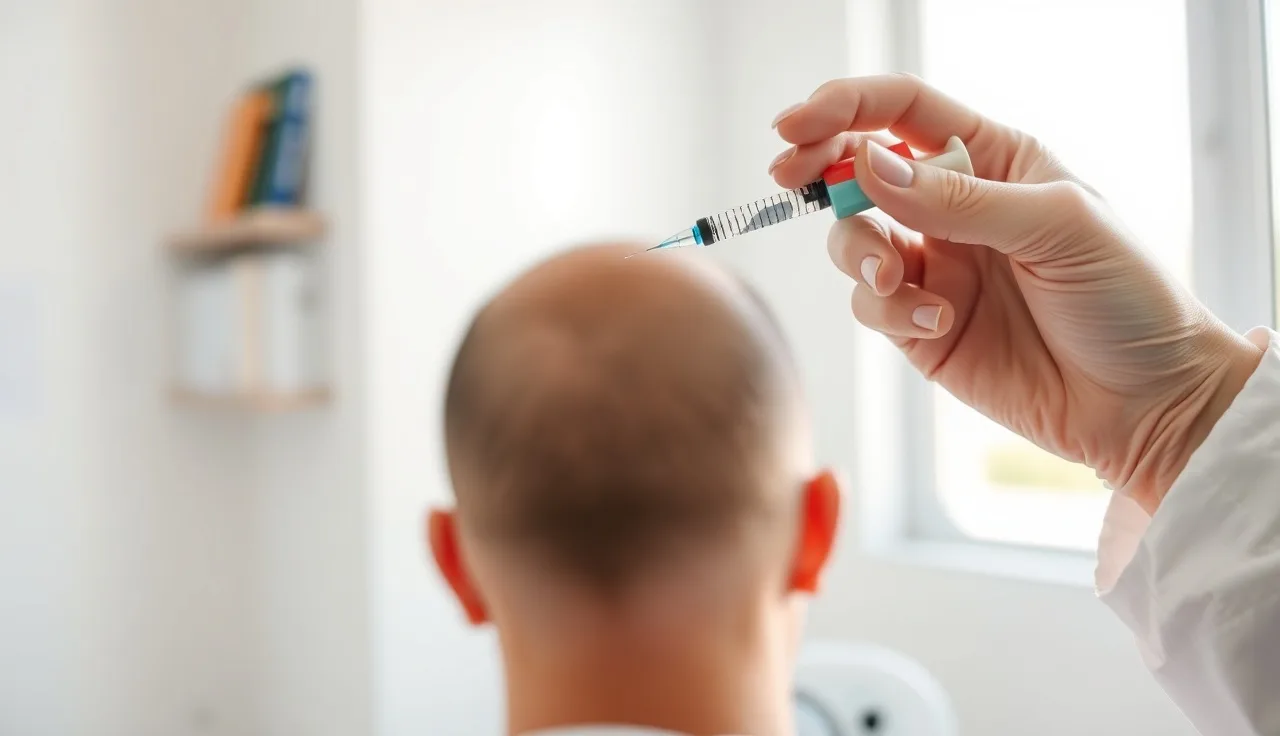
TL;DR: PRP (platelet-rich plasma) therapy injects growth factors from your own blood into the scalp to wake up dormant follicles. Multiple randomized controlled trials show statistically significant gains in hair density and thickness for androgenetic alopecia. The results are real but modest, variable, and not permanent without maintenance. PRP is not FDA-approved for hair loss, and it works best paired with proven treatments like minoxidil or finasteride.
What is PRP therapy for hair loss, exactly?
PRP stands for platelet-rich plasma. A clinician draws a small amount of your blood, spins it in a centrifuge to concentrate the platelets, and injects that concentrated plasma into your scalp. The in-office visit usually takes 60 to 90 minutes.
The logic is straightforward. Platelets carry growth factors, including platelet-derived growth factor (PDGF), vascular endothelial growth factor (VEGF), insulin-like growth factor-1 (IGF-1), and transforming growth factor-beta (TGF-b). These proteins signal cells to proliferate and repair tissue. In hair follicles, the theory is that flooding the scalp with them wakes up follicles that have shifted into a prolonged resting phase or shrunk under hormonal stress [1].
The procedure is "autologous," meaning the material comes from your own body, which is why it sidesteps most allergy concerns. That also makes it tricky to regulate. The FDA oversees devices (the centrifuge kits used to prepare PRP are regulated as medical devices), but PRP itself, when prepared and used on the same patient in one clinical visit, generally falls outside the agency's biologics licensing framework [2]. Clinics can offer it without the approval burden a drug requires, and quality control varies enormously from one clinic to the next.
Here's the context that matters if you're weighing this against minoxidil or finasteride. Those two drugs have large, decades-long datasets behind them. PRP's evidence base is much smaller, though it's grown a lot since about 2014.
Does PRP actually regrow hair? What do clinical trials show?
Yes, in many patients. But the size of the effect swings widely depending on the trial design, the patient population, and the PRP preparation protocol.
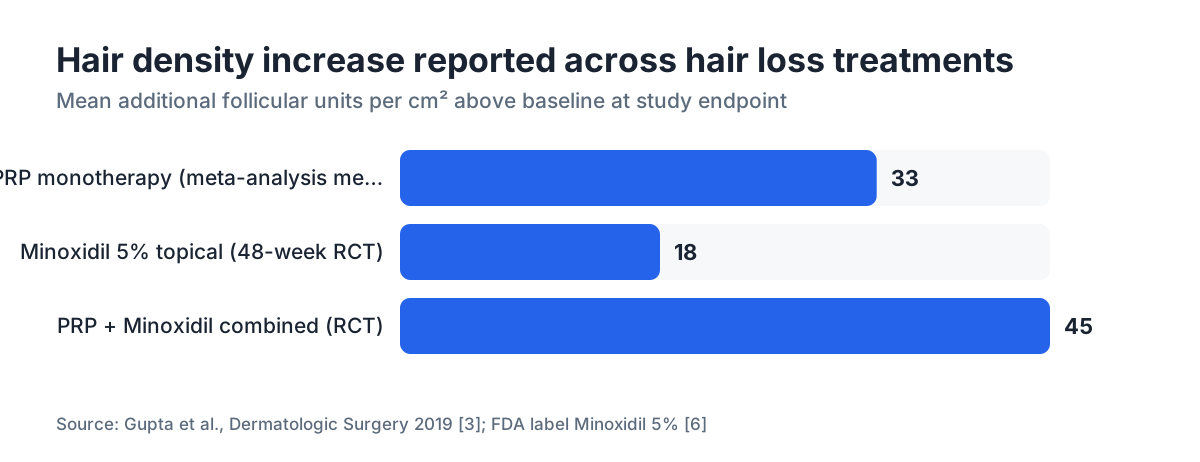
A 2019 systematic review and meta-analysis in Dermatologic Surgery pooled data from 19 studies (around 460 patients total) and found that PRP produced a statistically significant increase in hair density, hair thickness, and the ratio of hairs in the anagen (growth) phase compared to control groups [3]. The pooled increase in hair density was roughly 33 hair follicles per square centimeter over baseline, though the confidence intervals were wide.
A double-blind randomized controlled trial in the Journal of the American Academy of Dermatology compared PRP injections against placebo in patients with androgenetic alopecia. At the end of the treatment period, the PRP group showed significantly greater hair count and thickness than the control group [4]. Trials like this matter because they control for the placebo effect, which is real in any injection-based cosmetic treatment where patients pay a lot and expect results.
Not every trial is positive. Some smaller studies show no significant difference from saline injections. Most of that inconsistency traces back to preparation: different centrifuge speeds, platelet concentrations, injection depths, and intervals between sessions all produce different platelet counts in the final product. There's no agreed-upon standard. The American Academy of Dermatology treats PRP as an "emerging" treatment for androgenetic alopecia while noting that standardization is still an open problem [5].
The honest version: the signal is real, the effect is moderate, and the variability across clinics and patients is high. This isn't a treatment where you can count on predictable results the way you might with topical minoxidil.
What does PRP response actually look like in numbers?
Here's what trials have actually measured. These figures come from peer-reviewed studies, not marketing numbers from clinics.
| Outcome Measured | Typical Finding | Source |
|---|---|---|
| Hair density increase | ~20-35 follicular units/cm² above baseline | Dermatologic Surgery meta-analysis, 2019 [3] |
| Hair thickness increase | 5-15 µm increase in shaft diameter | Varied across RCTs |
| Anagen-to-telogen ratio change | Meaningful shift toward anagen phase | Multiple trials [3] |
| Response rate (some improvement) | 60-80% of treated patients across positive trials | Review estimates [3] |
| Duration without maintenance | 12-18 months before regression begins | Clinical observation, not large RCT data |
Those response-rate numbers look encouraging, but they come from trials that selected reasonably good PRP candidates. Real-world results are probably lower. People with extensive scarring from long-standing alopecia, or those at high Norwood stages where follicles are permanently gone, see little to no benefit.
For comparison, a 2002 trial of 5% topical minoxidil (published in the Journal of the American Academy of Dermatology) showed mean increases of about 18 hairs per cm² over 48 weeks in men with androgenetic alopecia [6]. PRP's density gains sit in a similar range. The two treatments work by different mechanisms and are increasingly combined, which we cover below.
Who is PRP most likely to work for?
PRP does its best work in patients who still have living follicles, shrunken or resting, in the treatment zone. Earlier-stage hair loss responds better than late-stage. A patient at Norwood II or III with diffuse thinning will almost always do better than someone at Norwood V or VI where follicles have been gone for years.
Research also suggests women with androgenetic alopecia (female pattern hair loss) and patients with telogen effluvium respond reasonably well. Telogen effluvium, where a shock or stressor pushes a large share of hairs into resting phase at once, may be a good fit because the follicles are intact and dormant rather than destroyed.
Patients with active scalp infections, bleeding disorders, those on anticoagulant therapy, and those with platelet dysfunction disorders are generally not good candidates. Heavy smokers may have impaired platelet function, which could blunt the response. People with very low platelet counts (thrombocytopenia) can't produce a useful PRP concentrate.
Age matters somewhat. Younger patients with more recent onset tend to respond better, presumably because their follicles are less atrophied. There's no hard age cutoff in the literature.
If you're trying to figure out whether your pattern of loss might respond, a baseline analysis of your hairline and density gives you a starting point. Tools like the free AI hair scan at MyHairline can help you map your loss pattern before you sit down with a dermatologist.
How many PRP sessions do you need, and how much does it cost?
Most protocols start with three to four monthly sessions as an induction phase, then move to maintenance injections every three to six months. That schedule comes from the most commonly replicated trial designs, not from a single definitive study proving it's optimal.
Cost per session in the United States typically runs between $700 and $1,500, depending on city, provider credentials, and the centrifuge system used. A full initial course of four sessions could run $3,000 to $6,000. Maintenance sessions add to that cost indefinitely if you want to hold results.
Health insurance does not cover PRP for hair loss. It's classified as cosmetic.
For comparison, finasteride costs roughly $20 to $80 per month depending on whether you use the brand (Propecia) or generic, and it requires daily use indefinitely. Minoxidil for men costs as little as $10 to $30 per month for the generic topical. Both have decades more evidence behind them. PRP as a standalone treatment at $4,000 or more per year is a real financial commitment for results that may be moderate and inconsistent.
That math shifts if you can't tolerate finasteride's side effects, or if you want an add-on to your existing regimen rather than a replacement.
Is PRP FDA approved for hair loss?
No. PRP is not FDA-approved as a treatment for hair loss or androgenetic alopecia [2]. The FDA regulates the centrifuge devices used to prepare PRP (most are cleared as Class II medical devices), but PRP prepared and injected in the same clinical visit from a patient's own blood is generally not subject to the biologics licensing process that governs drugs like minoxidil or finasteride.
The FDA's guidance on human cells, tissues, and cellular and tissue-based products (HCT/Ps) notes that "same surgical procedure" exceptions may apply when a product is removed from and implanted into the same patient during a single procedure, provided no more-than-minimal manipulation has occurred [2]. PRP generally falls under this reading, though the exact status can depend on how it's prepared and whether it's combined with any additives.
What this means in practice: clinics can legally offer PRP without going through the drug approval process, but they also can't make FDA-backed efficacy claims. When a clinic tells you PRP is "proven to regrow hair," they're not citing FDA approval. They may be citing the published trials, or they may be citing nothing.
Minoxidil and finasteride both carry FDA approval for hair loss specifically (minoxidil since 1988 for men, finasteride as Propecia since 1997) [6][7]. PRP has a real but much smaller evidence base and no approved label indication.
How does PRP compare to finasteride and minoxidil?
This is probably the most useful question for anyone deciding where to spend money. Let's be direct.
Finasteride is an oral DHT blocker that goes after the hormonal root cause of androgenetic alopecia. In the original approval trials, roughly 86% of men taking 1 mg daily stopped further loss, and about 65% saw visible regrowth over two years [7]. That's a strong signal. You can read more about DHT blockers and how they fit into a regimen.
Minoxidil for men is a topical vasodilator that extends the anagen phase of the hair cycle. Its evidence base runs more than 30 years deep, it's available over the counter, and it's cheap. Oral minoxidil at low doses has emerged as a newer option with strong compliance advantages.
PRP drives growth-factor stimulation that's mechanistically distinct from both. That's the case for combining all three. A randomized trial in the Journal of Cosmetic Dermatology found that PRP combined with minoxidil produced significantly better results than minoxidil alone [9]. The combination of finasteride and minoxidil is already the standard first line; adding PRP as an adjunct on top of that combination is where some dermatologists put it.
PRP alone against finasteride alone? Finasteride's evidence base is deeper, its effect size is larger, its cost is far lower, and it doesn't require quarterly injections. PRP by itself doesn't make sense as a first choice for someone who hasn't tried or can't tolerate the FDA-approved options.
Where PRP earns its place is as an add-on for patients already on standard treatments, or for those who want a non-hormonal option.
What are the risks and side effects of PRP for hair?
Because PRP uses your own blood, systemic immune reactions are very rare. The most common side effects are local: pain at the injection sites, temporary scalp tenderness, swelling, and occasional bruising. These usually resolve within a day or two.
More serious but uncommon risks include infection at injection sites, calcification (calcium deposits under the skin from repeated injections), and nerve injury from poorly placed needles. Scalp necrosis has turned up in case reports but is extremely rare and mostly tied to bad technique.
There's essentially no risk of disease transmission because the product comes from your own body.
For most healthy adults, PRP's safety profile is favorable. The bigger practical concern is inconsistent product quality from clinic to clinic. A poorly trained injector using a low-quality centrifuge may produce a preparation with only marginally elevated platelet counts, delivering far less growth factor than what was studied in trials. You can pay a lot of money and get very little active product.
Ask a clinic what their preparation protocol is, what centrifuge system they use, and what platelet concentration they typically hit. That's reasonable due diligence before booking.
Can PRP work for female pattern hair loss?
Yes. The evidence for women is meaningful, though the overall dataset is smaller than for men.
A double-blind randomized controlled trial published in Dermatologic Surgery in 2018 enrolled women with female-pattern hair loss and found that those receiving PRP injections had significantly greater hair density and thickness than those receiving placebo at 3 months [8]. Several systematic reviews since have confirmed the pattern: PRP produces measurable improvement in hair density in women with androgenetic alopecia.
For women, the positioning of PRP against alternatives looks different than for men. Finasteride is not FDA-approved for female pattern hair loss (and is contraindicated in women who are or might become pregnant due to risk of fetal harm) [7]. Minoxidil 2% topical is the main FDA-approved option for women, and low-dose oral minoxidil is increasingly used off-label.
So PRP faces less competition at the evidence level for women who want something beyond minoxidil. That said, minoxidil is still cheaper, better-studied, and a sensible starting point.
Understanding what causes hair loss in women, including hormonal drivers distinct from male-pattern loss, is worth doing before committing to PRP. Some cases of diffuse female hair loss turn out to be nutritional deficiencies, thyroid issues, or telogen effluvium, all of which respond to treating the underlying cause rather than scalp injections.
Can PRP be combined with hair transplant surgery?
Yes, and this is one of the better-supported uses of PRP in hair restoration. Many surgeons bathe the grafts in PRP before implantation and inject PRP into the recipient area during or right after a hair transplant.
The rationale: the same growth factors that stimulate dormant native follicles also appear to improve graft survival and speed healing after transplant. A 2012 randomized split-scalp study found that hair grafts implanted with PRP had significantly better growth rates and density at 6 months compared to grafts implanted without PRP on the same patients [1].
Some surgeons also use PRP post-transplant to reduce shock loss, the temporary shedding of both transplanted and surrounding native hairs that follows surgery. The evidence for this specific application is thinner, but it's commonly offered.
If you're evaluating a transplant clinic and they offer PRP as part of the procedure, that's not automatically a gimmick. It's a reasonable adjunct. If they're charging an extra $2,000 to $3,000 for it on top of an already expensive procedure, make sure you understand exactly what protocol they're using and what evidence supports that specific application.
PRP is not a substitute for transplant surgery in patients who have lost follicles permanently. Nothing injects follicles back into a bald scalp. It's an adjunct, not a replacement.
What should you ask before getting PRP for hair loss?
If you're seriously considering PRP, walk into the consultation with specific questions.
First, what centrifuge system do they use and what platelet concentration do they typically achieve? Effective PRP generally has platelet concentrations of three to five times baseline whole blood levels. Anything less starts to look like very expensive saline.
Second, how many sessions are included in their package and what does maintenance cost? Watch for packages that lock you into long contracts before you've seen whether you respond.
Third, what's their read on your specific hair loss pattern and stage? A provider who tells you PRP will definitely work without examining your scalp, assessing your Norwood stage, and discussing your overall trajectory is not giving you honest guidance. You can get a head start on that assessment before any clinic visit. The free AI hair scan at MyHairline maps your hairline and loss pattern from photos, giving you a baseline to bring to a dermatologist or hair restoration specialist.
Fourth, are they recommending PRP alongside or instead of medical treatment? An ethical provider will discuss how PRP fits with minoxidil, finasteride, or other evidence-based options, not as a replacement for them.
Fifth, do they have before-and-after documentation from their own patients? Not the generic photos from the centrifuge manufacturer's marketing, but from patients they treated in their own clinic with their own protocol.
If a consultation feels more like a sales pitch than a medical evaluation, trust that instinct.
What's the bottom line on PRP for hair loss?
PRP is real medicine with real (if modest) evidence behind it. It's not a scam, and it's not a miracle. The honest framing is that it belongs in the supporting cast of hair loss treatments, not the starring role.
For someone with early-to-moderate androgenetic alopecia who is already on an evidence-based regimen (finasteride and/or minoxidil), PRP as a quarterly add-on is a reasonable consideration if the cost fits your budget and you've talked through expectations with a board-certified dermatologist or hair restoration surgeon.
For someone who hasn't tried minoxidil or finasteride yet, start there first. Both are cheaper, better-supported, and can run continuously at low cost. PRP costs $700 to $1,500 per session for results that may be similar in magnitude to what minoxidil alone produces for $20 a month.
For anyone with a receding hairline that's moving fast, or anyone weighing a hair transplant, PRP is worth discussing with your surgeon as a complement rather than a standalone.
The underlying cause of your hair loss matters too. If you're losing hair for a reason other than androgenetic alopecia, like nutritional deficiency or a medication side effect, PRP injected into a growth-factor-starved scalp won't fix the root problem. Start with understanding what's actually causing your hair loss before committing to any procedural treatment.
Sources
- Anitua E et al., Journal of Dermatological Treatment 2012 - PRP and hair graft survival RCT
- U.S. Food and Drug Administration - Regulation of human cells, tissues, and cellular and tissue-based products (HCT/Ps)
- Gupta AK et al., Dermatologic Surgery 2019 - Systematic review and meta-analysis of PRP for androgenetic alopecia
- Gentile P et al., Journal of the American Academy of Dermatology 2015 - Double-blind RCT of PRP vs placebo for androgenetic alopecia
- American Academy of Dermatology - Hair loss treatment and emerging therapies
- U.S. FDA Drugs@FDA database - Minoxidil topical solution approval history
- U.S. FDA Drugs@FDA database - Finasteride (Propecia) 1 mg, approved 1997
- Hausauer AK, Jones DH - Dermatologic Surgery 2018 - Double-blind RCT of PRP for female pattern hair loss
- Alves R, Grimalt R - Journal of Cosmetic Dermatology 2016 - Randomized trial of PRP combined with minoxidil vs minoxidil alone
- National Institutes of Health MedlinePlus - Androgenetic Alopecia