

TL;DR: Combining PRP with microneedling likely beats either treatment alone for androgenetic alopecia. Multiple randomized trials show the combo produces greater hair density gains than PRP or microneedling by itself, though effect sizes are modest and results vary. Neither treatment is FDA-approved for hair loss. Expect 3-6 sessions, costs of $1,000-$4,000+ total, and no guarantees.
What is PRP for hair loss, and what does microneedling do on its own?
PRP stands for platelet-rich plasma. A technician draws a small amount of your blood, spins it in a centrifuge to concentrate the platelets, and injects that concentrated plasma into your scalp. Platelets carry growth factors including PDGF, VEGF, and IGF-1 that may wake up dormant follicles and stretch out the anagen (growth) phase. [1]
Microneedling works differently. A device covered in fine needles creates hundreds of tiny punctures in the scalp skin. Those micro-injuries set off a wound-healing response that raises local blood flow and may push follicles back into the growth phase. Some dermatologists apply topical minoxidil or peptide serums right after microneedling because the fresh channels briefly improve absorption. [2]
Both treatments push on overlapping biology: inflammation, growth factor release, better perfusion. That overlap is exactly why researchers started testing them together.
What does the research actually show about combining PRP with microneedling?
The honest answer: the combination looks promising, the trials are mostly small, and nobody has definitive long-term data.
A 2022 randomized split-scalp trial in the Journal of Cosmetic Dermatology enrolled 45 patients with androgenetic alopecia. Researchers treated one half of each patient's scalp with microneedling alone and the other half with microneedling plus intradermal PRP. After six sessions over 12 weeks, the combined side showed statistically significant greater increases in hair density and thickness than microneedling alone. The authors concluded: "the combination of PRP with microneedling produced significantly better results in terms of hair density and patient satisfaction compared to microneedling alone." [3]
An earlier 2019 meta-analysis in Aesthetic Plastic Surgery reviewed seven controlled trials of PRP for androgenetic alopecia. PRP consistently beat placebo on hair count, with mean increases ranging from roughly 10 to 45 hairs per cm² depending on protocol. [4] The meta-analysis did not isolate the microneedling-combo arm specifically, which points to a real gap in the literature.
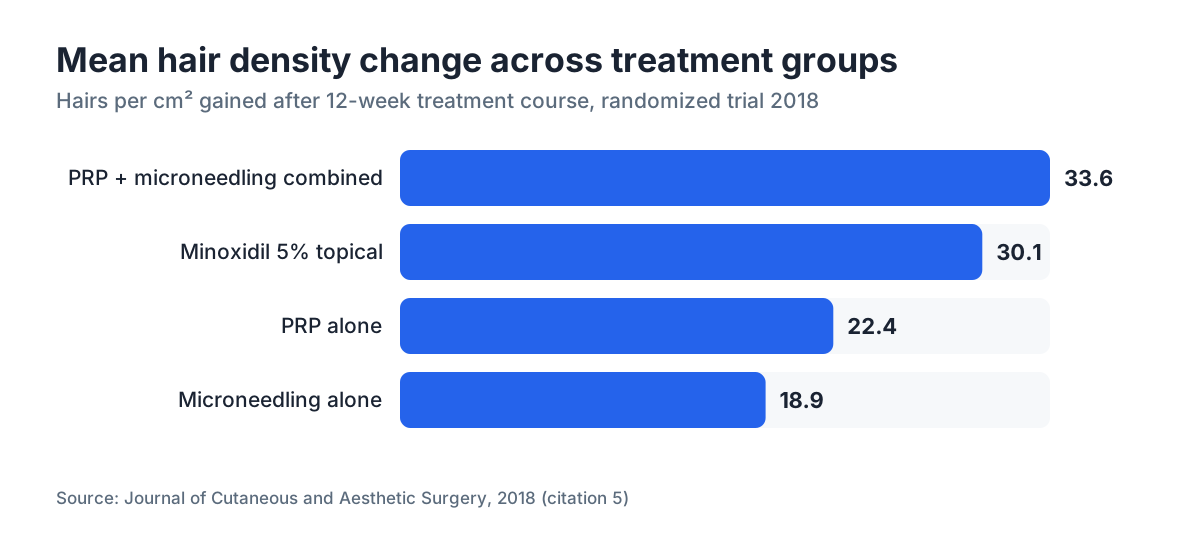
A 2018 study in the Journal of Cutaneous and Aesthetic Surgery compared four groups head to head: PRP alone, microneedling alone, combined PRP plus microneedling, and minoxidil 5%. After 12 sessions, the combined group had the highest mean hair count increase. Minoxidil came close. The combo edged it. [5]
So what does this mean in practice? The combination genuinely appears to be additive. Microneedling's channels improve PRP absorption and distribution, and PRP's growth factors amplify the wound-healing response the needling triggers. But effect sizes across all these trials are modest. You're not going to reverse a Norwood 6 with this. People with early-stage loss, Norwood 2-3 or diffuse thinning, tend to see the most meaningful response. [6]
Neither PRP nor microneedling carries FDA approval for hair loss. The FDA has cleared certain microneedling devices as cosmetic devices, not as hair-loss treatments, and has not approved PRP for this use. [7]
How does PRP plus microneedling compare to standard treatments like minoxidil and finasteride?
Minoxidil and finasteride have decades of data and FDA approval for androgenetic alopecia. PRP plus microneedling has neither. That gap should shape how you spend.
Minoxidil (topical 2% and 5%) is FDA-approved and produces meaningful hair retention plus modest regrowth in roughly 40-60% of men who use it consistently. [7] Finasteride 1mg daily blocks DHT production. In a two-year clinical trial, 83% of men on finasteride kept their hair compared to 28% on placebo, and about 66% showed some regrowth. [8]
The PRP-plus-microneedling combo has no comparably sized, long-running trials. The 2018 study above showed similar short-term hair count gains to minoxidil over 12 weeks, but 12 weeks is not 2 years of daily topical use.
| Treatment | FDA Approved | Evidence Level | Typical Monthly Cost | Needs to Continue? |
|---|---|---|---|---|
| Minoxidil (topical) | Yes (AGA) | Strong, RCTs + decades | $15-$40 | Yes, indefinitely |
| Finasteride 1mg | Yes (AGA, men) | Strong, RCTs + decades | $20-$70 | Yes, indefinitely |
| PRP alone | No | Moderate, small RCTs | $400-$800/session | Yes, maintenance |
| Microneedling alone | No | Moderate, small RCTs | $100-$400/session | Yes, maintenance |
| PRP + microneedling combined | No | Moderate, small RCTs | $500-$1,000+/session | Yes, maintenance |
For most people with androgenetic alopecia, the evidence-based first move is still minoxidil for men and finasteride, or both together. PRP plus microneedling works best as an add-on to those proven treatments, or for people who can't tolerate medication. You can read more about how finasteride and minoxidil interact.
How is a combined PRP and microneedling session actually done?
Sessions typically run 60-90 minutes from blood draw to aftercare instructions.
First, a technician or physician assistant draws 10-60 mL of blood from your arm, roughly the same as a standard blood test. That blood goes into a centrifuge for 5-10 minutes. The machine separates red blood cells from plasma and concentrates the platelets. Most systems aim for platelet concentrations 3-5 times above baseline whole blood, though protocols vary a lot across clinics, and that variation is a real source of inconsistent outcomes.
While the blood spins, a topical numbing cream sits on the scalp for 20-30 minutes. Then the microneedling device (a motorized pen or roller with needles typically 0.5-2.5mm long) passes across the treatment area. Most providers use 1-1.5mm depth for the scalp. The micro-channels are the point: they let PRP penetrate far deeper than surface application ever could.
Right after needling, the PRP is either injected into the scalp with a fine-gauge needle (intradermal injections every 1cm or so across the zone) or applied topically and massaged into the channels. Most studies that showed positive results used intradermal injection rather than topical application, so injection-based delivery appears more effective, though it hurts more. [3]
You leave with a red, slightly swollen scalp. Most people look presentable within 24-48 hours. Providers usually recommend skipping hair washing for 24 hours and avoiding anti-inflammatory drugs like ibuprofen for several days, since the inflammatory response is part of how the treatment works.
How many sessions do you need and how long before you see results?
Most protocols call for an induction phase of 3-6 monthly sessions, then maintenance every 3-6 months. Results, if they're going to happen, usually show up around the 3-month mark. Hair cycles are slow. Follicles you stimulate in month one don't produce visible shafts until month three or four.
Patient data from the 2022 Journal of Cosmetic Dermatology trial showed density improvements were detectable by standardized trichoscopy at 12 weeks in the combination group. [3] The 2018 minoxidil comparison ran for 12 weeks with 12 weekly sessions (aggressive spacing) and showed the combo group's improvements still trending upward at the final measurement. [5]
Here's a realistic yardstick. Do 4 sessions over 4 months and see nothing by month 5? The treatment probably isn't working for you. See real improvement? Expect to keep it up with sessions every 3-6 months indefinitely, because the effect isn't permanent. Follicles don't get cured by this. They get temporarily stimulated.
Who is the best candidate for PRP combined with microneedling?
The people most likely to benefit have early-stage androgenetic alopecia (Norwood 1-3 in men, Ludwig 1-2 in women), diffuse thinning rather than fully bald patches, and miniaturized follicles that are still alive. If a follicle is dead and replaced by scar tissue, no amount of growth factors brings it back.
PRP plus microneedling also makes sense for people with telogen effluvium, the temporary shedding triggered by stress, illness, or nutritional deficiency, because stimulating the scalp during recovery may speed the return to normal cycling.
Poor candidates include anyone with:
- Active scalp infection or psoriasis
- Platelet dysfunction disorders or low platelet counts
- History of blood cancers
- Current anticoagulant medications
- Active hepatitis C or HIV (though this varies by clinic)
People on isotretinoin (Accutane), or who used it within the last 6 months, should avoid microneedling because wound healing is compromised. Pregnant women are not candidates. [2]
Not sure where your hair loss falls on the scale? Understanding your specific pattern matters a lot before you commit to anything. What causes hair loss in your case, hormonal, genetic, or stress-related, changes which treatments make sense. Receding hairline patterns driven by DHT, for example, respond better when DHT blockade (finasteride or a DHT blocker) is added to any scalp treatment.
What does PRP with microneedling cost and is it worth the money?
This is where honesty matters. PRP plus microneedling is expensive, not covered by insurance, and needs ongoing spending to hold results.
A single combined session at a dermatology practice or medical spa in the U.S. typically costs $500-$1,200. Prices swing by city (New York and Los Angeles skew higher), provider type (board-certified dermatologist vs. aesthetician), and centrifuge system. A standard induction course of 4 sessions runs $2,000-$4,800. After that, maintenance sessions every 4-6 months add $500-$1,200 per year indefinitely.
For comparison, a year of generic topical minoxidil runs $180-$480, and generic finasteride runs $240-$840 per year, both with FDA-level evidence behind them.
Is the combo worth it? Here's my honest take. If you can only fund one thing, fund minoxidil and finasteride first. They have the evidence. If you've been on both for 12+ months and want to add something, or you can't tolerate the medications, then PRP plus microneedling is a reasonable next step given the trial data. Going straight to a $4,000 PRP course before trying a $20/month minoxidil is hard to justify.
For people already weighing a hair transplant, PRP plus microneedling is sometimes used as an adjunct post-transplant to improve graft survival, and some clinics have data supporting that specific use. That's a more defensible application than using it as a standalone primary treatment.
MyHairline's free AI scan (/scan) can map your current hair loss stage so you're spending on treatments matched to where you actually are, not where you think you might be.
What are the side effects and risks of this combined treatment?
The side effect profile is generally mild when a trained provider works under sterile conditions.
Common reactions (expected, resolve within 48-72 hours):
- Scalp redness and mild swelling
- Pinpoint bleeding at injection sites
- Temporary soreness
- Occasional pinpoint bruising
Less common but documented risks:
- Infection, if sterile technique isn't followed
- Calcification or small nodules from repeated PRP injections at the same site
- Post-inflammatory hyperpigmentation, more common in darker skin tones
- Temporary increased shedding in the 2-4 weeks after treatment (this usually resolves and may precede regrowth)
Serious adverse events are rare in the published literature but not zero. The American Academy of Dermatology notes that any injection procedure carries infection risk, and patients should confirm providers use single-use needles and proper sterile fields. [9]
Microneedling at depths above 1.5mm on the scalp should only be done by trained physicians or supervised practitioners. Over-aggressive needling can cause scarring, which does the opposite of what you want.
Does it matter what PRP system or protocol the clinic uses?
Yes, and this is one of the most overlooked variables in the whole literature.
Platelet concentration varies enormously across centrifuge systems. Some double-spin protocols hit 5-8x baseline concentration; single-spin systems may only reach 2-3x. Studies showing positive results often don't say which system they used, which makes replication hard. A 2020 review in Dermatologic Surgery pointed out that the lack of standardized PRP preparation is a major reason trial results stay inconsistent. [10]
Needle depth matters too. Depths of 1.0-1.5mm appear optimal for the scalp: deep enough to reach the superficial dermis where follicle bulge cells live, shallow enough to avoid nerve bundles and major vessels.
Activation is another variable. Some clinics add calcium chloride or thrombin to trigger platelet degranulation before injection, which may raise immediate growth factor release. Others inject unactivated PRP and let the tissue trigger activation. The 2022 trial showing superior combined results used activated PRP. [3]
The takeaway: if you're going to spend this kind of money, ask your provider which centrifuge system they use, what platelet concentration it achieves, and whether they use activated or unactivated PRP. A clinic that can answer those questions is more likely following a protocol close to what worked in the published trials.
Can you combine PRP and microneedling with minoxidil or finasteride at the same time?
Yes, and that stack is actually what most hair loss specialists recommend when they use PRP at all.
Finasteride goes after the DHT-driven miniaturization that causes androgenetic alopecia. Minoxidil directly prolongs the anagen phase and increases follicle size. PRP plus microneedling adds growth factor stimulation and better scalp circulation on top. The three work through different pathways, so they don't interfere with each other.
One timing note: avoid applying topical minoxidil on the day of a microneedling session. The open channels sharply increase absorption, and you could get systemic minoxidil levels well above normal, which carries cardiovascular side effects. Wait at least 24 hours post-treatment before resuming topical minoxidil. [2] If you're on oral minoxidil, that timing concern doesn't apply the same way, though it's worth discussing with your prescriber.
Finasteride has no timing restriction around microneedling. Keep taking it as prescribed. If you're thinking about minoxidil side effects or want to understand how oral minoxidil fits in, those are worth reviewing before layering in PRP.
Some practitioners also add hair loss supplements like biotin, saw palmetto, or vitamin D. The evidence for most supplements is weaker than for anything else discussed here, but they're low-risk additions if deficiencies are confirmed.
What questions should you ask a provider before booking a PRP-plus-microneedling session?
Most people walk into a consultation already sold by before-and-after photos on Instagram. That's backwards. These are the questions that actually help you evaluate a provider:
- Are you a board-certified dermatologist or plastic surgeon, or will an aesthetician perform this? (Physician involvement matters for safety and protocol quality.)
- Which centrifuge system do you use, and what platelet concentration does it achieve?
- Do you use activated or unactivated PRP?
- What needle depth do you use for scalp microneedling?
- What protocol (number of sessions, spacing) do you recommend and why?
- What results do your patients typically see, and what's your honest failure rate?
- Can you show me standardized trichoscopy or hair count data from your patients, more than photos?
- What are your post-procedure instructions, specifically around minoxidil timing and anti-inflammatories?
A provider who can answer these specifically is worth more than one with a gallery of suspiciously dramatic before-and-afters. Results photography is easy to fake with lighting, angle, and hydration. Trichoscopy numbers are harder to manipulate.
If a provider tells you to stop finasteride or minoxidil to "give PRP a fair chance," that's a red flag. There's no clinical rationale for it, and stopping those medications risks real regression.
Sources
- National Institutes of Health, National Library of Medicine: 'Platelet-Rich Plasma: New Performance Understandings and Therapeutic Considerations in 2020', International Journal of Molecular Sciences
- Journal of Cosmetic Dermatology (2022): 'Combination of platelet-rich plasma with microneedling in androgenetic alopecia: a randomized split-scalp trial'
- Aesthetic Plastic Surgery (2019): 'Platelet-Rich Plasma for Androgenetic Alopecia: A Review of the Literature and Proposed Treatment Protocol'
- Journal of Cutaneous and Aesthetic Surgery (2018): 'A randomized controlled trial comparing PRP, minoxidil, and combined PRP with microneedling for androgenetic alopecia'
- American Academy of Dermatology Association: 'Hair loss' section (aad.org)
- U.S. Food and Drug Administration: Drugs section (fda.gov)
- U.S. National Library of Medicine, DailyMed: 'Propecia (finasteride) prescribing information'
- American Academy of Dermatology Association: 'Platelet-rich plasma (PRP)' section (aad.org)
- Dermatologic Surgery (2020): 'PRP in dermatology: lack of standardization as a barrier to evidence-based practice'