TL;DR: Yes, you can take finasteride and minoxidil together. The two drugs work through completely different mechanisms, have no clinically significant interaction with each other, and multiple randomized trials show the combination beats either drug alone for androgenetic alopecia. Your side effects stay the same as taking each drug solo. No new risk appears from stacking them.
Why do doctors prescribe finasteride and minoxidil together?
They attack hair loss from two different angles, so stacking them adds up instead of overlapping.
Finasteride blocks the enzyme 5-alpha reductase, which converts testosterone into dihydrotestosterone (DHT). DHT is the hormone that shrinks hair follicles in people with androgenetic alopecia (male and female pattern hair loss). Less DHT means slower miniaturization and, in many people, some regrowth. [1]
Minoxidil does something else entirely. It's a vasodilator, first developed as a blood pressure pill. Applied to the scalp (or taken orally at low doses), it appears to stretch out the anagen (growth) phase of the hair cycle and increase blood flow around follicles. Exactly how it grows hair is still not fully understood, but the clinical evidence that it does is solid. [2]
Because the two drugs don't fight over the same receptor or metabolic pathway, stacking them isn't doubling down on one mechanism. It's running two separate strategies at once. Think of it like treating high blood pressure with a diuretic and a beta-blocker: different targets, additive benefit, no pharmacokinetic clash.
For anyone with androgenetic alopecia, this pairing has become the standard first-line recommendation from most hair loss specialists, in line with American Academy of Dermatology guidance. [3]
Is there a dangerous interaction between finasteride and minoxidil?
No. There's no clinically significant drug interaction between the two. The FDA label for finasteride does not list minoxidil as an interacting drug, and the reverse is also true. [1][12]
The one theoretical worry that comes up is blood pressure. Oral minoxidil is a vasodilator and can drop it. Finasteride has no meaningful effect on blood pressure at the 1 mg dose used for hair loss. Topical minoxidil at standard strengths (2% or 5% solution, 5% foam) puts roughly 1 to 2% of the applied dose into your system, which is generally too little to move blood pressure in healthy adults. [2]
Oral minoxidil at hair-loss doses (0.625 mg to 2.5 mg daily for women, 2.5 mg to 5 mg daily for men in most protocols) reaches your bloodstream far more reliably than the topical form, so blood pressure and fluid retention are worth watching, especially if you already take antihypertensives. But that's a concern with oral minoxidil on its own, not something finasteride adds to. [4]
The combination is pharmacologically clean. The side effects you track are the individual profiles of each drug, not some new reaction between them.
What does the research say about using both drugs together?
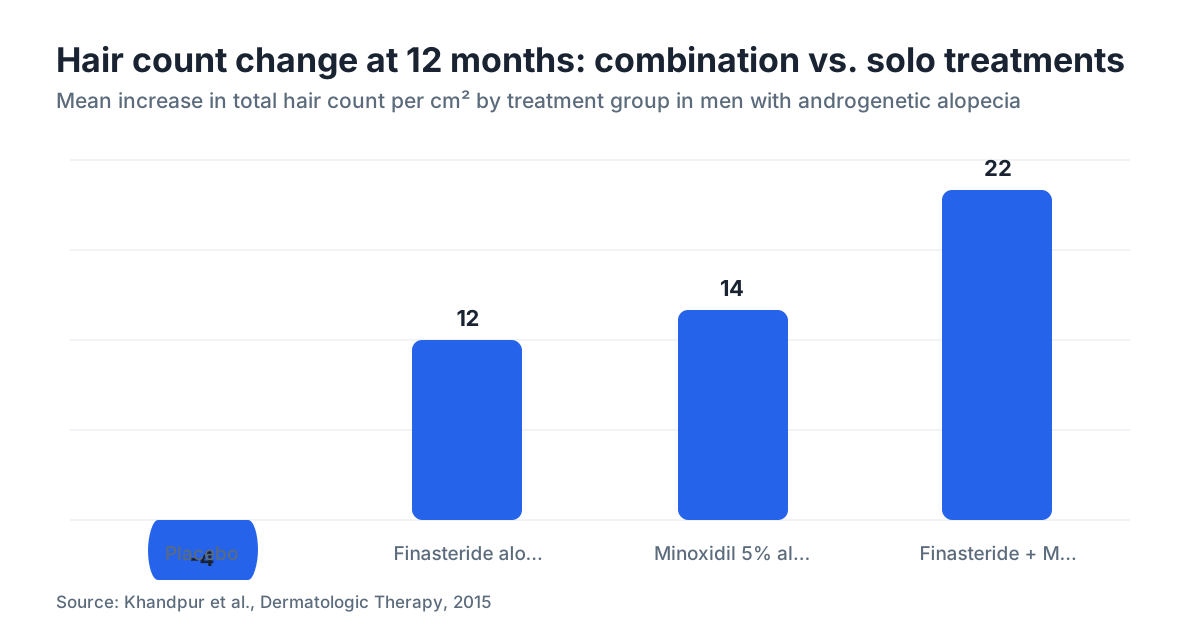
The most cited head-to-head study is a randomized controlled trial in Dermatologic Therapy in 2015. It split men with androgenetic alopecia into four groups: 5% topical minoxidil alone, 1 mg oral finasteride alone, both drugs together, and placebo. After 12 months, the combination group had the biggest jump in total hair count and hair weight. The authors concluded that "the combination of finasteride and minoxidil was more effective than either drug alone." [5]
A network meta-analysis in JAMA Dermatology (2022) pulled together 23 randomized trials covering finasteride, minoxidil, and other treatments. Combination therapy ranked highest for increasing hair density in men with androgenetic alopecia. [6]
For women the evidence is thinner. Finasteride has a narrower approval window (it's not FDA-approved for women's hair loss and carries pregnancy risk), so most female data pairs low-dose oral minoxidil with spironolactone or other anti-androgens instead. Women who do use finasteride off-label (post-menopausal women, or those on reliable contraception) can combine it with topical minoxidil, though dedicated female trials are scarce. [3]
The finasteride and minoxidil for men articles go deeper into each drug's solo evidence if you want to compare.
What are the side effects of taking both at the same time?
The side effect profile of the combination is basically the sum of each drug's individual risks. Nothing meaningfully new shows up.
Finasteride at 1 mg (brand name Propecia) has a well-documented sexual side effect profile in a subset of men: lower libido, erectile dysfunction, reduced ejaculate volume. The FDA label reports these in roughly 3.8% of men in clinical trials versus 2.1% on placebo. Post-marketing reports describe persistent symptoms in some men even after stopping the drug, though how common that is stays debated and isn't firmly pinned down. [1]
Topical minoxidil's main side effects are scalp irritation, dryness, and contact dermatitis, usually from the propylene glycol carrier in the solution. The foam uses less propylene glycol and irritates fewer people. Unwanted facial hair, especially in women, can also happen with topical minoxidil. [2]
Oral minoxidil piles on systemic effects: fluid retention, a few pounds of weight gain, and sometimes diffuse fine body hair growth called hypertrichosis. Some users report a faster resting heart rate even at hair-loss doses. [4]
The full breakdown lives in minoxidil side effects. The point that matters: combining the two drugs doesn't appear to amplify either one's side effects.
How long does it take to see results from the combination?
Both drugs are slow, and the combination is no exception. Plan on judging it at 12 months, not 12 weeks.
Most people spot the first clear signs of response around the 3 to 6 month mark, but the 12-month result is the honest measure of whether it's working. One thing trips up almost everyone early: more shedding in the first 4 to 12 weeks, often called a "minoxidil shed." Minoxidil speeds up the turnover of telogen (resting) hairs, pushing them out to make room for new anagen hairs. It looks alarming and usually settles down. [7]
If you want the follicle-level version of that story, the telogen effluvium article explains it.
The 2015 combination trial showed a real gap between groups at 12 months. At 6 months the combination already led the solo-drug groups, and the lead widened by month 12. [5]
No meaningful change after a full 12 months of consistent use? That's a fair point to reassess with a dermatologist. Some people are non-responders, and it's better to learn that at one year than at two.
What are the typical doses when combining finasteride and minoxidil?
Here's the protocol most trials and clinics use.
| Drug | Form | Typical dose | Frequency |
|---|---|---|---|
| Finasteride | Oral tablet | 1 mg | Once daily |
| Minoxidil | Topical 5% foam | ~1 g (half capful) | Once or twice daily |
| Minoxidil | Topical 5% solution | 1 mL | Twice daily |
| Minoxidil | Oral tablet | 2.5-5 mg (men) | Once daily |
Finasteride 1 mg is the FDA-approved dose for androgenetic alopecia. The 5 mg dose is approved for benign prostatic hyperplasia under the brand name Proscar, and some doctors prescribe it off-label for hair, but the evidence that 5 mg beats 1 mg for hair specifically is thin. [1][8]
Topical minoxidil 5% is generally more effective than 2% in men. A direct comparison trial in the Journal of the American Academy of Dermatology (2002) found 5% produced about 45% more regrowth than 2%. [10] Women often start on 2% to hold down unwanted facial hair, though 5% gets used in women too.
Oral minoxidil at hair-loss doses is a newer route. It isn't FDA-approved for hair loss; it's used off-label on a growing evidence base. See oral minoxidil for the full look.
Anything outside these ranges belongs with a prescribing physician who can weigh your cardiovascular and hormonal history.
Can women safely take finasteride and minoxidil together?
Women can use minoxidil, topical and low-dose oral, for hair loss. That part is settled. Finasteride is the complicated half.
Finasteride is not FDA-approved for women's hair loss. It's contraindicated in women who are or may become pregnant, because DHT is needed for normal development of male external genitalia in a fetus, and finasteride can cause serious birth defects if a pregnant woman is exposed, even by handling crushed tablets. [1]
Still, dermatologists sometimes prescribe it off-label for post-menopausal women or women on highly reliable contraception who have androgenetic alopecia. A trial in the Journal of the American Academy of Dermatology found finasteride 1 mg daily raised hair density in post-menopausal women over 12 months. [9] The AAD's guidelines list off-label finasteride in women as an option, with the pregnancy precaution spelled out. [3]
For a woman in that situation, combining off-label finasteride with topical minoxidil follows the same logic as the male version: different mechanisms, likely additive benefit, no pharmacokinetic clash. The extra care goes toward contraception status and a frank talk with the prescriber.
Women with a receding hairline or diffuse thinning should read the AAD guidance closely before pursuing finasteride, and should never self-prescribe.
Do you need a prescription to use both drugs together?
It depends on which minoxidil you pick. Finasteride always needs a prescription. Topical minoxidil never does.
Finasteride requires a prescription in the United States at any dose. It is not available over the counter. [1][8]
Topical minoxidil (2% and 5%) is sold over the counter in the US for both men and women. You can walk into any pharmacy and buy it without a prescription. [2]
Oral minoxidil needs a prescription because of its systemic effects on blood pressure, fluid balance, and heart rate. [4]
So topical minoxidil plus finasteride means one prescription (finasteride) and one OTC product. Oral minoxidil plus finasteride means two prescriptions.
Many telehealth platforms now prescribe both at once, sometimes as combination products (a single topical formula containing finasteride and minoxidil, built to hold down systemic finasteride exposure while delivering both actives to the scalp). These topical combos have early supporting data but less long-term evidence than the oral finasteride plus topical minoxidil pairing that most clinical trials actually studied.
Want a baseline read on your pattern before that first appointment? The free AI scan at MyHairline gives you a Norwood or Ludwig stage to bring into the conversation.
What happens if you stop taking one of the drugs?
Both drugs need continuous use to hold results. Stop either one, and the hair loss mechanism it was holding back comes back.
Stop finasteride and DHT climbs to baseline within about two weeks. The miniaturization it was suppressing resumes. Most men who quit finasteride see visible shedding and thinning within 6 to 12 months. [1][8]
Stop minoxidil and the anagen-extension effect ends. Hair that was staying partly because of the drug tends to shed, often noticeably, within 3 to 6 months. People sometimes call this a "minoxidil cessation shed," and it can be dramatic enough to scare you. [2]
Stop both at once and you lose both protective mechanisms at the same time. The shed in the following months can be heavy.
Some people who got substantial regrowth wonder whether they can drop one drug after things stabilize. The honest answer: nobody has good long-term data on where the maintenance threshold sits. Plenty of people taper to lower minoxidil frequency or dose after reaching a stable result, but individual responses vary enough that this should be worked out with a dermatologist, not decided on your own.
How does the combination compare to a hair transplant?
This is the real fork in the road for people with moderate-to-advanced loss. Short version: they aren't rivals. Most people who get surgery still take the drugs.
A hair transplant moves donor follicles from the back and sides of the scalp, which are genetically resistant to DHT, into thinning areas. Those transplanted follicles keep their donor traits and don't get lost to DHT. It's a one-time surgical procedure, not a daily lifelong regimen.
The catch: a transplant does nothing to stop loss in the native hair around it. Someone who gets surgery and skips medical therapy will likely lose more native hair over the following years and can end up with an unnatural gap.
That's why many transplant surgeons want patients on finasteride (and often minoxidil) afterward, to protect the remaining native hair. For most people the drugs and the surgery are sequential or simultaneous parts of one plan.
The cost gap is stark. Generic finasteride runs roughly $10 to $30 per month depending on pharmacy and dose. OTC topical minoxidil runs $15 to $30 per month for name brands, less for generics. A hair transplant in the US costs anywhere from $4,000 to $15,000 or more depending on graft count and surgeon, and insurance doesn't cover it.
At an early Norwood stage (1 to 3), drugs first is almost always the right opening move before you consider surgery. The dht blocker article covers the wider category of anti-androgen therapies if you want other pharmacological options.
Are there things that make the combination work better or worse?
A few factors genuinely move the needle.
Consistency is the big one. Both drugs need near-daily use to hold therapeutic levels. Missing a dose here and there is fine; stopping for weeks is not. Finasteride's half-life is about 5 to 6 hours, so daily dosing is what keeps DHT down. [1]
Starting early tends to pay off. Both drugs are better at slowing loss and holding hair than at regrowing follicles that already miniaturized past a point. Acting at the first signs of thinning beats waiting for a Norwood 5.
Scalp health affects topical minoxidil absorption. Heavy seborrheic dermatitis or scalp inflammation can cut absorption or cause irritation, so treating the underlying condition first can make the topical work better.
Some people ask whether hair loss supplements like biotin or saw palmetto add anything to a finasteride-plus-minoxidil routine. The evidence for most supplements is much weaker than for either prescription drug. Saw palmetto shows mild 5-alpha reductase inhibition in lab work, but no head-to-head trial shows it adds to finasteride. A handful of deficiencies (iron, vitamin D, zinc) can drive shedding and are worth checking, though topping them up on an already-solid regimen has modest value at best.
Seen the claims that creatine spikes DHT and speeds hair loss? The does creatine cause hair loss article walks through the actual evidence.
What does the combination cost, and is it worth it?
Honest numbers. Generic oral finasteride 1 mg costs roughly $10 to $25 a month at pharmacies like Costco, Walmart, or Mark Cuban's Cost Plus Drugs. Cost Plus lists it under $20 for a 90-day supply. Name-brand Propecia at the same dose runs $70 to $100 a month at many pharmacies, with no evidence it works better than the generic. [1][11]
Generic topical minoxidil 5% solution (60 mL bottles) runs about $8 to $15 per bottle, roughly a month at twice daily. Name-brand Rogaine foam is $25 to $45 a month. Generic foam keeps getting cheaper. [2]
All in, the full combination on generics is realistically $18 to $40 a month. That's less than most people spend on coffee.
Worth it? If you respond, yes, by a wide margin against the alternative of steady loss and eventual surgery. The complication: roughly 30% of men who try finasteride don't respond, and a fair share of minoxidil users see no big regrowth (though most see slower loss). [5][6] You won't know your category until you run it for 12 months.
The real math is simple. Spend $20 to $40 a month for a year, get a clear read on whether the combination works for your pattern, then decide to continue or escalate. That's a reasonable bet.
Want a clearer picture of your current loss before spending a dime? A quick analysis at MyHairline tells you whether you're still early enough that medical therapy alone is likely to do the job.
Sources
- FDA, Propecia (finasteride 1 mg) Prescribing Information
- FDA, Rogaine (minoxidil 5%) OTC label and Drug Approval Package
- American Academy of Dermatology, Hair Loss Clinical Guidelines
- FDA, Loniten (oral minoxidil) Prescribing Information
- Khandpur S et al., Dermatologic Therapy 2015, Comparative study of finasteride and minoxidil combination vs. either drug alone
- Gupta AK et al., JAMA Dermatology 2022, Systematic review and network meta-analysis of randomized trials for androgenetic alopecia
- Trüeb RM, Dermato-Endocrinology 2009, Molecular mechanisms of androgenetic alopecia and minoxidil's effect on hair cycle
- NIH MedlinePlus, Finasteride drug information
- Price VH et al., Journal of the American Academy of Dermatology 2000, Finasteride in women with androgenetic alopecia
- Olsen EA et al., Journal of the American Academy of Dermatology 2002, Minoxidil 5% vs 2% in men
- Cost Plus Drugs (Mark Cuban's pharmacy platform), finasteride 1 mg pricing
- FDA, Drug Interactions resources and Propecia label drug interaction section