

TL;DR: Minoxidil does grow eyebrows in many people, but it's not FDA-approved for that and works differently than on the scalp. Small randomized trials show 3% topical minoxidil beats placebo for eyebrow density. Expect results at 4 to 6 months. The gains reverse when you quit, and faint hair on your cheeks or forehead is a real risk.
What is minoxidil and how does it affect hair follicles?
Minoxidil started as an oral blood pressure drug in the 1970s. Doctors noticed patients grew more hair, and that side effect became a product. The FDA approved topical minoxidil for scalp hair loss in 1988 for men and 1991 for women. [6]
The mechanism still isn't fully pinned down. What researchers agree on is that minoxidil is a potassium channel opener. It widens blood vessels and appears to extend the anagen (active growth) phase of the hair cycle while shortening the telogen (resting) phase. In scalp follicles, that shifts more hairs into growth and keeps them there longer. [7]
Eyebrow follicles run the same basic cycle: anagen, catagen, telogen. So the logic of putting minoxidil on brows isn't crazy. The follicles aren't fundamentally different from scalp follicles in their biology. What is different is timing. Scalp hair grows actively for 2 to 7 years. Eyebrow hair's anagen phase lasts only about 4 to 6 weeks. [7] That short cycle is why brow hairs stay short naturally, and it's why minoxidil's effect on brows looks different than on your head.
If you want the fuller biology, what causes hair loss walks through the follicle level.
Is minoxidil FDA-approved for eyebrow regrowth?
No. The FDA has approved topical minoxidil only for androgenetic alopecia on the scalp: the 2% solution for women and both 2% and 5% formulations for men. [6] Eyebrow use is off-label.
Off-label doesn't mean unsafe or useless. Doctors prescribe drugs off-label all the time, and the FDA doesn't ban it. It does mean you're working without the same regulatory safety net. No large Phase III trial has gone to the FDA for eyebrow regrowth, so the agency has never reviewed that evidence.
That matters for two reasons. The exact dose and frequency for brows hasn't been settled through big trials. And your dermatologist is making a judgment call from smaller studies and clinical experience, not a stamped indication. That's a reasonable way to practice medicine. You just deserve to know it going in.
What do the clinical trials actually show for eyebrow regrowth?
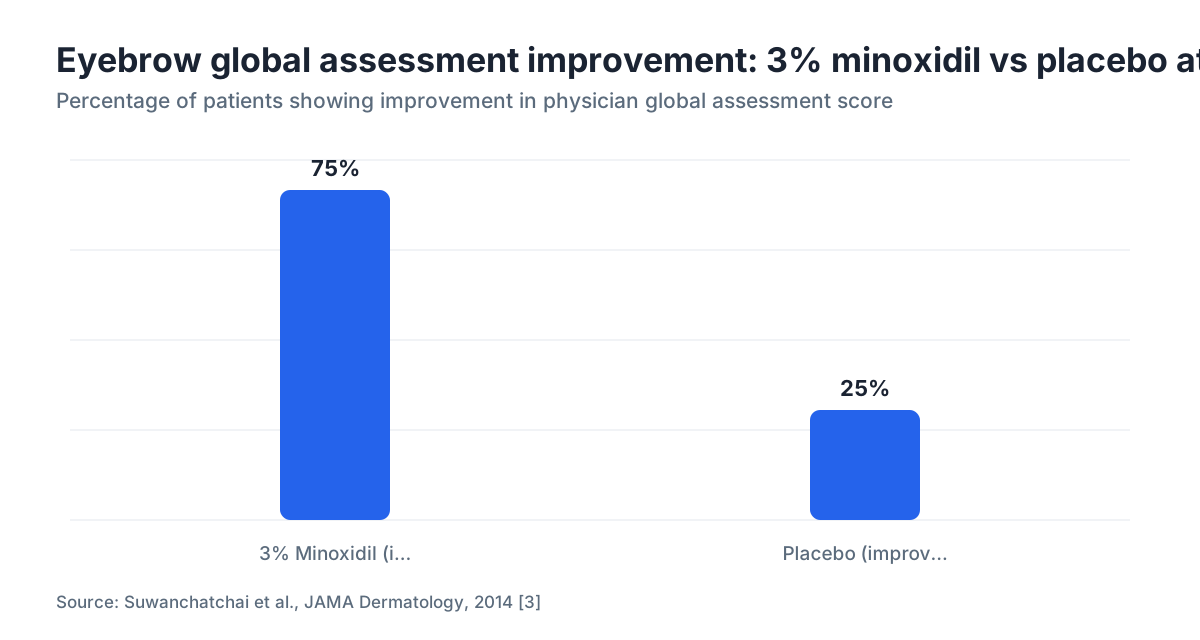
The best evidence is a randomized, double-blind, placebo-controlled trial published in JAMA Dermatology in 2014. Researchers enrolled 40 patients with eyebrow hypotrichosis (thin or sparse brows) and randomized them to apply either 3% minoxidil lotion or placebo twice daily for 16 weeks. At 16 weeks, the minoxidil group had statistically significant improvement in global eyebrow assessment scores over placebo, and both physician and patient satisfaction favored minoxidil. [3]
A 2020 study in the Journal of the European Academy of Dermatology and Venereology compared bimatoprost (a prostaglandin analog used in glaucoma drops) against 3% minoxidil for eyebrow hypotrichosis. Both improved density. Bimatoprost edged ahead on some measures, but 3% minoxidil still beat baseline by a meaningful margin. [4]
Neither trial was large. Forty to sixty participants can detect a signal. It can't finalize dosing or catch rare adverse effects. Nobody has good long-term data past 16 to 24 weeks for eyebrows.
Here's the honest takeaway. Minoxidil works for many people with sparse brows from over-plucking, alopecia areata in the brows, or general thinning. It doesn't work equally for everyone. It won't bring back brows where follicles are scarred shut.
For the wider risk picture, minoxidil side effects covers systemic absorption and the rest.
How does eyebrow regrowth compare to scalp regrowth with minoxidil?
Same mechanism, different result. That's the short version.
On the scalp, minoxidil's main job is rescuing miniaturizing follicles and stretching anagen. You might gain real density over 6 to 12 months, and if you catch androgenetic alopecia early you can hold onto hair for years while you keep using it. Quit, and the gained hair sheds within a few months. [6]
On the brows, anagen is naturally short, so you're not stretching growth cycles the way you do on your scalp. Instead you're likely pushing more follicles into active anagen at once, and maybe nudging follicle diameter up a little. The result is fuller-looking brows, not dramatically longer hairs you fight to trim (though a few people do notice longer hairs and groom more).
Here's how the two compare.
| Feature | Scalp use | Eyebrow use |
|---|---|---|
| FDA approval | Yes (2%, 5%) | No (off-label) |
| Natural anagen phase | 2-7 years | 4-6 weeks |
| Typical onset of results | 3-6 months | 4-6 months |
| Primary effect | Prolongs anagen, rescues miniaturizing follicles | Increases follicles in anagen, may increase follicle caliber |
| Effect if you stop | Hair shed within ~3 months | Brow density returns to baseline |
| Risk of unwanted hair | Rare (hairline changes) | More common (cheek/forehead fuzz) |
One difference is genuinely important. The risk of unwanted hair on nearby skin is higher with brow application. You're putting the drug on your face, and any drip or spread onto cheek or forehead skin can grow hair there too. That's not a rare fluke. It's the known trade-off of facial use.
What concentration should you use on eyebrows: 2% or 5%?
Start with 2%. The randomized trial with the clearest positive result used 3% minoxidil, a strength that isn't standard in US over-the-counter products. [3] So in practice most dermatologists steer people toward the 2% solution, the lowest OTC concentration, for brows. Some suggest 5%, but 5% raises the odds of unwanted facial hair.
Minoxidil also comes as a foam, which many scalp users like because it drips less. On brows, foam is harder to place precisely and tends to spread, so most practitioners prefer the liquid solution dabbed on with a small brush or cotton swab.
Apply a tiny amount, one or two drops, to each brow once or twice daily. Cover the brow without flooding the skin around it. Less really is more here.
Low-dose oral minoxidil (1.25 to 2.5 mg/day) is also studied for hair regrowth broadly, and some dermatologists use it off-label for patients who can't manage topical application. learn more about oral minoxidil. Systemic dosing means the drug reaches brow follicles through the bloodstream instead of the surface, which also means systemic side effects are more likely.
How long does minoxidil take to regrow eyebrows?
Give it 4 to 6 months before you judge it. The Thai JAMA Dermatology trial ran 16 weeks and measured its improvement at that endpoint. [3] Most dermatologists ask patients to commit to at least that long.
The hair cycle explains the wait. After you start, follicles sitting in telogen have to shed before new anagen hairs push through. In the first few weeks you may notice a slight shed, which mirrors the initial "minoxidil shed" some scalp users see. That shedding is the drug working, not failing.
A rough timeline:
- Weeks 1-4: No visible change, possible mild shedding
- Weeks 4-8: Some new fine hairs may appear
- Months 3-4: Density becomes noticeable
- Month 6: Most of the benefit you'll get is visible
No change at all by month 6 with consistent twice-daily use? It's unlikely to work for you.
Can minoxidil regrow eyebrows lost from over-plucking, alopecia areata, or thyroid disease?
The cause of your loss decides how well minoxidil works.
Over-plucking is the most hopeful case. Repeated trauma can push follicles into a long resting state without killing them. If the follicles are still alive (they usually are, even after years of plucking, unless the area has gone truly bare for a long time), minoxidil can pull them back into growth. Plucking-related thinning tends to respond well.
Alopecia areata in the brows is harder. It's an autoimmune condition where the immune system attacks follicles. [2] Minoxidil may help, but it does nothing about the autoimmune attack itself. Dermatologists often pair it with intralesional steroid injections or newer JAK inhibitors for brow alopecia areata. [10] Minoxidil alone gives partial results at best.
Thyroid-related loss, classically the outer third of the brow thinning out with hypothyroidism, usually improves once thyroid treatment brings hormone levels back to normal. Minoxidil might add a little, but treating the thyroid is the main lever. For more on systemic causes, read what causes hair loss.
Scarring causes (burns, certain skin conditions, trauma that destroys follicle architecture) won't respond. No drug regrows hair where the follicle is gone. That's when eyebrow transplant enters the conversation, and hair transplant covers the procedural side.
What side effects are specific to using minoxidil on your face and brows?
The side effect people flag most for brow use is hypertrichosis: unwanted hair on skin next to where you applied. That means faint hair on cheekbones, forehead, or the bridge of the nose if the product creeps. Studies on topical minoxidil for women's scalp hair loss already list facial hypertrichosis as an adverse effect to watch, and brow use puts the drug right there from day one. [6]
The good news is it's usually reversible. Stop the minoxidil and the extra hair fades over a few months. The catch is that stopping to lose the facial fuzz also loses your brow gains. Some people won't make that trade.
Contact dermatitis is possible too. The propylene glycol in many liquid formulations irritates sensitive skin. Redness, itching, or scaling around the brow means switch to a propylene-glycol-free formula if you can find one, or try a very small, careful amount of foam.
Systemic absorption from brow application is low but not zero. Facial skin is thinner and more vascular than the scalp. Scalp absorption of 2% minoxidil is already roughly 1.4% of the applied dose per the FDA label. [6] Painting a tiny brow area means the absolute systemic dose is tiny, but not nothing. Anyone with a cardiovascular condition should check with a doctor first.
For the full risk breakdown, see minoxidil side effects.
Do you have to use minoxidil forever to keep your eyebrows?
Yes. This is the part nobody wants to hear.
Minoxidil doesn't fix whatever thinned your brows. It changes the hair cycle environment while you use it. Stop, and follicles drift back to their old behavior. The density you built up sheds over roughly 3 to 4 months after quitting. Same dynamic as the scalp. [6]
For scalp loss from androgenetic alopecia, some people add finasteride or another DHT blocker to hit the hormonal driver, which can lean on minoxidil less. Brow loss usually isn't DHT-driven the same way, so that combination doesn't map over cleanly.
The real question is whether indefinite use suits you. In small amounts twice daily, most people tolerate it fine for years. If you won't commit to that, the honest answer stays the same: minoxidil works while you use it and stops when you stop.
Are there alternatives to minoxidil for eyebrow regrowth?
A few options have actual evidence behind them.
Bimatoprost 0.03% solution, originally a glaucoma drop (sold as Lumigan), grows eyebrow and eyelash hair. The 2020 comparison trial found it comparable or slightly better than 3% minoxidil for eyebrow hypotrichosis. [4] A bimatoprost eyelash formulation (Latisse) is FDA-approved specifically for eyelash hypotrichosis, and dermatologists use the same drug off-label for brows. Side effects include possible iris darkening (if it reaches the eye), darkening of the skin around the eye, and eye irritation.
Intralesional corticosteroid injections are standard for alopecia areata in the brows and pair well with minoxidil. [10]
Platelet-rich plasma (PRP) injections into the brow have early evidence for hair regrowth generally, but brow-specific data is thin. Sessions run $500 to $1,500 and insurance doesn't cover them.
Microblading and eyebrow tattooing are cosmetic, not medical. They don't grow hair, but they rebuild the look of full brows fast. The catch is upkeep every 1 to 3 years as pigment fades.
If scalp shedding is happening alongside brow thinning, check whether telogen effluvium is the shared cause, since diffuse shedding often hits brows too.
Myhairline.ai's free AI scan can help you figure out what type of hair loss you have before you spend money on treatment.
How do you apply minoxidil to eyebrows correctly?
Technique matters more for brows than scalp, because the target is small and ringed by skin you don't want to treat.
Start with clean, dry skin. Use a fine-tipped brush or cotton swab to place one drop of 2% minoxidil solution per brow. Apply to the brow itself, not the surrounding skin. Wait at least 4 hours before washing your face, or apply at night and rinse in the morning.
Don't touch your brows and then your eyes. Minoxidil is not meant to enter the eye. If it does, rinse right away.
Let it dry fully before any serum, makeup, or sunscreen goes on the brow area. Layering on top of wet minoxidil spreads it onto adjacent skin.
If you also use minoxidil for scalp hair loss, stagger the timing so you're not applying both at once and touching your face with product-coated hands.
Consistency is the whole game. Twice daily, every day. Skipping regularly blunts your results. If twice a day is genuinely hard, once daily still beats sporadic twice-daily use.
Who should not use minoxidil on their eyebrows?
Some people shouldn't touch it. The FDA label for topical minoxidil lists contraindications that apply to brows as much as scalp: don't use it with a known hypersensitivity to minoxidil or propylene glycol. [6]
People with cardiovascular disease should talk to a doctor first. Even low systemic absorption can move blood pressure.
Pregnant and breastfeeding women should avoid minoxidil. Animal studies show teratogenicity at high doses, and the AAD advises against use during pregnancy. [5]
Children shouldn't use it. The FDA label specifies adult use only, and there's essentially no safety data for pediatric brow application. [6]
If your brow loss is new, fast, or comes with other symptoms (fatigue, weight change, patchy scalp loss), see a dermatologist before self-treating. You could be dealing with a thyroid disorder, alopecia areata, or something else that needs a different fix. Minoxidil layered over an undiagnosed condition just delays the right treatment. Myhairline.ai's analysis tool is a starting point, not a substitute for a medical exam when symptoms are moving fast.
Sources
- National Institute of Arthritis and Musculoskeletal and Skin Diseases, Alopecia Areata
- Suwanchatchai W et al., JAMA Dermatology, 2014. Efficacy and Safety of Minoxidil 3% Lotion for Eyebrow Enhancement
- Roohaninasab M et al., Journal of the European Academy of Dermatology and Venereology, 2020. Comparison of bimatoprost and minoxidil for eyebrow hypotrichosis
- American Academy of Dermatology, Hair loss: diagnosis and treatment
- FDA, MedlinePlus Drug Information: Minoxidil Topical
- National Library of Medicine, StatPearls: Minoxidil
- Rossi A et al., Dermatology and Therapy, 2022. Low-dose oral minoxidil for hair loss
- National Alopecia Areata Foundation