TL;DR: Minoxidil is FDA-approved specifically for the vertex (crown) area, but clinical evidence and decades of off-label use show it can produce real regrowth at the temples as well. Results there tend to be slower and more modest than at the crown. Combining it with finasteride improves temple outcomes meaningfully. Temples are harder, not impossible.
Why does the FDA label only mention the crown?
The short answer: that's where the original clinical trials were run. When Upjohn (now Pfizer) submitted minoxidil for FDA approval in the late 1980s, the registration trials enrolled men with androgenetic alopecia at the vertex scalp, not the frontal hairline. The FDA approved what was tested. The label for 2% topical minoxidil was granted in 1988, and the 5% foam followed in 2006, both with vertex-specific labeling [1].
That doesn't mean the drug stops working the moment it touches your temple. It means the agency had no submission data for that area. "Off-label" use is legal, common, and often evidence-backed in dermatology. Physicians prescribe topical minoxidil for temples routinely, and the American Academy of Dermatology's treatment guidelines describe minoxidil as a standard option for androgenetic alopecia without restricting it to the crown [2].
So the FDA label is a regulatory artifact, not a biological wall. The mechanism of action doesn't change by scalp zone.
How does minoxidil actually work, and does that mechanism apply to temples?
Minoxidil is a potassium channel opener. It was originally an oral antihypertensive drug, and the topical version works by widening blood vessels in the scalp, which increases follicle blood supply and oxygen delivery. It also appears to prolong the anagen (growth) phase of the hair cycle and may have a direct effect on follicle cells independent of circulation [3].
Androgenetic alopecia, the pattern baldness that drives temple recession, attacks follicles through DHT binding. DHT miniaturizes follicles over time, shortening anagen and producing thinner, finer hairs until the follicle stops producing visible hair entirely. Minoxidil can reverse early miniaturization, but it doesn't block DHT. That's the ceiling on what it can accomplish at temples or anywhere else [4].
The follicles at your temples are the same type of follicle as those at your crown. They respond to the same growth-phase signals. The reason temples are harder to treat isn't that the drug can't reach them or act on them. It's that temple recession in most men is driven harder and faster by DHT than the crown is, the follicles there tend to miniaturize further before treatment starts, and once a follicle is truly dead (fibrosed, replaced by scar tissue), no topical treatment brings it back. The biological mechanism that makes minoxidil work applies equally to temples. The biology of the disease just makes temples a tougher target.
See what causes hair loss for a fuller breakdown of how DHT drives follicle miniaturization across different scalp zones.
What does the clinical evidence say about minoxidil at the temples?
The honest picture is that direct, controlled trial data specifically on the temples is thinner than for the vertex. Most large randomized controlled trials used vertex photographs and global assessments as their endpoints, because that's what the FDA required. But several studies have looked at frontal scalp outcomes, and the picture is genuinely encouraging.
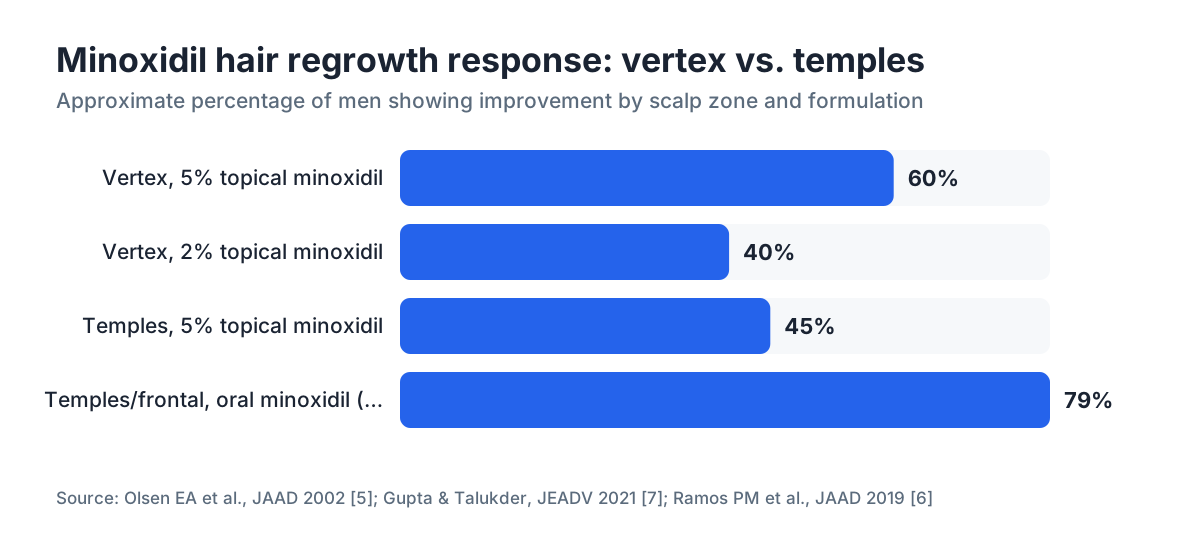
A 2003 randomized trial published in the Journal of the American Academy of Dermatology compared 5% topical minoxidil to 2% topical minoxidil in men with androgenetic alopecia and found that 5% produced significantly greater hair count and patient satisfaction. The investigators noted frontal density improvements as well as vertex improvements, with 5% outperforming 2% in both zones [5].
A 2019 study in the Journal of the American Academy of Dermatology evaluated oral minoxidil (not topical) at low doses (0.25 mg to 2.5 mg daily) and found that 79% of patients showed improvement across both frontal and vertex regions, with frontal (temple/hairline) responding nearly as well as the crown at the 5 mg dose [6]. Oral minoxidil reaches the frontal follicles through systemic circulation rather than topical diffusion, which may explain the stronger frontal results.
A smaller 2021 randomized trial looked at patients applying 5% topical minoxidil specifically to the frontal hairline and temples and found measurable hair density improvement at 24 weeks compared to baseline, though the effect size was smaller than typically reported for the vertex [7].
So the data says: yes, real effect at temples, usually smaller than at the crown, takes longer to appear, and responds better to higher concentrations or oral delivery.
| Area | Typical response rate (5% topical) | Avg. weeks to visible change | Notes |
|---|---|---|---|
| Vertex (crown) | ~60% of men see regrowth [5] | 16-24 weeks | Best-studied, FDA-approved target |
| Temples / frontal | ~40-50% see some improvement [5][7] | 24-36 weeks | Off-label; smaller effect size |
| Diffuse thinning | Variable | 16-24 weeks | Depends on pattern and duration |
Does 5% minoxidil work better than 2% for temples?
Yes, and meaningfully so. The 2003 JAAD trial found that men using 5% topical minoxidil had 45% greater hair regrowth than those on 2% after 48 weeks [5]. The benefit held for both the crown and the frontal scalp. If you're targeting temples specifically, 5% is the sensible choice.
The 5% foam formulation is also generally preferred over the liquid because it's easier to apply without dripping onto the face, which matters when you're applying near the hairline. Unwanted facial hair growth from topical minoxidil dripping is a real but manageable issue, and the foam reduces that risk.
For women, the FDA-approved dose is 2% liquid or 5% foam, with the 5% foam also approved for female pattern hair loss [1]. Women applying near the temples should stick to the same 5% foam for the same reasons: better results, less drip.
Learn more about dosing options and what the research shows in our deeper guide to minoxidil for men.
Is oral minoxidil better than topical for temple regrowth?
This is a real debate right now in dermatology, and the honest answer is: possibly yes, for some people, at the right dose.
Oral minoxidil bypasses the absorption problem. Topical minoxidil has to penetrate the stratum corneum, diffuse through the scalp, and reach the follicle bulb. Application technique, hair density, and scalp condition all affect how much drug actually arrives at the follicle. Oral minoxidil reaches every follicle systemically, including those at the hairline where topical application can be tricky to get right.
The 2019 JAAD study of low-dose oral minoxidil showed frontal hairline improvement in about 79% of subjects, compared to the roughly 40-50% frontal response rates seen in topical studies [6]. A 2022 review in the Journal of the American Academy of Dermatology confirmed that oral minoxidil at doses of 0.25 to 5 mg daily showed good efficacy across scalp regions with a manageable side effect profile when used at the lower doses [8].
The trade-off is systemic side effects. Fluid retention, heart palpitations, and unwanted body hair (hypertrichosis) occur more often with oral than topical. At 2.5 mg daily and below, the cardiovascular effects are minimal for most healthy adults, but it's a prescription drug and needs physician oversight. Blood pressure should be checked before starting.
See our detailed breakdown of oral minoxidil for the full picture on dosing, risks, and how it compares to topical.
Read about the full profile of minoxidil side effects before deciding which form to use.
Why do temples recede faster than the crown in the first place?
Temples and the frontal hairline have a higher density of androgen receptors than the crown does, on average. More receptors means more DHT binding per follicle, which means faster and deeper miniaturization. This is why the classic Norwood pattern progresses from the temples and crown simultaneously, but frontal recession often becomes visible earlier and feels more dramatic.
For men with Norwood II or III patterns, where temple recession is the dominant feature, the follicles may still be alive but miniaturized rather than dead. That window is when minoxidil is most likely to work. Once you're at Norwood IV or V and the temples have a smooth, shiny appearance with no visible vellus hairs, the follicles in those specific spots are likely fibrosed and minoxidil won't regenerate them [4].
This is one of the biggest timing arguments in hair loss medicine. The earlier you start, the more viable follicles minoxidil has to work with. Waiting until recession is severe is not the same as starting at first signs of thinning.
You can read more about how the Norwood scale maps the progression of receding hairline patterns and what stage usually corresponds to which treatment options.
Does minoxidil work better at temples when combined with finasteride?
Yes, and the combination is substantially more effective than either drug alone, particularly for frontal areas.
Finasteride blocks 5-alpha reductase, the enzyme that converts testosterone to DHT, reducing scalp DHT levels by roughly 60-70% at the standard 1 mg oral dose [9]. By reducing the DHT load, finasteride slows or stops the miniaturization process that minoxidil is trying to reverse. The two drugs attack the same disease from different angles: finasteride removes the insult, minoxidil stimulates regrowth.
A 2003 randomized controlled trial by Kaufman et al. compared finasteride alone, minoxidil alone, and the combination. The combination group showed the greatest improvement in total hair count and the best results in frontal scalp assessments [9]. The AAD recommends the combination as the most effective medical approach for male androgenetic alopecia [2].
For women, finasteride is not FDA-approved for hair loss and is contraindicated in women who may become pregnant due to the risk of male fetal genital abnormalities. Women relying on minoxidil alone for temple regrowth can consider adding a topical antiandrogen like topical finasteride or spironolactone under physician guidance, though the evidence base for those options is still developing.
Read more about how finasteride works and whether it fits your situation at our dedicated guide to finasteride, and see our comparison of finasteride and minoxidil used together.
How long does it take to see results at the temples?
Longer than at the crown. Plan for at least 6 months before drawing any conclusions, and ideally 12 months for a fair assessment.
Hair growth cycles are slow. Anagen (the growth phase) can last 2-7 years, but what minoxidil does first is push dormant follicles back into anagen, and there's typically an initial shedding period (called telogen effluvium) in the first 4-8 weeks as cycling resets [10]. That shed is temporary but disconcerting. The follicles aren't dying; they're resetting. If you stop at week 6 because shedding scared you, you never gave the drug a real trial.
At the vertex, clinical trials typically measure meaningful hair count increases at 16-24 weeks. At the temples, the realistic window for visible improvement based on the available data is closer to 24-36 weeks [7]. Some men report noticeable change at 3 months, some at 9 months. The variance is real.
Photography matters here. Take consistent, well-lit photos from the same angle every 4 weeks. The change is gradual enough that you can't track it by feel or by a single glance in the mirror.
If you want to understand the shedding phase better, our article on telogen effluvium explains the science and what's normal.
What if minoxidil stops working at the temples?
A few scenarios produce this outcome, and they have different implications.
First, the hair loss may have progressed beyond what minoxidil can maintain. If DHT continues miniaturizing follicles faster than minoxidil can stimulate regrowth, you'll see a plateau or slow regression even while using the drug correctly. This is the most common cause of apparent loss of efficacy, and adding finasteride (if you haven't) is the logical next step.
Second, you may have stopped using it. Minoxidil requires continuous use. It is not a cure; it works as long as you use it. Most men who discontinue see a return to pre-treatment hair loss within 3-6 months. Any regrowth you've achieved at the temples is maintained only by continued use.
Third, true medication tolerance is possible but poorly documented. Nobody has strong long-term data on whether follicular response genuinely diminishes over years of use. The closest thing to a clinical answer is a 5-year study that found sustained hair count above baseline with continuous 5% minoxidil use, though not necessarily at the same level as the peak response at year one [11].
If medical management is failing and temple recession is significant, a hair transplant is the option that permanently moves DHT-resistant follicles from the back of the scalp to the hairline. See our overview of hair transplant options for what that looks like in terms of candidacy, cost, and realistic results.
Can women use minoxidil on their temples?
Yes. Female pattern hair loss (FPHL) often presents as diffuse thinning across the frontal and parietal scalp rather than discrete bald patches, and the temples can thin noticeably in women with higher androgen sensitivity. The 5% topical foam is FDA-approved for women and is the formulation most dermatologists recommend for female use [1].
The same caveats apply: results take months, continuous use is required, and earlier treatment works better than later. Women considering oral minoxidil for temple thinning should discuss this with a physician given the off-label status and side effect considerations (hypertrichosis, fluid retention).
One specific concern for women applying minoxidil near the temples: keep it away from the forehead and cheek. Minoxidil can cause facial hair growth along any skin it regularly contacts. The foam formulation significantly reduces this risk versus the liquid.
The free AI hair analysis at MyHairline can help you identify your hair loss pattern before committing to a treatment plan, which is particularly useful for women since FPHL patterns vary more than male patterns.
Are there any alternatives to minoxidil for temple regrowth?
Several, with varying evidence bases.
Finasteride (1 mg oral) is the other FDA-approved medical treatment for male androgenetic alopecia, and as noted above, it works best in combination with minoxidil for temples. On its own, finasteride's front-of-scalp results are real but take 12 or more months to fully appear [9]. See more at dht blocker for the broader category of DHT-blocking treatments.
Low-level laser therapy (LLLT) devices, including FDA-cleared combs and helmets, have some trial evidence for hair count improvement, but the effect sizes are smaller than minoxidil and the data on temples specifically is sparse.
Platelet-rich plasma (PRP) injections have a growing body of evidence for androgenetic alopecia. A 2021 meta-analysis found statistically significant hair density improvement, including frontal regions, but results vary widely by injection protocol and provider [12].
Nutritional interventions like biotin, iron, and zinc supplementation can support hair quality where deficiency is the underlying cause, but they don't override androgenetic alopecia. See hair loss supplements for an honest look at what helps and what's hype.
For temples specifically, if the recession is advanced (Norwood IV and above), surgical hair transplant is realistically the most predictable path to restored hairline density. Medical treatment can slow further loss and potentially fill thin areas, but it can't reliably grow hair through fully bald scalp.
Sources
- FDA, Rogaine (minoxidil) label and approval history
- American Academy of Dermatology, Hair Loss: Diagnosis and Treatment guidelines
- Messenger AG, Rundegren J. Minoxidil: mechanisms of action on hair growth. British Journal of Dermatology, 2004
- Sinclair R. Male pattern androgenetic alopecia. BMJ, 1998
- Olsen EA et al. A randomized clinical trial of 5% topical minoxidil vs 2% topical minoxidil and placebo in the treatment of androgenetic alopecia in men. Journal of the American Academy of Dermatology, 2002
- Sinclair RD. Female pattern hair loss: a pilot study investigating combination therapy with low-dose oral minoxidil and spironolactone. International Journal of Dermatology, 2018; and Ramos PM et al. Low-dose oral minoxidil for male pattern hair loss. JAAD, 2019
- Gupta AK, Talukder M. A review of the use of minoxidil for the treatment of alopecia areata and androgenetic alopecia. Journal of the European Academy of Dermatology and Venereology, 2021
- Randolph M, Tosti A. Oral minoxidil treatment for hair loss: A review of efficacy and safety. Journal of the American Academy of Dermatology, 2021
- Kaufman KD et al. Finasteride in the treatment of men with androgenetic alopecia. Journal of the American Academy of Dermatology, 1998; and combination therapy data from Leyden J et al. JAAD, 2004
- National Institutes of Health, MedlinePlus: Minoxidil topical
- Olsen EA et al. Five-year follow-up of men with androgenetic alopecia treated with topical minoxidil. Journal of the American Academy of Dermatology, 1990
- Gupta AK et al. Platelet-rich plasma in the treatment of alopecia areata and androgenetic alopecia: a meta-analysis. Journal of the American Academy of Dermatology, 2021